

Recent Posts










Before travelling to a foreign country, I always force myself to learn a few phrases in the local language. Even if all I can do is order coffee, ask for directions and say thank you, that still feels better than exposing myself, from the first syllable, as a complete outsider. Real fluency, of course, is another matter. My father taught languages for a living, so I learned French as a child. In my twenties, while drifting through Mexico, I picked up some Spanish. But then life began to tighten in its usual way: work, family, bills, emails, deadlines, each filling the day before the next could arrive. Italian remained a bright and distant longing. By middle age, however, I had advanced little beyond per favore and grazie.
Not long ago, I received an invitation to attend a conference near Milan. At once, my old affection for Italian flared up again. Reality, however, was less accommodating. My days were compressed by work; my evenings were occupied by domestic obligations. I had no time to enrol in a night class, and no patience to submit myself to the daily discipline of a language app. Then a ridiculous but tempting idea occurred to me: if I had no time to learn while awake, could I perhaps learn while asleep?
The idea is not new. Nearly a century ago, “sleep-learning” swept through the modern world, cloaking itself, like many modern myths, in the language of science. It promised knowledge without effort. Later, neuroscientists declared the whole thing impossible. The sleeping brain, they said, could not absorb information like a sponge; sleep-learning was merely another pseudoscientific illusion. Yet the story did not end there. In recent years, a new body of research has begun quietly revising that conclusion. The sleeping brain is not a silent darkness. It sorts, filters, replays and strengthens the experiences of the day. If we could intervene at the right moment, perhaps we could open a narrow passageway for learning at night.
That prospect is undeniably exciting. Imagine studying a little during the day and consolidating it at night; imagine waking to find that yesterday’s unfamiliar words, melodies or formulas had sunk a few roots deeper into the mind. If the technology advances, it might even be used to treat trauma, weaken addiction or reshape stubborn psychological associations. But for precisely that reason, it is also unsettling. Sleep is one of the few remaining territories of modern life that has not yet been fully conscripted. If even sleep must serve efficiency, growth, productivity and self-optimisation, are we gaining more time, or losing the last unclaimed part of ourselves?
The belief that dreams can bring knowledge or revelation is ancient. In the Bible, Jacob sees a ladder in his dream, with angels ascending and descending between earth and heaven, and in that night vision his destiny is partly disclosed. But the first person to turn this belief into a commercial product came much later. In 1932, an inventor named Alois Benjamin Saliger patented a machine called the Psycho-Phone. Born in what is now the Czech Republic and later based in New York, Saliger was the sort of modern tinkerer who seemed to believe that human destiny could be placed inside a machine and set gently in motion.
His invention resembled a phonograph fitted with a repeating mechanism and a small acoustic horn. It was to be placed beside the bed, where it would play recordings in a voice barely louder than a whisper. Once the user fell asleep, the device would begin its work. Saliger sold records with titles that carried the unmistakable scent of early self-improvement: Prosperity, Inspiration, Normal Weight, Ideal Mate. On one of them, he intoned in a hypnotic voice: “I radiate love. I have a fascinating personality. I am attractive.” If the advertisement was to be believed, the buyer would wake the next morning slimmer, more confident, more magnetic, and better prepared for romance.
The assumption behind the Psycho-Phone was that a sleeping person, like a hypnotised one, could be easily influenced by suggestion. Aldous Huxley later carried this idea into Brave New World. In that dystopian novel, the state uses recorded messages to train sleeping children to accept their assigned social order and values. One official proudly describes the method as a great instrument of moral and social conditioning. Even today, the premise chills because it touches a deep fear: if people can be educated when they are most defenceless, how much distance remains between education and manipulation?
The real world never created Huxley’s system of mass nocturnal indoctrination, but sleep-learning did enjoy a period of genuine popularity in the first half of the twentieth century. Some used it to learn foreign languages; others to quit smoking or correct bad habits. Early studies appeared to support it. Sleeping subjects were played Chinese words and their English translations, and the next day supposedly performed better than a control group. Children who bit their nails were made to hear, night after night, phrases such as “my fingernails taste terribly bitter”; after several weeks, some reportedly stopped. The Soviet Union was especially enthusiastic, and stories circulated of entire villages learning foreign languages while they dozed, like parables of a futuristic age.
The reckoning came when electroencephalography entered the laboratory. For the first time, scientists could determine with reasonable certainty whether a subject was truly asleep, rather than merely lying with closed eyes in a drowsy borderland. The results disappointed the believers. When brain signals confirmed that subjects had actually entered sleep, the words played to them did not leave reliable traces in waking memory. The apparent successes of earlier experiments had probably occurred not during true sleep, but in the hazy outskirts of it. Scientific consensus soon hardened: the sleeping brain could not learn new information. Sleep-learning was no longer the future; it was quackery, banished to the attic with miraculous machines and exaggerated advertisements.
Yet things stored in attics sometimes fall back into the light. Today, sleep-learning is being discussed again, not because the old frauds have returned, but because our understanding of sleep has changed. In the past, sleep was often imagined as a shutdown state: consciousness switched off, the body repaired, the system rebooted in the morning. But experiment after experiment has shown that sleep is not a blank interval. It is a highly active state, only active in a different mode. While we sleep, the brain continues to process the experiences of the day. It no longer reaches outward, but inward, turning over freshly acquired memories.
Researchers have long known that sleep helps memory. After a sleepless night, things learned the previous day scatter more easily; after proper rest, certain forms of knowledge become more stable. The question was where this consolidation happens. Some once believed that dreams were the key. Since dreams seem to recombine the residues of the day, perhaps memory was processed during rapid eye movement sleep. Later, however, the evidence shifted toward another phase: slow-wave sleep, the deep, dreamless state in which the brain’s electrical activity rises and falls like distant surf.
Animal studies helped reveal the mechanism. When a rat runs a maze during the day, certain “place cells” in the hippocampus fire in sequence along the route. During slow-wave sleep at night, those same cells fire again in a similar order, as if the brain were replaying the path it had taken. Later studies suggested that humans do something similar. The hippocampus acts like a temporary warehouse, holding new experiences until they can be transferred into more stable networks in the cerebral cortex. In other words, sleep is not an abandonment of learning. It is where learning is digested.
Once this became clear, sleep-learning no longer seemed entirely absurd. If the sleeping brain is already replaying memories, could an external cue give it a nudge? There would be no need to smuggle an entire textbook into a dream. Perhaps, at the right moment, a sound or smell could prompt a memory to be replayed more often and preserved more firmly.
In the 1990s, Japanese researchers performed a simple experiment. While subjects slept, they played a tone and delivered a mild electric shock to the leg. After waking, the subjects’ heart rates rose when they heard the tone alone. This did not mean they had acquired knowledge, but it did show that the sleeping brain was not sealed off from the outside world. It could at least connect a sound with a bodily response.
More persuasive experiments came later. A team at the University of Lübeck asked subjects to memorise the locations of objects on a computer screen while smelling roses. Later that night, when the subjects entered slow-wave sleep, the researchers released the rose scent again. The next morning, those who had smelled the scent during sleep remembered the object locations better than those who had not. The fragrance had not taught them anything new. But it had acted like a gentle hand, drawing a daytime memory back into the mind so it could be processed again.
Similar effects appeared in music and language learning. Researchers at Northwestern University taught subjects to play a short melody, then replayed that melody while they napped. After waking, those who had heard it made fewer mistakes. Other studies asked subjects to learn foreign vocabulary during the day, then replayed those words during slow-wave sleep. The next morning, recall and translation improved. These findings are especially alluring because they no longer depend on electric shocks or aversive conditioning. They point directly to what we most want from sleep-learning: learning itself. A nighttime cue, it seems, can help the brain consolidate what waking life has already begun.
Anyone hoping to master an instrument, acquire a new professional skill, or descend into the mysteries of particle physics might be offered a shortcut that feels almost magical
There remains, however, a crucial limitation. In all of these experiments, the subjects had first encountered the information while awake. Nighttime cues only helped them review; they did not teach from scratch. True sleep-learning must answer a bolder question: can a sleeping subject acquire something genuinely new?
In 2015, French researchers performed a startling experiment on mice. They first recorded the firing patterns of place cells in the hippocampus as the animals moved around a circular platform. Later, when the mice were asleep, the researchers waited for a particular place cell to reactivate, then stimulated the brain’s reward centre. When the mice woke, they went directly to the location associated with that cell and lingered there, as if expecting a reward. But they had never received a reward there while awake. In effect, the researchers had implanted a new association during sleep, something close to a false memory.
This was a mouse study, and it remains very far from learning Italian in bed. But it crossed a deeper psychological boundary. The sleeping brain, it suggested, may not merely replay old experience. Under certain conditions, it may be guided to form new associations.
In human research, scientists have been more interested in using sleep to change behaviour. Researchers in Israel exposed nicotine addicts during slow-wave sleep to the smell of cigarettes paired with the smell of rotten food. When the participants woke, they had no memory of the night’s conditioning, but over the following week they smoked significantly less. Another group of researchers tried to weaken fear memories. Volunteers first learned to associate certain faces with mild electric shocks, while smelling specific odours. During sleep, the researchers presented the odours alone. At first, the subjects showed fear responses, but with repetition those responses diminished. The next day, their anxiety when seeing the faces was reduced.
If developed carefully, such techniques could become therapeutic tools. Traumatic memories, addictive behaviours and anxiety responses might be adjusted during sleep. Future devices may no longer resemble Saliger’s crude Psycho-Phone, but a precision system: a headband to monitor brain waves, an algorithm to identify the optimal window of slow-wave sleep, headphones to deliver sound cues, a scent generator to release odours, perhaps even mild electrical stimulation to enhance memory processing. Study by day, consolidate by night. Treat by day, reshape by night. It is not hard to see the appeal.
The appeal is especially strong for those of us who never have enough time. Students want to remember textbooks faster. Office workers want to acquire new skills at night. Musicians want to wake with more fluent fingers. Language lovers want to bypass the swamp of grammar and vocabulary while asleep. If a person could turn seven or eight hours of nightly rest into an invisible classroom, life’s learning capacity would appear to double. Who would not want to wake up a little smarter than they were the night before?
But the problem lies precisely there. Sleep is not valuable only because it helps us learn. It also performs many more hidden and fundamental repairs. The sleeping brain prunes excess neural connections to make room for new learning; it consolidates long-term memory so that yesterday’s experiences do not simply dissolve; it clears metabolic waste through the glymphatic system, helping preserve the brain’s internal environment. If we keep inserting tasks into sleep, will we crowd out the resources that belong to restoration?
A single night might leave us remembering dozens of extra words, but at the cost of making the next day’s learning harder. Repeatedly strengthening one set of memories during sleep might mean weakening the consolidation of others. In forcing the sleeping brain to keep working, we may disturb the delicate balance of immune, endocrine and emotional regulation. Medicine has already reminded us again and again that chronic sleep loss and sleep disorders are associated with depression, obesity, diabetes, cardiovascular disease and many other conditions. We still do not fully understand sleep, yet we are already eager to convert it into a production line. That eagerness itself deserves suspicion.
There is another danger, harder to measure but no less real. I am old enough to remember life before smartphones, when it was still possible to be unreachable for a while. There were hours in the day when one did not have to answer messages, know what was happening in the world, or be available to anyone. Night remained a boundary. You could be busy, anxious, late, defeated; but once the lights went out, the world at least temporarily withdrew. Today, waking life has been nearly occupied: emails, messages, alerts, calendars, social media, work chats. Sleep seems like the last piece of land that has not yet been fully developed.
If sleep-learning matures, that land too will be rezoned. A boss might say: listen to tomorrow’s presentation data after lights out. Schools might distribute nightly consolidation tracks. Friends might compare how much foreign vocabulary they absorbed in their sleep. Social media would discover a new form of boasting: some would post fitness statistics, others their sleep-learning progress. To decline to use sleep might come to seem lazy, just as failing to answer email can now seem unprofessional.
How much, exactly, do we want to take from the night?
In Healing Night, the sleep psychologist Rubin Naiman recalls a game he played with his mother as a child. She would ask him: “What is the best thing in the world?” Like any child, he would guess: toys, cartoons, ice cream. But her answer was always the same: night. She had spent years in a Nazi concentration camp. For her, darkness was not emptiness or inconvenience, but a daily shelter. Daylight belonged to fear, labour and command; night at least brought sleep. Sleep brought dreams. And dreams allowed a person, however briefly, to enter a reality that could still be soft, merciful and malleable.
“We speak of falling in love and falling asleep. Both require a kind of surrender”
Naiman believes modern society has lost this reverence for night. We live in an over-illuminated world, where darkness is thinned by lamps, screens and the long extension cords of work. Sleep is treated as battery charging rather than as something with value of its own. We stay awake as late as possible, then use pills to knock ourselves out; in the morning, we push ourselves back into the day with caffeine. We assume that waking is real life and sleep merely its maintenance department. In the process, the mystery of night, the elasticity of dreams, and the capacity to relinquish control all come to seem like inefficient leftovers.
When Naiman was asked what he thought of sleep-learning, his answer was almost severe. He compared it to making love in order to burn calories, or eating while using the toilet. Sleep, he said, is a time to digest the experiences of the day, not to keep swallowing information. It asks us to suspend the exertions, plans and possessiveness of daylight. We “fall” asleep, just as we “fall” in love, because neither can be fully accomplished by force of will. The more tightly we try to control them, the more likely we are to lose them.
This is what makes sleep-learning so unsettling. On the surface, it promises to help us learn. At a deeper level, it extends a larger modern impulse: to leave no time idle, no state unproductive, no person truly outside the system of efficiency. Day is conscripted by work; night by learning. Waking life is managed by goals; dreams are optimised by algorithms. In the end, sleep would no longer be a dark zone of freedom, but another territory to be developed, measured, sold and administered.
Of course I still want to learn Italian. I still want to order coffee in a small town near Milan with a passable accent, to exchange a few words about the weather with a taxi driver instead of smiling awkwardly. But if the price is to surrender the night as well, I would rather proceed slowly. Perhaps learning a language is supposed to involve clumsiness, forgetting, repetition and waking effort. Perhaps some things belong to us only when we have stumbled toward them in daylight.
As for the classroom of sleep, I think I will be absent for now.
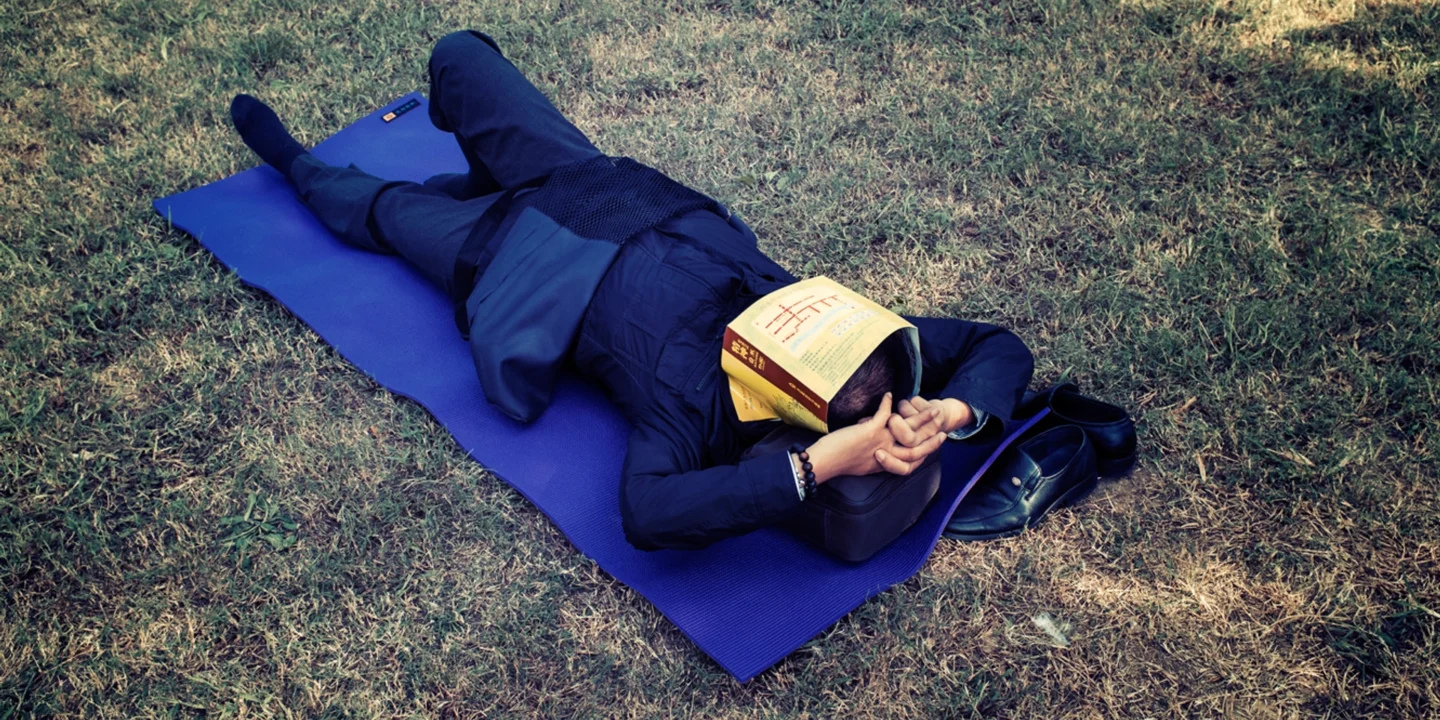
Tonight, then, I will not put on headphones. I will not allow any recording to whisper beside my pillow. I will turn my phone face down, darken the screen, nod respectfully to Mr Saliger — long dead, yet somehow still selling his machine — and hang out my sign:
Do not disturb. Let me sleep.