










ASTRONOMY / THE PHYSICS OF TIME
A collision leaves a brief vibration in spacetime. Its silence raises a larger question about entropy, time and what the universe can remember.
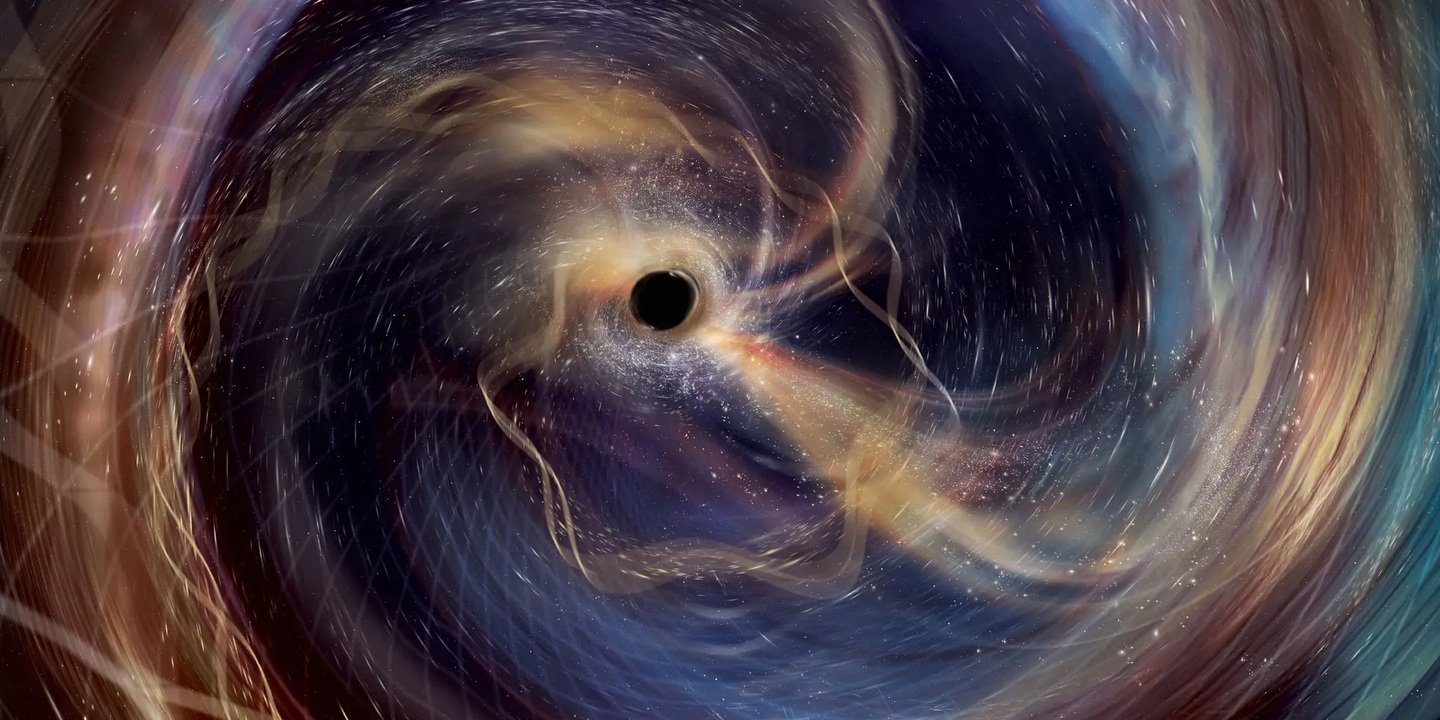
The signal from a black hole collision ends with a curious change of pace. First comes the accelerating pattern of two massive bodies circling toward one another. Then the merger reaches its violent peak. Afterward, the newly formed black hole gives off a short sequence of diminishing gravitational waves. The pattern resembles a vibration dying away, although nothing is vibrating through air and no human ear could hear it directly.
Physicists call that final stage ringdown. It lasts only a moment for the black holes detected by today's observatories, but it carries a remarkable amount of information. Its frequency and rate of decay describe the object left behind. If the observed pattern departed from the predictions of general relativity, it could point toward a gap in our account of gravity. For now, the measurements have given Einstein's theory an increasingly demanding set of tests.
There is another puzzle concealed in the fading signal. A merger begins with particular objects, orbits and disturbances. The remnant eventually appears, to an observer at a distance, to have remarkably few identifying features. An event with a complicated past produces an exterior that is mathematically spare. How can the aftermath of such turmoil tell us so little about the events that made it?
The answer connects black holes to an ordinary feature of daily life: the future looks different from the past. Heat spreads, mixtures disperse and a vibration subsides. We call the statistical tendency behind many such changes an increase in entropy. To see why that familiar principle matters at the edge of a black hole, it helps to begin with the last vibration itself.
The last vibration
The theoretical story begins with a surface that can be crossed in only one direction. Soon after Einstein published general relativity, Karl Schwarzschild found a solution to its equations describing a nonrotating, spherical gravitating object. In the black hole interpretation, that solution includes an event horizon: once a signal passes inward through this boundary, it cannot return to a distant observer.
The horizon is not a hard shell that a spacecraft would strike. It is a feature of the geometry of spacetime, a division between paths that can still carry information outward and paths that cannot. This is why a black hole can be physically present without exposing a conventional surface. Its surroundings may shine or move, but the region beyond the horizon cannot send us a direct report.
Real black holes do not live in immaculate isolation. Matter can fall toward them, nearby objects can disturb them, and two of them can join. In 1957, Tullio Regge and John Wheeler studied whether a small disturbance would destabilise the idealised Schwarzschild solution. They found that the disturbance could produce oscillations that decay. The black hole does not keep changing shape forever after being perturbed; it approaches a stable state.
A struck instrument offers a useful analogy, provided we remember where it stops. A bell transfers some of its energy into pressure waves in the surrounding air. A disturbed black hole emits gravitational waves, changes in the geometry through which light and matter travel. Part of the disturbance can fall inward; part can travel outward at light speed. Its characteristic frequencies are often called quasinormal modes because the oscillations fade rather than continue indefinitely.
Those modes are shaped by the properties of the remnant. The pitch of the analogy is set mainly by mass and spin, while the rate of fading also depends on the same underlying geometry. A large body and a small body do not leave identical patterns. Nor does a slowly rotating remnant behave precisely like a rapidly rotating one. Measuring more than one mode offers a particularly sharp way to ask whether the object fits the expected black hole description.
For decades, this was largely a calculation awaiting an instrument. The first direct gravitational wave detection, GW150914, arrived at LIGO's detectors in the United States on 14 September 2015. It came from two black holes merging roughly 1.3 billion light years away. The observatories measured an extraordinarily slight change in length as the wave passed Earth. A prediction about violent events far beyond the Milky Way had become a recorded signal.
The 2015 observation made the final moments of a merger accessible, although extracting subtle features from ringdown remained difficult. Later detections improved the situation. The particularly clear GW250114 signal enabled the LIGO, Virgo and KAGRA collaborations to test more of the fading pattern. Their analysis found that at least two damped modes were needed to describe the post-merger data, with measurements consistent with the expected rotating black hole.
That result is a test, not a declaration that every question is settled. Each detected wave has noise, and each inference depends on careful modelling. Greater sensitivity should make it easier to separate faint modes that are currently hard to resolve. A disagreement between several independently measured frequencies and one consistent mass-and-spin description would be important evidence that the familiar picture needs revision.
The ringdown matters for another reason. While the signal lasts, it gives us an unusually direct view of the transition from collision to a settled remnant. We can observe the final exterior taking shape. Then the oscillations fade below what we can measure. What remains is an object whose past has become hard to distinguish from many other possible pasts.
An exterior with few clues
The nonrotating Schwarzschild solution is a starting point, but a merger usually produces a black hole with angular momentum. Roy Kerr's solution describes a rotating black hole. Rotation changes the geometry and the shape of the horizon, yet it does not provide an unlimited new set of visible features. The stationary exterior is still described by a small collection of quantities.
In the classical account, these quantities are mass, angular momentum and electric charge. Astrophysical black holes are expected to lose or neutralise substantial net charge, so discussions of actual merger remnants usually focus on mass and spin. This economy is often expressed by saying that stationary black holes have no hair: the exterior does not preserve a distinct mark for every event in their formation.
The phrase can be misleading if taken as an account of everything in the wider scene. A disk of matter, escaping gravitational waves or other external material may reveal something about a particular black hole's environment and recent history. The claim concerns the final, settled black hole exterior under the relevant classical assumptions. It does not erase every record that may have escaped into the surrounding universe.
Even with that qualification, the simplicity is startling. Consider two very different chains of events that end with the same final mass and spin. One black hole might have grown mostly by absorbing gas; another might have formed through a sequence of mergers. Their earlier surroundings could have been entirely different. Once each remnant has settled, those details need not be readable from its stationary exterior.
This does not mean that a merger has no observable history at all. The approaching black holes send out a changing gravitational wave; the merger broadcasts another part of the story; the ringdown supplies final parameters. Scientists reconstruct a great deal by using the whole signal. The puzzle arises when we ask what could be learned from the isolated remnant after those passing records have gone by.
There is a useful distinction between a physical event and the limited list of properties available to an outside observer. We may know that something fell in, because we watched it approach. Later, someone who sees only the settled object may have no way to recover what that thing was. The object's present exterior offers a much shorter description than the narrative that produced it.
The horizon has one more property that deepens this puzzle. In classical general relativity, the total area of black hole event horizons cannot decrease under the usual assumptions. A merger can radiate energy in gravitational waves and still leave a final horizon whose area is at least as large as the relevant initial total. The statement concerns area, not simply a comparison of masses in isolation.
Stephen Hawking established this classical area result decades before the first merger was observed. Modern gravitational wave measurements let researchers test it with real events. From the earlier part of a waveform they infer the properties of the two incoming black holes; from the later part they infer the remnant. The estimated horizon areas can then be compared, with measurement uncertainties taken seriously.
Why should a one-way increase in area feel familiar? In the kitchen, a warm drink cools toward room temperature. In a sealed container, two gases tend to mix. These processes have a preferred direction when considered on a human scale. A growing horizon area seems to participate in that broader story of irreversible change. Understanding the resemblance requires a closer look at what entropy actually measures.
Why mixtures keep spreading
Imagine placing a single drop of dye into a clear glass of water. At first its colour occupies a small region, which tells you roughly where the drop entered. Without further intervention, the coloured molecules disperse. Eventually the water appears nearly uniform. Knowing the glass's present colour is then insufficient to identify the exact entry point by sight alone.
At a microscopic level, the water and dye molecules have positions and motions. An exact inventory would be enormous. For ordinary purposes we use a compressed description: temperature, volume, average colour and perhaps a concentration gradient. Many distinct arrangements of molecules produce the same appearance. A uniformly coloured glass can be realised in vastly more microscopic ways than one in which almost every dye molecule remains near a single tiny point.
This imbalance explains the likely direction of the change. The molecules are not commanded by a special rule to spread evenly. Their motion simply carries the system into the much larger collection of arrangements that look mixed. An accidental return to a highly concentrated pattern is not prohibited by elementary mechanics. For a macroscopic quantity of molecules, however, its probability is so small that waiting for it would be pointless.
Entropy provides a way to relate a large-scale description to the number of microscopic possibilities compatible with it. A macrostate with more compatible microstates has greater entropy. That is more precise than treating entropy as a synonym for untidiness. A tidy-looking glass may have high entropy; a messy-looking one may not tell us much without specifying the physical system and what is being measured.
The second law says that the total entropy of an isolated system is overwhelmingly likely to increase or, at equilibrium, remain near its maximum. Statistical language matters here. The microscopic equations often allow a process to be described backward as well as forward, but an ordinary large collection of particles almost never moves spontaneously from a common arrangement to an exceptionally rare one.
Suppose an impossible observer could know the exact positions and velocities of every particle in the glass, together with every interaction relevant to the calculation. In a classical idealisation, that observer could run the description backward and determine much about the earlier state. Our inability to do so in practice is a problem of access and complexity. A smooth colour conceals a great deal of detail without necessarily destroying the underlying microscopic record.
The French scholar Pierre-Simon Laplace imagined an intelligence that knew the state of the world with perfect precision. That old thought experiment remains useful because it separates the way a system looks to us from the information that an ideal description might retain. We do not possess that intelligence. We experience a glass of coloured water, not an index of every molecule's trajectory.
This change of scale is often called coarse-graining. We group innumerable fine details into a few observable variables. The grouping is essential to doing science and to living in the world: nobody must track each molecule to know whether a drink is warm. But the convenience has a cost. Once we use only the broad variables, many different pasts become compatible with the same present.
The asymmetry we call the arrow of time is linked to this statistical tendency and to the low-entropy conditions from which many systems begin. A stain spreading through water feels normal; the reverse would be astonishing. Nothing about a single photographed instant labels it as past or future. The sequence gains its direction because the range of likely microscopic arrangements changes as the mixture evolves.
The black hole comparison can now be stated more carefully. A settled exterior resembles a coarse description: a few numbers replace a multitude of possible histories. Yet the black hole has an additional feature that a glass does not. The event horizon limits what anyone outside can, even in principle within the classical picture, inspect. That difference became crucial when physicists asked whether entropy can disappear into a black hole.
The meaning of a growing horizon
Jacob Bekenstein confronted a disturbing possibility in the early 1970s. Imagine matter with a known amount of entropy falling across a horizon. If the black hole were assigned no entropy of its own, an outside observer would see entropy leave the accessible world with nothing to replace it in the accounting. That outcome seemed to put the second law in conflict with black hole physics.
The area theorem offered a clue. When matter enters a classical black hole, its horizon can grow. Bekenstein proposed that the hole itself should carry entropy connected to that area. Then the increase in black hole entropy could compensate for the entropy no longer visible outside. This extends the familiar second law into a generalised second law involving both ordinary matter and the black hole.
The proposal was bold because an ordinary entropy suggests microscopic possibilities, while a classical black hole seemed to display only a short list of external properties. Stephen Hawking's later work on quantum effects showed that black holes can have a temperature and emit radiation. His result fixed the quantitative relation between entropy and horizon area. A black hole's thermodynamic behaviour could no longer be dismissed as a superficial analogy.
In ordinary systems, entropy tells us that the same large-scale appearance can arise from many fine-grained configurations. The area-entropy relation likewise points toward an immense accounting of possible black hole states. Exactly what the fundamental microscopic states are remains a question for quantum gravity. Several approaches offer partial pictures, but there is no need to pretend that the classical geometry alone supplies a completed microscopic catalogue.
The scale is remarkable. For a black hole, the thermodynamic entropy is proportional to the area of its horizon rather than to the volume one might initially expect. The formula contains the Planck scale, making the entropy enormous for astrophysical black holes. The significant point here is conceptual: a seemingly plain exterior may be associated with an extraordinary range of hidden or indistinguishable fine detail.
This helps explain how a complex history can be followed by a simple exterior without declaring that complexity never existed. The final mass and spin do not specify a unique sequence of infalling objects and collisions. Many histories lead to the same coarse result. The additional entropy tracks the breadth of possibilities that cannot be separated by the sparse exterior description.
Still, there are limits to the analogy with coloured water. The glass can be opened, sampled and in principle described molecule by molecule. We can imagine more powerful instruments and an observer willing to do a fantastically large calculation. The event horizon is a causal boundary. No improvement in an outside telescope lets a message return from inside it under the classical rules.
Black hole entropy therefore raises two related questions that should be kept distinct. Why does the exterior lose the detailed imprint of the past as the object settles? And is the information about that past absent from the complete laws of nature, or merely unavailable to an observer who remains outside? The first is part of the classical account of horizons and ringdown. The second touches the unresolved foundations of quantum gravity.
Is the past gone, or only out of reach?
The thought experiment with dye illustrates a weak kind of forgetting. Looking at the finished mixture, we cannot tell where the drop entered. Yet an ideal microscopic description, imagined under suitable assumptions, might still encode enough correlations to recover the earlier arrangement. The missing history is concealed by our limited measurements and by the formidable calculations required to interpret them.
For a black hole, the outside observer faces a stricter obstacle. Once a record crosses the horizon, a classical light signal carrying that record cannot get back out. Someone who follows it inward cannot send a report to the person who stayed behind. The exterior settles into a state with very few distinguishing parameters, and the usual method of opening the system for inspection is unavailable.
It would be too strong, however, to turn this outside observer's difficulty into a proof that nature destroys information. Classical no-hair statements concern the stationary exterior under specified conditions. They do not settle the microscopic fate of everything that crossed the horizon. The possible role of quantum effects and the radiation black holes may emit requires a different, more complete theory than the classical picture alone provides.
Hawking radiation sharpened the question. If a black hole radiates for an immense time and can eventually evaporate, what becomes of the information associated with the matter that formed it? A naive picture of featureless thermal radiation makes the earlier details look irrecoverable, conflicting with the usual expectation that quantum evolution preserves information. That tension is known as the black hole information problem.
Physicists have developed many ideas about how the accounting might work, including subtle correlations in radiation and ways of relating horizon physics to more complete quantum descriptions. Progress in theoretical models has been substantial, but the observable ringdown of stellar black hole mergers is not itself an experimental solution to the information problem. It tests the gravitational behaviour of the remnant on an entirely different timescale.
That separation of timescales is easy to miss. Ringdown in the detected stellar-mass mergers passes in a fraction of a second. The hypothetical Hawking evaporation of a black hole of comparable mass would take vastly longer than the current age of the universe. A detector's view of the fading oscillation and a quantum theory's account of ultimate information recovery address linked but distinct questions.
The phrase that a black hole "forgets" is therefore an analogy with a carefully defined viewpoint. From outside, after the transient signals have passed, the settled black hole exposes little of its biography. Some evidence may have travelled away in gravitational waves or in the surrounding environment. Some information may have a quantum description we cannot yet read. The stationary exterior alone does not tell the whole story.
This restraint makes the ordinary comparison more illuminating, not less. Everyday irreversible changes also depend on what we can observe and how much detail we choose to track. The sound of a struck bell fades because its energy disperses into the surrounding world. A cup cools as energy spreads. The transformations are physical even when the bookkeeping of every microscopic motion lies far beyond our reach.
The black hole adds a geometric edge to that familiar limitation. It radiates an observable final vibration; it approaches a compact exterior description; and it conceals a region from which classical messages cannot return. Its horizon area grows in a way that invited physicists to extend thermodynamics to gravity. These are concrete links among waves, geometry and entropy, even while the deepest microscopic interpretation remains unsettled.
The next clear merger may refine those links. Better measurements could reveal more ringdown modes, improve tests of the Kerr description and sharpen comparisons between the horizons before and after collision. An unexpected pattern would be a clue worth following. A pattern consistent with prediction would also teach us something: an extreme event still obeys rules that can be tested from far away.
When the last measurable oscillation ends, the remnant continues to exist. Silence does not mean that its past was simple. It means that the exterior has become a poor witness to most of that past. The same world that lets us hear an event, watch a colour spread or detect a gravitational wave also makes detailed histories difficult to recover. A black hole makes this everyday arrow of time visible on a cosmic scale—and shows exactly where our view stops.