










SPACE EXPLORATION / LUNAR ENERGY
A proposed lunar microreactor would send its hottest output to oxygen production, then use the remaining heat for electricity and habitats.
A permanent lunar outpost needs more than lights. At many locations, darkness lasts about two Earth weeks, while some polar terrain receives little sunlight. Crews would still need life support, communications and thermal control. Batteries alone become demanding when every kilogram must first travel from Earth.
One answer under study is a compact fission system that works regardless of the Sun. A team at the Technical University of Munich has proposed a reactor called MULE, short for Microreactor Utilisation for Lunar Exploration. Its purpose is broader than supplying electricity. The concept treats reactor heat as a resource that could help a small base make useful materials from lunar soil before the heat is converted into electrical power.
An early base might import most supplies; a sustained one would make some locally. The team’s paper models a 100-kilowatt-thermal reactor for an outpost of about six people. No MULE machine operates on the Moon.
Heat for local production
The Moon’s loose surface material, or regolith, contains oxygen bound within minerals. Turning that oxygen into a usable supply would reduce some dependence on deliveries from Earth. A process called molten salt electrolysis is one possible route: an electrical current helps separate oxygen from material processed in a hot salt bath, leaving metal-rich products that may also have industrial uses.
The catch is temperature. The process generally needs more than 900°C, so a power system must provide substantial heat as well as electricity. If a reactor first converts heat into electricity and electric heaters then turn some of that electricity back into heat, each conversion places additional demands on the system. High-temperature process heat supplied directly from the reactor’s coolant could avoid part of that detour.
MULE is designed around helium leaving the proposed reactor at roughly 1,000°C. That makes the hot side suitable, in principle, for transferring heat to an electrolysis plant. The reactor would not simply be bolted to a tank of lunar soil: heat exchangers, material choices and controls must all work reliably at temperatures far above those inside a habitat. The research so far addresses the nuclear core mainly through modelling, with much of the integrated plant still to be engineered.
The team also proposes thermal storage. By storing energy as heat when demand is lower, the base could smooth the supply to its processing equipment and retain a limited reserve during interruptions. This is a design feature rather than evidence that a complete storage system has been demonstrated under lunar conditions.
One heat source, several jobs
Instead of discarding the coolant’s remaining energy after oxygen production, the concept uses a sequence of progressively cooler stages. The paper envisages a closed Brayton cycle: heated gas drives a turbine connected to a generator, while the gas circulates through the system. The article’s example places the electrical conversion stage around 750°C, after the highest-temperature industrial use.
The next portion of the heat budget could warm habitats and other equipment that must stay within safe operating temperatures. In the illustrative thermal chain, heat available around 150°C would pass through suitable controls and exchangers; nobody is proposing to pipe gas at that temperature directly into a living space. Eventually radiators would reject the remaining waste heat to space, with the article describing an example near 75°C.
These temperatures illustrate a proposed heat cascade, not a measured lunar installation. The ordering matters: reserve the hottest output for industry, use a cooler stage for electricity, and recover what is practical before radiating the rest away. The efficiency of a complete plant remains to be established.
Continuous output could also serve sites with poor solar access. Panels remain useful where illumination permits, and the design relies on batteries and solar power during startup. MULE would be one part of a lunar energy system.
What the proposed core contains
Inside the proposed unit is a largely ceramic core built for very high temperatures. Silicon carbide is the main structural material, and the design arranges fuel in 37 hexagonal assemblies. Each assembly holds TRISO particles: small fuel kernels enclosed within protective carbon and ceramic layers. The proposed fuel contains uranium carbide, while helium carries energy away from the core.
Six rotating control drums around the outside change the neutron environment. They present either a neutron-absorbing surface or a reflecting one toward the fuel, providing a way to regulate the reaction. The design uses beryllium oxide in its reflecting structures and boron carbide in the absorbing sections. These are features of the published concept, not instructions for an assembled flight reactor.
To keep the core compact, the model assumes uranium enriched to about 93% uranium-235, with roughly 34 kilograms of uranium in the design. That high enrichment makes fuel supply, security and mission approval material questions for any real deployment. The proposed reactor has a dry mass of about 2.1 tonnes and dimensions of roughly 2.3 metres by 0.78 metres, before a full lunar installation and its protective surroundings are considered.
Its size also explains a separate engineering choice. The model does not include a heavy biological radiation shield attached to the reactor. Instead, the researchers discuss placing it away from the crew and using lunar regolith as shielding. On paper, that saves transported mass; on the Moon, it creates a construction task. Equipment would have to excavate and position enough soil, while the base would need power and controls to perform that work safely.
A simulation is not a service life
The researchers tested the core’s neutron behaviour with Serpent 2, a Monte Carlo simulation code. They examined whether the model could maintain the reaction as fuel was consumed and the control drums changed position. The published result supports at least 10 years of neutronically feasible operation at 100 kilowatts of thermal power under the assumed conditions. It does not show that a complete power plant has run for a decade.
At the 10-year point, the calculation left about 98.41% of the initial uranium-235 mass in the core. Extending the same type of calculation produced a figure near 95 years before the model reached a control limit. That much longer number describes a theoretical neutron-balance scenario. It is not a prediction that ceramics, seals, turbines, radiators, storage and electronics would operate for 95 years without replacement.
But the unmodelled demands are central to deciding whether MULE could work on the Moon. Helium must carry heat through components that tolerate extreme temperatures; ceramic parts must survive thermal stresses, including changes during startup and shutdown. The team identifies coupled thermal-hydraulic studies and broader plant modelling as next steps. Radiation protection, excavation, landing and integration with a base add further practical tests.
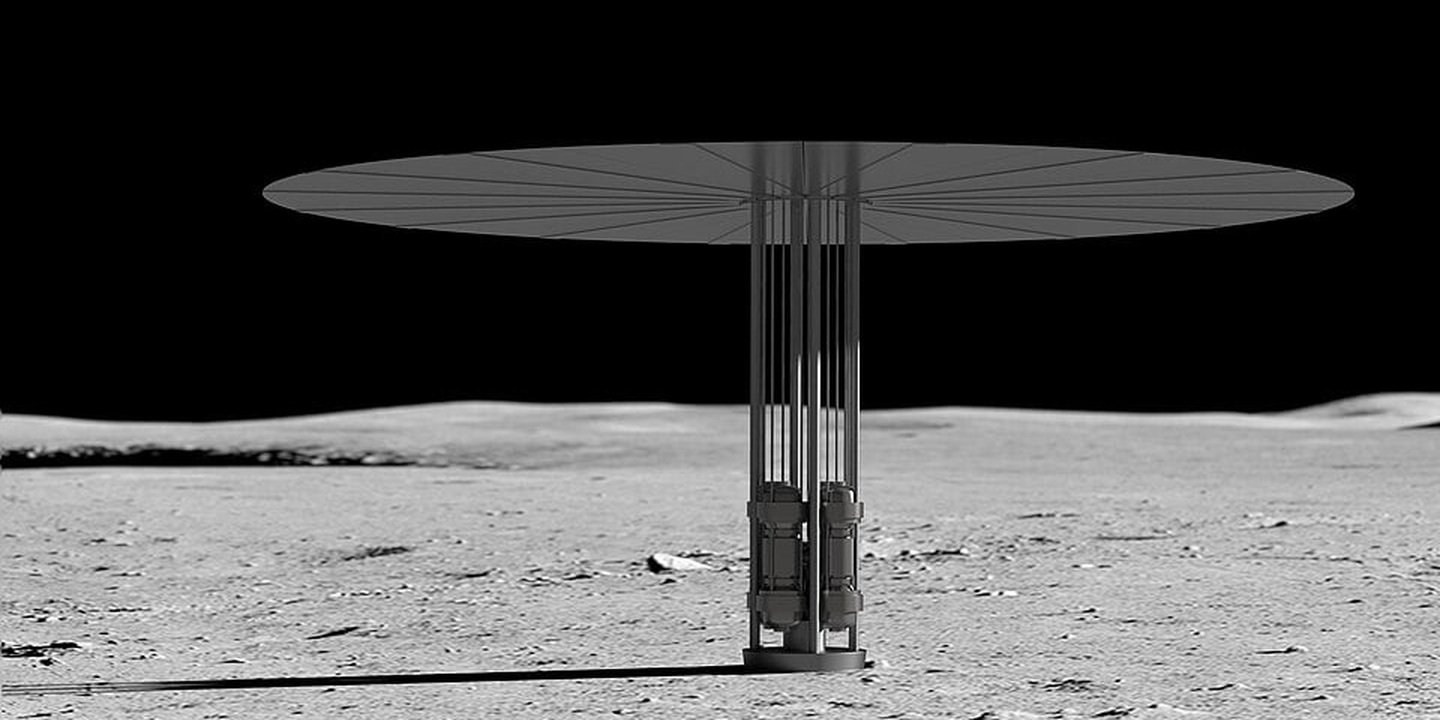
The NASA Kilopower artwork illustrating this story depicts a different reactor concept, not MULE hardware. MULE proposes a common heat source for manufacturing and base operations, but substantial work remains before deployment.
For future explorers, the appeal is straightforward: continuous power through darkness plus enough high-temperature heat to process material already on the Moon. The research shows that the core’s neutron behaviour warrants further investigation. Whether the whole chain can be built, landed, shielded and operated is the next, harder question.