









This week I have been in Hangzhou, in eastern China, for a workshop about how societies might learn to measure their relationship with the living world. Each morning before the sessions began, I walked along the shore of Xihu, West Lake, where water, hills, trees and pavilions seem to have been arranged not as separate elements but as parts of a single, breathing composition.
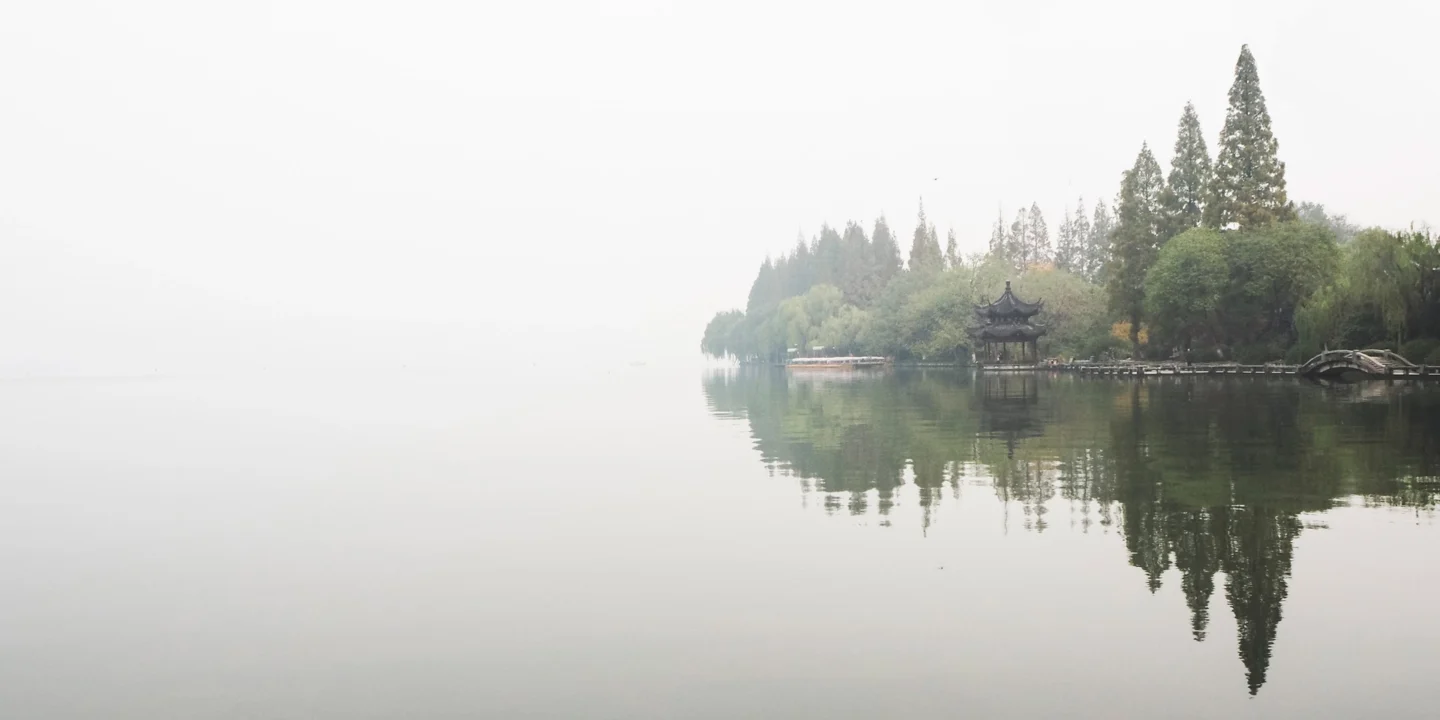
Before the city fully woke, mist gathered over the lake in pale folds. From the promenade, beneath the thick-armed camphor trees, the far hills appeared and disappeared behind the morning haze. Pagodas rose from them as though they had grown out of the slopes rather than been placed there by human hands. Nothing in the scene was untouched by people, and yet nothing felt merely imposed. The human forms seemed to deepen the landscape’s own grammar.
Along the water, groups of men and women practised tai chi in padded jackets, wool hats and soft shoes. Their movements were slow, attentive, and almost tidal. Chinese classical music drifted from a portable speaker, mingling with birdsong and the low wash of the lake. Nearby, cormorants opened their wings toward the weak sun, holding themselves still as if participating in the same morning discipline.
Behind me, another Hangzhou was beginning to stir. Glass towers caught the light. Traffic thickened. Delivery riders moved through the city’s early bustle with the quiet precision of a new urban nervous system. The headquarters and research campuses of China’s technology economy were not far away. In the same glance, one could see an ancient landscape ideal and one of the most intensely modern urban economies on Earth.
Centuries ago, this city was Lin’an, the capital of the Southern Song Dynasty and likely one of the largest cities in the world. Marco Polo, arriving from what was then the far western edge of Eurasian wealth and sophistication, called it the ‘City of Heaven’. His astonishment is still understandable. In Hangzhou’s older quarters, the curved grey eaves, stone bridges, markets and lanes seem to preserve the afterimage of that splendour, even as the modern city has risen around them.
I first came to China in the early 1990s, travelling as a young academic not long after finishing my PhD. The country was beginning to open itself more fully to the world economy. Since then, the scale of change has been almost impossible to absorb. Hundreds of millions have left extreme poverty. Cities have expanded at astonishing speed. Infrastructure, manufacturing, education and technology have remade everyday life for much of the population.
Prosperity, however, has never arrived alone. Rapid urbanisation brought pollution, habitat loss, immense demand for energy, and the resource hunger of a growing middle class. China now accounts for a large share of global carbon emissions, even though its per-capita emissions remain far below those of the richest high-consuming countries. The shopping malls and high-speed rail stations, the electric vehicles and smartphones, the new apartments and digital services are all connected to planetary supply chains whose ecological consequences stretch far beyond any single city.
Still, the story is not one of simple degradation. Hangzhou and many other Chinese cities are also becoming greener. Hillsides stripped by earlier land use have been reforested. Electric vehicles increasingly fill the streets. Air and water have improved in ways that visitors from only a decade or two ago can notice. China’s vast investment in renewable power and electrified transport may help bend its emissions trajectory in the years ahead.
Standing there between the lake and the towers, I found myself thinking less about the usual opposition between development and nature than about the inadequacy of that opposition. The scene before me was not wilderness resisting civilisation, nor civilisation triumphing over wilderness. It was something more difficult and more useful: a landscape showing that human prosperity and ecological life are always already entangled, sometimes destructively, sometimes beautifully, usually both.
Flourishing is not a condition we inherit from nature; it is a relationship we either cultivate or exhaust.
For much of the modern era, economic development has been imagined as a human ascent from natural constraint. Forests became timber. Rivers became irrigation channels, transport routes or hydroelectric potential. Soils became agricultural productivity. Species became resources, pests, luxuries, symbols or losses. Nature entered the development story mainly as background, input or obstacle.
That narrative achieved real things. It helped justify investments in food, sanitation, housing, health, education and infrastructure. Billions of people now live longer, safer and more materially secure lives than their ancestors could have imagined. To romanticise the past as a time of easy balance with nature is to forget the hunger, disease, infant mortality and vulnerability that marked most human lives for most of history.
Yet the same narrative is now failing. The living world cannot remain merely the background against which human wellbeing advances, because the background has begun to move. Climate change, biodiversity loss, water stress, soil degradation, zoonotic disease risk and ecological instability are no longer peripheral environmental issues. They are conditions that shape food systems, health, migration, conflict, insurance, infrastructure, national security and the future of human prosperity itself.
Ecology has always taught a lesson that political economy often preferred to ignore: humans are not only supported by nature, as though nature were a platform beneath us. We are made of it, fed by it, surrounded by it, regulated by it, and psychologically formed through contact with it. Our bodies carry the chemistry of soils and oceans. Our cities depend on distant watersheds, pollinators, forests and climates. Our mental health is affected by trees, birds, heat, light, air and access to living landscapes.
A better development story therefore cannot simply add nature to the existing list of concerns. It must change the unit of imagination. The question is not how far human beings can rise while minimising damage to the rest of life. It is how societies can flourish as members of a wider living system whose vitality is not ornamental but constitutive of their own.
Such a shift requires more than warnings. Environmental discourse has become highly skilled at describing limits: planetary boundaries, carbon budgets, extinction rates, ecological overshoot, tipping points. These concepts are indispensable. They tell us where danger lies and what must not be exceeded. But limits alone rarely provide a compelling picture of what development is for. A politics built only around avoiding catastrophe can struggle to inspire the long, patient work of institutional change.
Another kind of narrative is needed, one that is neither nostalgic nor naïve. It must not ask billions of people to accept poverty in the name of nature, and it must not pretend that premodern societies always lived gently on the Earth. Many did not. Human beings have transformed landscapes for millennia, sometimes with care, sometimes with violence. The task is not to retreat from development, but to ask what development becomes when the living world is treated as partner, condition and fellow participant rather than as warehouse or waste sink.
These questions motivated the work that brought me to Hangzhou. Last year, with the US ecologist Erle Ellis, colleagues from the UN Human Development Report Office, and scholars working across ecology, history, anthropology, psychology and other fields, I helped publish a paper arguing for a reframing of development as flourishing with nature. We proposed that the world needs not only better evidence of environmental decline, but also a more aspirational account of what progress could mean on a human-dominated planet.
From that work has come the idea of a Nature Relationship Index: a country-level measure intended to complement existing accounts of human development by asking how societies are doing in their relationship with the rest of the living world. The UN is expected to begin reporting this index annually from late 2026. Our workshop in Hangzhou was part of the difficult work of turning a broad idea into something measurable, comparable and politically useful.
No single number can capture the full complexity of human entanglement with nature. That is obvious. A river is not a spreadsheet. A forest cannot be reduced to a rank. A child’s experience of walking under trees on the way to school, the presence of insects in a field margin, the cultural meaning of a mountain, the rights of Indigenous communities, the carbon stored in a wetland and the migratory route of a bird cannot be compressed without loss.
Yet indicators matter because modern institutions often see through them. Budgets, rankings, policy targets, media narratives and national reputations are shaped by numbers. A measure does not merely describe the world; it can train attention. It can make some forms of success visible and others harder to ignore. Used badly, a metric can distort reality. Used well, it can help societies ask better questions about themselves.
The Human Development Index offers the clearest precedent. Introduced in 1990 by the UN Human Development Report Office, it shifted attention away from gross domestic product alone and toward a broader understanding of human wellbeing. By combining income with health and education, it helped weaken GDP’s monopoly over the imagination of progress.
The Human Development Index changed what counted as progress by changing what countries were invited to compare.
Its power lay partly in its simplicity. Countries could see themselves in relation to one another. Citizens, journalists, policymakers and international organisations could ask why some societies achieved long life, education and decent living standards more effectively than others. Economic output remained important, but it no longer appeared to be the whole story.
Since 1990, the Human Development Index has recorded broad improvement across much of the world, although unevenly and with setbacks. Many countries have risen as health, education and incomes improved. Others have stagnated or fallen amid war, institutional collapse or persistent poverty. Crucially, the index gave societies a way to compare development as quality of life rather than economic power alone.
A Nature Relationship Index would not replace that achievement. It would extend the question. How well is a society flourishing within the living world that sustains it? Does its prosperity depend on degrading ecosystems elsewhere? Are its cities places where people can encounter trees, birds, shade, rivers and seasonal change? Are its rural landscapes biologically rich or simplified into industrial surfaces? Does it protect nature only in distant reserves while allowing everyday environments to become ecologically sterile?
The word relationship is important. We are not trying to measure whether citizens say they love nature, nor whether a country possesses dramatic scenery for tourists. A country may have mountains, forests and lakes and still live from them extractively. Another may have fewer spectacular landscapes but cultivate cleaner rivers, greener cities, lower consumption pressures and stronger public access to nature. Relationship is not possession. It is a pattern of conduct.
Many cultures have long understood this. Our co-author, the Maori scholar Krushil Watene, has emphasised that human beings have often been understood not as owners standing above the living world, but as members of a wider community of beings bound by care, obligation and reciprocity. Indigenous and local knowledge systems, Daoist thought, and many other civilisational traditions contain versions of this insight.
None of these traditions should be turned into decoration for modern environmental policy. They were and are diverse, contested and historically situated. Some societies that articulated deep ideals of reciprocity also damaged ecosystems. Others sustained complex forms of stewardship for long periods. The point is not that the past contains a ready-made answer, but that modern development is not the first attempt to ask what a good human relationship with the living world might require.
What is new is the scale and institutional context. Today, development is negotiated through nation states, global markets, multinational corporations, trade agreements, financial systems and international organisations. Ideas gain practical force when they can move through those systems. Stories matter, but stories paired with indicators can sometimes travel farther inside bureaucracies, ministries and development agencies.
In recent decades, the UN Sustainable Development Goals have tried to provide a broad framework for linking human wellbeing, environmental protection and social justice. Their scope is valuable, but their abundance can make them difficult to hold in the public imagination. A more focused index cannot replace them, but it may help crystallise one essential question: what kind of relationship with nature is a society building as it develops?
Designing such a measure is hazardous. A bad index can reward the wrong behaviour, punish the wrong countries, conceal displaced harm, or confuse poverty with ecological virtue. We were determined not to create a metric that treats low consumption caused by deprivation as an admirable relationship with nature. A collapsing state with widespread poverty may have a smaller ecological footprint, but that is not flourishing. Misery is not sustainability.
Equally, wealth cannot be allowed to purchase innocence. A high-income country may have excellent healthcare, education, infrastructure and protected landscapes while outsourcing ecological damage through imports, fossil-fuel exports or high-consumption lifestyles. A city may be rich, efficient and technologically advanced while offering its citizens little daily contact with the living world. A nation may advertise its wilderness while its prosperity depends on extracting and selling carbon.
A rich country can be poor in relationship if its comfort depends on distant ecological silence.
Norway and Canada, for example, possess immense natural beauty and rank highly on conventional human development measures, yet remain deeply entangled with fossil-fuel extraction and exports. Tokyo is prosperous and sophisticated, but many residents experience urban life in environments where accessible everyday nature is limited. By contrast, a middle-income country may retain diverse agricultural mosaics, urban tree cover, rivers that still support life and lower consumption pressures, while still needing to improve health, income and institutional capacity.
The emerging framework we have been working on centres on three broad dimensions. Each is imperfect; together they try to make visible different aspects of a society’s relationship with the living world.
First comes the question of whether nature is thriving and accessible. This means asking not only whether a country contains protected areas or spectacular landscapes, but whether ordinary people can encounter living systems in daily life. Are cities shaded by trees? Are parks safe and abundant? Do rivers run through neighbourhoods as living corridors rather than polluted drains? Do rural landscapes contain hedgerows, wetlands, woodlands, field margins and species-rich mosaics, or are they simplified into lifeless monocultures?
Everyday contact matters because most human beings now live in cities. The ecological quality of urban life is therefore not a luxury concern for wealthy societies. Green space affects heat, air quality, mental health, physical activity, childhood development and social life. A child who grows up hearing birds, touching soil, watching insects and walking under trees inhabits a different world from one whose environment is almost entirely concrete, traffic and screens.
There is also a deeper loneliness involved. For nearly all of human history, people lived among other species in ways that were practical, dangerous, intimate and imaginative. Modern urban life has often narrowed that field of encounter. Species-loneliness — the thinning of felt membership in a wider community of life — may be difficult to measure directly, but it is not trivial. A developed society should not mean a society in which humans become more comfortable while becoming more alone.
Second, the index asks whether nature is treated with care. This dimension concerns the pressures a society places on climate, biodiversity and ecosystems, both within its borders and through global supply chains. Local emissions matter, but so do imported goods whose production destroys habitats elsewhere. Consumption in one country can reshape forests, savannas, fisheries and rivers on another continent.
Brazil’s high-meat consumption, for instance, is tied to cattle ranching and pressure on savannas and rainforests. Much of Europe has displaced a portion of its ecological footprint into landscapes far beyond its borders. Wealthy consumers may experience their own surroundings as clean and orderly while participating in systems that degrade distant places they never see. A serious measure of relationship must follow those hidden connections.
This is one of the most important innovations such an index can offer. Environmental accounting often stops at national borders because political authority stops there. Ecological causality does not. Carbon, commodities, capital and consumption move through the world in tangled lines. If the goal is flourishing with nature, then a country’s relationship includes the landscapes it affects through trade, not only those visible to its own citizens.
Third, we ask whether nature is safeguarded for the future. Protected areas, restoration efforts, clean air, clean water and policies that preserve ecological function all belong here. The focus is not only on resources available for human use, but on the wider living world’s capacity to continue its own patterns of existence. A river is not healthy merely because it can supply water to people. It is healthy when it can also support fish, insects, plants, sediments, floodplains and the other relations that make it a river rather than a pipe.
These three dimensions can pull in different directions. Intensive agriculture may reduce pressure for land expansion while damaging local biodiversity and water quality. Economic growth can provide resources for pollution control while increasing consumption. Protected areas may expand while urban environments become more hostile to everyday contact with nature. No metric can dissolve these tensions. At best, it can make them harder to hide.
At the Hangzhou workshop, we spent long hours with datasets, maps and methodological questions. Which indicators are available for most countries every year? Which are reliable? Which capture something meaningful rather than merely something convenient? How should local environmental quality be balanced against global supply-chain impacts? How can the index remain simple enough to communicate while honest enough not to mislead?
Evenings brought a larger international online workshop, with colleagues from multiple countries asking the awkward questions that any serious metric must face. Data availability remains a constraint. Many things we would like to know are poorly measured, irregularly reported or available only for wealthy countries. Some of the most important dimensions of relationship — cultural connection, Indigenous stewardship, ecological memory, intergenerational responsibility — resist simple quantification.
A measure that ignores these dimensions would be impoverished. A measure that tries to include them carelessly could become misleading. The challenge is to create something modest enough to be usable and ambitious enough to matter. Like the Human Development Index, it must be understood as an invitation to public comparison, not as a final philosophical account of the good life.
Early results suggest that the index will not simply reproduce the ranking of rich and poor countries. Some wealthy societies may perform less well because their consumption, fossil-fuel dependence or urban design weakens their relationship with nature. Some middle-income societies may do better than expected where ecological mosaics remain intact, public access to green space is strong, and environmental pressures are more moderate. Others may reveal sharp internal contradictions: good protected-area coverage but poor urban access; cleaner domestic environments but heavy displaced footprints; strong restoration efforts but rising consumption.
This complexity is not a flaw. It is the point. A society can no longer be judged as developed only by asking how much income, education and longevity its citizens enjoy. We must also ask what kind of world its prosperity produces, and whether that world can continue to support flourishing for humans and nonhumans alike.
In the age of planetary entanglement, every country is still developing its capacity to belong.
Kate Raworth, the ‘renegade economist’, has often argued that humanity must learn to live within the doughnut: above the social foundation of human need and below the ecological ceiling of planetary limits. That image remains powerful because it refuses both poverty and overshoot. In a similar spirit, the Nature Relationship Index starts from the premise that no country has yet solved the problem of co-flourishing. In this respect, all countries are developing countries.
This claim is not a rhetorical gesture toward equality. It is analytically important. High-income countries have not graduated from the ecological challenge. Many have simply become better at separating the experience of affluence from the sites of damage that sustain it. Low-income countries should not be told to remain poor for the sake of global nature. Middle-income countries face the immense challenge of improving lives without repeating the most destructive pathways of earlier industrialisation.
A meaningful index should therefore avoid nostalgia and accusation as its primary tones. Its purpose is not to shame societies for failing to inhabit an impossible purity. Rather, it should help them see the direction of travel. Are rivers becoming more alive or less? Are cities becoming more hospitable to nonhuman life or more sealed against it? Is consumption becoming less destructive or merely more distant in its impacts? Are children growing up with more or fewer chances to know the living world directly?
Such questions matter because they shift attention from stock to relationship. A country may possess large forests, but are they protected, fragmented, burning, exploited or regenerating? A city may contain parks, but are they accessible to ordinary people or enclosed by wealth? A landscape may produce abundant food, but does it leave room for birds, insects, soils and water? Prosperity is not only what a society accumulates. It is also what its way of living permits to remain alive.
The geopolitical moment makes this work feel both urgent and fragile. Multilateral institutions are under strain. Trust between states is thin. National rivalries, wars, trade tensions and ideological conflicts make global cooperation harder. Some leaders openly reject climate science or treat ecological concern as a luxury that can be postponed until after growth, security or political advantage.
Interdependence, however, does not disappear when cooperation weakens. Countries continue to trade, emit, consume, pollute, restore, conserve and transform one another’s futures. Carbon dioxide ignores borders. Biodiversity loss travels through food systems and commodity chains. Water, disease, heat and ecological disruption do not respect sovereignty. The living world remains connected even when politics fragments.
Measures such as the Human Development Index mattered because they gave countries a way to compare themselves in terms of wellbeing rather than economic power alone. A Nature Relationship Index could provide a similarly useful mirror. It would not end geopolitical rivalry, but it might alter what counts as prestige. A country could ask not only whether it is richer or more powerful than its neighbours, but whether its development is more compatible with the flourishing of life.
Numbers cannot love a landscape, but they can teach institutions to stop overlooking it.
After the workshop ended, I returned once more to West Lake. I walked slowly along the causeways, past bridges, gardens, willows and pavilions. The landscape has been celebrated for more than a millennium in Chinese poetry, painting and philosophy. It is often described as a place of harmony between human presence and the more-than-human world, but that harmony is not the harmony of absence. People made this landscape.
In the 9th century, the Tang poet-governor Bai Juyi dredged the lake and helped shape its waters and embankments. Later generations added causeways, temples, gardens, bridges, paths and plantings. The famous Ten Scenes of West Lake — ‘Breeze-ruffled Lotus at Quyuan Garden’, ‘Orioles Singing in the Willows’, ‘Autumn Moon over the Calm Lake’ and the rest — are not descriptions of untouched wilderness. They are titles for a cultivated relationship.
That distinction matters. Western conservation has often imagined nature most purely as a place without people. Such places are precious and must be defended where they still exist. But a planet of 8 billion humans cannot rely only on separation as its ecological ideal. Most of the world’s future will be decided in working landscapes, farms, suburbs, cities, rivers, coasts, plantations, fisheries, roadsides, parks and restored places where human intention and nonhuman life meet.
West Lake does not offer a model that can simply be scaled up. A historic Chinese landscape cannot by itself govern global supply chains, carbon budgets or industrial food systems. Ancient philosophies of human-nature attunement cannot substitute for satellites, biodiversity datasets, emissions accounting, environmental law or international finance. Poetry cannot replace policy.
Yet policy without poetry is also inadequate. Data can show where forests are disappearing, but it cannot by itself tell a society why a forest matters. A ranking can reveal that a city lacks accessible green space, but it cannot alone create love for shade, birds, soil, water or seasonal change. The older landscape traditions surrounding West Lake and the modern attempt to build a Nature Relationship Index belong to very different worlds, but they answer related questions. What should humans notice? What should they protect? What forms of prosperity are beautiful enough to be worth wanting?
Perhaps the deepest task of a metric is not to settle these questions, but to keep them open in public. GDP made economic activity visible, sometimes too visible. The Human Development Index made health and education harder to ignore. A Nature Relationship Index might make it more difficult for societies to call themselves successful while their rivers die, their children grow up without trees, their consumption erases distant habitats, or their cities become wealthy deserts of concrete and glass.
A number cannot capture flourishing. It can only point toward it. The danger is that we mistake the pointer for the thing itself. The opportunity is that, without such pointers, large institutions often fail to see what is not already priced, ranked or reported.
Morning returned to Hangzhou with the same quiet choreography: the tai chi groups, the music, the cormorants, the lake brightening under the mist. Behind the trees, the modern city continued its enormous work of construction, invention, consumption and ambition. Neither the ancient landscape nor the contemporary skyline contained the answer alone.
Between them lay the question that will define development in this century. Can human societies become richer, healthier, more educated and more secure while also becoming better members of the living world? Can prosperity be measured not only by what it gives to people, but by what it allows to flourish around them? Can development become less a story of escape from nature than a discipline of belonging within it?
If the Nature Relationship Index succeeds, it will not be because it reduces the living world to a single number. It will succeed if it changes what societies notice, compare and aspire to become. Indicators shape attention; attention shapes ambition; ambition shapes institutions; institutions shape landscapes. Over time, landscapes shape us back.
The measure of flourishing, then, is not simply the condition of people or the condition of nature. It is the quality of the relationship by which each makes the other’s future possible.