












DEMOCRACY & POLITICAL ECONOMY
Western democracy’s troubles are not simply failures of character. They reflect rules that reward concentrated power—and rules can be redesigned.
Democracy is usually judged by its ceremonies: elections occur, governments change, legislators argue, and courts continue their work. Yet those forms can survive while public purpose weakens. Across many affluent countries, citizens describe housing as unreachable, infrastructure as unreliable, services as strained, and decision-makers as remote. Elections remain competitive, but the choice can feel narrower than the problems demanding attention.
One explanation blames leaders; another focuses on polarisation, misinformation, or voters. Those factors matter, but a more durable question is what conduct the rules encourage. Institutions decide who can realistically seek office, which interests receive access, what governments measure, and whether wrongdoing brings personal consequences. When those arrangements favour insiders, disappointing outcomes should not surprise us.
The argument here is structural. Since the market turn of the late 20th century, Western governments have often treated deregulation, privatisation, lower taxes, and financial expansion as general solutions. Advocates expected competition to release initiative and curb waste. Critics contend that the programme weakened public capacity, shifted risk to households, and strengthened asset owners. The record resists a single-cause story, but the institutional question remains urgent.
How the Rules of the Game Changed
The political shift became unmistakable under Ronald Reagan and Margaret Thatcher. In 1981, Reagan’s administration received the Heritage Foundation’s roughly 3,000-page Mandate for Leadership, covering taxation, regulation, defence, and the federal bureaucracy. Heritage later reported that about 60 per cent of its proposals had been adopted or initiated within a year. That partisan assessment is not independent proof, but it shows how prepared ideas can become governing machinery.
Thatcher pursued a parallel British transformation through privatisation, restrictions on organised labour, financial liberalisation, and a smaller direct role for the state in production. Variations spread elsewhere. The order was never uniform: welfare states survived, spending did not vanish, and regulation often changed form rather than disappearing. Still, the presumption shifted toward markets, while public action was increasingly required to justify itself.
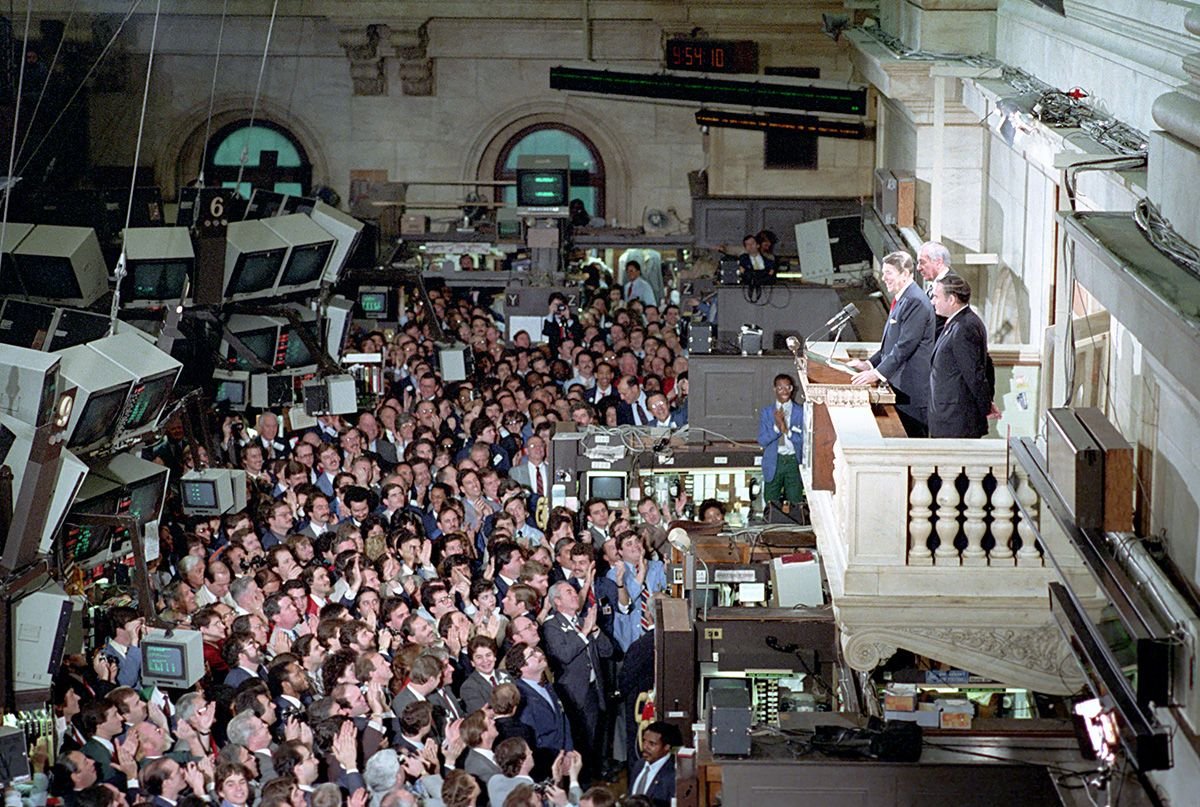
A useful way to examine that change comes from industrial economics: structure influences conduct, and conduct shapes performance. Applied to politics, the model asks us to look behind a scandal or a bad quarter. Campaign rules, administrative capacity, ownership patterns, legal standards, and measures of success form the structure. They influence how politicians, regulators, companies, and investors behave. The accumulated results appear in growth, debt, resilience, trust, and the distribution of opportunity.
This approach does not absolve anyone. It explains why replacing a minister or chief executive may achieve little when incentives remain. A government that outsources expertise can depend on firms it must oversee. An under-resourced regulator may struggle against an industry, while a donor-dependent party may grant funders greater access without an explicit bargain. Repeated conduct can emerge from ordinary adaptation to a skewed system.
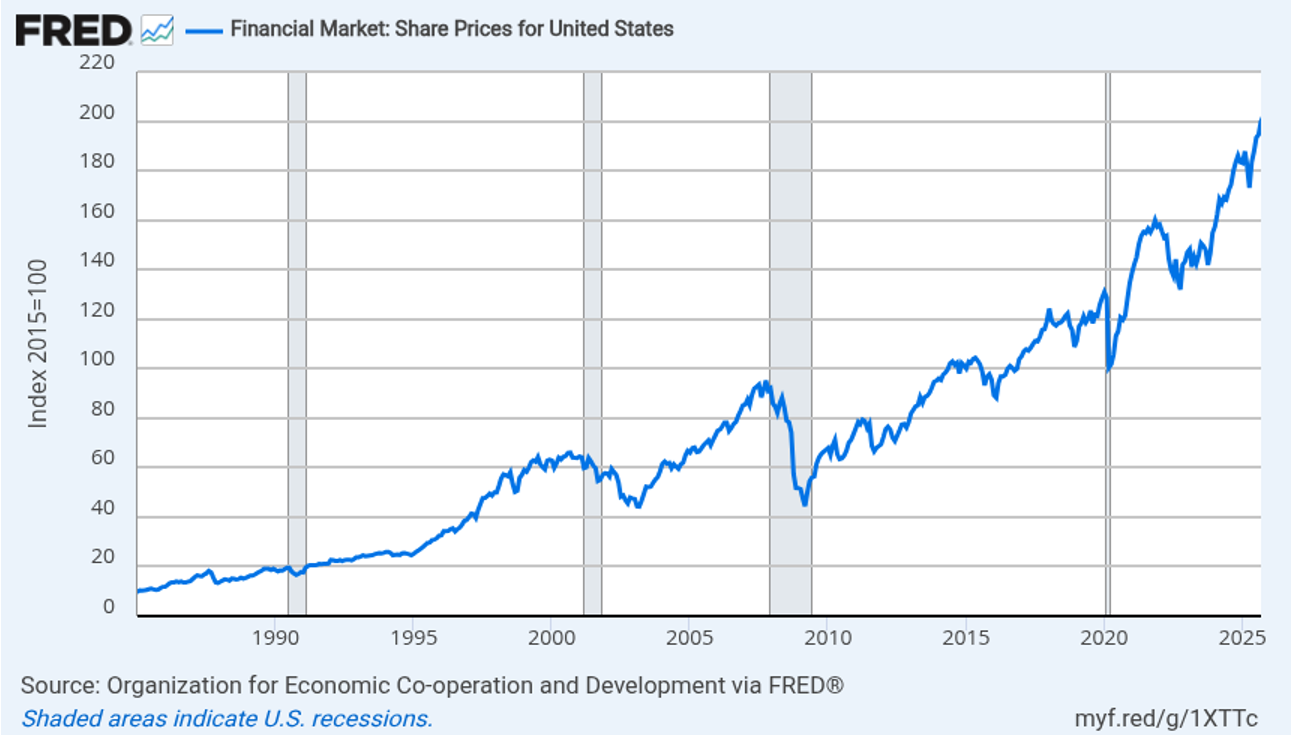
The 1987 crash showed how quickly financial shocks could travel. Later crises exposed hidden risks, institutions too interconnected to fail safely, and public rescues of systems whose gains were mostly private. Deregulation did not single-handedly cause Black Monday or every later crash; technology, capital flows, monetary policy, and investor behaviour mattered. Even so, thinner safeguards reduced the margin for error and made public backstops more important.
Reading the Record Without Overclaiming
The economic case begins with a striking divergence. In the source essay’s unweighted averages for selected Western democracies, public expenditure stayed high while government debt rose from roughly 40 per cent of GDP around 1980 to about 65 per cent in recent years. At the same time, growth in real output per person slowed from close to 3 per cent a year in the 1980s to near 1 per cent. Household borrowing also expanded substantially relative to national income.
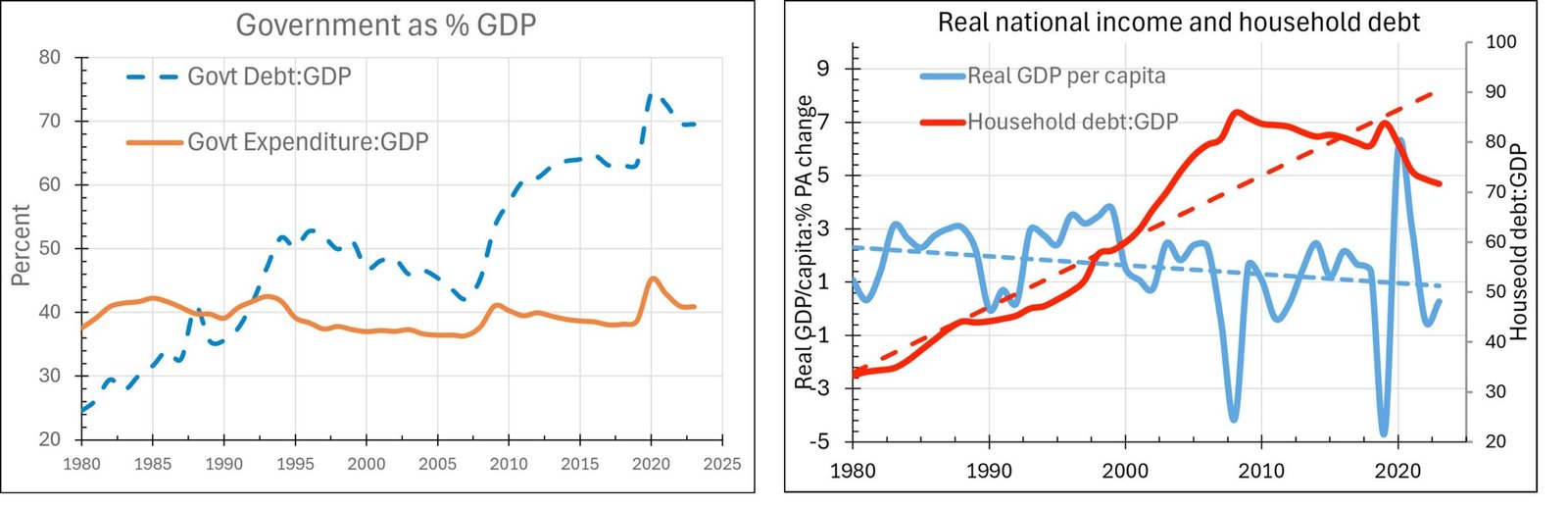
These parallel trends do not prove that one ideology caused them. Mature economies often grow more slowly than countries catching up. Ageing, weaker productivity, energy shocks, wars, the financial crisis, and the pandemic all affected the period. Debt may reflect tax choices, recessions, social insurance, or emergencies as well as failure. The charts do not settle Coleman’s causal argument; they show that leaner administration did not reliably deliver the promised acceleration.
Infrastructure helps explain why. Postwar states built transport, power, water, schools, and communications systems that also supported private enterprise. Deferring maintenance or selling assets without long-term investment can improve an immediate budget while productive capacity erodes. Privatisation may improve services where competition and capable regulation exist. In a natural monopoly, however, new ownership does not create a market and may merely replace public control with private toll-taking.
Finance tells a double-sided story. Capital markets can fund innovation, spread risk, and help families save. Yet the decades after 1980 also brought more leverage and large gains for existing asset owners. Rising stock and property prices increased wealth at the top while raising barriers for younger buyers. Coleman sees recurring speculative cycles, though no fixed seven-year rhythm governs them; each crisis has distinct mechanisms and timing.
Economic strain becomes corrosive when paired with visible impunity. Corporate collapses, misleading financial products, the failure to find the weapons used to justify the Iraq invasion, and the 2008–09 rescue of finance all weakened confidence. Pandemic restrictions then triggered dispute over health, liberty, and uncertainty. Policies varied widely and their effects remain contested, so calling lockdowns uniformly excessive obscures local conditions and their protective purpose.
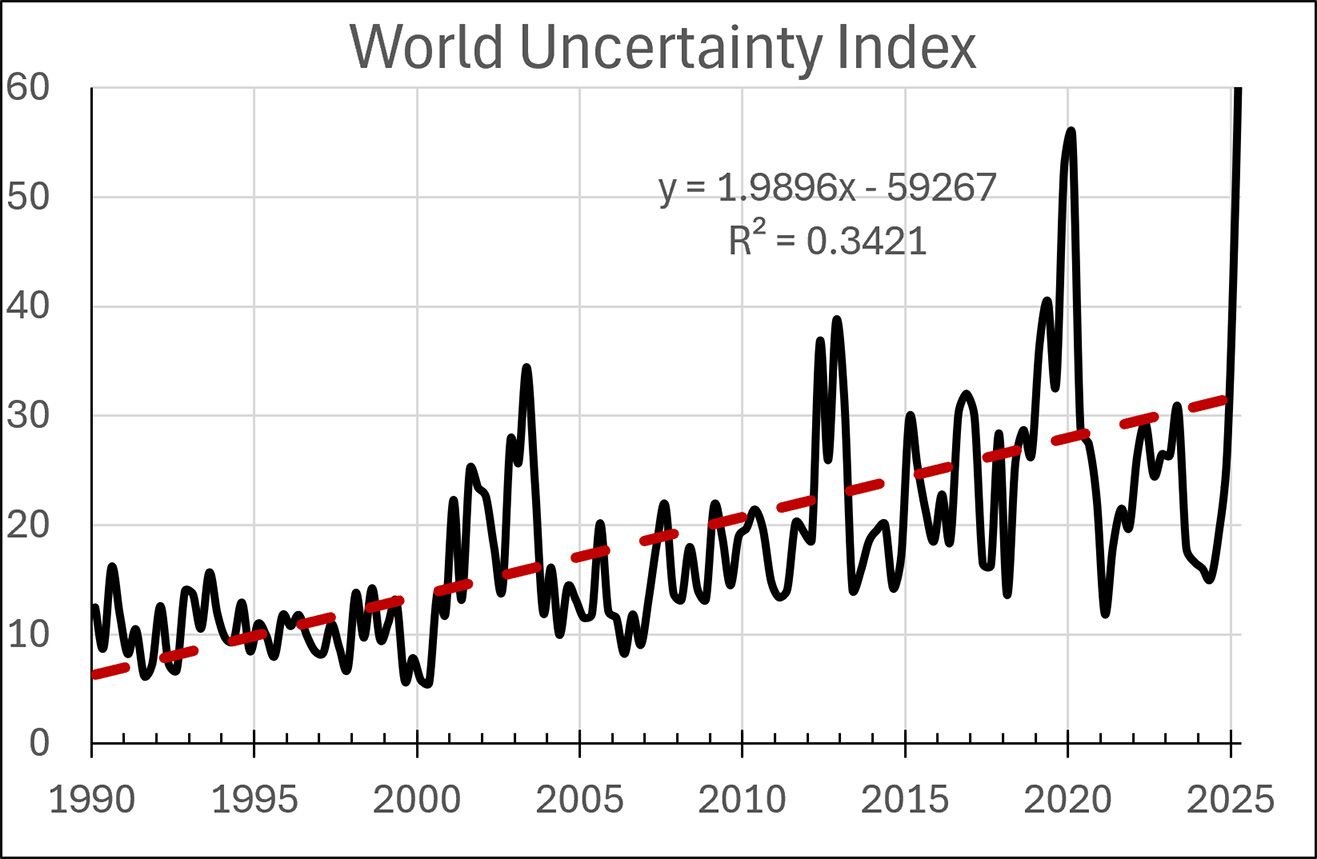
Measures of uncertainty capture the atmosphere, not a verdict on its cause. The World Uncertainty Index counts relevant terms in country reports and shows repeated spikes around major disruptions. Its upward tendency is consistent with a more anxious political economy, but it cannot tell us whether citizens are reacting to policy, technology, conflict, disease, or media. China and India likewise cannot serve as controlled experiments proving that rejection of Western prescriptions guarantees superior results; their institutions, development stages, demographics, and political systems differ too greatly.
What the evidence does support is a more modest and useful finding: institutional arrangements made some democracies less resilient than their wealth suggested they should be. Governments retained large obligations while losing expertise, markets delivered impressive fortunes without broad security, and accountability repeatedly lagged behind complexity. That diagnosis points beyond nostalgia. The task is not to restore the state of 1975, but to build rules suited to financialised economies, ageing societies, digital platforms, and planetary limits.
Open Political Competition
Repair begins with the route into public office. Major parties in Australia, Britain, and the United States have alternated in government for generations, yet their professional networks and assumptions frequently overlap. A two-party system can still offer meaningful differences, and smaller parties are not automatically wiser. The structural concern is narrower: high campaign costs, weak candidate pipelines, and electoral rules can make established organisations too difficult to challenge.
One provocative remedy is to pay senior politicians much more. The argument is that governing a large country requires judgement comparable to leading a major organisation, while public salaries are modest beside executive compensation. Better pay might widen the pool of candidates or reduce temptation. Yet evidence that salary increases reliably improve integrity is limited. Public purpose, scrutiny, job insecurity, and the hostility of modern campaigning also shape recruitment. Compensation should therefore be considered alongside selection, ethics enforcement, and working conditions—not as a stand-alone cure.
Any rise in pay should come with demanding disclosure. Candidates and senior officeholders could publish assets, liabilities, business ties, gifts, outside income, and relevant family interests in a searchable form. India’s candidate affidavits demonstrate one version of pre-election disclosure. Strong privacy rules would still be necessary, especially for home addresses, children, and information unrelated to public risk. Transparency works best when an independent body checks declarations rather than leaving voters to decipher incomplete forms.
Campaign finance is the next gate. Seattle’s democracy-voucher programme gives eligible residents publicly funded certificates that they can assign to participating local candidates. Such systems do not eliminate private money, but they can give newcomers a donor base and encourage campaigns to seek many small supporters. Public matching funds, spending limits, fair media access, and simpler ballot requirements can pursue the same goal. The design challenge is to lower barriers without financing sham candidates or allowing parties to route money around the rules.
Electoral systems also determine whether a vote for a new movement is expressive or effective. Ranked ballots, proportional representation, independent redistricting, and open or well-regulated primaries each alter the competitive landscape. No formula fits every country, and institutional changes can produce unexpected incentives. Still, a democracy should periodically test whether its rules protect voter choice or incumbent organisations. Genuine competition is valuable not because outsiders are inherently virtuous, but because secure monopolies rarely examine themselves with urgency.
Count What a Good Society Needs
Political competition will disappoint if governments continue to define success too narrowly. Gross domestic product records priced production within an economy. It is indispensable for comparing economic activity, estimating tax capacity, and tracking recessions. It was never designed to tell us whether growth is fairly shared, whether homes are affordable, or whether people are healthy. Treating it as a complete scorecard confuses a useful accounting measure with a social purpose.
Some of GDP’s oddities are familiar. Cleaning up a disaster adds measured activity, while preventing the damage may appear mainly as a cost. Unpaid care has enormous value but no market price. Free digital tools can improve daily life without a corresponding rise in recorded consumption, and depletion of forests, soil, or minerals may accompany higher output. Quality improvements are difficult to capture. None of this makes GDP fraudulent; it shows why political targets need more than one dimension.
A democratic dashboard should combine material security with human and ecological conditions. Median disposable income, housing costs, healthy life expectancy, educational attainment, time use, carbon emissions, biodiversity, infrastructure quality, and trust can reveal trade-offs hidden in an aggregate total. Distribution matters as much as the average: a rise in national wealth tells a different story when its benefits reach most households than when gains accrue almost entirely to asset owners.
New Zealand’s Living Standards Framework illustrates the approach. Its categories connect individual and collective wellbeing with financial, physical, human, social, and natural forms of wealth. Such frameworks are not immune to politics; choosing indicators and weights is itself a democratic decision. But that is an advantage when the choices are explicit. A public scorecard can force ministers to explain whom a policy benefits, what it depletes, and how today’s improvement may impose costs on the future.
Limit Entrenched Wealth and Enforce the Law
A broader scorecard inevitably raises the distribution of power. In a 2023 OECD survey, about seven in ten respondents favoured a more equal allocation of economic resources, while roughly half believed differences in political influence were too large. Wealth concentration is not only a matter of consumption. Large fortunes purchase time, expertise, media reach, lobbying, litigation, and repeated access to officials. Even when every transaction is lawful, this unequal capacity can shape which proposals reach the agenda.
Data assembled for the source essay show that the richest 1 per cent own more than a quarter of total wealth in France, Germany, and the United States, and more than one fifth in Australia, Italy, and Britain. A 2025 study estimated that America’s wealthiest 1 per cent supplied around 30 to 45 per cent of private presidential-campaign contributions, depending on how the calculation was made. These figures deserve context, but they confirm that economic and political resources are closely connected.
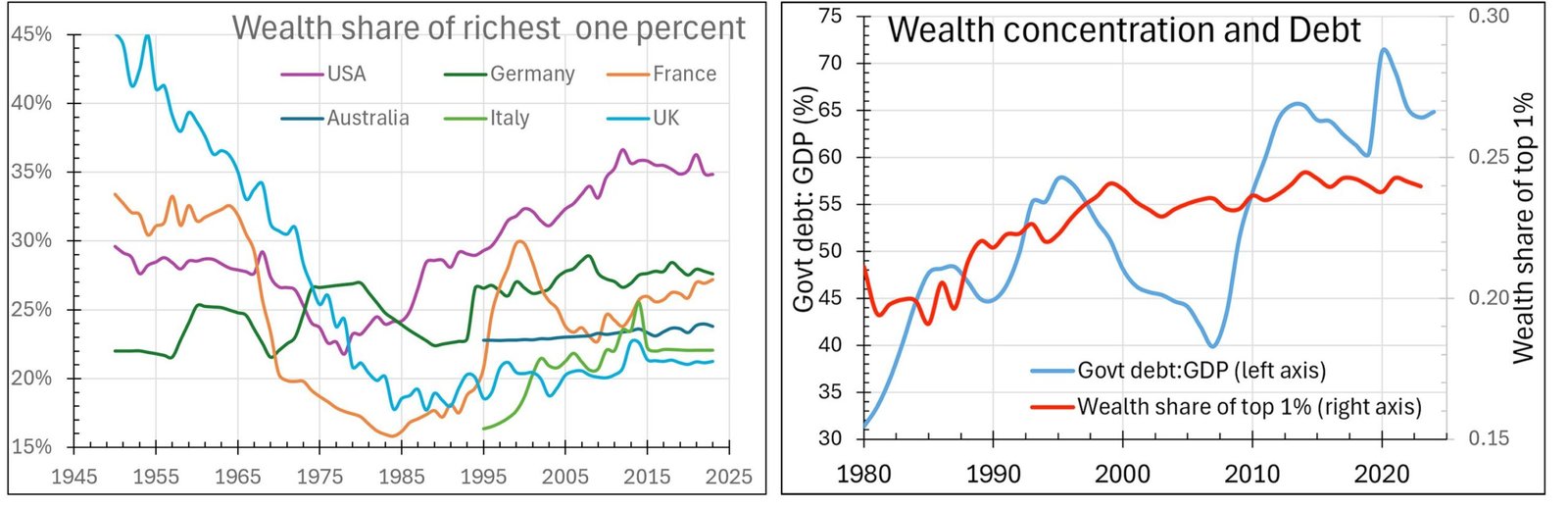
Policy can amplify the connection. Cheap credit and high asset prices disproportionately reward households that already hold property and securities. Government guarantees, procurement, tax concessions, and rescue programmes may socialise risk while preserving private upside. The chart’s association between public debt and top wealth shares is suggestive, not proof that borrowing automatically enriches oligarchs: debt can also finance hospitals, income support, or productive infrastructure. What matters is who receives the spending, who owns the resulting claims, and who bears repayment.
A progressive estate or inheritance tax is one way to prevent immense fortunes from hardening into hereditary power. The strongest case is not punishment of success but preservation of open competition across generations. Sensible design would protect ordinary estates, family homes below a high threshold, and viable operating businesses from forced sales. It would also coordinate valuation, trusts, gifts, and cross-border assets so that only people without sophisticated advisers pay. Revenue could fund a universal inheritance, education, housing, or other assets for young adults.
Economic power is especially damaging when corporate wrongdoing produces fines that shareholders absorb while decision-makers remain untouched. Enron, WorldCom, mortgage abuses, emissions cheating, opioid marketing, and antitrust controversies differ in law and evidence, but together they expose a familiar accountability gap. Complex organisations divide knowledge across departments, making individual intent difficult to prove. Specialised regulators may lack criminal-investigation skills or grow too close to the industries they supervise.
Reform should be precise. The United Kingdom’s failure-to-prevent-fraud offence, created by the Economic Crime and Corporate Transparency Act 2023 and brought into force later, makes qualifying organisations responsible when associated persons commit specified fraud for their benefit unless reasonable prevention procedures existed. It does not abolish intent requirements for every executive or criminalise any company failure. Broader strict liability for vaguely defined “incompetence” could punish accidents and discourage responsible risk-taking, so personal liability should attach to clearly stated duties, serious breaches, and available due-diligence defences.
Enforcement architecture matters as much as the offence. Multidisciplinary teams can combine police powers, forensic accounting, market knowledge, data analysis, and prosecutorial judgement. Singapore’s Commercial Affairs Department offers one model of a specialist unit within law enforcement, though its wider political setting should not be copied uncritically. Whatever the structure, investigators need independence, stable funding, protection from industry capture, and authority to pursue both the organisation and responsible individuals. Predictable enforcement is more democratic than spectacular punishment after a scandal.
Turn Reform Into Democratic Power
Yet institutions seldom redesign themselves simply because a better blueprint exists. Thomas Kuhn’s account of scientific change offers a useful analogy: a prevailing framework weakens when its anomalies accumulate and an alternative becomes credible. Political systems are not laboratories, and reform need not wait for total collapse. Still, people must first recognise that recurring failures are connected to rules rather than isolated episodes.
The elections of 2024 strengthened that recognition without delivering one universal message. Incumbent parties lost vote share in many democracies, but not literally every developed country, and voters moved in different ideological directions. Inflation, migration, war, local scandals, and post-pandemic fatigue all mattered. International IDEA’s review of the global election cycle nevertheless described a moment for reassessing democratic institutions. The safer inference is that attachment to established parties has weakened, creating an opening that democratic reformers and anti-democratic movements can both exploit.
Historical analogy can clarify stakes while also misleading. The present echoes the 1920s in its aftermath of a pandemic, rapid consumer technologies, cultural experimentation, and financial excitement. That decade ended in catastrophe, but history does not move on rails toward another 1929. Its lesson is institutional contingency: shocks can produce social protection and wider participation, or repression and exclusion. Preparation determines which proposals are ready when an unexpected opening arrives.
Nonviolent mobilisation can create such openings. Research by Erica Chenoweth and Maria Stephan found that campaigns engaging at least 3.5 per cent of a population had succeeded in their historical dataset. That observation is often turned into a guarantee, but it is neither a natural law nor a simple turnout target. Later movements have faced stronger surveillance, fragmentation, and repression. Participation still matters, especially when it is sustained, diverse, strategically organised, and connected to institutions capable of converting pressure into durable rules.
Protest is only one democratic instrument. Petitions, consumer boycotts, labour organising, strategic litigation, local campaigns, and persistent lobbying can expose costs that leaders would prefer to ignore. Citizens’ assemblies add deliberation to pressure. Ireland has repeatedly brought together demographically representative groups selected by lot to hear evidence, question experts, and recommend action on difficult issues. Their authority comes not from replacing elected legislatures but from giving ordinary people time and information that election campaigns rarely provide.
Assemblies also need safeguards. Sponsors must publish how members and experts are chosen, present competing evidence fairly, compensate participation, and explain publicly what happens to recommendations. Otherwise a celebrated exercise can become consultation theatre. The strongest model links a representative mini-public to a guaranteed legislative debate, referendum, or formal government response. It creates a bridge between outside demand and inside authority, because entrenched systems ultimately change through pressure and lawful decision together.
Western democracies begin this work with enormous advantages. Compared with earlier generations, their citizens have greater health, knowledge, productive capacity, and formal freedom. The danger is not that every gain has vanished. It is that housing, infrastructure, environmental security, and trust are deteriorating for enough people to make democratic promises feel unreal. A politics that merely celebrates aggregate prosperity will miss the lived evidence on which legitimacy depends.
The structural view ends on a demanding form of hope. Rules built over decades can be rebuilt: political entry can be widened, public success measured honestly, inherited power restrained, and complex wrongdoing investigated competently. None of these reforms guarantees wise leaders or harmonious citizens. Together, however, they make accountability more likely and monopoly less secure. The answer to democratic disappointment is not a manager above politics, but institutions that distribute political power more effectively.
The repair in one sentence: renew democracy by opening competition, measuring shared wellbeing, dispersing inherited power, enforcing clear duties, and giving citizens meaningful routes from informed judgement to public decision.