








Cinema gave human evolution one of its most durable myths. In the opening sequence of Stanley Kubrick’s 2001: A Space Odyssey (1968), apes move across a barren plain, hungry, exposed and barely distinguishable from the animals around them. A leopard attacks. Then the monolith appears, black and absolute, and something changes. To the sound of Richard Strauss’s Also sprach Zarathustra, one ape grasps a bone, raises it, and discovers violence as power. The bone smashes down. The victim becomes weapon. The scavenger becomes hunter. Tossed into the air, the bone turns into a spacecraft.
Few images have done more to compress a theory of human origins into a few unforgettable seconds. Kubrick’s sequence does not merely show the beginning of technology. It makes technology, violence and masculinity seem like the same event. Humanity begins when a male ape turns an animal remain into an instrument of domination. The leap from bone to satellite suggests that the entire modern world — war, tools, intelligence, conquest, spaceflight — was already contained in that first blow.
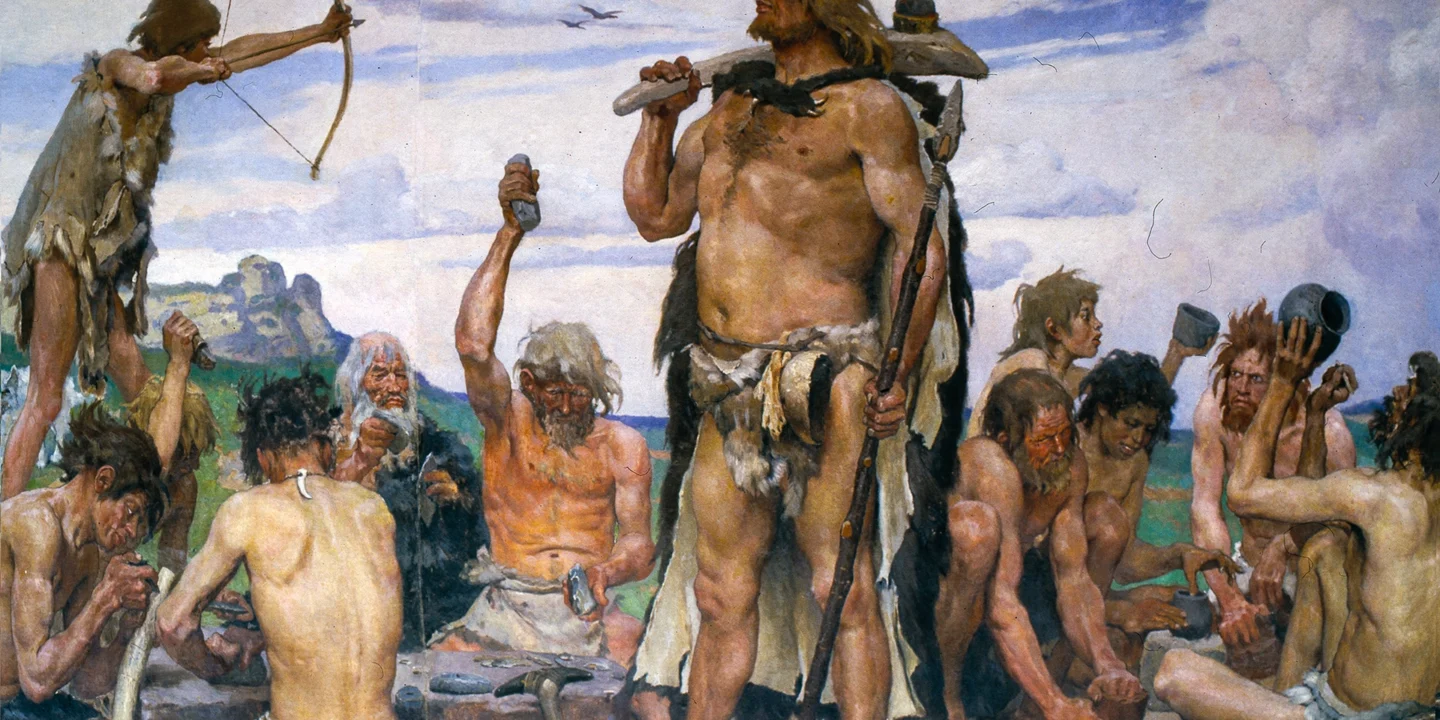
The story has a name: Man the Hunter. In its most familiar form, it claims that hunting made us human. Pursuit of prey shaped our bodies, sharpened our minds, required cooperation, produced tools, disciplined aggression and organised social life. Men hunted; women gathered, reproduced and waited near the hearth. From this imagined division flowed later domestic arrangements, gender expectations and political fantasies. The Palaeolithic became a mirror in which modern society saw its own hierarchy reflected back as nature.
For much of the 20th century, this story was everywhere. It suited a world of Cold War violence, breadwinning fathers, nuclear families and anxieties about masculine decline. It appeared in popular science, cinema, advertising, psychology, evolutionary speculation and, eventually, diets and online masculinity movements. Even where people did not know the phrase, they knew the picture: men with spears, women with babies, meat at the centre of the camp, violence as destiny.
Among anthropologists, however, Man the Hunter had long since lost its authority. For those of us who study hunter-gatherer societies, it often seemed like a relic: historically important, culturally influential, but scientifically tired. The field had moved on to questions of cooperation, ecology, sharing, childcare, gathering, mobility, gender flexibility, life history, and the immense diversity of foraging societies. Hunting mattered, but no serious account of human evolution could rest on the fantasy of the killer male alone.
And yet the phrase keeps returning. Every few years, Man the Hunter is declared dead again. Archaeologists find women buried with hunting tools. Ethnographers document women hunting in contemporary foraging societies. Physiologists ask whether women might have been well suited to endurance hunting. Commentators announce that a patriarchal myth has finally been dismantled. The headlines feel fresh, but the cycle is old. Man the Hunter dies repeatedly because it has never been one thing.
That repetition should make us suspicious. If an idea has been disproved several times and still requires another public execution, then the problem may not be the evidence alone. Perhaps the target keeps moving. Perhaps the phrase has carried several meanings at once. Perhaps we are not debating a scientific hypothesis so much as a cultural image with scientific fragments attached to it.
A few years ago, my colleagues and I began to reconstruct the history of Man the Hunter more carefully. What emerged was not a simple tale of sexist science overthrown by better evidence. It was a stranger story about how myths and research programmes become entangled. Over the past century, Man the Hunter has referred to at least three different things: a popular story about violent male origins, a 1966 academic conference and edited volume, and an empirical pattern concerning the gendered division of labour in many hunting-and-gathering societies.
Confusing these meanings has allowed the phrase to survive in a suspended state between scholarship and myth. It can be attacked as ideology, defended as data, dismissed as popular fantasy, or revived as a shorthand for serious evolutionary questions. The same words do too much work. Until we distinguish them, Man the Hunter will continue to be killed in public and quietly resurrected elsewhere.
Kubrick did not invent the killer-ape story. He inherited it. One of its most influential scientific sources was the palaeoanthropologist Raymond Dart, who spent decades studying australopith fossils from South Africa. Dart believed these early human relatives were not timid prey but violent predators. In his 1953 essay ‘The Predatory Transition from Ape to Man’, he argued that early humans rose through aggression, weapons and the successful development of lethal force. Humanity, in this view, was born not from innocence lost but from violence refined.
Dart was a dramatic thinker. Fossils became for him traces of ancient battles. Broken bones and cave deposits were not only evidence but scenes. In lectures, he reportedly threw bones across the room to evoke prehistoric slaughter. His science was inseparable from spectacle. He offered not merely an interpretation of fossils, but a theatre of origins.
Scepticism came quickly. In 1957, the anthropologist Sherwood Washburn published a critique with the pointed title ‘Australopithecines: The Hunters or the Hunted?’ Dart had argued that skulls found in South African caves showed that australopiths were selective killers or trophy collectors. Washburn proposed a less heroic explanation: carnivores such as hyenas may have dragged bodies into caves and left skulls behind. The australopiths, he suggested, were probably not the hunters at all. They were the game.
Scientifically, Dart’s position weakened. Popularly, however, it gained a champion. Robert Ardrey, a playwright and Hollywood screenwriter, became the great evangelist of the killer-ape vision. If Thomas Henry Huxley was Darwin’s bulldog, Ardrey was Dart’s dramatist. In African Genesis (1961), the first book in his bestselling Nature of Man series, Ardrey announced that humans were descended not from fallen angels but from armed, risen apes. It was a sentence built to travel.
Ardrey knew how to turn anthropology into destiny. His books gave readers a total story: violence was ancient, masculinity was biological, territoriality was natural, and civilisation was only a thin surface over predatory inheritance. The appeal was obvious. A century marked by war, nuclear dread and social upheaval could imagine itself not as historically contingent but as the expression of a deep evolutionary script.
Ardrey did not merely popularise a theory; he gave modern violence a prehistoric alibi.
Kubrick kept African Genesis nearby while working on 2001. He gave Dart’s and Ardrey’s writings to the actor who played Moonwatcher, the ape who discovers the weapon. In a 1972 interview, Kubrick said he was interested in the brutal and violent nature of man because he thought it was a true picture. To build institutions on a false view of human nature, he suggested, was doomed.
Such statements reveal the power of Ardrey’s story. Evidence mattered less than narrative inevitability. Hunting became the key that unlocked war, technology, male dominance, territorial aggression and the restless drive of modern civilisation. To understand humanity was to return to the bone in the ape’s hand.
Recent debates about Man the Hunter often respond to this image rather than to mid-century anthropology itself. When scholars invoke cartoon cavemen, clubbed women, meat-hungry males or the opening of 2001, they are engaging a tradition that runs from Dart through Ardrey into cinema and satire. Mel Brooks’s History of the World: Part I (1981), with its caveman dragging a woman into a cave, parodies the same visual grammar. The joke works because the myth had already become common sense.
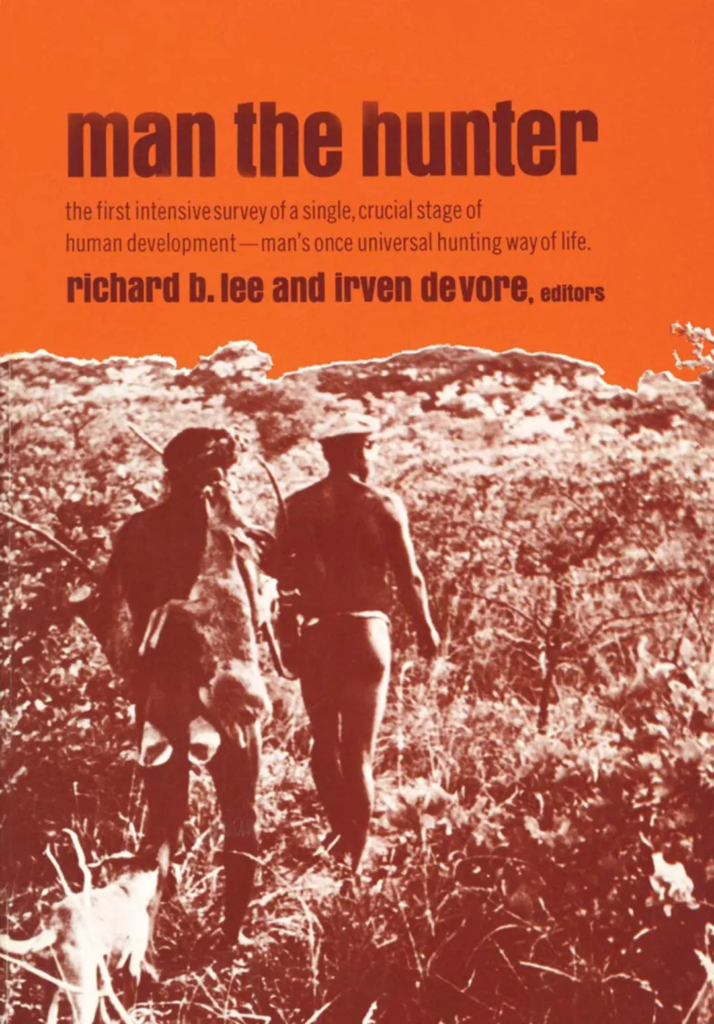
In quieter academic settings, however, a second meaning of Man the Hunter was taking shape. In April 1966, the University of Chicago hosted a conference that gathered many of the anthropologists then working with contemporary hunter-gatherer societies. The organisers, Richard Lee and Irven DeVore, had both been trained in an intellectual world shaped by Washburn. Their question was broad: what could living foraging societies, understood cautiously and comparatively, tell us about human evolution?
The conference later became famous as a turning point in hunter-gatherer studies. Claude Lévi-Strauss, delivering the keynote address, remarked that he barely recognised the younger generation assembled before him. The age bracket had changed. So had the field. Participants debated hunting, gathering, violence, band organisation, food-sharing, residence, childcare, gender, mobility and work. Rather than simply affirming male hunting as the engine of everything, the conference helped open a more complex picture of forager life.
Women’s gathering emerged as central to subsistence. Plant foods were taken seriously. Male-centred bands no longer looked like a universal ancestral norm. Marshall Sahlins advanced the famous idea of the “original affluent society”, arguing that hunter-gatherers often worked fewer hours than agricultural and industrial peoples. Many assumptions inherited from older evolutionism were unsettled.
The irony is that the conference was called Man the Hunter. Sol Tax, a University of Chicago anthropologist who helped initiate the event, suggested the title to Washburn. Lee later recalled worrying that a title putting “man” and hunting at the centre would provoke feminist criticism and misrepresent the volume’s contents. Washburn dismissed the concern. The title stayed. Its consequences lasted.
Naming matters in science. A title can outlive the nuance of the work it names. The volume Man the Hunter, published in 1968, contained a richer and more varied set of arguments than the phrase suggests. Yet the phrase itself was too vivid to remain merely bibliographic. It became easy to treat the conference as if it had solemnly endorsed the popular myth, when in fact much of the research presented there complicated that myth.
Washburn himself contributed to the confusion. Although he did not deliver a paper at the conference, he later co-authored a chapter for the volume titled ‘The Evolution of Hunting’. There he argued that human intellect, emotion, interests and social life were, in a very real sense, products of the hunting adaptation. That sentence sounds close to Ardrey. Both men centred hunting, imagined men as primary hunters, and treated violence as biologically significant.
The resemblance, however, hides a crucial difference. Washburn was a scientist of method. Coming of age during the modern evolutionary synthesis, he helped push physical anthropology away from racial typologies and toward variation, hypothesis testing, evolutionary process and comparative evidence. His programme, often called the new physical anthropology, transformed the field. He did not merely tell stories about fossils. He asked how claims about human origins could be tested.
Ardrey rejected much of that caution. He distrusted the use of contemporary hunter-gatherers as comparative evidence, arguing that they were too altered by history, culture and technology to illuminate earlier phases of evolution. He preferred comparisons with wolves, primates and imagined precultural ancestors. In his view, contemporary foragers were not windows into the past but evolution’s losers.
Washburn saw matters differently. Contemporary hunter-gatherers were not living fossils, but they were not irrelevant either. They offered imperfect, historically situated, comparative data. Their lives could not be read as direct survivals of the Palaeolithic, but neither could human evolution be reconstructed from bones and animal analogies alone. The 1966 conference aimed to bring ethnographic evidence into evolutionary discussion without pretending that the present simply preserved the past.
The real divide was not between hunting and gathering, but between mythic certainty and scientific revision.
Professional anthropologists largely dismissed Ardrey. To them, he treated culture as a superficial layer covering a deeper animal truth. Anthropology had spent decades showing the opposite: culture was not decoration added to human nature. Culture was part of human nature. Marshall Sahlins criticised African Genesis for ignoring the accumulated anthropological evidence of human behaviour. Edmund Leach thought Ardrey’s The Territorial Imperative was best left alone. Washburn called Ardrey a populariser of data he did not understand.
Their irritation was not academic jealousy. It concerned the difference between a theory that can change and a myth that only recruits evidence. Washburn’s hunting hypothesis could be revised, challenged, narrowed, corrected or replaced. He made speculative claims, some of which now look wrong, but they belonged to a scientific practice in which disagreement could matter. Ardrey’s vision was less flexible. Contradictory evidence rarely disturbed its architecture. Criticism from anthropologists became proof that the establishment could not face the truth.
That difference can be seen in their legacies. Washburn trained students who went on to shape primatology, biomechanics, palaeontology, archaeology and evolutionary anthropology. His intellectual descendants helped build research programmes that tested hypotheses, gathered field data and revised assumptions. Ardrey’s legacy flourished elsewhere: in popular science, film, political rhetoric and cultural common sense. He shaped not research so much as imagination.
A third meaning of Man the Hunter developed from the research inspired by the 1966 conference and its aftermath. Lee and DeVore wrote that the conference raised more questions than it answered. That was its strength. It helped create hunter-gatherer studies as a distinct field and encouraged systematic research on foraging economies, social organisation and ecological variation. In the 1970s and ’80s, these efforts contributed to human behavioural ecology, an approach concerned less with grand origin myths than with how people make decisions under ecological constraints.
Within this research tradition, hunting became one part of a broader pattern. Human beings are cooperative, flexible foragers whose diets often include risky, high-value foods and more reliable gathered foods. Meat matters, but not alone. Hunting can provide calories, status, alliance, sharing opportunities and social signalling. Gathering can provide stability, daily nutrition and economic centrality. Childcare, cooking, knowledge of landscapes, tool use and cooperative networks all matter. No single activity explains humanity.
Fieldwork across many societies revealed a recurring pattern: men tend to hunt, and women tend to gather. The word tend is essential. Women do hunt in many societies, sometimes regularly, sometimes under specific conditions, sometimes with particular weapons or prey. Men gather too. Children forage. Older people contribute knowledge and labour. Variation is everywhere. Still, a gendered division of labour appears often enough to require explanation.
Earlier scholars sometimes interpreted this division through assumptions about female dependence or male dominance. Women were imagined as constrained by reproduction, tied to domestic space, waiting for men to bring meat. Contemporary anthropology rejects such simple stories. Women are economic actors pursuing strategies under constraints and opportunities. Pregnancy, lactation, childcare, risk tolerance, mobility, prey type, technology, cooperation and local ecology all shape who does what.
Risk is central. Hunting large animals is often high variance: it can produce a great deal or nothing. Gathering and small-scale foraging may be more reliable. In many contexts, reproductive and childcare responsibilities make extremely risky foraging less attractive for women on average, while men may gain social benefits from high-variance hunting success. Such explanations are not moral claims. They do not say what men and women should do. They describe patterns that vary across environments and histories.
Against this background, recent announcements that women hunted can feel scientifically less revolutionary than publicly advertised. Women’s hunting has never been impossible within serious anthropology. Nor does evidence of women hunters alone demolish the existence of gendered divisions of labour. It complicates caricatures. That is valuable. But caricatures are not the same as the research tradition.
The problem, then, is not that the old model is being questioned. It should be. The problem is that the object being killed is often a composite creature: part Ardrey, part Washburn, part Kubrick, part conference title, part internet masculinity, part outdated anthropology, part real ethnographic pattern. A single phrase gathers them all, and the debate proceeds as though they were one beast.
When recent scholars describe Man the Hunter as the claim that early males banded together to kill animals while females stayed home, they are often describing Ardrey’s cultural afterlife more than the content of the 1966 conference. When they say the term was coined at a conference and then promoted in an edited volume, they risk assigning to the academic event the modern connotations that popular writers and filmmakers did much more to spread. The history becomes too neat: sexist science invented a myth; new evidence corrected it.
A more accurate history is less satisfying. Sexist assumptions did shape science. Hunting was overemphasised. Women’s labour was undervalued. Domesticity was projected backward. Yet the most enduring popular image of Man the Hunter came through narrative, cinema and cultural politics as much as through academic anthropology. Meanwhile, the conference called Man the Hunter helped generate research that undermined many of the very assumptions its title now seems to announce.
Language is part of the trouble. Scientific phrases are not neutral containers. They carry metaphors, images, moods and politics. “The selfish gene” has had a similar fate: a phrase useful in one technical context becomes, in public, a theory of moral life. Man the Hunter works even more powerfully because it names both an activity and a protagonist. It makes the male hunter appear as the central character in the human story before the evidence has even begun.
Man the Hunter survives because it is not a hypothesis so much as a title searching for evidence.
That is why public debate can become so unstable. One person uses Man the Hunter to mean Ardrey’s killer ape. Another uses it to mean Washburn’s hunting hypothesis. Another means the 1966 conference. Another means the empirical observation that men often hunt in foraging societies. Another means patriarchal ideology in general. Agreement and disagreement then miss each other. Evidence against one meaning is treated as evidence against all.
Media coverage amplifies the instability. Stories announcing the death of Man the Hunter are attractive because they reverse a familiar image. The old caveman loses his spear; the woman hunter steps forward; patriarchal science is exposed. There is truth in the correction, and such stories can help undo lazy assumptions. But they also keep the original phrase alive. Every declaration of death repeats the name. Every debunking reanimates the myth.
Popular culture is better at remembering pictures than qualifications. Kubrick’s bone-wielding ape, Brooks’s caveman, Paleo masculinity, the hunter father returning with meat — these remain more vivid than the methodological details of hunter-gatherer studies. Science proceeds through distinctions. Myth survives by dissolving them. Man the Hunter can move between the two because it has the shape of science and the force of a story.
The Ardrey-Washburn contrast shows how this happens. Both wrote about hunting. Both were men of their time. Both made claims that later research has complicated. Yet one produced a myth of human nature resistant to correction; the other helped build a scientific programme capable of revising itself. When we treat them as parts of the same ideological block, we miss the difference between bad evolutionary storytelling and imperfect but productive science.
Such distinctions matter because critique itself can become mythic. To say that Man the Hunter has been dismantled may feel emancipatory, but if the phrase has several meanings, the claim is imprecise. Has the killer-ape myth been discredited? Yes, scientifically. Does hunting explain all of human evolution? No. Did the 1966 conference simply promote male-centred evolutionary ideology? Not really. Do men tend to hunt more than women in many foraging societies? Often, yes. Do women hunt in many societies, and has their labour been underestimated? Also yes.
Holding these claims together is less rhetorically satisfying than declaring victory over an old monster. It is also better science. Human evolution did not have one engine. Foraging societies do not have one gender pattern. Culture does not float above biology, and biology does not dictate culture. Hunting mattered, gathering mattered, childcare mattered, cooking mattered, tools mattered, cooperation mattered, ecological variation mattered, and stories about all these things mattered too.
Perhaps the deeper lesson is that origin stories are never only about the past. They tell us what we wish to naturalise in the present. Ardrey’s killer ape made mid-century violence feel ancient. Manosphere fantasies use prehistoric hunting to bless contemporary gender hierarchy. Some contemporary reversals, in turn, may seek a different Palaeolithic in which women hunters redeem the past from patriarchy. The desire is understandable. But the past does not exist to comfort our politics, even when our politics are better than the myths we oppose.
Anthropology’s task is not to replace one cartoon with another. It is to make human variation harder to flatten. Some women hunted. Many men gathered. Some societies organised labour flexibly; others marked it more sharply. Hunting could be subsistence, status, cooperation, courtship, obligation or risk-taking. Gathering could be expertise, economy, childcare-compatible labour, social knowledge and ecological intelligence. The human story is not a single scene on a windswept plain.
Returning to Kubrick, one can now see why the image remains so powerful and so misleading. The bone-to-satellite cut works because it compresses evolution into an elegant line: weapon, tool, technology, space. But human evolution was not a line. It was a branching, uneven, ecological, social and cultural process. It involved grandmothers, children, plants, fire, stories, camps, hands, stomachs, alliances, landscapes, and forms of attention no single cinematic gesture can contain.
A better image might not be an ape smashing bones, but a camp at dusk: children learning where food comes from; women and men returning with different resources; old people telling stories; meat being shared; tubers roasting; tools repaired; conflicts negotiated; infants carried; knowledge passing in glances, jokes, corrections and songs. Hunting may be present. Violence may be present. But neither owns the scene.
To hunt Man the Hunter, then, is not to deny hunting. It is to track a phrase through the territories it has occupied: fossil interpretation, popular science, cinema, academic conference, feminist critique, behavioural ecology, media headline and political fantasy. The quarry is not prehistoric man. It is the modern habit of turning partial evidence into a total story.
The phrase will probably return. It is too memorable not to. Some new discovery will be announced; some old assumption will be challenged; some headline will declare that Man the Hunter has finally fallen. When that happens, the useful question will not be whether the phrase is alive or dead. It will be: which Man the Hunter are we talking about?
Only then can the science proceed without carrying more myth than it knows. Only then can the public debate distinguish between evidence, metaphor and inheritance. And only then can we stop mistaking the shadow thrown by a bone in a famous film for the shape of human evolution itself.