





Pain is often imagined as something the face must confess. A twisted mouth, a tightened brow, a body folding inward: modern viewers are trained to look for suffering where flesh visibly fails to master itself. In the gold mosaics of the Zen Chapel vault at Saint Mark’s Basilica in Venice, however, the evangelist Mark is dragged across rocky ground by rope and chain, and his face gives almost nothing away. The violence is clear. The body is in danger. Yet the saint does not cry out.
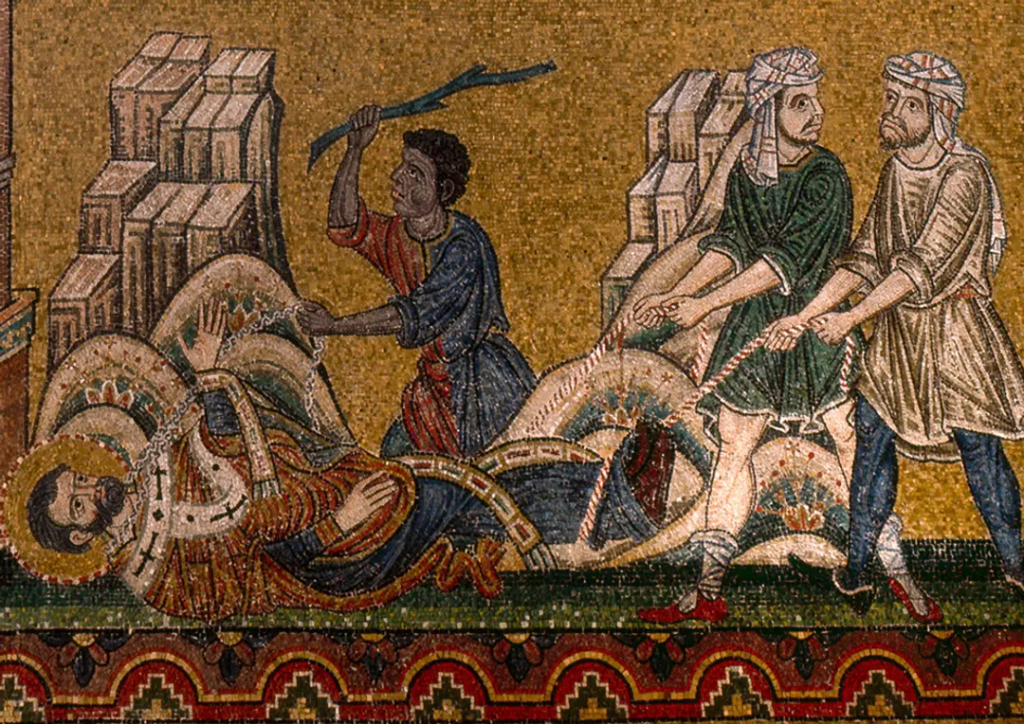
Mark’s martyrdom, detail from the Zen Chapel, Saint Mark’s Basilica, Venice, Italy
Around him, other figures labour. Two men pull the rope near his feet and glance toward one another, their bodies angled into effort. Near Mark’s head, another figure raises a stick, his arm suspended at the threshold of impact. The scene is full of strain, direction and threat. Mark alone remains composed. One hand lifts slightly, not quite warding off the blow, not quite blessing, not quite surrendering. The gesture hovers between action and acceptance.
Medieval martyrdom images were not designed to show suffering as modern realism imagines it. They were designed to show sanctity under assault. The saint’s stillness was not an absence of pain but the sign of a body ruled by faith. The refusal to scream mattered because it reversed the ordinary order of flesh. Pain might act upon the body, but it could not command the saint. Silence became proof. Composure became victory.
If Mark’s suffering is not located in his face, the viewer must find it elsewhere. It is displaced into the bodies around him: into arms that pull, ropes that tighten, sticks that rise, glances that register confusion or force. The scene distributes violence across a visual field. One body receives and spiritualises pain. Other bodies enact it. The mosaic does not merely narrate an event. It assigns functions.
That assignment is crucial. Medieval images often worked through repeated bodily roles: the composed martyr, the threatening captor, the converted witness, the pagan ruler, the torturer, the executioner. Over time, such roles could harden into visual expectation. What begins as a narrative function starts to look like a bodily quality. The saint does not simply behave serenely; serenity appears to belong to his flesh. The executioner does not simply perform violence; violence appears to inhabit him.
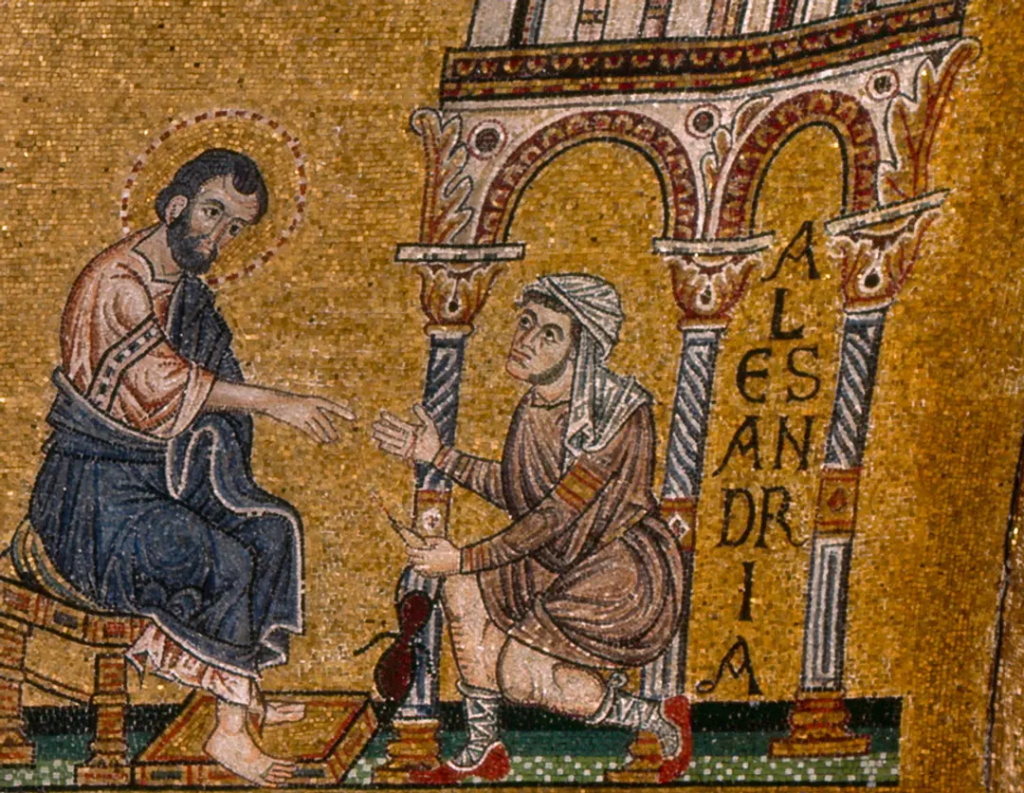
Mark with the cobbler Anianus, detail from the Zen Chapel, Saint Mark’s Basilica, Venice, Italy
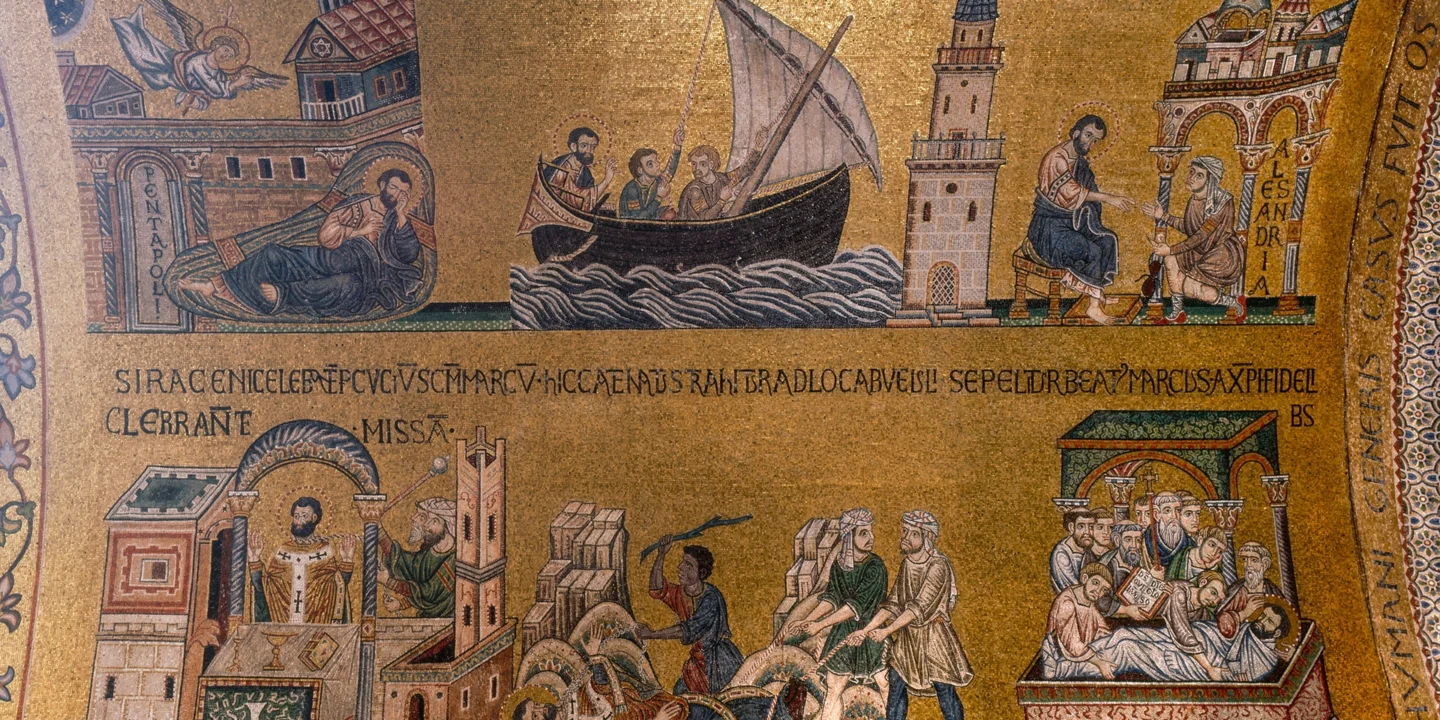
The Zen Chapel mosaics, created in the mid-13th century, narrate the Life of Saint Mark. The cycle moves from divine election to missionary travel, miracle, arrest, martyrdom and burial. Mark journeys to Alexandria in Egypt, heals the cobbler Anianus, is arrested during Easter Mass, dragged through the streets of Baucalis, and finally entombed by monks and clergy. Throughout the sequence, Mark’s body organises the story.
At first, the saint appears in repose while an angel approaches. His garments fall in ordered folds around him, and his resting body is already marked as chosen. Before he speaks, heals or suffers, the image distinguishes him as a figure through whom divine purpose will move. The body is not merely a container for holiness. It is the place where holiness becomes visible.
Later, Mark stands in a small boat bound for Alexandria. His hand rises in blessing, fingers extended in a gesture that will echo through the cycle. When he reaches the city and encounters Anianus, the wounded cobbler, the gesture becomes active. Mark points toward the cobbler’s injured hand, and the miracle takes place in the charged space between them. Touch, proximity and gesture carry sacred power.
In the lower register, Mark stands inside a church, hands raised, at the moment before violence overtakes him. Even there, his body is an axis. Others move around him, but he holds the centre. In the following scene, as he is dragged to his martyrdom, violence is directed against this body without visibly undoing it. No blood marks him. No bruise disfigures him. No grimace breaks his face. The same body that blessed and healed now endures. Its continuity is the point.
The final image of Mark’s entombment completes the visual argument. His body lies enclosed and preserved, framed by architecture and attended by clerical figures. Martyrdom has not scattered him. It has confirmed him. The saint’s body remains intact enough to become relic, foundation and proof. In Venice, where Saint Mark’s body was central to civic and sacred identity, such preservation mattered politically as well as devotionally. The cycle secures the claim that sanctity resides here, in this body, in this church, in this city.
Yet Mark’s centrality requires other bodies to perform the work of contrast. His composure means little without the surrounding animation of aggression. His sanctity becomes legible because other figures strain, bind, pull and threaten. The image needs violence in order to show faith overcoming it. It therefore needs bodies to carry that violence.
At the centre of the martyrdom scene stands a Black would-be executioner. He is visually arresting, the only Black figure in the composition, and he occupies the most charged position in the scene. His arm is raised to strike. A chain or rope is drawn around Mark’s neck. His body concentrates the imminent act of harm. The blow has not yet fallen, but the image has already lodged violence in him.
This figure was not invented at San Marco. By the 13th century, the Black executioner had become a recognisable type in Western European art. He appears in Passion scenes, martyrdom images, Old Testament narratives and legal or royal episodes. Often he performs the physical act that others command. A ruler judges, a crowd demands, a saint endures, but the Black executioner’s body is made to carry the final force. Violence is authorised elsewhere and embodied in him.
In the San Marco mosaic, that routing is especially precise. The executioner’s weapon is lifted but halted. According to the written narrative of Mark’s life, the air suddenly turns turbulent through divine intervention, interrupting the martyrdom. The executioner looks upward, exposed to the sacred event. His glance registers the interruption. Yet the suspended blow does not clear him of the violence assigned to him. On the contrary, suspension intensifies his role. He remains forever on the verge of striking.
The contrast between Mark and the executioner is therefore not merely expressive. It is structural. Mark absorbs force into stillness; the executioner externalises force through movement. The saint’s body transforms violence into testimony. The Black executioner’s body makes that violence visible before it is transformed. The scene depends upon this asymmetry. Without the raised arm, Mark’s composure would have no trial through which to prove itself.
The image does not simply show violence; it decides which bodies will be asked to carry it.
Two other figures participate in Mark’s dragging. Their headgear marks them as Muslims, identified in the accompanying text as “Saracens”, a derogatory medieval term that racialised Muslims within Christian imagination. Similar figures appear in the earlier arrest scene, where they enter the church aggressively. One raises a baton. Another holds a rope tied around Mark’s neck. Their gestures anticipate the later martyrdom: the raised arm, the restraint of the saint, the conversion of a sacred body into a captive one.
Yet in the martyrdom itself, their role is carefully limited. They pull and bind, but they do not deliver the decisive blow. They stand nearer Mark’s feet than his face and hand, farther from the most spiritually charged region of his body. When the air turns turbulent, they look toward each other in confusion rather than fury. The most intimate violence — the chain at the throat, the weapon poised near the head — has shifted to the Black executioner.
This distribution matters. It creates gradations among Mark’s persecutors. The Muslim captors threaten and restrain. They are agents of hostility, but not the final bearers of lethal force. The Black executioner, by contrast, is positioned as the focal point of bodily harm. The scene thus differentiates adversaries. Some are dangerous but still narratively available for transformation. Another is made to hold violence more completely.
The distinction is illuminated by the earlier scene of Anianus. When Mark arrives in Alexandria, he heals the wounded cobbler, whose headgear connects him visually to the Muslim figures below. The miracle occurs through contact or near-contact between hands: Mark’s sacred gesture and Anianus’s injured body meet within a charged space. In the written Life, Anianus marvels at the miracle, invites Mark into his home, and is baptised with his household. The image does not show conversion directly, but it prepares the viewer for it. The wounded outsider can be touched, healed and brought within Christian order.
The martyrdom scene inherits this possibility. The lighter-skinned Muslim figures are violent, but their violence is restrained. Their bodies remain within a visual economy of potential conversion. They bind the saint, but they are not made to enact the ultimate blow. Their role allows them to be enemies without becoming the image’s purest embodiment of harm. That burden falls elsewhere.
The art historian Suzanne Conklin Akbari has shown that medieval romances often distinguished between lighter-skinned Saracens who might be assimilated and darker or Black Muslim figures who were represented as unrecoverable. The San Marco martyrdom operates within a similar logic. By assigning the imminent execution to the Black African figure, the image offsets some of the culpability of the lighter-skinned Muslim captors. Their violence remains real, but it becomes less final. They may still be imagined as reachable. The Black executioner becomes the point against which their relative assimilability is measured.
Such a system does not require explicit theory to operate. It works visually. The viewer sees bodies placed in relation to one another and learns to compare them. The saint’s white or light body is composed, central and sanctified. The lighter-skinned Muslim figures are hostile but potentially transformable. The Black executioner is isolated as the bearer of lethal force. A hierarchy of bodies is produced through narrative placement.
Still, the executioner is not entirely outside the sacred field. His upward glance matters. The divine turbulence interrupts him, and he responds. Mark’s raised hand extends in the direction of the heavens but also toward the space of the executioner’s weapon. If the stick were to fall, it would meet the saint’s hand. The potential point of contact recalls, uneasily, the earlier miracle between Mark and Anianus. There, sacred power passed across the space between hands. Here, the space between saint and executioner is wider, more dangerous, but not empty.
That ambiguity is one of the scene’s most revealing features. The visual system assigns roles, but it also exposes their constructedness. The executioner is made to concentrate violence, yet he is also shown at the instant when violence is halted by divine intervention. He looks upward. He is touched by the event, if not by the saint. The image wants him to be the locus of harm, but the interruption makes him momentarily more than that role. He is both fixed and unsettled.
The mosaic cycle at San Marco thus does more than represent religious history. It teaches viewers how to sort bodies. Mark’s body is a channel of grace, endurance and legitimate sacred authority. The Muslim figures are adversaries whose violence remains within the horizon of possible conversion. The Black executioner becomes the site where harm gathers most intensely. Through this arrangement, the image gives moral qualities a bodily location.
Repetition turns narrative labour into bodily essence.
This pattern was not confined to Venice. Across medieval manuscripts, frescoes, sculptures and portals, saints often remain composed under torture, while adversaries strain with animated aggression. Darker bodies are repeatedly assigned concentrated force. The Black executioner appears in Passion images, martyrdom scenes and Old Testament narratives. Each appearance is local, but together they form a visual habit.
At Chartres Cathedral, on the west portal of the north porch, a darkened executioner appears in the scene of Solomon’s judgment. Two women claim the same child. To reveal the true mother, Solomon orders that the infant be cut in half. The executioner stands ready to unsheathe his sword. Solomon’s wisdom and authority remain intact, while the brutality of the potential infanticide is displaced onto the executioner’s body. As Jacqueline Lombard has argued, the selective use of black polychromy marks him as the place where violence resides. He is, quite literally, darkened by the deed.
Such examples accumulate. No single image creates the association between blackness and lethal agency. Repetition does the work. Across media and centuries, the Black executioner becomes a mobile type. He appears where a scene needs violence to be enacted but also contained. He allows rulers, saints and institutions to remain legible in their proper roles: the judge wise, the martyr holy, the community outraged, the executioner brutal.
A similar logic shapes representations of Muslim figures in medieval hagiography and romance. They often occupy an intermediate zone: threatening yet redeemable, adversarial yet potentially convertible, foreign yet available to Christian narrative closure. Their otherness has narrative work to do. It must dramatise conflict without always foreclosing assimilation. The Black executioner performs a different task. He concentrates violence so that other adversaries may remain more flexible within the story.
In this sense, medieval images do not merely reflect prejudice; they organise it. They do not simply say that some bodies are holy and others dangerous. They stage events in which holiness, violence, conversion and authority are repeatedly routed through particular bodies. Over time, viewers may stop seeing the routing. The body appears to possess what the narrative has assigned to it.
This is the subtle violence of visual convention. The executioner does not appear to be playing a role; he appears to be what the role requires. The saint does not merely enact composure; composure seems native to him. The Muslim captor does not simply occupy a narrative middle ground; his body appears to signify partial danger and partial recoverability. Staging becomes attribute. Attribute becomes expectation.
Once expectations become habitual, perception becomes anticipatory. The eye arrives before the evidence. A body is seen not as an unknown presence but as a familiar category waiting to be confirmed. The viewer does not have to reason consciously from image to judgment. Recognition feels immediate. That is precisely why it is powerful.
Medieval devotional art trained viewers in this kind of recognition. It had to. Its purpose was not neutral observation. It taught the faithful who was holy, who was hostile, who was redeemable, who was dangerous, who possessed authority and who threatened it. Bodies were never blank. They entered the image already charged by theology, politics, geography and race-making.
Our own visual culture is less gilded, but it is not free of such training. We prefer to imagine seeing as passive reception. The eye simply records what stands before it. Yet recognition is guided by inherited patterns. We do not only see. We have learned what to look for, whom to fear, whom to trust, whose pain to believe, whose presence to scrutinise and whose movement to interpret as threat.
A teenager walking home in a hooded sweatshirt can become suspicious before he has done anything. A man at an airport can become a security concern before he speaks. A protester can be read as violent before raising a hand. A Black driver can be stopped because presence, place and expectation have already converged into suspicion. In each case, judgment moves faster than evidence. The body appears to confirm what the culture has rehearsed.
This does not mean that medieval mosaics directly caused modern racial profiling. Historical continuities are not so simple. The San Marco executioner and contemporary policing belong to different institutions, technologies and epistemic worlds. But both reveal a shared mechanism: roles become attached to bodies through repeated acts of representation, classification and interpretation. Once attached, they feel like perception rather than history.
When recognition comes too quickly, it often carries the memory of older arrangements.
Modern security regimes show how anticipatory seeing becomes institutional. In 2004, the FBI wrongfully identified the Oregon lawyer Brandon Mayfield as a suspect in the Madrid train bombings. The error began with a faulty fingerprint match, but it was reinforced by an interpretive frame in which Mayfield’s Muslim faith and military experience made him appear plausible as a threat. Biometric evidence seemed objective, yet the meaning of the match was shaped by assumptions about which bodies and affiliations fit the story.
Simone Browne and other scholars of surveillance have shown that biometric systems are often treated as neutral or infallible even though they are designed, calibrated and interpreted within unequal social worlds. A fingerprint, face scan or database flag does not float above culture. It enters systems already organised by histories of race, suspicion, policing and state power.
The same problem appears in facial-recognition technologies, which have been shown to misidentify darker-skinned people at higher rates than lighter-skinned people in many commercial systems. Predictive policing programs repeatedly target neighbourhoods already marked as risky. Large-scale image and language models absorb patterns from the data on which they are trained, including the associations, distortions and stereotypes embedded in digital culture. Artificial intelligence does not invent these habits of seeing. It accelerates, stabilises and scales them.
Machine learning systems operate differently from mosaics. They do not compose saints and executioners in gold. They detect correlations, classify inputs, generate predictions and sort cases. Yet they too distribute expectation. A model trained on biased histories may learn that certain faces, names, neighbourhoods, accents or affiliations belong nearer to danger than others. The violence is no longer arranged by hand in a sacred image. It is compressed into statistical form.
That compression can make bias harder to see. A medieval viewer could look at the San Marco mosaic and observe the raised arm, the darkened body, the rope, the saint’s calm face. A modern algorithmic system may bury its associations inside weights, training data and thresholds. The visual field becomes technical. The old question remains: who is made to carry danger before any encounter has occurred?
To acknowledge the continuity is not to claim equivalence. Medieval Christian art and contemporary artificial intelligence do not share the same purposes, materials or theories of knowledge. One serves devotion and imperial theology; the other serves prediction, automation and institutional efficiency. Still, both show how classification can become naturalised when repeated often enough. Both remind us that the category is never innocent simply because it appears useful.
The danger lies not in classification as such. Human perception requires pattern. Institutions require categories. Law, medicine, education, security and social life all depend on making distinctions. The question is what happens when distinctions inherit violence and then present themselves as neutral recognition. At what point does a pattern become a presumption? When does a correlation become a character judgment? When does a role assigned by history become a quality imagined to belong to the body?
Medieval images can help us ask these questions because their arrangements are visible. The saint, the captor, the convert and the executioner are placed before us with almost diagrammatic clarity. We can see the labour of distribution. We can see who is allowed composure, who is granted possible transformation, who is made to embody harm. The very distance of the image helps expose the mechanics of perception.
Modern systems are more difficult because they often deny that they are interpretive at all. A database match, risk score or automated flag can appear as fact rather than judgment. But every system that recognises also inherits a world of prior recognitions. Data is not raw experience. It is the residue of previous categories, previous institutions, previous fears, previous exclusions. To train a system on such data is to risk turning history into prediction.
The Black executioner at San Marco therefore matters not only as a medieval racial type but as a lesson in how visual orders work. He shows how violence can be outsourced to a body so completely that the body begins to seem violent by nature. He shows how the innocence or sanctity of one figure may depend on another figure absorbing the sign of harm. He shows how an image can preserve the possibility of conversion for some by concentrating unrecoverability in another.
He also shows that such arrangements are never entirely stable. The halted blow, the upward glance, the echo of Mark’s healing gesture — these details interrupt the neatness of the system. They do not redeem the image. They do not undo its racial logic. But they reveal that what appears inevitable has been staged. The executioner has been placed there. The blow has been suspended. The role has been assigned. Arrangement is not destiny.
Seeing differently may begin with noticing arrangement. Noticing does not purify the eye. It does not erase inherited categories or make perception innocent. But it can create a pause between recognition and judgment. It can make visible the work that repetition has hidden. It can remind us that what feels immediate may be the afterlife of long training.
The mosaics at San Marco glitter with gold, but their deepest lesson is not brilliance. It is instruction. They teach viewers where to locate grace, where to locate danger, where to imagine transformation and where to expect violence. Our own images and systems teach similar lessons, often in less sacred and more bureaucratic forms. The task is not to pretend that we can see without categories. It is to ask which categories have been handed to us, whom they serve, whom they endanger, and how quickly they turn encounter into verdict.
At the moment of Mark’s martyrdom, the executioner’s arm is still raised. The blow has not yet fallen. The saint’s hand reaches upward. The air has turned turbulent. The scene holds itself in suspension. That suspension is the image’s most unsettling gift. It shows violence before it becomes completed action, and recognition before it hardens entirely into fate.
What appears inevitable, the mosaic reminds us, is often arranged. And what has been arranged can, at least for a moment, be seen as arrangement.