









Does reading make us better? The question returns with suspicious regularity, as though books were a medicine whose effects had to be periodically tested. Do novels enlarge sympathy? Do poems refine judgment? Does the habit of reading make citizens more humane, more subtle, less easily manipulated? Or is this merely the flattering superstition of people who read?
Marcel Proust answered with characteristic perversity. In 1905, before he had become the author of In Search of Lost Time, he wrote an essay called On Reading in which he denied that books make us morally better in any simple or respectable sense. Reading, he insisted, had never given him useful instruction of the kind teachers, reformers or moralists wanted to claim for it. It had not improved him as a civic being. It had not supplied maxims for living.
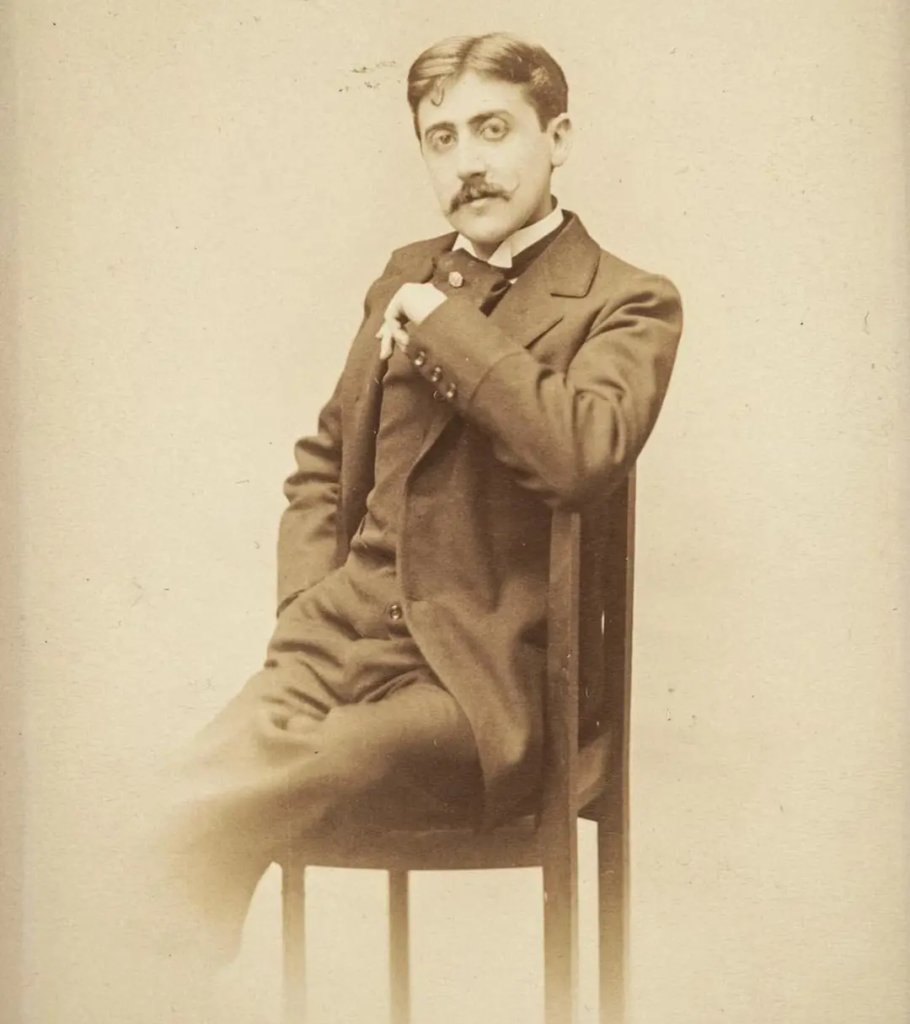
Marcel Proust by Otto Wegener, c1895. Courtesy Wikimedia
Yet the denial was not a dismissal. Books had mattered to him intensely. They had preserved sensations that would otherwise have vanished: rooms from childhood, relatives long dead, weather, boredom, expectation, the particular feeling of being alone with a book while the surrounding world quietly entered the act of reading. Literature did not give him rules. It made time tangible. It allowed the past to remain available without pretending that it could be restored.
From the vantage point of literary history, it is tempting to read On Reading as a small prelude to Proust’s great novel, a rehearsal for the vast inquiry into memory, time and perception that would follow. But the essay was not written in isolation. It appeared as the preface to Proust’s French translation of John Ruskin’s Sesame and Lilies, a work whose earnest defence of reading Proust both admired and resisted. Translation became argument. Proust had to enter Ruskin’s sentences in order to discover why he could not accept their moral confidence.
Ruskin, speaking in Manchester in the 1860s, had lamented the spiritual impoverishment of Victorian Britain. Everything, he thought, had been infected by the demand that it should “pay”. Education was increasingly valued as a route to advancement, social polish or profitable association. Reading had become another instrument of worldly calculation. Against this, Ruskin defended literacy as a discipline of attention, humility and disinterestedness. To read well was to submit to the chosen words of another mind and allow their seriousness to correct one’s own superficiality.
His diagnosis was severe. Many people could decode print, but that did not make them truly literate. They read quickly, socially, vainly, for recognition among peers, without the patience required to understand either a writer or an important question. Ruskin therefore imagined a different society, one that would maintain “armies of thinkers” instead of armies of stabbers. Books, properly read, could become a civic resource, a defence against coarseness and violence.
Still, Ruskin could not entirely escape the utilitarian language he criticised. He tried to persuade his audience by describing reading as the better investment. The wealthy and ambitious sought contact with powerful people, but such encounters were unreliable. A politician might be rushed, a journalist vain, a great man irritable or dull. A book, by contrast, offered access to the strongest minds in a more dependable form. The library became a treasury in which the wisdom of the dead waited patiently for the living.
Proust found this image false to the experience of reading. Books were not recommendation letters to the great. They did not introduce us into an elevated society of superior minds. Reading was not conversation improved by immortality. Social conversation always contains pressure: politeness, status, timing, embarrassment, the need to respond. Reading frees us from that pressure. We may find a great writer boring. We may love a minor passage for private reasons the author never intended. We may misunderstand and still be changed.
What reading offers, then, is not moral elevation but a strange kind of solitude shared with another. Proust called it a “fruitful miracle of communication in the midst of solitude”. The phrase is important because it refuses both isolation and instruction. In reading, we are not simply alone, but neither are we being commanded. Another mind has left marks that awaken our own. The writer does not hand us truth; the writer provokes our capacity to make sense.
This is the point on which Proust remains most useful. Reading does us good, if it does, not because books contain moral nutrients that enter us automatically. It does us good because it preserves a space in which meaning is neither dictated nor instantly consumed. It trains a kind of inward freedom: the freedom to linger, to misread fruitfully, to resist the obvious lesson, to discover that our own experience contains more than the available descriptions of it.
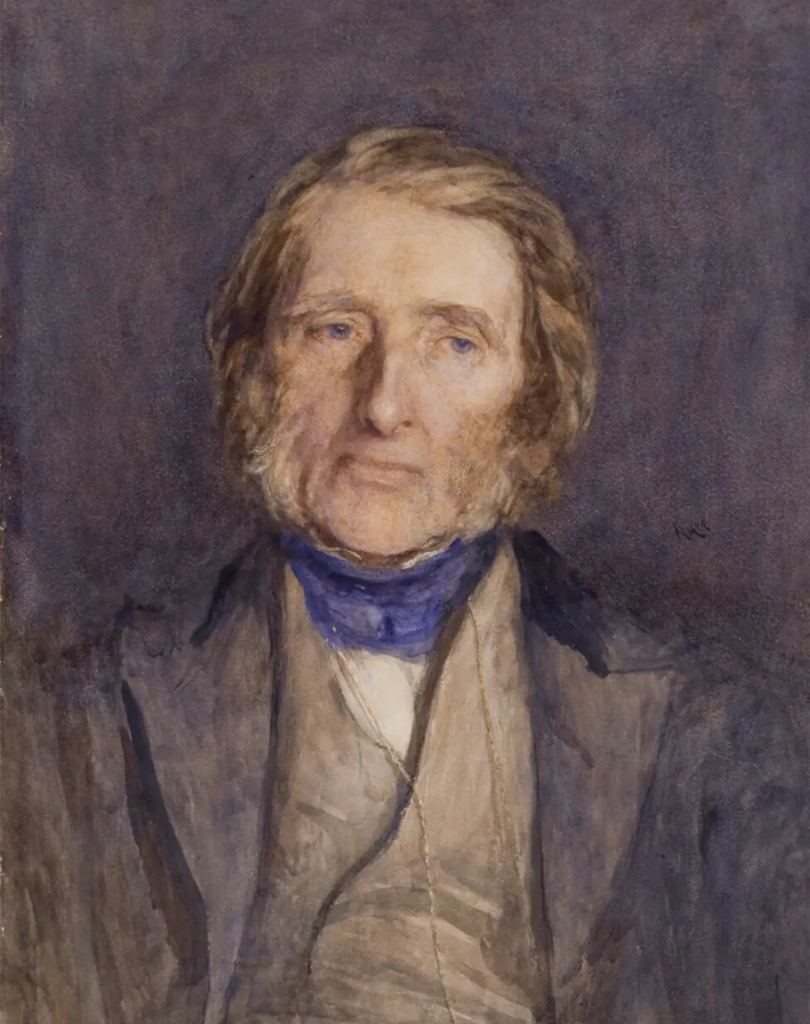
John Ruskin by Sir Hubert von Herkomer, 1879. Courtesy the National Portrait Gallery, London
Reading does not improve us by delivering virtue, but by interrupting the speed with which we accept ready-made meanings.
Proust and Ruskin shared reverence for the written word, but they imagined its power differently. Ruskin placed his faith in writers and books as moral authorities. Proust placed more weight on the reader’s inner life. For him, even mediocre books could matter, because the decisive event was not the greatness of the author but the awakening of the reader’s own powers of sensation and association. A bad book read at the right moment may attach itself to a summer, a house, a voice, a grief, and become inseparable from the texture of a life.
This view does not make reading trivial or purely subjective. On the contrary, it gives reading an ethical seriousness more delicate than moral instruction. The reader must attend, but not obey. The book opens a world, yet the world becomes meaningful only through the reader’s effort. Reading is therefore a training in relation without submission. We enter another’s language while remaining responsible for what happens there.
During much of the later 20th century, Proust’s anti-moralising position seemed to have won within literary studies. Critical movements of many kinds — New Criticism, structuralism, deconstruction, reader-response theory, New Historicism — differed sharply from one another, yet most rejected the idea that literature’s primary purpose was to teach right conduct. Form, language, structure, historicity, textuality, reception and power became more respectable objects of study than edification. To say that reading made people better sounded naïve, sentimental, or insufficiently theoretical.
Public culture, however, never fully abandoned the older hope. Great books continued to promise social ascent, moral seriousness and entry into a broader inheritance. Working-class readers in Britain and elsewhere often used canonical literature not as an academic puzzle but as a route into dignity, self-education and public voice. Grammar schools, public libraries and adult education movements treated literature as a form of cultural citizenship. Even as university criticism became suspicious of moral uplift, many readers continued to experience books as a way of escaping the limits imposed on them.
This split helps explain the later popularity of figures such as Harold Bloom and Allan Bloom. Their defences of the canon reached audiences far beyond the academy because they spoke to a hunger that academic criticism often neglected: the desire to believe that books matter to life, not only to discourse. Their versions of that belief were narrow and often nostalgic, but the desire itself was real. Readers wanted literature to do something.
In the 21st century, moralising has returned with new force. Digital life has made reading seem endangered, and every endangered practice acquires defenders. The decline of sustained attention, the dominance of screens, and the transformation of leisure into scrolling have produced renewed anxiety about what is lost when people stop reading books. The defence of reading now comes from many directions, but it often falls into familiar ideological patterns.
Conservatives praise older books for preserving moral order, beauty and discipline. Progressives criticise inherited canons for exclusion and defend reading as a training in empathy toward marginalised lives. One side worries that young people will lose touch with duty, transcendence and inherited standards. The other worries that they will never encounter sufficiently varied experiences. Both sides assume, in different ways, that books should improve the reader by delivering the right moral content.
The disagreement is real, but the shared premise matters more. Books are treated as processed food for the soul. The question becomes which ingredients they contain: tradition or representation, discipline or empathy, beauty or justice. The reader appears as someone to be nourished, corrected or protected by the proper diet. Literature is valued according to the lesson it is expected to deposit.
This approach flattens both books and readers. Greek myth will disappoint anyone looking for domestic moral stability. Madame Bovary can be read as a warning against romantic escapism, but it can also be read, as Elena Ferrante suggested, as an account of the impossible bind imposed on women trapped within marriage and motherhood. Jane Austen can be treated as an author of social order, but also as a ruthless analyst of dependency, money, humiliation and female intelligence under constraint. The meaning of a book cannot be secured in advance by the moral use to which one wishes to put it.
The same is true of the canon. Its exclusions are real, but literary history has always involved revision, appropriation and reply. New works do not merely ask admission into an old house. They often rebuild the house from within. Kamel Daoud’s The Meursault Investigation reopens Camus’s The Stranger from the perspective of the murdered Arab’s world. Percival Everett’s James returns to Huckleberry Finn through the voice of Jim, forcing a canonical American text to confront the intelligence it had constrained. The answer to flawed inheritance is not only correction. It is creation.
Yet the moralising view remains stubborn because it has deep historical roots. Modern literature inherited from Romanticism the idea that writers have public duties. After the French Revolution shattered old forms of religious and political authority, many thinkers began to imagine the writer as a new kind of spiritual figure. The poet or novelist could replace, or at least rival, the priest: seeing through appearances, speaking to the people, warning of collective danger, articulating the future.
Paul Bénichou described this transformation as the consecration of the writer. Literary authority became a modern substitute for older sacred authority, but with a crucial difference: the writer answered not to a church but to the public. Victor Hugo’s image of the poet as a seer belongs to this tradition. So does the expectation that literature should reveal difficult truths to society. The writer was not merely an entertainer. He was a guide.
The masculine grandeur of that role has often obscured the fact that one of its most sophisticated early theorists was Madame de Staël. In Literature Considered in Its Relation to Social Institutions, published in 1800, she argued that literature was inseparable from politics, religion, customs and law. She believed in the perfectibility of the human species, and she thought fiction could contribute to collective improvement by shaping shared representations. Literature, for Staël, was not ornamental. It helped create the mental conditions of national life.
Her claim was not simply that books teach private morals. Literature sharpened language, and sharpened language prepared citizens for liberty. A democratic society required people capable of thinking and expressing thought beyond slogans, commands and inherited formulas. Literary progress was therefore tied to political freedom. A people incapable of subtle expression would be vulnerable to domination.
Here, Staël gives us something more interesting than Ruskin. She does not treat reading only as exposure to greatness. She sees literature as a practice that keeps language from becoming predictable. In that sense, literature is politically valuable because it gives citizens access to forms of thought not already captured by government, market or fashion. It expands the possible uses of speech.
Literature matters when it keeps language from becoming the servant of power’s most convenient phrases.
Jean-Jacques Rousseau had reached a related conclusion by a darker path. His novel Julie, or the New Heloise became one of the 18th century’s great reading events, moving readers across Europe. But Rousseau, who had made his reputation as a severe critic of civilisation, knew that writing a sentimental love story required justification. In the preface, he stages a dialogue between the author and publisher, asking whether such a book could be proper, useful or morally defensible.
Rousseau’s answer is not simple. He distrusts fashionable readers. Urban elites, he suggests, do not learn from books because they read as another form of social performance. They praise what confirms them, dismiss what unsettles them, and convert literature into an instrument of distinction. For them, reading is rarely educational. It is a way to demonstrate taste.
If literature is to educate anyone, Rousseau argues, it must speak to a different readership: provincial, solitary, less corrupted by fashion, more available to feeling and reflection. He says the writer must “speak the language of the lonely”. The phrase is beautiful because it makes literature neither sermon nor entertainment. It is a civic address to those not fully absorbed by the chatter of power.
Rousseau’s writer is a citizen, not a priest. His task is not to preach virtue in ready-made formulas but to examine the conditions of happiness. Julie does not offer simple moral instruction. Its tragedy unfolds without a villain. The reader must inhabit conflicting claims of love, duty, social expectation and self-command. The novel’s power lies not in telling readers what to think, but in forcing them to feel the cost of every available answer.
Christopher Kelly has called this dimension of Rousseau’s work “literary citizenship”. In a commercial society where language becomes transactional and values are increasingly measured by exchange, literature offers another currency. It can resist both governmental command and market simplification by preserving forms of speech in which social duties are examined rather than merely repeated.
Staël’s optimism and Rousseau’s suspicion thus belong to the same lineage. Both imagine literature as a path to freedom because it interrupts the reduction of language to social utility. Rousseau sees literature struggling against domination that cannot be fully defeated. Staël sees it helping to produce a freer national future. Between them lies a modern belief that written language can enlarge the conditions of citizenship.
The great realist novels of the 19th century inherited this ambition. Dickens, Hugo, Dostoyevsky, George Eliot, Balzac, Tolstoy and others created worlds in which private feeling and public structure could be seen together. Poverty, crime, inheritance, marriage, law, debt, bureaucracy and faith entered the novel not as abstract systems but as lived pressures on characters. Such books did not simply moralise. They allowed readers to recognise their participation in social worlds larger than themselves.
That ambition came at a cost. The writer who claims to speak for a people risks mistaking a partial audience for the whole nation. The novel that seeks to reveal society may reproduce the blindness of its class, gender, race or empire. By the late 19th and early 20th centuries, sociology and psychoanalysis began to take over some of literature’s explanatory authority. Durkheim and Freud offered new ways to understand social facts and hidden desire. Fiction no longer possessed a monopoly on the interpretation of modern life.
This was Proust’s moment. Once literature was relieved of the duty to serve as priest, legislator or sociologist, it could become more faithful to its own powers. Proust did not deny that books affect life. He denied that their value is best understood as moral instruction. Literature, at its strongest, does not guide readers toward a stable heaven of correct opinions. It alters the quality of attention. It teaches us to seek pleasure somewhere other than wellbeing, vanity or social confirmation.
That kind of pleasure is not escapist. It is exacting. To read Proust, Ferrante, Woolf, Baldwin, Morrison, Kafka or Sebald is not to receive a message that can be detached and carried away like a slogan. It is to be drawn into an experience of perception, syntax, hesitation, contradiction and memory. The value lies in the difficulty of reducing what has happened to a lesson.
This difficulty may be literature’s most urgent contemporary use. We live in an environment saturated by images, opinions, headlines, feeds and pre-interpreted emotion. Social media teaches us to respond before we have understood. Advertising teaches desire to speak in borrowed language. Political messaging turns complexity into identification and enemy-making. News formats often compress reality into conflict scripts. The danger is not only that we stop reading books. It is that we lose the habit of dwelling with meanings not already packaged for reaction.
Images, of course, can be profound, subtle and liberating. But images often strike with a speed that leaves less room for resistance. Literary language is slower. It asks the reader to collaborate in forming the scene, the voice, the implication, the doubt. That slowness gives readers space to disagree, to notice ambiguity, to remain partially unpersuaded. It keeps understanding from being identical with impact.
This is why reading can be liberating without being moralising. It does not free us by giving us better opinions. It frees us by loosening the hold of prefabricated narratives. A novel may show that a marriage is not simply happy or unhappy, that a victim is not only a victim, that a criminal is not only a criminal, that a desire may be both humiliating and necessary, that truth may be present without becoming simple. Such experiences train us to distrust explanations that arrive too smoothly.
The freedom reading offers is not escape from the world, but escape from the first story the world tells about itself.
This freedom matters especially when trauma, injustice and identity are turned into consumable formulas. Contemporary culture often demands stories that are clear about harm, recognition and recovery. Such clarity can be politically necessary, but it can also become another cage. Neige Sinno’s Sad Tiger, a memoir about incest, is powerful partly because it resists the conventions of marketed trauma. Sinno has said that fiction was more useful to her than theory because fiction offers oblique, tangential responses through unreal stories. Obliqueness can make room for truths that direct discourse cannot hold.
Literature does not replace politics or therapy. It does not abolish the need for testimony, law, institutions or collective action. But it can reveal how available narratives shape what we are able to notice. It can make us responsible not only for responding to suffering, but for examining the forms through which suffering becomes intelligible. That is a political function deeper than instruction.
Hernan Diaz’s Trust offers a different example. Its four interlocking narratives draw readers into the abstraction of finance by making economic power a problem of form, voice and concealment. The reader must move among versions, noticing how wealth edits reality and how narrative authority is distributed. The novel teaches nothing as simple as “finance is bad”. It trains suspicion toward the stories by which financial power makes itself invisible.
Everett’s James does something similar with literary inheritance. By giving Jim his full name and narrative intelligence, the novel does not merely correct Twain. It reveals the performance of ignorance that survival required. The old text is not cancelled; it is made stranger, more dangerous, less available to comfortable memory. Such rewriting is not moral supplementation. It is an act of interpretive liberation.
The best literature today may therefore do what Proust, Rousseau and Staël, in their very different ways, all sensed: it preserves the freedom of language against its capture. For Rousseau, that meant speaking beyond fashionable corruption. For Staël, it meant preparing citizens for liberty through expressive precision. For Proust, it meant opening the reader’s deepest self through solitary communication. In each case, literature’s good lies less in moral content than in the reconfiguration of attention.
This does not mean that every book is liberating. Many books flatter prejudice, simplify experience, decorate cruelty, or reproduce domination with elegant sentences. Reading by itself is no guarantee of virtue. A well-read person can be vain, cruel, cowardly or foolish. History supplies too many examples to allow comfort on that point. The cult of reading can become another form of superiority.
Nor should we pretend that style is politically innocent. Formal complexity can conceal evasion. Ambiguity can become a luxury. The refusal to moralise may protect aesthetic freedom, but it can also shelter indifference. Literature’s independence from instruction is valuable only if it deepens experience rather than merely escaping responsibility.
The question, then, is not whether reading makes us better people. That is too blunt. Better according to whom, and in what way? More empathetic? Sometimes. More intelligent? Not necessarily. More moral? The evidence is uncertain. What reading can do, at its best, is make us less captive to the meanings handed to us in advance. It can return difficulty to experience. It can keep alive the gap between sensation and slogan.
In that gap, judgment becomes possible. Not judgment as quick verdict, but judgment as a slow activity of comparison, memory, uncertainty and articulation. Reading gives us practice in holding together incompatible claims without immediately resolving them. It allows us to inhabit minds not because we become virtuous by doing so, but because we learn how much work interpretation requires.
Perhaps this is why books remain necessary even when other media dominate experience. Screens are faster, more immersive and more social. Images circulate with force. Influencers, experts and therapists offer frameworks for self-understanding. Algorithms anticipate desire. In such a world, the book’s relative awkwardness becomes part of its value. A book cannot adapt instantly to our reactions. It does not flatter us in real time. It asks us to sustain attention without immediate reciprocation.
Reading is therefore not an obsolete form of enrichment. It is a discipline of delayed response. To read is to accept that understanding may come late, that pleasure may be difficult, that disagreement may coexist with admiration, that a sentence may matter before we know why. Such habits are not moral lessons, but they have moral consequences. They slow the conversion of feeling into certainty.
Proust saw that books lift, if only partially, the veil of ugliness and insignificance that makes us incurious before the universe. The word partially is important. Literature does not tear away illusion once and for all. It gives intermittent access to a more vivid apprehension of things. A room, a face, a social cruelty, a childhood afternoon, a nation’s lie, a shame one had never named: all may suddenly become available under the pressure of words.
That is why reading does us good, if we can still use so modest a phrase. Not by making us virtuous in the approved manner, nor by handing us correct opinions, nor by certifying our refinement. It does us good by making the world less pre-digested. It restores our participation in meaning. It reminds us that experience is not exhausted by the stories most loudly told about it.
Books do not save us from stupidity, cruelty or self-deception. They do not guarantee democracy, empathy or wisdom. But they can make certain forms of captivity harder to bear. They can make language feel less like a set of commands and more like a field of possible freedom. They can teach us to enjoy truth not as possession, but as search.
And in an age when every power wants to tell us in advance what our experience means, that incomplete, difficult pleasure is no small good.