

Recent Posts










Edited by Pam Weintraub
What I remember most clearly about the first time I hurt myself is not sadness, but anger. As a writer, I would like to give that moment a more elegant explanation. I could say that the wound became an exit through which emotion left the body. Or that I converted invisible psychological pain into visible physical pain. Or that I carved my inner disorder into my skin so the world could finally read it.
Those explanations are not entirely false. Looking back, they might touch something real. But in the moment itself, I was not thinking that way. I was not standing in the depths of suffering, making some poetic and lucid decision. I was simply furious.
I had argued with my mother. The cause of the argument was so ordinary that it has long since vanished from memory, leaving only the heat of adolescent rage: huge, burning, with nowhere to go. I ran into my bedroom and slammed the door. Anger covered everything like fog. I picked up an old pair of scissors and turned them in my hand. The next thing I knew, I saw small dots of blood on my leg. In that instant, the anger receded.
I cleaned the wound quickly, filled with shame. The scissors were old and dull, so the injury was not serious. But I could not explain why I had done it. Even now, I find it difficult to explain. After that day, I promised myself I would never do it again. Less than two weeks later, I broke that promise.
For years, I tried again and again to explain self-harm to other people. Therapists asked. My parents asked. Friends asked. Later, my husband asked too. Everyone’s question was the same: “Why?” It sounds simple, but it left me with no answer. Most of the time, I shrugged and said I didn’t know. I did not tell them that I was asking myself the same question.
I did not enjoy hurting myself. I did not like the process, and I did not like the marks it left behind. It embarrassed me. It shamed me. It made me feel that there was some failure in me too difficult to admit. I desperately wanted to stop. But the problem was that, each time, I did feel briefly better afterwards. That small relief was what made it so hard to escape.
I have written often about my mental health. Depression, anxiety, anorexia, obsessive thoughts, even suicide attempts — all of these are, in a certain sense, easier to narrate. They have available language. They have diagnostic names. They have shapes of suffering that people more or less recognise. Self-harm is different. It is more hidden and harder to say aloud. It is not simply wanting to die, nor simply crying for help. It looks absurd, frightening and counterintuitive, yet it pulls people back again and again.
I am not an isolated case. Studies suggest that many young people have deliberately harmed themselves at least once. Not all do so repeatedly, and not all self-harm involves suicidal intent. But even occasional self-harm is associated with a higher risk of suicide. That means it cannot be dismissed as adolescent drama or attention-seeking. It is a form of suffering, and it can also be a warning sign.
Why do people keep pressing the self-destruct button? There is still no simple answer. But research in psychology and neuroscience is making the picture clearer. For some people, the most bewildering fact is precisely this: when they feel unbearably bad, hurting themselves can bring a momentary sense of relief.
Blood has always carried immense symbolic force in human culture. We speak of bloodlines, blood debts, land consecrated by blood. Religion contains blood; war contains blood; sacrifice and redemption are often imagined through blood. In Christian communion, wine represents the blood of Christ, shed for salvation. Ancient priests offered their own blood to gods. Blood is life, but it is also suffering. It is something hidden inside the body, and something that can be forced into view as truth.
Self-injury also has a long history. Ancient writings include accounts of people mutilating themselves. Modern medical literature began recording repeated self-injury in the late 19th century, often among women who inserted needles or other objects into their bodies, or injured themselves in other ways. Early doctors tended to describe these women as hysterical, deceptive, or attention-seeking. From the beginning, self-harm was surrounded by moral suspicion. People did not first ask where the pain was. They first wondered whether it was performance.
That suspicion lasted a long time. Until the early 21st century, much of the clinical literature still linked self-harm mainly with severe psychiatric states such as psychosis or borderline personality disorder. People who self-harmed were often imagined as deeply chaotic, dangerous, and unable to live outside hospitals. Some women were hospitalised every time they hurt themselves, and over a lifetime that might happen many times. Their lives were almost swallowed by medical institutions.
Later, however, some clinicians began to suspect that this picture was incomplete. In outpatient settings, they were meeting more and more people who harmed themselves but did not show obvious signs of psychosis, did not necessarily meet the criteria for a personality disorder, and, crucially, did not necessarily want to die. They had school, work, families, and daily lives that continued to function on the surface. They were not rare figures at the edge of medical imagination. They might be in ordinary classrooms, offices and streets.
“These people were intelligent, sensitive and full of promise, but consumed by thoughts of hurting themselves”
In the 1980s, some psychologists began to study non-suicidal self-injury more systematically. They placed advertisements looking for people who regularly hurt themselves without intending to die. The responses poured in. It seemed that people had been doing this all along; they simply had not had a public language for it. Self-harm began to emerge from silence and enter television programmes, clinical discussions and popular culture.
One of the earliest programmes dedicated specifically to treating people who self-injured was founded in this context. At the time, many psychologists still believed that self-harm was a severe problem affecting only a tiny subset of people. But some clinicians saw something else: not hopeless people beyond reach, but intelligent, sensitive, promising people caught inside a strong and recurring impulse. They did not lack a future. They were trapped by the thought of hurting themselves.
What truly changed the field was later research on ordinary student populations. Researchers initially assumed that it would be difficult to find enough people with a history of self-harm in regular high schools or universities. But the results were startling: a significant number of young people admitted that they had deliberately harmed themselves. Even when researchers worried that students had misunderstood the questions, conducted follow-up interviews and applied stricter standards, the rates remained strikingly high.
The importance of these studies was not only the numbers. It was also that the participants were not psychiatric inpatients. They were ordinary students. They were the person sitting next to you in class, the person standing ahead of you in a cafeteria line, the person whose life seemed normal from the outside. This forced researchers to redefine self-harm.
The definition that emerged was roughly this: non-suicidal self-injury is the deliberate destruction of one’s own body tissue without suicidal intent and without a socially sanctioned purpose such as tattooing or piercing. The definition matters because it separates self-harm from suicide without minimising its danger. A person who self-harms may not want to die, but that still means they are using a dangerous method to manage pain they cannot otherwise bear.
Research also found that self-harm is not simply a “girl problem”. Popular culture often imagines it as a secret wound of teenage girls, but males and females both self-injure. The group is also highly varied. Some people struggle with depression, anxiety or eating disorders. Some meet the criteria for borderline personality disorder. Some are on the autism spectrum. Others, like me, live with long-term anxiety and obsessive thinking.
For researchers, a key question became: what does self-harm do for the person who does it? Why would someone deliberately injure themselves and then repeat the act?
Psychologists developed an influential model that understands self-harm through reinforcement. Positive reinforcement means that a behaviour brings something. Negative reinforcement means that a behaviour removes something unpleasant. Self-harm can involve both. It can alter a person’s internal emotional state, and it can also alter relationships with others.
Some people feel so numb from depression that they hurt themselves in order to feel something, anything, even pain. That is one way of gaining sensation. Others are overwhelmed by anxiety, anger or shame, and self-injury temporarily reduces those feelings. Still others may use self-harm to show others how distressed they are, or to make someone stop doing something. The same person may have different reasons at different times. Self-harm may be a plea, a punishment, a way to feel something, or a way to stop feeling too much.
But across many studies, the most common answer is that people self-harm in order to stop feeling so bad.
I understand that. Before every episode of self-harm, some powerful negative emotion almost always arrived first. Anger, anxiety, shame, self-disgust, or a kind of inner noise I could not name. It gathered until I could no longer think. Self-harm felt like suddenly turning the volume down. Sometimes I simply wanted to feel better. Sometimes that wish was mixed with self-punishment: I thought I deserved pain, deserved marks, deserved to have my body bear what I believed I morally deserved.
Not everyone who self-harms feels obvious pain. Some people report feeling little or no pain at the time. This led researchers to examine pain perception. Perhaps people who self-harm differ from others in how they experience pain.
The harder it is for someone to regulate emotion, the longer they may be able to endure pain
In one study, researchers brought people who regularly self-harmed into a laboratory and asked them to place their hands in ice-cold water, a common way of measuring pain tolerance. Compared with control participants, those who self-harmed tended to keep their hands in the water longer. This suggested that their perception of, or response to, pain might be different.
Even more strikingly, those who had the greatest difficulty regulating and responding to emotions were often the ones who endured physical pain the longest. It was as though emotional pain occupied so much attention that physical pain became less prominent. Other research has found that high levels of self-criticism can also increase pain endurance. A person who habitually attacks herself may be more able to force herself to withstand pain, and more likely to believe that she ought to suffer.
This struck me hard. Some of my worst periods of self-harm came after struggles in graduate school. A thesis I could not finish, a bad exam result, or simply the prolonged feeling that I was not good enough. I was not merely sad; I was sunk in self-loathing. I felt failed, stupid, defective. I felt pain was something I had earned. Perhaps that belief made physical pain easier to accept.
But if people feel relief when pain stops, the question shifts: why do more people not self-harm? The answer may be that most people have a strong aversion to damaging their own bodies. When they see images of bodily injury, they instinctively look away. Some people who self-harm appear different. They may be drawn to such images instead. That attraction does not necessarily mean pleasure. It may mean that injury has become associated in their minds with relief, control or release.
But people like me do not self-harm in order to manage physical pain. Physical pain is the instrument. The thing that feels impossible is emotional pain.
Neuroscience helps make this easier to understand. We often describe psychological pain in bodily language: heartbreak, the sting of rejection, shaking with anger, anxiety that feels ready to burst. Such language is not merely metaphorical. When the brain processes emotional pain and physical pain, it uses some of the same regions. The pain of rejection and the pain of bodily injury are not entirely separate at the neural level.
Research shows that the anterior insula and the anterior cingulate cortex are involved in processing pain, whether that pain comes from physical injury or from social rejection, shame and emotional distress. Some studies have even found that ordinary pain relievers can reduce distress associated with social rejection and decrease activity in related brain regions. This does not mean that painkillers can replace antidepressants. It means that emotional pain and physical pain are deeply intertwined in the brain.
For most people, rejection, humiliation or intense anxiety already hurts. For people prone to self-harm, that emotional pain may be sharper and more overwhelming. It is not “I feel a little upset”. It is “I cannot endure what is happening inside me right now”. In that state, self-harm offers a strange route: physical pain rises, then falls. And when physical pain falls, it can carry part of the emotional pain down with it.
That is the most dangerous thing about self-harm. It can work, briefly.
My self-harm was not a quasi-poetic gesture, but a sign of scrambled pain signals in the brain
I used to want to understand my self-harm as something literary. Wounds, blood, scars — these things lend themselves too easily to symbolism. But research made me realise that I was not writing poetry on my skin. More accurately, my brain was using physical pain to regulate emotional pain. The wounds were not profound artistic gestures. They were evidence of a misfiring between pain systems.
I did not like the pain itself. But I knew that when the pain began to fade, some inner pressure faded with it. The problem was that the relief was brief. After it came shame, fear and concealment. I was afraid someone would see the marks. Afraid I would have to explain. Afraid I would be seen as dangerous, fragile or incomprehensible. So after the brief calm, I often felt worse. And feeling worse made me more vulnerable to wanting the same escape again.
That is the cycle.
Much attention has been paid to young people who self-harm, but less is known about what happens over time. Self-harm sometimes stops, sometimes returns. It may disappear for years and then re-emerge during periods of high stress. For families and partners, this can be agonising. They think someone is better, that the danger has passed, and then something happens and the impulse returns.
Treatment is imperfect. Dialectical behaviour therapy is often used to help people who self-harm. It focuses first on changing behaviour, with changes in thought patterns following over time. At its centre is a belief in both acceptance and change: a person is doing the best they can, and can also learn to do better. This therapy helps some people, but research results are not always consistent. Part of the difficulty is that self-harm itself fluctuates, making it hard to judge whether a treatment has truly worked.
It has been several years since I last hurt myself. The urges have not vanished entirely, but they are easier to recognise and easier not to obey. Under high stress, the thoughts still return. They say: this will make you feel lighter. This will quiet things down. This will stop the chaos for a moment.
I have learned to keep some distance from those thoughts. They still appear, but I no longer treat them as commands. I think of them as comments shouted from some noisy audience in my head, not as reliable advice from a trustworthy source. Therapy helped me build that distance. As with obsessive thoughts, I do not have to believe a thought has authority over my actions simply because it appears.
I have also learned that emotions pass. They look as if they will swallow me, but they do not stay forever. I can survive them in other ways: tell someone, leave the room, take a shower, sleep, write, walk, wait. None of these methods offers the same sharp immediate relief as self-harm, but they do not leave shame and scars behind. They do not make me wake up the next day with one more secret to hide.
It is hard not to press the self-destruct button, especially when you know it can provide a few minutes of quiet. It is hard to live with the urge and not follow it. But slowly, self-harm changed from the only exit into one possible option among many. Later, it became an option I could see and name without choosing.
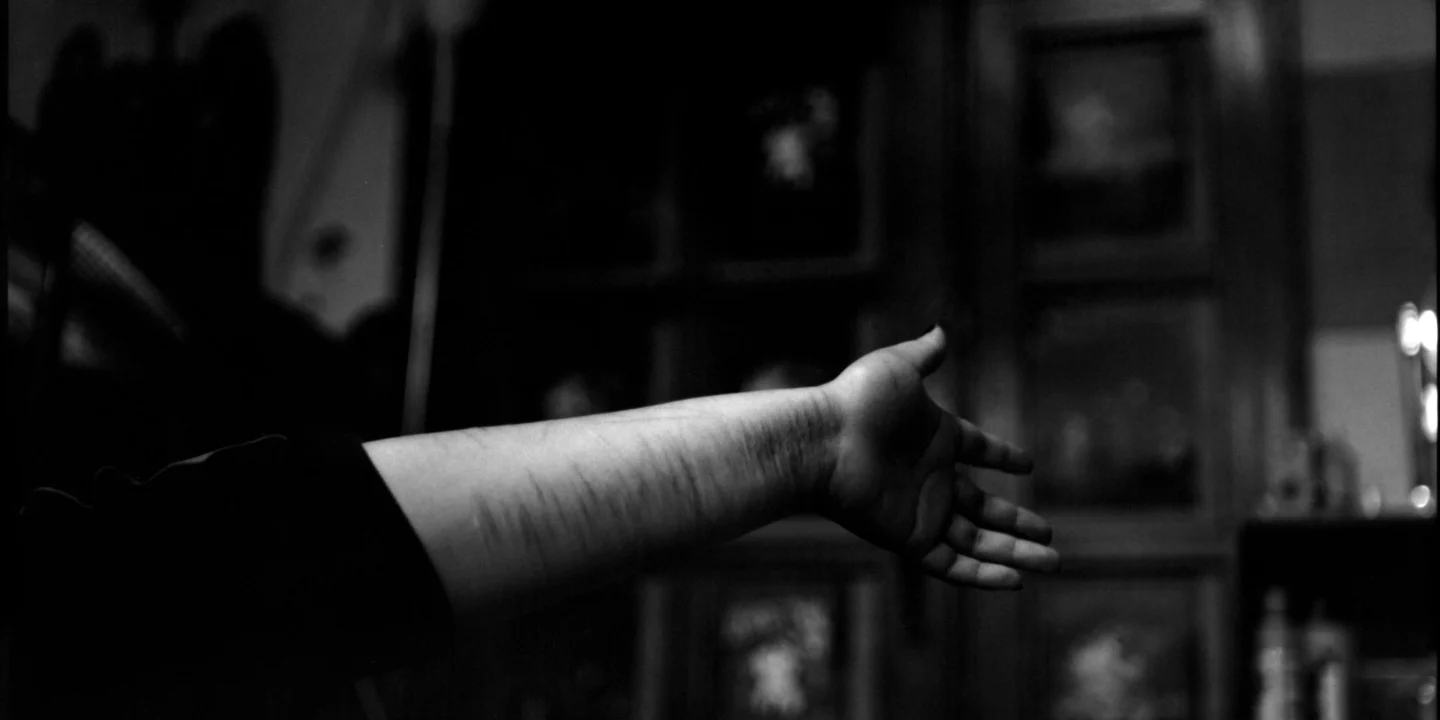
My blood stays inside my body. My skin remains intact. The old scars are still there, but they no longer feel like instructions. They feel more like records: proof that I once did not know how to live through certain moments, and that now I am learning other ways.
This essay is provided as general information only. It is not a substitute for independent, professional medical or mental health advice tailored to an individual’s specific circumstances. If you are experiencing psychological distress or urges to self-harm, please seek help from a qualified professional as soon as possible.