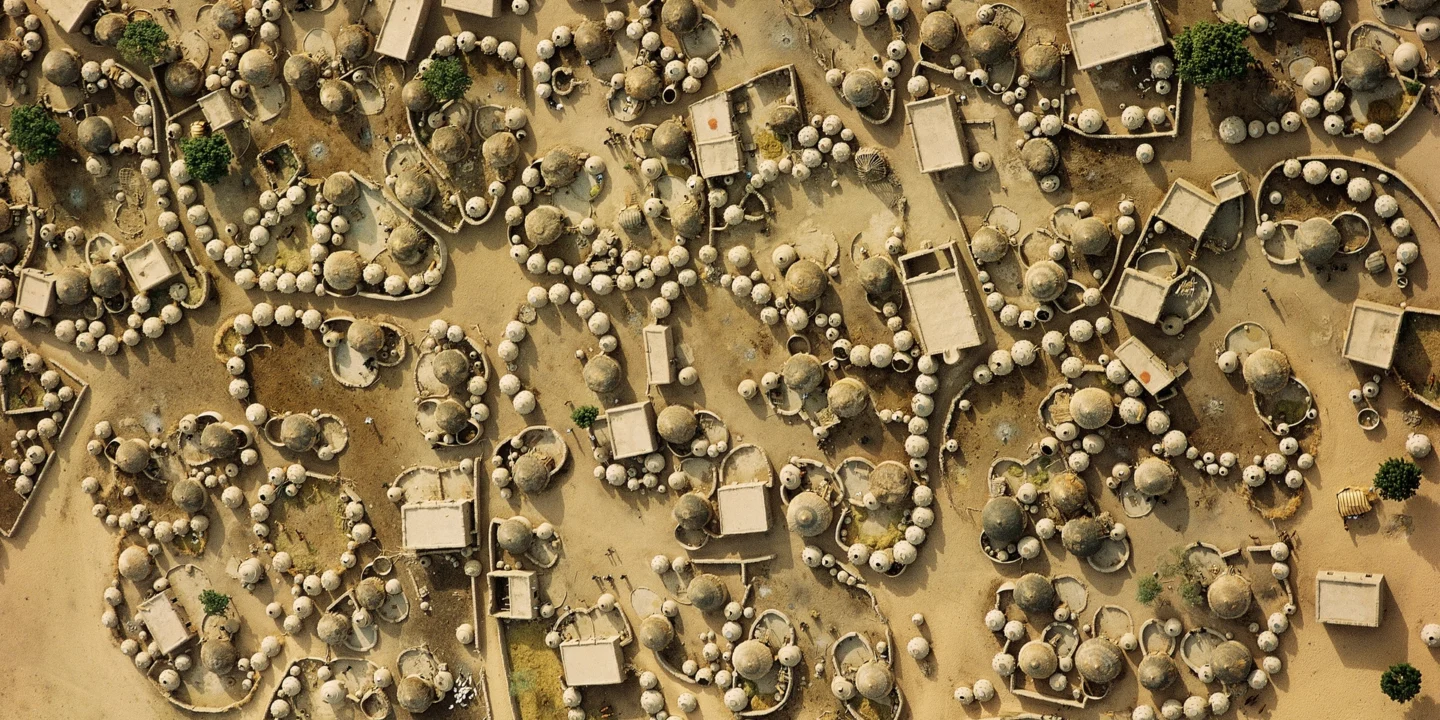











Ron Eglash did not set out to find a political theory in the shape of a village. In the 1980s, the American ethnomathematician was studying African settlement patterns when aerial photographs and ground plans began to reveal something unexpected. The villages were not arranged randomly. Their forms repeated. A cluster of homes echoed the shape of a larger compound; the compound echoed the wider settlement; the settlement repeated the same organising logic at another scale.
What Eglash was seeing was a fractal: a geometric structure in which a pattern recurs from the smallest level to the largest. No professional mathematician had imposed the design. It had emerged from people building, arranging and governing space according to principles embedded in practice. Geometry was not an abstract system floating above culture. It was there in the ground plan of social life.
The discovery led Eglash across the African continent. He found fractal organisation in architecture, textile design, religious symbolism, hair braiding, sand drawings, numeracy systems and political structures. In many cases, the recurrence was not accidental. People were deliberately using recursive forms to organise space, authority, knowledge and value.
One of the clearest examples appears at Logone-Birni in Cameroon, which Eglash identifies as a fractal settlement. There, nested rectangles repeat across the city and the chief’s palace. The pattern is not only decorative. It helps structure social relations. As one moves inward through the palace, rank intensifies and behaviour changes. Space itself becomes a diagram of hierarchy.
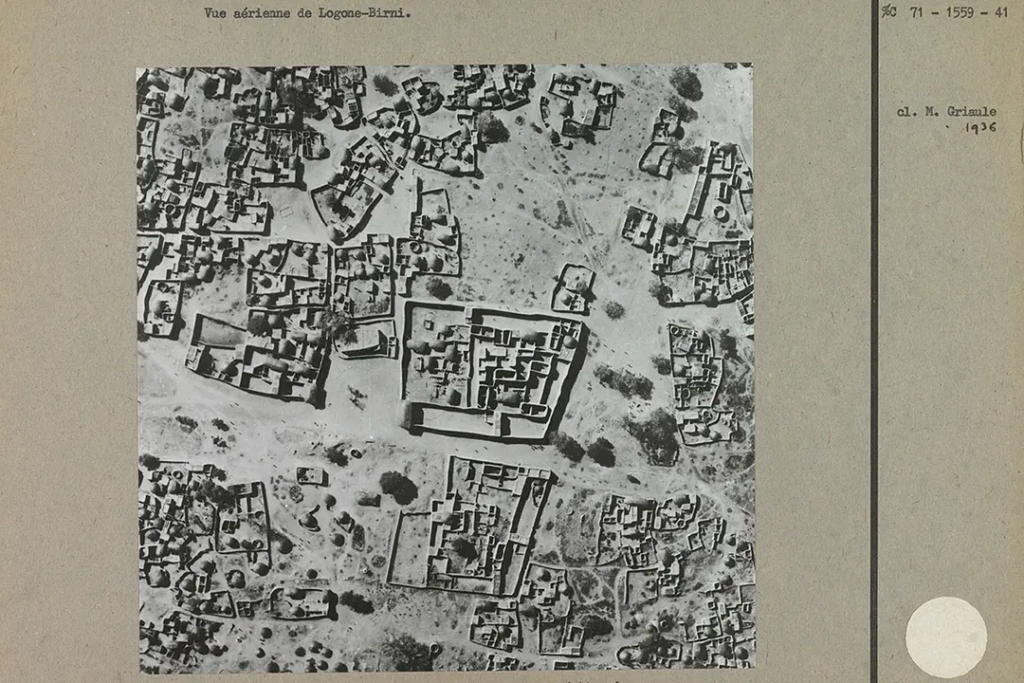
The city of Logone-Birni in Cameroon in 1936. The largest building complex is the palace of the chief. Photo courtesy Musée du quai Branly-Jacques Chirac
Other settlements use different forms of the same logic. In southern Zambia, family enclosures may be arranged as rings within rings, so that the settlement mirrors the structure of its component parts. What fractal geometry reveals in these cases is not simply an aesthetic preference. It shows how large, complex systems can be built from smaller self-organising units without requiring every decision to descend from a single centre.
That principle matters far beyond architecture. It has implications for politics, economics and justice. Modern institutions often imagine order from the top down. Governments centralise authority. Corporations extract value through platforms, fees, ownership and control. Decisions are pushed downward while wealth flows upward and outward, away from the communities that generated it.
Since European empires spread the model of the centralised state across much of the world, this has come to seem normal. But it is not inevitable. Precolonial African societies included centralised kingdoms and empires, but also many communities governed through layered, overlapping and self-organising institutions. European observers often dismissed these arrangements as primitive because they lacked the familiar machinery of the state. In many cases, the opposite was true. Their complexity lay precisely in the way authority and obligation repeated across scale.
To understand this, we have to return to geometry. Fractals are shapes built from repeating patterns. The same logic appears at different levels: branch and tree, frond and fern, stream and river network. In Les objets fractals: forme, hasard et dimension (1975), later revised and translated as Fractals: Form, Chance, and Dimension (1977), the mathematician Benoît Mandelbrot gave such forms their modern name and rigorous description. Euclidean geometry was good at lines, circles and ideal solids. But the world was rougher than that. “Clouds are not spheres, mountains are not cones, coastlines are not circles,” Mandelbrot wrote.
Nature is full of irregular repetition. Blood vessels branch fractally. Lightning forks. Coastlines repeat roughness at different magnifications. Galaxies, rivers, lungs, trees and market movements all reveal forms of recursive order. Fractals show that complexity can emerge from simple rules repeated across levels.
Three principles are especially important. Recursion is the process by which a pattern generates another pattern like itself. Self-similarity is the resemblance between parts and wholes, even when the resemblance is not exact. Scaling is the ability of a pattern to expand or shrink while preserving its underlying logic. Together, these principles explain how order can arise without a single master plan.
Applied to society, the implications are powerful. A household rule can become a lineage principle; a lineage principle can become a village practice; a village practice can become a regional structure. Each level does not need to be identical, but each can repeat a shared logic. A society organised in this way does not require one centre to hold everything together. It can hold itself through nested, self-organising relations.
Fractal patterns don’t appear only when designed on purpose. Sometimes they arise through growth itself.
The usefulness of fractals is not limited to cultural interpretation. In 1988, Nathan Cohen wanted better radio reception but was forbidden by his landlord from installing a new antenna on the roof. He experimented with a fractal-shaped antenna and found that it could pick up multiple frequencies in less space and with better performance. The discovery helped inspire the fractal antennas now used in mobile phones, GPS and other communications technologies. The lesson was clear: fractal organisation can increase efficiency without simply increasing size.
Cities, too, often grow fractally. Districts branch into neighbourhoods, neighbourhoods into streets, streets into smaller paths. The parts need not look identical to the whole, but similar organising patterns can recur at different scales. Growth itself can generate recursive form.
Shenzhen offers a striking case. In 1980, it was a fishing town in southern China. Today, it is a metropolis of more than 17 million people. Its growth was shaped by state policy, factories and migration, but the speed of expansion exceeded any single plan. Studying maps of Shenzhen over time, researchers Yanguang Chen and Xiaoming Man found that the city’s parts and whole retained similar spatial patterns as it grew. They described its urban form as fractal because its expansion repeated across scale.
For Eglash, African fractals revealed something still more significant. In African Fractals: Modern Computing and Indigenous Design (1999), he documented fractal geometry in African design, architecture, religion and systems of knowledge. His concern was not only that fractals appeared in African societies, but that they moved between domains. A pattern visible in a settlement might also appear in ritual, craft, governance or cosmology. Geometry was a cultural practice.
This matters because it unsettles a familiar hierarchy of knowledge. Modern mathematics has often been imagined as abstract, universal and Western, while Indigenous and African practices were treated as local, intuitive or merely decorative. Eglash reversed that assumption. He showed that sophisticated mathematical thinking could be embedded in everyday forms and that cultural design could contain computational insight.
In political and economic life, the same recursive principles appear in institutions. The guild system in Benin, for example, organised artisans who produced works for the royal court as well as for ordinary people. According to scholars Michael Ediagbonya, Yemi Ebenezer Aluko and Duyile William Abiodun, each guild had its own district, leadership, administrative responsibilities and forms of internal regulation. Guilds controlled aspects of production, workspace and dispute resolution while remaining connected to the wider city and royal authority.
Such institutions were not anarchic. They were orderly without being entirely centralised. Authority existed, but it did not exist only at the top. Smaller units had their own capacity to govern, coordinate and respond. When the king required an object, the guild could answer. But within its own domain, it also organised the conditions of its livelihood.
Age-grade systems show another version of the same logic. Among the Igbo of Nigeria, age grades were not simply peer groups. They were civic bodies made up of people born within a few years of one another. As Bonaventure Chigozie Uzoh and Iheanyi Valentine Ekechukwu have shown, these groups raised funds for development projects, helped resolve conflicts, supported vulnerable members and encouraged investment back into the village.
Within each age grade, members chose leaders, made rules and took responsibility for shared tasks. Elders might hold the highest authority, but younger cohorts carried much of the labour of community development. The fractal quality lay in repetition: each age grade governed itself while participating in a larger society composed of other self-governing groups. The form repeated, but the function changed with scale.
The Chokwe of Angola joined age-grade initiation to lusona, intricate sand drawings that grew more complex as initiates advanced through stages of seniority. The designs were not random ornament. They expressed and taught recursive knowledge. As initiates learned to draw more elaborate patterns, they entered deeper levels of social belonging and shared understanding. The geometry of the drawing mirrored the geometry of life passage: one form unfolding into another, one level nested inside a larger whole.
Lineage was not just a matter of family background. It was a formal structure of mutual support.
Lineage systems worked through kinship rather than age, but they followed a similar recursive logic. In many African societies, lineage was a structure of obligation, political belonging and mutual aid. A household belonged to a lineage, the lineage to a larger clan, the clan to a wider network. The relevant circle could expand or contract depending on the dispute or task at hand.
Eglash calls such arrangements segmented lineage systems. Their flexibility is precisely what makes them fractal. The same basic form repeats at different scales, but the active level changes with context. A quarrel between relatives might be handled within a smaller lineage unit. A broader conflict might activate a larger kinship segment. Social order emerges from overlapping structures rather than from a single court standing above everyone.
Kinship was one strand; age was another; place, craft and economic role were others. Eglash compares these overlapping memberships to an artist’s palette. People belonged to multiple recursive systems at once. That gave them several routes toward cooperation, accountability and repair.
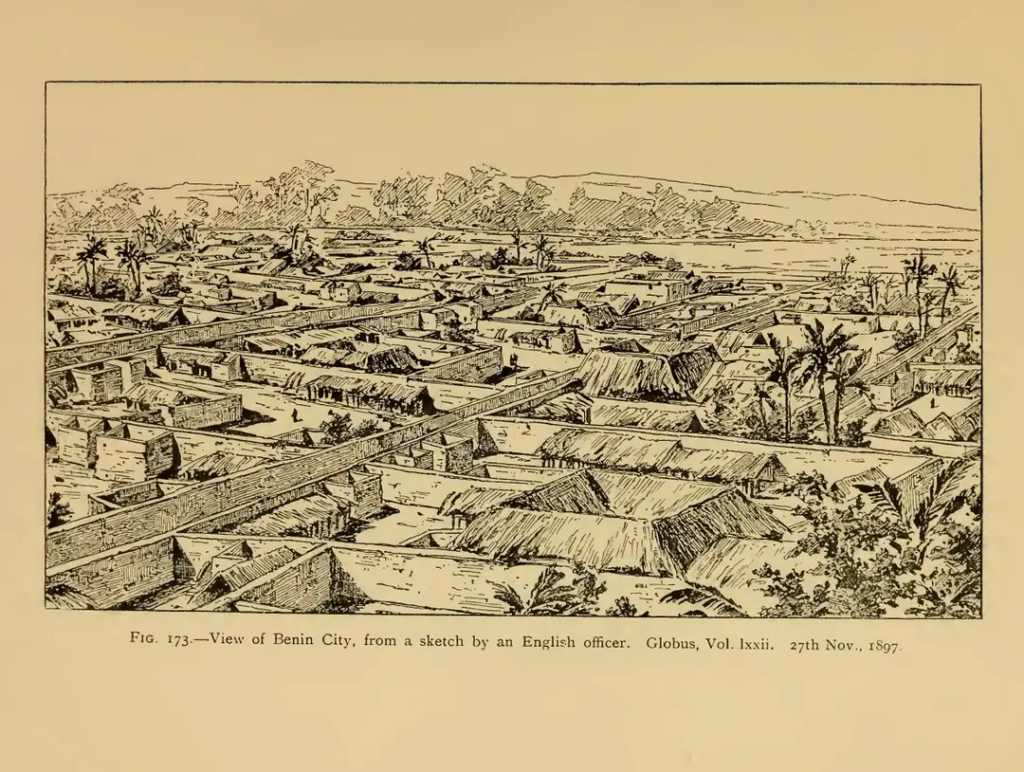
Edo, or Benin City, Nigeria. Courtesy the Internet Archive/public domain
Legal anthropologist Simon Roberts described how such arrangements could work in practice. In Order and Dispute (1979), drawing on H P Gulliver’s study of the Arusha of northern Tanzania, Roberts showed how disputes could be resolved through the social groups people already inhabited. An Arusha man belonged to a lineage, an age set and a parish. If a conflict arose, resolution might proceed through one or more of these overlapping units, depending on the issue.
In one case, a father’s land had been given to his brother. When the son came of age, he claimed the land for himself, as norms suggested he could. The lineage worked out a compromise: half the land went to the son, and half remained with the uncle. The solution did not simply apply a rigid rule. It preserved cohesion. The aim was not to produce a winner and loser before an abstract law, but to maintain the relations that allowed the community to continue.
This is where fractal social organisation begins to look like a theory of justice. Justice is not only the distribution of goods from above. It is the maintenance and repair of relations across scale. A dispute is not merely a violation to be punished; it is a disturbance in a network that must be rebalanced. The law is not only a command from the centre; it is a practice of restoring connection among people who must continue living together.
Not every African system that distributed authority across levels was strictly fractal in the mathematical sense. Edo, the historical centre of Benin City in southern Nigeria, offers a related but distinct example. Organised around the Oba’s palace, with roads radiating outward and compounds gathered into neighbourhoods and districts, Edo was a layered urban system. Its structure nested space and authority without necessarily forming the demonstrated fractal pattern found at Logone-Birni.
Within that layered city, economic life also operated through nested institutions. Edo’s craftsmen produced the famous Benin Bronzes, many of which now sit in museums across the Global North. The city supported prosperous guilds whose artisans made goods for the Oba and for broader society. These guilds trained apprentices, managed labour, controlled workspace, settled disputes and coordinated production. They served a monarchy, but they also preserved forms of organisation below the palace.
This does not make Edo egalitarian. Much of its production served elites, and authority remained deeply hierarchical. Fractal or nested structure does not guarantee justice. Geometry can organise domination as well as reciprocity. A palace can be fractal; so can a corporation. The question is not whether a system has repeating levels, but what flows through them and who controls the flow.
That is why Eglash’s idea of generative justice matters. A just system is not merely one that distributes benefits more fairly after extraction has already occurred. It is one that returns value to the sources that generated it: workers, communities, ecosystems, knowledge systems and social relations. Justice is not only redistribution. It is regeneration.
Value moves outward and then back again, rather than being extracted and hoarded.
This idea resembles a circular economy, but it is broader. Circularity is not only environmental; it is social and political. Land should be replenished. Labour should be compensated and empowered. Knowledge should not be taken without return. Communities should not be drained of the value they create. A generative system keeps the cycle alive.
In Eglash’s account, egalitarian fractal societies support this kind of return because their structures are nested and self-similar. Value can move outward to larger levels of coordination, but it can also move back to the people and places that produced it. Authority is distributed enough that local units retain agency. Participation is not swallowed by the centre.
The contrast with many modern economies is stark. Platform capitalism depends on extraction at scale. Local businesses pay fees to distant payment processors, delivery apps, hosting companies, banks and data platforms. Artists create images, texts, designs and music that are absorbed into training datasets without compensation. Communities produce culture, labour and attention, while value accumulates elsewhere.
The AI boom makes this especially visible. Large language models and image generators are trained on vast datasets, many of which include copyrighted or culturally specific creative work. The resulting systems can produce immense commercial value, yet the people whose work helped build them often receive nothing. Their labour becomes input; the profit flows away.
In response, Eglash and a network of global creatives have developed Ubuntu AI, a platform designed to let African artists and designers upload their work and receive payment if companies use it to train AI systems. The project, one of 10 OpenAI grant winners, aims to democratise the AI economy by giving creators a claim on the value their work generates.
Eglash distinguishes this from mere consultation. Citizen input on AI policy matters, but input without ownership does little to change the economic structure. A community can be asked for advice while still being excluded from value. The deeper question is how to organise AI so that local creators and communities retain control, compensation and dignity. Eglash calls this “fractal scaling of democracy”: connecting local ownership to global systems without erasing the local.
Ubuntu AI is one possible model. Instead of allowing creative value to be extracted into distant technical infrastructures, it builds a pathway for return. But payment is only the beginning. The larger question is how technologies can be organised through local clusters and community institutions, so that they circulate value rather than drain it.
A Detroit-based project led by Eglash and his collaborators pursues a similar logic with Black-owned cooperatives, worker-owned businesses and community ventures. Its premise is simple: even when an enterprise is local, the infrastructure beneath it may not be. Web hosting, payment processing, delivery routing, banking and software platforms can all siphon fees away from the community. A business may sell local food or provide local services while its technical dependencies quietly extract value.
When local enterprises rely on outside platforms for essential services, money leaks out of the community.
The Detroit project partnered with organisations already rooted in community repair: farmers, designers, cooperatives and economic collectives. Using open-source tools, it sought to reduce technical and financial barriers while keeping more value within local networks. One participant, Deeply Rooted, ran a delivery service for urban farms, something like a neighbourhood-scale alternative to Uber Eats. Each month, however, fees for routing, hosting and banking pulled money away from the very people producing and distributing the food.
The project helped develop a worker-owned delivery platform. The change was technical, but not only technical. It altered the direction of value. Instead of transaction fees flowing outward to outside firms, more money could return to workers, farmers and the community. Infrastructure became part of justice.
This is the broader promise of fractal design in public life. The aim is not simply to make systems small. Small systems can also be unjust, exclusionary or inefficient. Nor is the aim to abolish scale. Large-scale coordination is necessary for many modern problems. The aim is to build nested institutions in which local units retain agency and value can return to its source even as systems connect upward and outward.
Fractal democracy would not mean the absence of central structures. It would mean that larger structures are accountable to the smaller units that compose them. A village, guild, cooperative, neighbourhood or creative community would not merely feed data, labour or money into a remote centre. It would participate in governance and receive value back. Scale would amplify local agency rather than replace it.
Such a model challenges both state centralisation and corporate platform power. The modern state often claims to represent the people while concentrating decision-making in distant bureaucracies. The platform corporation claims to connect users while extracting fees, data and control from every interaction. Both can turn living networks into pipelines of value moving upward. Fractal justice asks whether networks can be organised otherwise.
African precedents do not offer a simple blueprint. Precolonial societies were diverse, unequal in many cases, and shaped by their own histories of hierarchy, gendered authority, slavery, warfare and exclusion. To romanticise them would be to repeat another colonial mistake: treating Africa as a symbolic resource for other people’s fantasies. The value of Eglash’s work lies not in idealising the past, but in recovering design principles that modernity has often ignored.
Those principles include recursion, overlapping membership, local autonomy, nested responsibility and cyclical return. They suggest that complexity need not require alienation. A society can be large without making ordinary people powerless. An economy can circulate beyond the village without stripping the village of value. Technology can scale without dissolving the communities that feed it.
The danger, however, is that fractal language itself can be captured. A corporation can describe its platform as decentralised while controlling the protocols. A blockchain project can promise community ownership while reproducing speculation and concentration. A payment network can present itself as connective while extracting a fee from every transaction. Geometry alone does not save us. Design must be joined to politics.
This is why justice is geometric only in a qualified sense. Geometry can reveal patterns of relation, flow and scale. It can show us whether value returns or disappears, whether authority repeats or concentrates, whether communities remain self-organising or become mere inputs. But geometry does not decide the ethical purpose of a system. People do that.
If fractal systems are to support justice, they must be deliberately oriented toward regeneration. Labour value must return to workers. Cultural value must return to creators. Ecological value must return to the land. Social value must return to communities. Knowledge must circulate without being stolen. Participation must be more than consultation. Ownership must be more than symbolic.
In this light, the old African fractals become newly contemporary. They show that decentralisation is not a Silicon Valley invention, that recursive governance is not a novelty, and that community-based economies are not backward remnants. They are part of a long history of sophisticated social design. The future of fair technology may depend on ideas that colonial modernity once dismissed.
The lesson from Logone-Birni, Igbo age grades, Chokwe initiation, Arusha dispute resolution, Benin guilds, Ubuntu AI and Detroit cooperatives is not that all these systems are the same. They are not. The lesson is that justice can be built through patterns that repeat at human scale. A household, cohort, guild, cooperative or neighbourhood can organise itself in ways that mirror larger democratic principles. The whole can become more just only if its parts are allowed to practise justice themselves.
Modern economies often ask us to accept extraction as the price of scale. African fractal traditions suggest another possibility: scale through return. Growth need not mean distance from the source. Complexity need not require a single centre. Innovation need not sever itself from the communities that make it possible.
Eglash’s final emphasis is on decolonised economies: community-based, worker-owned, ecologically sustainable and rooted in unalienated labour. The phrase may sound ambitious, but the underlying principle is simple. People should not be separated from the value they create. Communities should not be reduced to raw material for distant systems. The patterns that organise production should also organise return.
If the future is to be more just than the present, it will need more than new technologies. It will need new geometries of power. Or perhaps older geometries, remembered and reworked. It will need systems in which the smallest units are not crushed by the largest, and the largest structures remain answerable to the smallest. It will need economies that behave less like funnels and more like living branches.
Justice, in that sense, is geometric. It has a shape. It can be centralised or recursive, extractive or regenerative, rigid or self-similar, hoarding or returning. The question is not only who gets what at the end. The question is how value moves, where it gathers, and whether it finds its way back to the people and places from which it came.