








‘Fuck Earth!’ Elon Musk said, laughing. “Who cares about Earth?”He said this while we were sitting in a corner of the open-plan office at SpaceX headquarters in Los Angeles. His cubicle had no aura of mystery about it. If anything, it was almost ordinary: a black leather couch, a large desk, a few wine bottles and awards scattered across it, and beyond the window, a parking lot bleached by the California sun. It was a Thursday afternoon, one of the days Musk regularly spends at SpaceX. He was laughing because, of course, he did not mean it. A man who also runs an electric car company can hardly be said not to care about Earth. But this is often how Musk speaks. He pushes a sentence to the edge of absurdity, and then you realise that somewhere beneath the absurdity is something quite serious.
When I arrived, he was at his computer, answering emails with the speed and brevity of a telegraph operator. One short reply after another. He did not immediately turn toward me, so I sat and looked around. The room did not resemble the command centre of a man planning to send human beings to Mars. Nor did it resemble the futuristic lair of a science-fiction film. It was too practical, too corporate, too much like the corner of an ordinary office. After a few minutes, I began to wonder whether he had forgotten I was there. Then, suddenly, with a slightly theatrical movement, he spun around in his chair, rolled toward me, and extended his hand. “I’m Elon,” he said.
It was a polite introduction, though by then he hardly needed one. Musk had already ceased to be merely a technology entrepreneur and had become a cultural figure. Not since Steve Jobs had an American businessman so thoroughly occupied the public imagination. His biography had been told and retold: the South African childhood, the lonely boyhood, the video game he wrote at twelve, the later move to America; then the sale of Zip2 in his twenties, followed by PayPal’s sale to eBay. A normal story could have ended there: a young man becomes rich, buys houses and cars, and begins enjoying life. But Musk instead poured his fortune into two projects that looked almost deranged in their ambition. Tesla would remake the automobile industry. SpaceX would remake aerospace. The first was controlled by century-old car companies; the second by government agencies and defence contractors. Neither was a light software business. Both were heavy industries that consumed money, time, engineering capacity and nerve. Musk intended to overturn them at the same time.
At first, many people dismissed this as another rich man’s fantasy after the internet bubble. They called him an amateur. They said he had mistaken luck for destiny. But a few years later Tesla went public, SpaceX won NASA contracts, Falcon rockets rose again and again from their pads, and the tone changed. SpaceX built rockets in its own Los Angeles factory and pushed launch prices down to levels the traditional aerospace companies had no wish to believe possible. It launched satellites and ferried cargo to the International Space Station. Later, NASA selected it, alongside Boeing, to carry American astronauts to orbit. This meant Musk was no longer simply a cheaper supplier to the space industry. He had begun to touch the older and more sacred business of human spaceflight.
I had come to SpaceX to ask him a question that was familiar but unavoidable: with so much poverty, disease, war and injustice on Earth, why spend such vast resources on space? The question might seem more naturally directed at NASA, but it was necessary to put it to Musk as well. His largest customer was NASA, and more importantly, he spoke openly about “the future of humanity”. He did not shrink from such phrases because they sounded grandiose, nor because history had been crowded with dangerous people who used similar language. Of course, he liked business success, and he enjoyed the freedom that great wealth brings. But he was not merely a money-making machine. He had put his capital and his energy into industries that touched the fate of the species. So the question became sharper: why space?
His answer was not the usual rhetoric of space advocacy. He did not say that space inspires children to study science. He did not describe aerospace as a laboratory for technological spin-offs. He did not say that human intelligence needs extreme challenges in order to prove itself. He said something else: going to Mars belongs in the same moral category as fighting poverty and disease. It is a humanitarian project.
His logic was direct. If human beings live on only one planet, then no matter how much we improve life on that planet, we still face an ultimate risk: collective extinction. If a catastrophe large enough occurs, poverty, disease and inequality will indeed disappear, but not because we have solved them. They will disappear because there will be no human beings left to be poor, sick or oppressed. For Musk, building a multi-planetary civilisation is not a science-fiction hobby. It is insurance, a survival policy taken out on consciousness itself.
He admitted that not everyone accepts this premise. Some people see humanity as a destroyer, a blemish on the surface of nature. Mountains, forests and oceans without people seem to them purer, cleaner, better. Musk does not belong to this school. He believes that human civilisation has value. He believes consciousness has value. He says we have a duty to keep the light of consciousness burning.
It is an ancient metaphor. Since Plato, people have compared consciousness to light. Light makes things visible; consciousness makes the universe visible to itself. Carl Sagan once said that human beings are a way for the cosmos to know itself. But light is everywhere, while consciousness of the human kind appears not to be. At least for now, it looks more like a single candle trembling in an immense darkness.
Musk said that he often thinks about the silence of the universe. We have not, of course, completed any exhaustive search for extraterrestrial intelligence, but neither have we done nothing. For decades, we have pointed radio telescopes at the stars, hoping to catch a signal from deep space. We have looked for hidden probes in our own solar system, for signs of engineering around distant stars, and soon we will examine the atmospheres of exoplanets for industrial pollutants. So far, there has been no greeting, no beacon, no cosmic neighbour knocking at the door.
This is strange. According to the modern picture of the universe, we do not live at a privileged centre. The cosmos is vast and broadly uniform, a web of galaxies, seas of stars, planets beyond counting. The elements that make our bodies also make the rocks, oceans and atmospheres of other worlds. If the laws of physics are the same everywhere, and if Earth’s chemistry was not a miracle, then life ought to have appeared in many places. Give nature water, rock, energy and enough time, and it seems capable of stirring dead matter into living matter. Then, on some fortunate worlds, life might evolve intelligence; intelligence might invent tools, language, cities and starships.
Musk presses the question further. If any truly advanced civilisation had ever emerged anywhere in the galaxy, at any time, why has it not spread everywhere? Even if it moved slowly, interstellar expansion would not be unimaginable across the deep timescale of the universe. Hundreds of thousands of years are absurdly long to us, but on a cosmic scale they are almost nothing. So why do we see no one?
“If you look at our current level of technology, something strange must happen to civilisations — and I mean strange in a bad way”
Life appeared early on Earth. Soon after the planet cooled, microbes had already taken root. This suggests that wherever conditions are right, life may not be especially difficult to start. But from microbes to technological civilisation lies an immense gulf. Evolution is good at reinventing certain things: eyes, wings, fins, venom, shells. They appear again and again on different branches of the tree of life. Technological intelligence, however, has appeared only once. Perhaps we are merely among the first of many species that will lift tools, speak languages and build machines. Perhaps the galaxy will one day be full of such civilisations. But perhaps intelligence is not among natural selection’s favourite solutions. It may be accidental, fragile, expensive and unstable.
Musk’s speculation is darker. The silence of the universe, he says, may itself be a clue. Perhaps we live in a simulation, like characters in a game who can see the stars in the background but can never actually reach them. Or perhaps we are like mould in a petri dish, observed by some higher civilisation. It sounds like late-night science fiction, but it points toward the same disquieting conclusion: if intelligent civilisations are not rare, why has none come before us? Perhaps the answer is that civilisations fail at some stage. They die before they can leave their home planets.
This is Musk’s central fear: one-planet civilisations do not last. Even without war, plague, climate collapse or nuclear disaster, the star itself will not remain gentle forever. The Sun is now the source of life on Earth, but one day it will become too bright, too swollen, too cruel. Billions of years from now it will bake the Earth dry, perhaps even swallow it. But the real problem will not wait that long. Long before the Sun expands into a red giant, Earth’s biosphere may already be unable to sustain complex life.
In a few hundred million years, the brightening Sun will alter the chemical balance between atmosphere and rock. The continents may fuse again into a supercontinent. Climate will grow more extreme. Weathering will intensify. Carbon dioxide will be drawn steadily out of the air. Plants need carbon dioxide for photosynthesis; when the atmosphere becomes too carbon-poor, forests will retreat and food chains will collapse. Plants will die, and animals with them. Earth will still be there, perhaps slowly losing its blue, but the complex world made by life will be extinguished piece by piece.
Later still, the oceans will evaporate, the surface will heat, and Earth may become another Venus. Hot, dry, high-pressure, hostile even to the hardiest microbes. And this is only the slow version of death, the version in which the planet dies of age. The universe may arrange a more sudden ending: an asteroid impact, a supervolcano, a gamma-ray burst, a rogue planet, a nearby supernova. Earth’s history has already seen mass extinctions. The biosphere recovered each time, but recovery is not mercy. Whole branches of life vanished; long achievements of evolution were wiped clean; life began again.
Human culture is too young to remember the truly terrible things. Our myths contain floods, heavenly fires, chariots of the sun falling to Earth, perhaps faint echoes of ancient catastrophes. Plato tells of Phaethon failing to control the chariot of the sun and scorching the planet’s surface. Such stories feel like legends, but also like old intuitions. We have no oral memory of giant asteroid impacts, no lived tradition of global ice, no civilisational story of a supervolcano darkening the sky. The rocks remember. The fossils remember. Human beings do not.
So Musk’s plan for Mars looks futuristic, but beneath it lies an ancient instinct: survive. Life does not place all its hopes in staying put. It spreads, mutates, migrates, searches for new niches. Fish crawled onto land. Animals left the sea. Human beings crossed continents, straits and oceans, reached islands, archipelagos and nearly every habitable place on Earth. If catastrophe is inevitable, departure is part of survival.
Some in the space community argue that, at least in the short term, sending humans into space is an expensive and dangerous obsession
The question is whether we need to do it now. Not everyone who supports space exploration supports human spaceflight in the near term. Some argue that we remain technologically young, only a million years removed from the first control of fire, and yet we are already placing explosions inside metal cylinders and trying to escape Earth’s gravity. Rockets are astonishing, but they are dangerous. The presence of even one human being inside a spacecraft multiplies the engineering difficulty. A human needs air, water, food, heat, pressure, radiation protection and psychological stability. A probe can fly silently, die in deep space, and reach distant places with relatively little support. A human cannot.
For this reason, some argue that robots should explore on our behalf for now. Voyager has slipped beyond the edge of the solar system. Rovers can drive across the Martian desert. Telescopes can show us distant galaxies. After artificial intelligence, materials science and energy technology have advanced further, after spaceflight has become cheaper and safer, perhaps then we can send people. This view is rational and cautious. It is not anti-space. It is opposed only to putting vulnerable human bodies into spacecraft too soon.
I put this argument to Musk. He objected at once that there was no real “focus” on near-term human spaceflight at all. In his view, human spaceflight was far too weak, not too strong. As for probes, he had no objection to them. He merely pointed out that they, too, were enormously expensive. Sending a rover to Mars costs billions. If even a robot is that costly, he thinks the true problem is not whether to send people, but why we have made getting to space so expensive.
The origin of SpaceX lies in this dissatisfaction. Musk once spent a late night searching NASA’s website for a crewed Mars plan. He expected to find a roadmap, a schedule, a mission in progress. He found nothing. At the time, the space shuttles were still flying, and the public still saw rockets rise on television often enough to believe that human spaceflight was advancing. But what Musk saw was absence. No real Mars plan. No engineering path toward a multi-planetary civilisation.
The dream of flying into the sky is as old as myth. There were flyers, sun chariots, towers reaching toward heaven. After the scientific revolution, the telescope turned the sky from a mythic backdrop into a legible world. Kepler imagined, in a letter to Galileo, vessels and sails suited to the heavenly ether, and brave travellers crossing the empty wastes. Later came balloons, airplanes and rockets, and space colonisation moved from fantasy toward planning. What made this vision mainstream was the Space Race. In 1957, Sputnik rose. In 1969, human beings walked on the Moon. In just twelve years, space seemed to become not only a theatre of geopolitical rivalry, but a stage for the human future.
After the Moon landings, however, the story did not continue as expected. Humanity did not build a lunar base. The Moon did not become a way station to Mars. We did not hop from planet to planet like stones across a pond. We did not build stations on the moons of Jupiter, sail beneath the rings of Saturn, or treat the edge of the solar system as the next frontier. Instead, budgets shrank, missions were cancelled, and the Saturn V production line closed. NASA’s share of the federal budget fell from several per cent at its peak to less than one per cent. Once the political contest was over, space lost urgency. Money became a problem again.
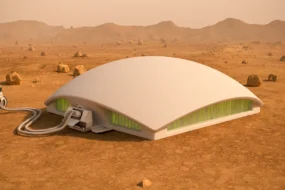
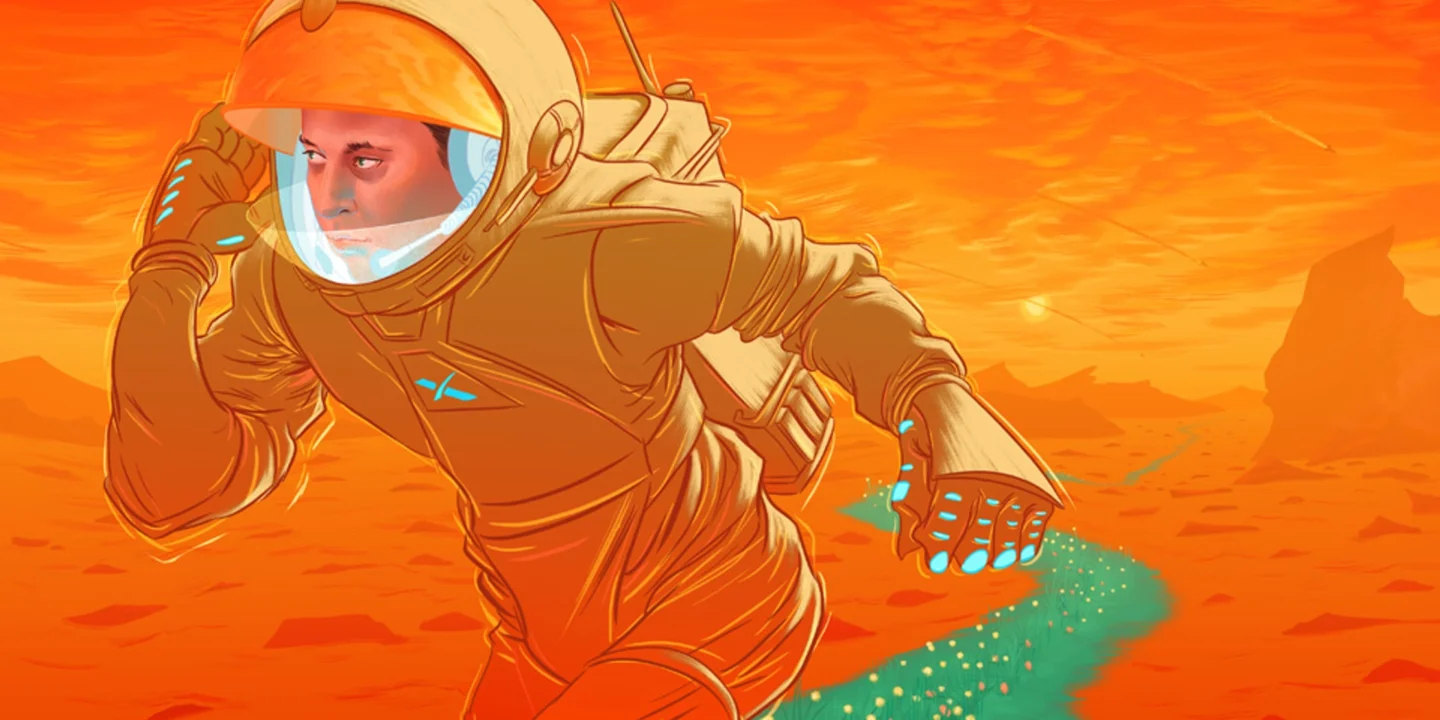
Musk initially thought this was a failure of public will. Then the Columbia shuttle disaster filled newspapers and television screens, and he realised that space still lay deep in the American imagination. People had not stopped caring about space; they had stopped believing that it would truly carry human beings to new worlds. So he decided to create an image that might reignite public feeling: a greenhouse on Mars, plants growing on the red planet. Green life on a red world might move people as the image of Earthrise had moved an earlier generation.
When he asked launch providers for prices, the quotes were absurdly high. He tried to buy a retired Russian missile, but the negotiations became intolerable. Finally he reached a characteristically Muskian conclusion: if he could not afford other people’s rockets, he would build his own. His friends thought he was insane. Aerospace was not internet entrepreneurship. It was not code and rented servers. It was materials, fuel, engines, explosions and death. But Musk had read stacks of books on rockets. He regarded himself first as an engineer, not an investor. He wanted to try.
Great migrations often depend on timing: waiting for a strait to freeze, a tide to fall, or two planets to draw near
In its early years, SpaceX looked very much like a rich man’s failing toy. By 2008, nearly everything had gone wrong. Tesla was running out of money. The financial crisis had struck. Musk was divorced and short of cash. SpaceX was worse. The first three Falcon 1 launches had failed. The rockets had not reached orbit; they had died in the atmosphere. The fourth launch became a matter of survival. If it failed too, the company would probably end. Aerospace reporters were already preparing its obituary.
Then the fourth Falcon 1 succeeded. It rose on flame, reached orbit, and became the first privately developed liquid-fuel rocket to do so. That moment saved SpaceX and changed NASA’s view of it. Contracts followed. The company expanded, flew cargo missions, leased the Apollo-era launch pad, and began planning its own spaceport in Texas. In a little more than a decade, a company that had nearly failed began challenging an aerospace order guarded by states and giants.
Musk likes to emphasise this speed. He also likes to needle his rivals. When he speaks of other space start-ups, his verdict is sharp: they failed, or their success did not matter. It sounds arrogant, but SpaceX has forced the industry to recalculate. When the United States sanctioned Russia over Crimea while still relying on Russian rockets to send American astronauts to the International Space Station, the embarrassment became obvious. A Russian official joked that America should use a trampoline to get its astronauts to orbit. The remark almost became an advertisement for SpaceX.
NASA eventually split the crew launch contract between Boeing and SpaceX. For Musk, this was only a low-Earth-orbit mission, but it was proof on the way to something larger. He needed to show that he could carry not only cargo, but people. What he truly wanted was to transport human beings safely to another world.
Mars is the first stop not only because it resembles Earth in the cultural imagination, but because celestial mechanics periodically opens a window. Earth and Mars both circle the Sun, sometimes far apart and sometimes relatively near. At their most distant, Mars is vastly farther away than the Moon. But about every twenty-six months, the planets align favourably. Some windows are especially close, and Mars burns bright orange in the night sky, like a lamp waiting to be approached. Great migrations have never been powered by will alone. They also depend on timing. Ancestors waited for ice bridges; sailors waited for winds; Musk waits for planets to come into position.
He believes that by the 2030s SpaceX may be ready to begin the first real colonial missions to Mars. He imagines that by around 2040 there could be an early functioning base there, perhaps with thousands of people, perhaps more. SpaceX is still young, he says; by then, its lifespan will be several times what it is now. If technology continues to improve linearly rather than stalling, a Martian base is not impossible.
The first people to go will probably have to pay their own way. Musk imagines the ticket price eventually falling to the level of a few hundred thousand dollars. It would not be tourism. It would be more like early settlers selling their possessions to leave for a new world. There must be a large enough overlap between those who want to go and those who can afford to go. It sounds harsh, but also very American: the new world is not granted; it is entered by those willing to spend everything for passage.
Yet it is not easy to romanticise a one-way ticket to Mars. The deep-space journey would be magnificent. You would watch Earth shrink behind you, float between worlds, and step onto a red desert under an alien sky. But in that sky one of the stars would be Earth. One night you might look at it through a telescope and see blue oceans, white cloud bands, the net of city lights on its dark side. You might remember mountains, rivers, rain, trees, insects, birdsong, the smell of the sea, family, friends and the billions of strangers left behind on that blue planet. Leaving Earth would not only be an adventure. It would be a permanent loss.
Mars itself does not welcome human beings. From a distance, it resembles a desert and invites comparisons with the Sahara or the American West. In reality, it is colder than the heart of Antarctica. Its atmosphere is too thin to provide pressure or hold heat. Without a suit, a person would die quickly. Skin and eyes would suffer damage, blood would boil, the body would collapse within seconds. Even inside a suit, there would be radiation, dust storms, equipment failure and long isolation. The first life on Mars would probably not mean watching sunsets beneath a glass dome. It would mean keeping systems alive in underground caverns. It would be like returning to the cave age, except that outside the cave there would be not wild animals, but vacuum, cold and lethal dust.
“Even with a million people, you are assuming astonishing productivity from each person, because you have to rebuild the entire industrial base on Mars”
Perhaps one day Mars could be transformed into a world fit for human life. It might acquire a thicker atmosphere, a warmer climate and a more stable water cycle. But that is the distant future. Even on Earth, after centuries of studying the weather, we still cannot fully predict complex climate systems. Geoengineering remains a dangerous early idea. We may know how to spray aerosols into the stratosphere to reflect sunlight, but no one knows how to manufacture an entire atmosphere for a barren planet.
Real Martian colonisation, then, will not look like a beautiful science-fiction cover. At first it will mean crude habitats built by robots, probably near ice or mineral deposits. Communication will not be like communication on Earth. There will be unavoidable light-speed delays between the two planets, making natural video conversation impossible. Martian settlers will live in a world connected to Earth, yet always delayed from it.
Society may be the harder problem. Tight quarters, scarce resources, long supply cycles and fragile governance will magnify conflict. Reinforcements will be months away; rescue may be impossible. Early colonies on Earth collapsed in environments far friendlier than Mars, suffering hunger, violence, disease and internal breakdown. Mars will be harsher. It will require not only machines, but institutions, discipline, psychological endurance and some shared faith.
Musk says that a truly self-sustaining, genetically diverse and industrially complete civilisation may require a million people. This is not simply a matter of moving a million bodies to Mars. Each person will need food, air, shelter and work. The colony will have to mine minerals, refine materials, make parts, repair equipment, produce energy and recycle water and air. There will be no trees, no ready oxygen, no oil, none of the vast invisible industrial support that exists on Earth. A Martian civilisation cannot remain a base. It must gradually become an industrial ecology.
I asked how a million people could get there. Musk calculated roughly: if a ship carried a hundred people at a time, it would take ten thousand crewed trips. But people are not the only cargo. Each crewed mission might require many cargo missions behind it, carrying equipment, food, building materials and backup systems. That pushes the number toward a hundred thousand giant spacecraft flights. This is not a matter of a few rockets. It is an entire interplanetary transport network.
For Musk, the key is reusability. Traditional rockets are disposable vehicles; expensive hardware is thrown away after each launch. He often compares them to airplanes. If an airplane had to be rebuilt after every flight, air travel would never become common. Only if rockets can be used again and again, like aircraft, can launch costs fall by orders of magnitude. At a certain price, Earth’s launch pads become something like machine guns, firing spacecraft toward Mars.
This sounds like techno-futurist fantasy. But one glance back at the world a century ago makes it difficult to say that a century is not enough time. In 1914 there were no jetliners, computers, internet, nuclear energy, Moon landings or smartphones. A century can turn fantasy into infrastructure. SpaceX itself already resembles an object dragged out of fantasy into metal. Walk through its rocket factory and you see huge white rocket bodies, shining engines, technicians in cleanroom suits, managers in glass offices, and a production line moving like an industrial hive under electronic music. Twelve years earlier, none of it existed except as a thought in Musk’s head.
So it is difficult to say what SpaceX will be in a hundred years. Musk may be remembered as one of the rare action-prophets in the history of spaceflight. Or he may become the Icarus of the post-Apollo age, flying too high, too quickly, and falling. The first Mars mission could succeed, or it could end in tragedy. Martian settlement might prove like cold fusion, always twenty-five years away. The history of technology is full of half-fulfilled promises.
Musk does not seem naive about this. He knows he may not see the final result. He says he has thought about death or illness forcing him to pass the baton. He wants to build a structure that allows SpaceX to continue its mission without him. He worries that the company could fall into the hands of people who care only about short-term cash flow, that the Mars goal could be worn away by commercial logic. He has even considered whether some institutional or family influence might stabilise the company’s direction. To him, SpaceX is not an ordinary asset. It is a mission-bearing instrument.
“We have to be laser-focused on becoming a multi-planetary civilisation. That is the next step”
When I asked whether he would go to Mars himself, his answer again circled around the mission. He would like to go, but not while the risk of death remains too high. If his death would endanger the company’s purpose, he would rather stay. This makes him less like an explorer desperate to set foot on a new continent, and more like the builder of a vessel. He can be read as Noah, constructing an ark to preserve humanity. He can also be read as Moses, leading people through the wilderness but perhaps never entering the promised land himself.
Before leaving, I asked him a more distant question: would human beings go to the stars? When a man tells you that a million people may live on Mars, you naturally want to know where his imagination ends.
He did not leap into prophecy. He became cautious. Alpha Centauri is four light years away. Even travelling at a tenth the speed of light, the journey would take decades, and that does not include acceleration and deceleration. A flyby would be one thing; stopping would be another. To stay, you must slow down before arrival. This demands enormous energy, propulsion technology and time. With current human lifespans, perhaps we would need generation ships. Antimatter propulsion might be efficient, but it is still far from reality.
I asked whether he was skeptical of star travel. He said he was not skeptical of the stars. He was wondering what humanity would even look like by the time we tried. For him, the stars are not the next step. Mars is. If a Mars colony succeeds, it will create the economic and technological pressure needed to open the whole solar system. The moons of Jupiter, Titan, the asteroid belt — all might come within reach. Once an Earth-Mars transport system exists, the solar system will gradually open. The stars belong to a more distant consequence.
His logic always returns to the same point: first make multi-planetary civilisation real. Do not begin with fantasies of interstellar empire. Do not wait for perfect technology. First rescue humanity from the fate of a single planet. Mars is the test and the threshold. If we fail, we remain an Earth civilisation. If we pass, the universe truly begins to unfold.
This is why NASA has given Musk his chance. He does not merely build rockets. More importantly, he carries an older spacefaring vision, the cosmic sense of mission that fell asleep after Apollo. He is a revivalist preacher for those who still believe in a destiny beyond Earth. He says that staying here is unsafe. He says disaster will come. He says the light of consciousness cannot be entrusted to one planet alone. He invites humanity to follow him toward the darkest, most dangerous and most distant shore.
What he promises is not comfort. Nor does he promise victory.
He promises an escape, an ark, a path through the wilderness.
He promises a miracle.