








In December 1930, a working man living in a small bungalow on the outskirts of Stoke-on-Trent sat down at his table and traced both of his hands onto paper. Let us call him Mr H. He drew them carefully, folded the sheet, added a note describing his condition, and placed everything in an envelope addressed to the Eugenics Society at 20 Grosvenor Gardens, London. Then he waited, anxiously, for a reply.
His timing was not accidental. Britain was in the middle of an intense campaign to legalise the sterilisation of people labelled “mentally deficient”. Across the Atlantic, thousands had already been sterilised under eugenic laws in several US states. British campaigners watched with admiration. The Eugenics Society, whose members included doctors, clergy, scientists and public intellectuals, was pushing hard to make similar measures possible at home.
Its argument was familiar and chilling. Sterilisation, campaigners said, was safe, humane and urgently necessary. It would prevent the supposed overbreeding of those they called “defectives”. It would protect the future of the British people from racial and social decline. In the bleak economic climate of the Great Depression, it promised something else as well: reduced public spending on institutions that housed people deemed “feebleminded”.
Historians usually know how this story ends. In Britain, unlike in the United States, Canada or Nazi Germany, Parliament did not legalise targeted eugenic sterilisation. A Sterilisation Bill backed by the Eugenics Society was introduced in 1931 but defeated decisively, with Labour MPs among its strongest opponents. The proposal never returned to Westminster for a vote. Britain, so the standard narrative goes, stood at the edge of eugenic extremity but did not cross it.
That story is true only in a narrow legislative sense. Eugenic sterilisation was not legalised in Britain as a public programme. There was no national law mandating the sterilisation of disabled people, poor people, institutionalised people or those classified as mentally defective. But the absence of a law did not mean the absence of practice. Sterilisation happened anyway — quietly, privately, unevenly, and often through networks that connected anxious individuals, sympathetic doctors and the Eugenics Society itself.
Mr H entered that hidden world after reading an article in The Daily Mail by Julian Huxley, titled “One In 100 A Burden To The Rest”. Huxley advocated new methods for dealing with the supposedly growing number of “mental defectives”, including sterilisation and institutionalisation. The article invited readers to contact the Eugenics Society for more information. Mr H did exactly that.
His request was personal. Doctors had told him that the congenital deformities of his hands and feet would not be inherited by his children. For five daughters, that seemed true. Then his sixth baby girl was born with deformities that, in his words, resembled his own. He wanted to undergo “any operation” that would ensure no future child of his would be born, as he understood it, handicapped in the same way.
He was not alone. During the 1930s, ordinary people wrote to the Eugenics Society seeking help in obtaining sterilisation. Some were women exhausted by unreliable or expensive birth-control methods and searching for a permanent alternative. Some were husbands afraid that another pregnancy would kill or further injure their wives. Some, like Mr H, understood themselves as disabled and feared passing on conditions they considered hereditary. Others sought sterilisation because there were disabled or “feebleminded” relatives in the family, showing how deeply eugenic categories had entered private imagination.
One woman wrote after losing her three-month-old baby following an operation to repair a cleft lip. Though she described herself as “normal”, her doctor had told her that the trait followed Mendelian inheritance. Wanting only “physically perfect” children, she turned to sterilisation. The language is painful to read. It shows how eugenics worked not only through state coercion or elite policy, but through grief, fear, medical authority and the desire to avoid suffering.
The Eugenics Society answered such letters. Usually, the response came from its general secretary, Carlos Paton Blacker. He advised correspondents and doctors on how to work around the legal limits of the time. Sterilisation in public hospitals could not be justified purely on eugenic grounds. It had to be framed as therapeutic: necessary to cure disease or prevent danger to life. But Blacker’s correspondence shows how flexible such justifications could become.
In one case, a doctor in London hoped to sterilise a blind pregnant girl whom he described as a borderline “mental defective”. Blacker explained that sterilisation could not legally proceed because she was defective. But if her pelvic measurements were small enough to make childbirth dangerous, or if some other medical reason could be found, the operation would be permissible. The advice was not an outright order; it was more insinuating and strategic. Find a therapeutic justification, and the eugenic objective could be achieved.
The casualness of such advice suggests that eugenic sterilisations were performed on disabled people in Britain, but quietly.
The Eugenics Society knew the roadblocks and knew how to move around them. It maintained a network of sympathetic surgeons willing to perform operations for a fee. Blacker admitted as much in one letter: although it was illegal to sterilise mental defectives, it was nevertheless done “to a considerable extent” in Britain “on the quiet”, usually by parents who could afford surgeons’ fees.
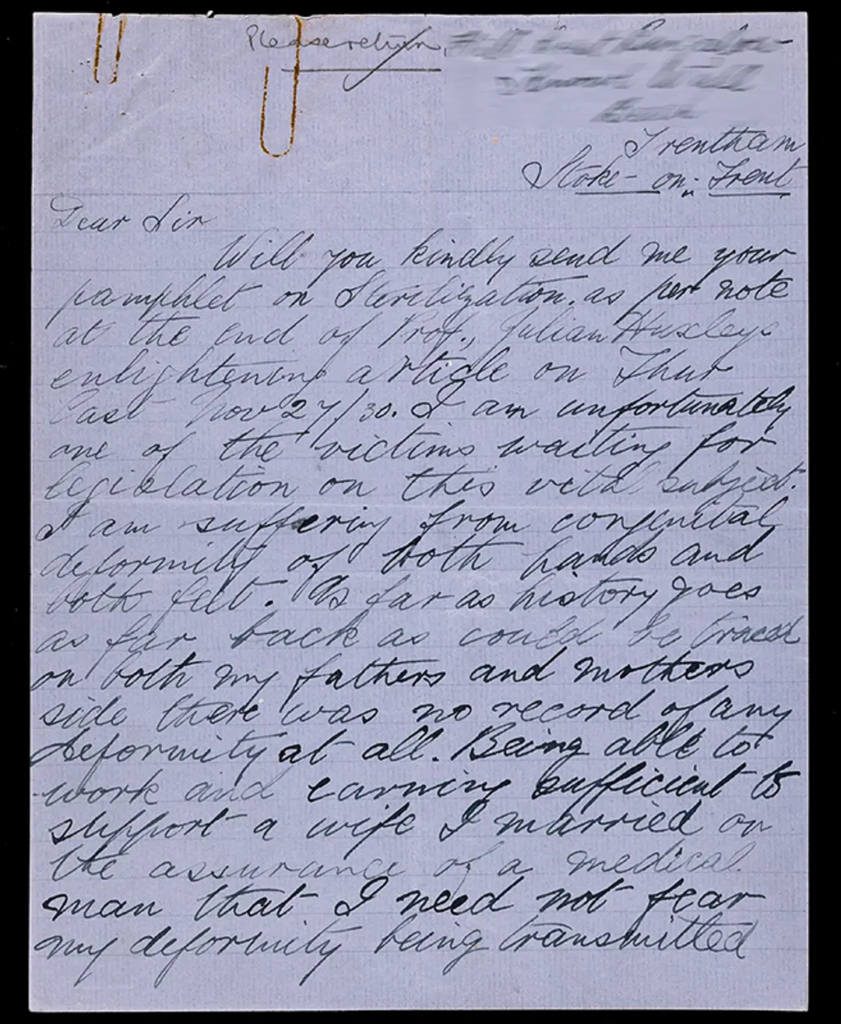
Letter from Mr H of Stoke-on-Trent, UK. Courtesy the Wellcome Collection
This was not a public sterilisation regime imposed by the state. It was not the bureaucratic machinery of compulsory eugenics seen elsewhere. But it was eugenic sterilisation. It was enabled by ideology, medical cooperation, social pressure, class privilege and institutional networking. The law had refused to authorise the practice openly, but eugenics found private channels.
Those channels were easier to access for the wealthy. Middle- and upper-class families could pay doctors. Poor and working-class people who wanted sterilisation faced another obstacle: cost. In some such cases, the Eugenics Society intervened directly, though covertly. If a candidate was judged eugenically suitable — that is, undesirable as a reproducer — the society might connect them with a surgeon and arrange for well-off members of its council to cover the fees.
The letters preserved in the Eugenics Society archive reveal this hidden network. They also do something rarer and more unsettling: they show disabled people thinking with, against and through eugenics. Some did not experience eugenics only as a force imposed from above. Some used its language to pursue what they understood as bodily and reproductive agency.
Mr H is the most striking example. He did not present himself as incapable or dependent. He was proud that, despite his deformities, he could work and support his family. He wrote that he had walked unaided since the age of two and could do most things with his hands that a “normal person” could do. Yet he also believed that reproducing his condition would be wrong. His sense of competence and his desire for sterilisation existed side by side.
He could not afford the operation. Blacker wrote to contacts, including a doctor at Guy’s Hospital in London, asking whether they would take the case and reassuring them that the legal risk was likely negligible. One surgeon hesitated to operate in a public hospital. Another candidate had to be found. Mr H urged Blacker to continue, even encouraging him to raise money among members of the Eugenics Society.
Eventually, support came. One doctor offered half the surgeon’s fee. Major Leonard Darwin, son of Charles Darwin and president of the Eugenics Society, sent money to cover the hospital stay. A surgeon in Leicester agreed to perform the operation for a nominal payment.
Afterward, Mr H wrote with gratitude. His mind, he said, had been relieved of a terrible anxiety. He hoped he might someday help the Eugenics Society in its work. A few months later, Blacker encouraged him to write publicly about his experience as part of a media campaign designed to reduce working-class opposition to the 1931 Sterilisation Bill. Although the Bill failed, Mr H remained willing to assist. He offered to let Blacker share his details with others in similar circumstances so that he could reassure them through his personal testimony about the benefits of sterilisation.
He was a willing participant who used the Eugenics Society to further his bodily and reproductive agency.
That sentence is difficult. It complicates the roles we usually assign in histories of eugenics. We expect the eugenicist to be the perpetrator and the disabled person to be the victim. Often, that is exactly right. Eugenic policies have targeted disabled people with extraordinary violence. But Mr H’s case shows a more entangled history. A disabled working-class man used eugenic networks to obtain a medical procedure he wanted and could not otherwise afford. He then volunteered his story to advance the cause of eugenic legal reform.
This does not make the Eugenics Society innocent. It does not make Mr H an accomplice in any simple sense. It does not erase the ableist assumptions that shaped his choices. But it does require us to take his agency seriously, even when that agency was exercised through a framework we now find abhorrent. He was not silent. He was not passive. He was articulate, persistent and strategic.
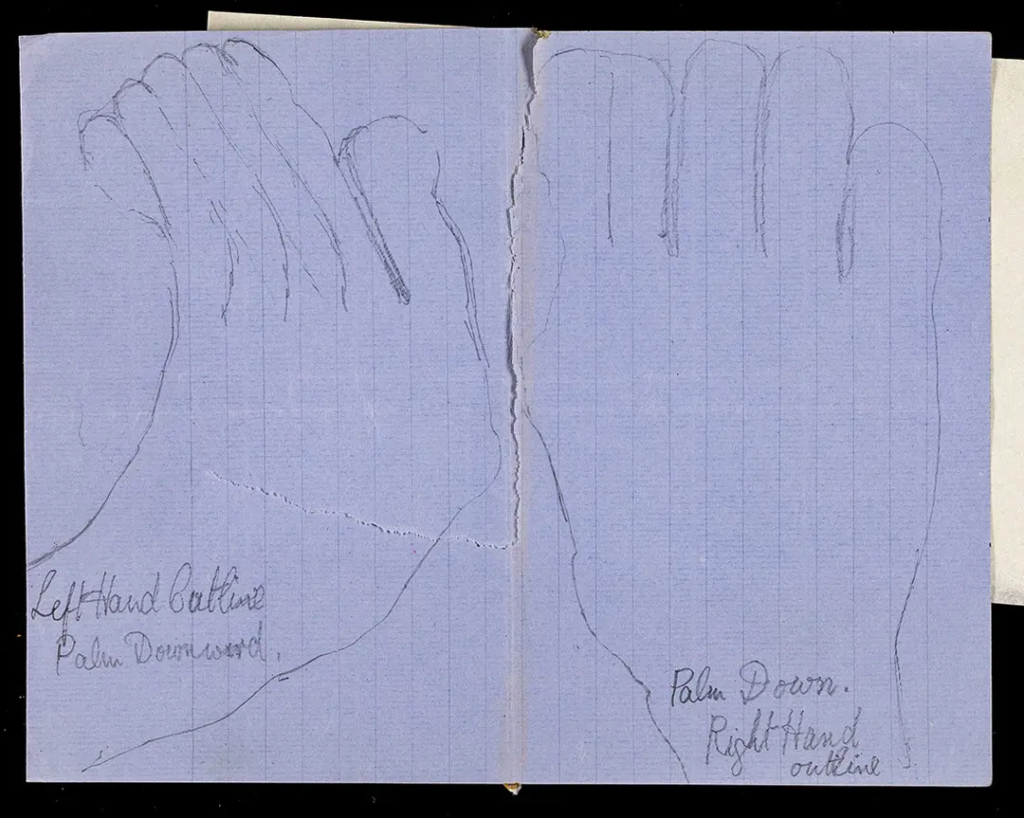
The hand drawings he sent to London make that agency visible in a startling way. The hands are drawn from above, palms down, as though seen from Mr H’s own perspective. One hand is large, with three regularly spaced fingers beside a much larger fused digit. The other seems bent away, its fingers curved as if blown sideways by wind. The pencil lines sit on purple graph paper. They recall children’s handprints brought home from school, but their effect is very different. They seem to wave across the decades, demanding attention.
That attention has been slow in coming. The drawings sit in the papers of Britain’s Eugenics Society, held at the Wellcome Collection in London. The archive has been studied for decades. Scholars have examined its famous members, its policy campaigns, its publications and its links to public debate. Yet the hand drawings and the wider body of letters from sterilisation-seekers have been largely overlooked.
There are practical reasons. The materials are not secret, but they are hard to find. Digital catalogues make archives more accessible, but they also reproduce the classifications through which some lives become visible and others disappear. If a researcher wants correspondence with a prominent figure such as Aldous Huxley, it is easy to locate a file under a named folder. Ordinary people are harder to find. Disabled people are harder still.
As disability historians have shown, disability is rarely tagged clearly in archival metadata. Disabled voices often survive in hostile archives organised by institutions that never intended to preserve them as voices. The letters from sterilisation-seekers are scattered under vague headings such as “general” or “miscellaneous items”. Unless one already knows to look for them, one might never find them. Their discovery depends on luck, patience and a willingness to search against the grain of the archive.
That difficulty has shaped historical interpretation. Scholarship on British eugenics grew substantially in the 1970s and ’80s, often focusing on whether British eugenics was primarily classist or racist. The answer, of course, is that it could be both. But the emphasis on class and race often pushed disability to the margins, even though disabled people were among the most persistent targets of eugenic thought and intervention.
Disability, race and class were not separate categories. They overlapped constantly. Mr H’s experience was shaped both by disability and by working-class poverty. Another correspondent described himself as disabled because he wore glasses and because he was the product of a “mixed marriage”, which he believed caused “racial troubles”. In such cases, race itself was imagined as disabling. Eugenic thinking made these categories reinforce one another.
Courtesy the Wellcome Collection
Still, surprisingly few histories of eugenics place disability at the centre. Fewer still treat disabled people as historical actors with their own interpretations, desires and strategies. When disabled people appear, they are often presented as silent victims. That is understandable, given the violence done to them. But it is incomplete.
Eugenics is something that happened to disabled people, never something they did.
This assumption must be challenged. To do so is not to deny victimisation. It is to ask what kinds of agency existed within oppressive systems. One common way to resist victim narratives is to call people survivors instead. But some historical actors explicitly understood themselves as victims, and not always in the way we expect.
Mr H described himself as a victim not of eugenic policy, but of its absence. He wrote that he was one of the victims waiting for legislation on sterilisation. In his view, the lack of legal access denied working-class disabled people control over reproduction. He was a Labour voter, but he disagreed with Labour opposition to the Sterilisation Bill. He argued that eugenic legislation would benefit the working classes economically as well as eugenically. He told Blacker he was in hearty agreement with the society’s aims.
We do not have to endorse his reasoning to recognise its meaning. Mr H inhabited a world in which disability was stigmatised, poverty was precarious, birth control was limited, medical authority carried great weight, and eugenic language offered one of the few available ways to articulate a demand for reproductive control. His choices were shaped by oppressive assumptions. They were also choices.
This is why believing disabled historical actors matters, even when what they say is uncomfortable. Disabled people have long been subjected to epistemic injustice, including disbelief about their own bodies, pain, capacities and needs. To dismiss Mr H’s testimony because it does not fit our expectations would repeat, in another form, the silencing that disability history seeks to undo.
Taking him seriously means acknowledging the depth of entanglement between disability and eugenics. Eugenics was not only a doctrine imposed on disabled people by able-bodied experts. It also entered the ways some disabled people understood heredity, responsibility, suffering, family and bodily autonomy. For some, it became a language through which they could ask for medical intervention. That fact is disturbing precisely because it shows how deeply eugenic assumptions had travelled.
The same recognition should sharpen, not soften, our criticism of the Eugenics Society. Its members did not merely campaign for laws that failed. They built networks, shaped medical opinion, answered private requests, helped arrange operations and used ordinary people’s stories to advance political aims. They profited rhetorically from the desperation of those who wrote to them. They offered access, but access on eugenic terms.
The British story of eugenics therefore cannot be told as a simple story of failure. The Sterilisation Bill failed. Parliament did not authorise the programme. But eugenic practice continued below the level of law. It moved through private medicine, class privilege, charitable payments, professional discretion and personal correspondence. It was not absent. It was unofficial.
Nor can the story be told only as one of powerful men victimising disabled people, though that story contains much truth. There were powerful men. There were victims. There was exploitation, coercion, ableism and class contempt. But there were also disabled people who wrote, argued, requested, negotiated and sometimes collaborated with eugenic institutions for their own reasons. The archive forces us to hold these realities together.
Such complexity is not comfortable. It unsettles the moral clarity that histories of eugenics often seem to demand. But discomfort is not a reason to simplify. The past is not more ethical when it is made easier to narrate. If anything, the danger of eugenics becomes clearer when we see that it did not operate only through monsters, laws and camps. It also operated through ordinary anxiety, parental grief, medical advice, financial barriers, newspaper articles, personal letters and the hope of avoiding future suffering.
Mr H’s hands remain at the centre of this history. They were evidence, plea, self-portrait and argument. They showed the society what he feared he had passed on. They also showed what he could do: draw, write, petition, insist. They make it impossible to imagine him as only an object of eugenic power. He was also a participant in the archive, marking the page with the body whose future he wanted to control.
The story those hands hold has barely been told. It changes what we thought we knew about Britain. Eugenic sterilisation did not simply bypass the country. It took forms that were quieter, more private and more difficult to count. It changes what we thought we knew about disabled people in eugenic history. They were not always only acted upon. Some acted, even within the terms of a violent ideology.
To recognise this is not to blame them. It is to understand how oppressive systems become powerful enough to shape desire itself. Eugenics promised control in a world that denied control to many of the people who sought it. That promise was false and damaging, but it could still feel like agency to those who had few other routes.
A fuller history of eugenics must therefore include not only the lawmakers, scientists and campaigners, but also the letter-writers, petitioners and sterilisation-seekers. Their stories show how policy failure can coexist with private practice, how ideology can become intimate, and how victims of a system may sometimes speak in its language while trying to secure their own ends.
The standard story of British eugenics has been too tidy. It tells us that an idea born in Britain found its most brutal applications elsewhere. The letters say otherwise. Britain did not need a successful Sterilisation Act for eugenic sterilisation to occur. It needed doctors willing to help, campaigners willing to coordinate, wealthy supporters willing to pay, and people desperate enough to ask.
Those people left traces. Some are folded into envelopes. Some are hidden in miscellaneous files. Some are drawn in pencil on purple graph paper. They are difficult to find, and harder still to interpret. But once seen, they change the archive around them.
The hands are still waving.