









I find it hard to remember the first time I became aware of wealth. It seems always to have been there, like a smell in the air: not necessarily named, but unmistakably present. At seven, I attended a private Quaker school in Cambridge, Massachusetts. Some of my friends came from the Boston suburbs, from houses that were large, quiet and polished, the sort of houses that seemed to belong in magazines. When they came to my home, I felt ashamed. Our house was smaller, and in that difference I sensed something had been exposed. Later, when we moved to Arlington, Virginia, and I went to public school, the shame reversed itself. Our house was larger and more comfortable than the homes of some of my friends, and I became uneasy about having too much. A house, absurdly enough, was one of the first instruments by which I learned to measure class.
Wealth was never an abstraction. It was the size of a room, the manners at a table, where one went on holiday, who could afford to call someone to fix things, who spoke with the confidence of never needing to explain. My father was born into a poor farming family and climbed, by scholarships and work, into a world that had not been built for him. My mother came from the opposite pole. Her father was an early billionaire. From the beginning, then, my identity was pulled between two competing psychologies of class. On one side there was the confidence, daring and expectation of welcome that privilege can produce; on the other, the thrift, endurance, self-drive and suspicion of luck that grow out of scarcity.
My grandfather was never embarrassed by his position. He pursued wealth with the concentration with which other people pursue salvation. My childhood memories of him are attached to his country estate in Millbrook, New York: salamanders by the swimming pool, the smell of hunting dogs in their kennels, caviar appearing at dinner as if it were merely another condiment. He was the sort of man who competed at everything, even with children. He would beat us at backgammon and take the victory seriously. He was also the sort of man around whom other people became alert. They wanted his attention, his approval, a place inside his field of vision, though he himself lived a highly private life.
He came from a Greek shipping family and arrived in the United States after the war. It was a moment when shipping fortunes could expand with astonishing speed. Decommissioned vessels were bought cheaply and converted into machines for profit on newly enlarged trade routes. Greek shipping rose on loans, state guarantees and the reorganisation of postwar commerce. As the only son in his family, my grandfather was chosen to carry forward an industrial dynasty. As a young man, he tried briefly to escape it. He dropped out of Princeton and imagined becoming a writer, writing novels, living some bohemian life. But when my grandmother became pregnant with my mother, that literary dream was closed down. He returned to the role prepared for him: provider, heir, shipping magnate.
When his father died, he inherited the principal share of the company and fortune. The women of the family believed they had been pushed aside. His sisters spent years in litigation, arguing that he had failed to provide properly for his mother and sisters according to the will, and had instead concentrated resources in his own business and art collection. Wealth, in this sense, was not merely money. It was the power to interpret, to inherit, to narrate the family. Whoever could claim to represent the family could determine the radius of everyone else’s life.
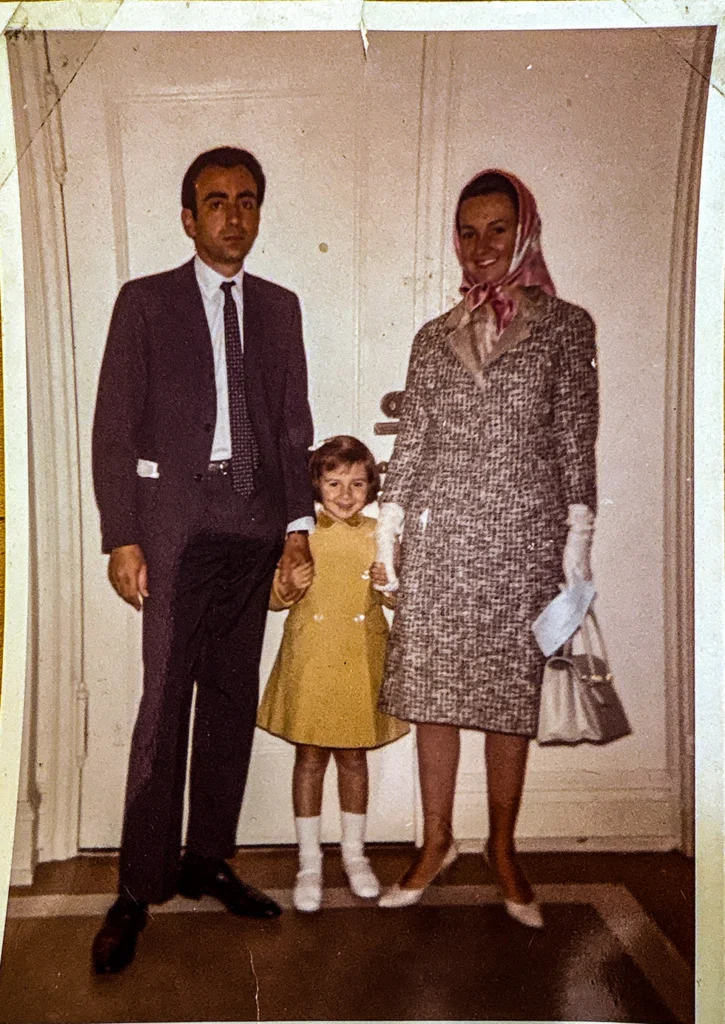
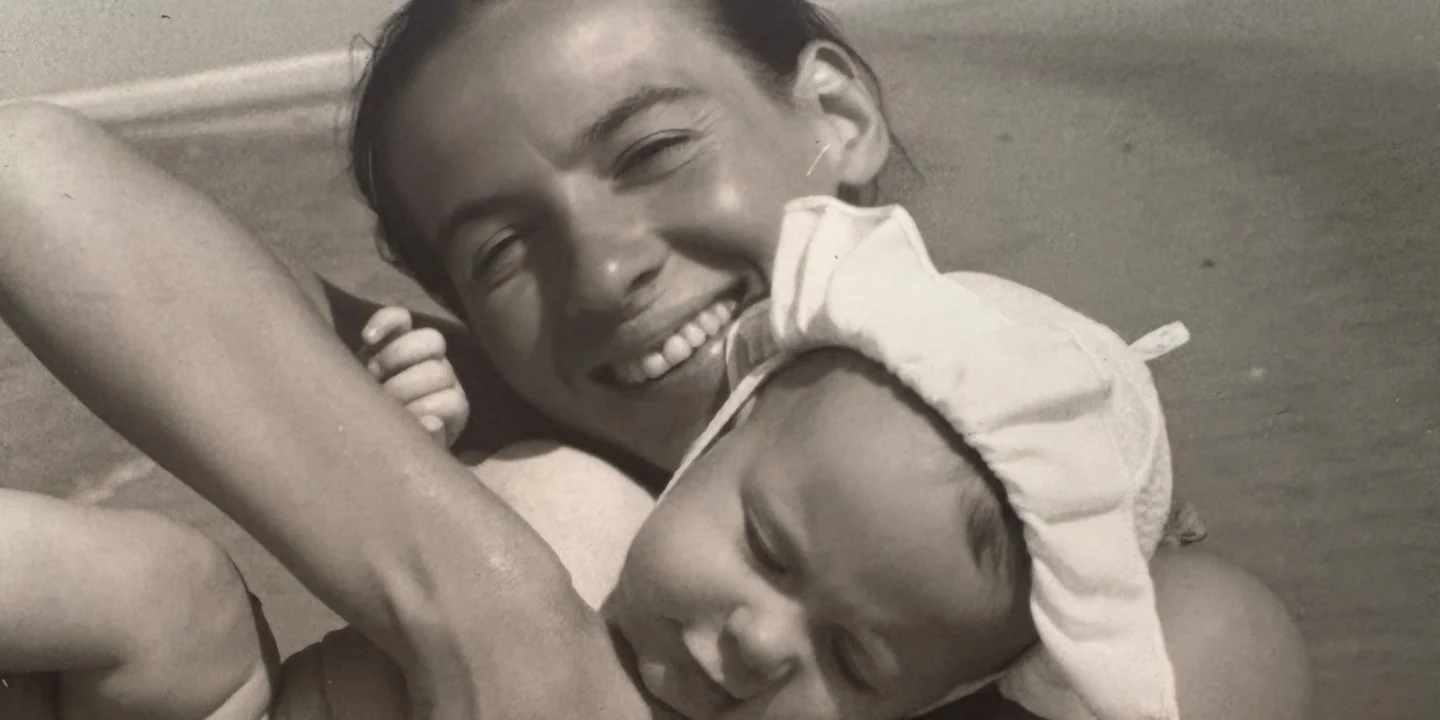
The author’s mother with her parents on her first day of kindergarten, Park Avenue, New York City, 1963
It is not unusual for the children and grandchildren of the super-rich to leave the feathered nest.
When my mother and her sisters grew up, they too received less support than they believed should have been theirs. My grandfather did help them with down payments on houses, and with certain buffers for retirement, but set against the scale of wealth they had seen as children, these gestures seemed like luggage handed out from the door of a palace. They entered adult life with a Park Avenue mentality and without Park Avenue finances. They loved travel, romance, motherhood, books, mysticism and spiritual pursuits. They loved the juicy parts of living. They approached the world with meraki, as the Greeks say: doing something with love and soul. Yet they lacked stable financial training, like exiles from an aristocratic theatre who had kept the gestures of the stage but lost the stage itself.
I became, very early, an observer of the world of wealth. From the outside it glitters. From within it often has a cold, airless, hollow quality. Extreme wealth does not always make people freer. It can also produce a protected desolation. I later learned that it is not rare for the children and grandchildren of the super-rich to turn away from money, power and the family orbit. My own ease in distancing myself from privilege came largely from my father. He grew up in a poor farming community in Missouri, in a household with almost no margin. He made his way to Harvard on scholarship, like the hero of an American self-improvement tale, pulling himself out of one landscape and into another.
My parents seemed to understand the world from different planets. My mother believed in abundance, exception and the idea that life should open itself to her. My father was cautious, frugal and risk-averse, carrying the shame often found in those who rise from working poverty into spaces that still do not feel made for them. He worked hard, but in certain upper-class settings he seemed uneasy, as though someone might at any moment discover that he did not properly belong. A family friend once described the difference between them through the way they peeled a pear. My father peeled carefully, making sure no fruit remained on the skin. My mother did it casually, as though fruit was not something one had to count. That image stayed with me. I grew up trying to locate my own hand somewhere between their two ways of peeling.
My father’s childhood and my grandfather’s later life formed an almost absurd contrast. In the Missouri winters of his boyhood, my father slept on the porch because there were too many children and not enough rooms, keeping warm with a heated iron. My grandfather spent much of his old age at the Carlyle Hotel in New York, surrounded by a doorman, a cook and staff. Yet both men believed themselves to be self-made. That shared belief gave them a form of mutual respect, even though their starting lines were so far apart that they might as well have been in different countries.
My father was accepted into my mother’s family, and not only because of love. In Greek society, cross-class marriage was not uncommon, especially when aristocratic daughters were matched with ambitious merchant or entrepreneurial sons. There could be suspicion toward sons of privilege. Had comfort softened them? Would they still possess the drive to earn, provide and fight? My father’s poverty, in this respect, became a kind of trustworthy masculine capital.
I slept in a tiny bedroom without a proper door, then flew to Rio for Carnival.
Neither of my parents was good with money. My father had not learned financial planning from his family. His own father died in a tractor accident when my father was 14, leaving no pension, no savings and, as it turned out, tax troubles and debt. My mother, meanwhile, had grown up inside a myth of wealth and believed money would somehow appear. She believed in inheritance, in luck, in a mysterious multiplication of loaves and fishes. In different ways, both of them were outsiders.
As a young person, I romanticised that outsider quality. The toughness of the lower classes and the abandon of the upper classes both seemed more dramatic than middle-class life. In my 20s, I swung between severe frugality and sudden extravagance. In college, I rarely ate out and lived in a tiny room without a proper door, paying rent so low it felt like a moral exercise. But when the chance came, I would fly to Rio de Janeiro for Carnival and disappear into music, bodies and the night of privilege. By day, I lived like a Protestant. By night, I behaved like an heir.
With age, I have come to accept something my younger self would have despised: the virtues of the middle class. Stability, budgeting, retirement accounts, insurance, paying bills on time, moderated desire — all these things once seemed dull to me. Later, they became the basis of psychological safety. I discovered that I could navigate mainstream American culture better than either of my parents. I understood its rules and could use its protections. The middle station is not merely an economic position; it is a form of self-regulation. Hume once praised the middle station of life as the condition most favourable to virtue, friendship and judgment. I used to find that idea dreary. Now I increasingly understand it. Class positions too high or too low both produce distortions. The middle is not romantic, but it allows one to breathe.
And yet the world today seems to be moving away from any middle. Billionaire wealth, power and influence expand with every news cycle. Almost daily, there is another story of extreme accumulation. Some predict that trillionaires will soon arrive. Strangely, most people do not treat being extremely rich as a moral problem in itself. They are often quicker to condemn divorce, gambling, adultery, marijuana, even spanking children, than to say that unlimited wealth accumulation is a social danger.
Part of this permissiveness comes from our own fantasies. Billionaires keep alive our unrealised dreams of success. They are magnified versions of our own desires: larger houses, faster aircraft, freer time, lives that require less explanation. But in other moods, we resent them, because they seem to be tearing holes in the social contract. Tech billionaires influence elections and policy, hold weddings like royal ceremonies, become fascinated by apocalypse compounds, psychedelic retreats, longevity experiments, reproductive ethics and heroic masculine myths. Some psychologists have described the mentality of the very rich in terms of a “Dark Triad” of Machiavellianism, psychopathy and narcissism, as though billionaire wealth were not only an economic state but a personality ecology.
Moral philosophers of earlier ages would not have been surprised. They were deeply suspicious of luxury, believing that it poisoned both the individual and the commonwealth. Desire, once freed from restraint, could produce restlessness, rivalry, vanity and spiritual hollowness. Eighteenth-century thinkers worried that emerging consumerism would unbalance the self. If they could see the mythology surrounding today’s runaway entrepreneurs, they might feel that their warnings had not aged. Excess wealth does not merely allow more enjoyment. It gives fuel to impulse, exceptionalism and self-deification.
Speaking about privilege can feel like a coming-out. Many feel shame, even speechlessness, around wealth.
But one need not be a billionaire to be poisoned or paralysed by wealth. Inherited money is especially capable of doing this. Studies suggest that wealthy teenagers experience higher levels of anxiety than their less affluent peers. They are expected to achieve, but not to appear vulnerable; protected, yet isolated; resourced, yet often cut off from ordinary forms of intimacy. A friend from a multigenerational wealthy family once told me a catalogue of dysfunction: addiction, personality disorders, theft within the family, emotional coldness, the trauma of losing money, abuse. He had seven nannies in childhood, found his mother distant, and grew up inside a family legend that traced itself proudly to William the Conqueror. Yet he often felt unseen. People noticed the surname, the history, the fortune, the estate — not him.
Many young inheritors are taught from childhood not to talk about money. Do not tell lovers. Do not tell friends. Do not tell classmates. Do not let people know what you really have. Money becomes a secret, and also a danger. Some grew up during Occupy Wall Street and absorbed a public story in which rich people were evil and deserved punishment. One young woman described feeling stranded with her wealth on a tiny island. She knew she had benefited, but feared being reduced to an oppressor.
This silence has its own etiquette. Rich people do not avoid talking about money because money is unimportant. They avoid it because money is too important. Wealthy families have a whole system of money manners: do not ask, do not say, do not appear too interested, and do not admit how thoroughly money has formed you. Many heirs reach adulthood without really knowing how much they have, how much they may use, or how much they are allowed to give away. Wealth managers often teach them to protect the principal, preserve the line, and prioritise future descendants. It sounds prudent. In practice, it often locks wealth inside a family machine and prevents it from flowing outward.
Some heiresses see particularly clearly the relation between wealth and control. In certain families, women have money but no power; trusts but no freedom; the status of beneficiaries, but lives managed by fathers, husbands, brothers, lawyers and family offices. One young woman was required at 18 to sign over control of her finances to her father. Another could not open a bank account or obtain a phone contract without permission. Another was told that work was something ordinary people did. For them, wealth was not liberation. It was a gilded leash.
Patriarchy recurs constantly in stories of wealth. Wives ask husbands for allowances. Daughters are excluded from companies. Sisters are pushed aside by brothers. Women trade identity for social function, expected to maintain a class image rather than control the assets beneath it. Great wealth often does not weaken patriarchy. It magnifies it, because money makes control easier and more respectable. One does not need to forbid directly. One need only control the trust, the account, the inheritance and the family reputation.
My mother and her sisters were different from the silent ornamental women of such stories. Perhaps because they did not truly inherit their father’s empire, they acquired a certain freedom. They were reckless, vivid, forceful, sometimes too expressive, sometimes careless of other people’s feelings. They were often broke, but not trained in the habits of poverty. They had aristocratic gestures without aristocratic security. They did not naturally know how to budget, plan for retirement, handle parking tickets, arrange childcare without help, or perform the rites of middle-class existence. They were exiles from their original class who had never fully learned the language of the next one.
As a child, I saw them as goddesses without a kingdom: free, excessive, dangerous. Later, I understood that their freedom carried a wound. Their exclusion from their father’s wealth had paradoxically created a small female universe. Younger men in the family sometimes describe growing up under a matriarchy, because these women were so strong, so present, that no man could easily take the centre near them.
By leaving only a very small part of his vast fortune to his children, Bill Gates is giving them the chance to become themselves.
Perhaps my grandfather’s refusal to hand my mother the fortune forced her, in some way, to become herself. Not inheriting required her to create a life rather than merely administer one. But this does not mean the wound disappeared. In the psychology of families, not inheriting can mean not being loved. Money is not only material. It is recognition, the gaze of the father, proof of being chosen.
Some wealthy people have begun to address this problem differently: by redistributing wealth, or by confronting the historical debts attached to inherited money. Bill Gates has said that leaving children enormous wealth is not a favour to them, but a way of depriving them of the chance to build their own success. By leaving only a very small portion of his fortune to his children, he is, in a sense, allowing them to develop identities not simply continuous with his money.
I have spoken with young wealth-holders who describe redistribution as a form of liberation. One, from Portland, Oregon, came from a family that made money selling pipes and hardware supplies to real-estate developers. He now directs funds toward Indigenous sovereignty, housing, racial justice and causes connected to the places and systems from which his family wealth was extracted. He understands that his money did not arise from air. It came from land, labour, policy and unequal structures. Redistribution, for him, is not decorative charity. It is a way of admitting his relation to historical harm.
Some of these young people belong to organisations that bring together wealthy young adults to redistribute money. When I first heard of such groups, I did not entirely understand them. A person in his 20s agonising over a million-dollar inheritance seemed, to me, almost self-indulgent. That amount could provide housing security, children’s education, medical protection. Why rush to dismantle one’s advantage? A practical and judgmental aunt inside me said: why not keep it? The world is so unequal; your small fortune will not change the structure.
But later I saw that such groups offer not a macroeconomic solution but a training in consciousness. They help the wealthy speak about money, understand money, and dismantle the shame, fear and myth surrounding money. The members seemed to have undergone a kind of therapy. They were no longer paralysed by wealth, nor did they treat it only as a private cushion. They had begun to see money as relation, history, power, and something capable of being rearranged.
She can give away more money than she earns, and her life will hardly change.
One young inheritor from Tokyo told me that her wealth came from a father and grandfather in investment banking and finance. Her parents were conservative and would see redistribution as a rejection of their work and sacrifice. But her trust gave her a particular freedom: she could use money for causes they did not approve of. She realised that she could give away more money than she earned, and that her life would not materially change. This recognition was profound because it broke an artificially manufactured sense of scarcity.
We rarely imagine that rich people suffer from scarcity mindsets. Yet many holders of multigenerational wealth live inside exactly that story. Ancestors endured war, famine, bankruptcy, migration or economic collapse, and passed down the belief that there is never enough. My grandfather saw people begging for food at the gates during the Greek famine. Wealth protected him, but it also taught him that if he stopped working, accumulating and defending, hunger might be just outside the door. For many of the very rich, hoarding is not described as greed. It is described as safety. They say it is not for themselves, but for children, grandchildren, lineage, the future.
Scarcity thinking is the most convenient moral justification for hoarding wealth. Any substantial gift can be called irresponsible. Any use of principal can be called betrayal of future generations. Any tax can be called punishment for success. Wealth management often reinforces this logic, because its own livelihood depends on wealth continuing to be managed rather than released. The wealthy are trained to become gatekeepers, guarding a vault they themselves are often afraid to leave.
Another young inheritor told me that she had come to see her wealth as a product of deep inequality, while also feeling psychologically bound by her parents’ fears about money. She later studied the international financial system, trying to understand how it might be made less extractive. In a sense, she was working against the very system from which her privilege had benefited. Yet she also admitted that she had almost no working-class friends. Wealth gives people not only money but a boundary of relationships. It quietly teaches that the rest of the world exists to serve, manage, protect, transport, clean and care for you. To change, one must not only give money away, but relearn how to relate to people outside one’s class.
Some inheritors go further. One heiress deliberately relinquished her identity as part of the owning class and invited a cross-class, racially diverse group of artists, activists and organisers to help determine how millions of dollars should be used. She did not merely write cheques; she created relationships. She did not merely give; she gave recipients decision-making power and personal gifts. The radicalism of such an approach lies in its recognition that economic justice is not only a movement of funds, but a rebuilding of relationships.
American economic mythology loves the story of self-reliance, as though upward mobility comes chiefly from diligence and grit. But more and more research suggests that social capital, cross-class relationships and economic connectedness are what matter most. Who knows you, who vouches for you, who teaches you the rules, who brings you into the room — these things often matter more than grit. A society without cross-class friendship loses the very structure of opportunity. If the re-education of the wealthy consists only of giving, without changing their networks of relationship, it remains inside the bubble.
My grandfather gave up Greek citizenship and became a citizen of the Bahamas to protect his wealth.
Of course, not all wealthy people are reflecting. Many are enjoying power quite comfortably. Philanthropy itself is often a vanity project: a way for the rich to enhance reputation, bypass democratic process and turn private preference into public good. Philanthropy can ennoble wealth without touching the structure by which wealth was accumulated. A person first gains vast resources through a system, then returns a small portion under his own name. This may do good, but it can also reinforce the illusion that private accumulation naturally serves the public.
Taxation is less glamorous than philanthropy, and more democratic. It does not depend on the moods, tastes or brand strategies of the wealthy, but redistributes through public institutions. For precisely this reason, rich people often resist it more. They may like charity dinners and hate tax authorities. When proposals arise for billionaire taxes, the fear is always that the wealthy will leave for tax havens and offshore accounts. My own grandfather never became an American citizen and eventually renounced his Greek citizenship to become a citizen of the Bahamas, protecting his wealth. This break with place and nation is typical of modern super-wealth.
The industrial magnates of the past could be ruthless, but they were often more deeply attached to place. Carnegie, Rockefeller, Mellon, Hershey, Ford — these men built libraries, universities, museums, factory towns. Whether out of paternalism, vanity or civic pride, they invested part of their wealth back into local and national life. Today’s billionaires are more placeless. They can register, reside, shelter wealth, invest and withdraw almost anywhere. Their loyalty belongs to capital mobility, not to a city, a nation or a particular group of workers.
The immigrant story often contains the idea of a better place elsewhere: leave here, go there, find prosperity. Upward mobility can mean exchanging local roots for economic opportunity. For many who pursue wealth, severance is not a side effect but the path itself. Seen this way, we can better understand why taxing the wealthy triggers such intense defences. It is not only a financial issue. It is an identity issue. Taxation asks the wealthy to admit again that they belong to a society, not merely to their balance sheets.
If the very rich are to change, policy alone may not be enough. Every year I read about the billionaire “summer camp” in Sun Valley, Idaho: hiking, rafting, golf, media barons, tech founders, private conversations, corporate deals. It is a resort for power. I often imagine what an opposite kind of billionaire retreat would look like.
I would design for them an existential curriculum. The first module would be feminist theory, racial justice and intersectional analysis, specifically to counter bro culture, patriarchal culture and structures of white supremacy. The second would be a history of philanthropy, from Victorian charity to modern foundation politics, showing how giving can both help people and preserve power. The third would be immersive fieldwork — not poverty tourism, but serious study of how housing, migration, debt, healthcare, labour and environmental inequality interlock. The fourth would be social-capital training, requiring them to build durable relationships outside the boardroom, private school and foundation dinner circuit. The fifth would be work on the self: distinguishing authentic identity from internalised class identity, examining exceptionalism, entitlement and the myth of being self-made.
Naturally, to accommodate their appetite for pleasure, I would include a Scandinavian field trip, with northern lights and dog-sledding, so they could study how high-tax, high-trust societies function. Then on to the Brazilian rainforest, to learn something about ancestorhood and environmental stewardship. They would need to understand that wealth is not fuel for escape from the world, but a debt the world is asking them to answer.
The purpose of such re-education would be to help wealth-holders understand the phenomenology of their wealth: how it feels in the body, how it works in relationships, how it was formed historically, how it is protected institutionally. Great wealth creates many illusions: I am exceptional; I deserve this; I am smarter; I worked harder; my success proves the system works. The first step in therapy is to loosen these illusions. The second is to make the rich face the raw fact of inequality: they do not possess too much because others need too little, but because the system permits some people to lock too much under their own names.
Today, many billionaires indulge in fantasies of apocalypse preparation. They buy remote land, build compounds, plan private escape routes and imagine how they will survive social collapse. But what needs preparation is not their individual retreat. It is the survival of the common world. If society is at risk of collapse, those with the greatest resources also have the greatest responsibility. They should not merely prepare shelters for themselves. They should prepare for the common good.
Billionaires could adapt to a different kind of descent. They could give money away and learn to become ordinary multimillionaires, returning to a human scale. Class descent sounds like punishment, but it may in fact be a form of rehumanisation. My mother did not inherit an empire, and because of that she was forced to create her own life. She carried a wound, but also a freedom. Perhaps the therapy many billionaires truly need is not more safety, more control, more compounds or more wealth management, but the loss of some portion of wealth, and the recovery of the ability to live among others.