











Four centuries ago, in the Norwegian coastal town of Vardø, a woman named Else Knutsdatter was executed after being accused of raising a storm through witchcraft. The storm had killed dozens of men at sea. In a world without modern meteorology, disaster demanded a human author. Wind, pressure, currents and weather systems were too abstract to hold responsible. A woman could be named, tried and burned.
We now know that storms are not summoned by malice. They emerge from vast systems: temperature differences, oceanic forces, air pressure, geography and chance. In matters of weather, at least, we have learned to think systemically. Bad things can happen without a villain directing them. But in politics and economics, our progress has been less certain. When a harmful transformation occurs, we still ask: who planned this? Which executive, politician, billionaire or hidden cabal decided it should happen? Sometimes this question is necessary. Powerful people do make decisions. They lobby, profit, deceive and coerce. Yet not all power appears in the form of a secret meeting. Some of it moves through systems that carry people along, rewarding those who accelerate the dominant trend and punishing those who resist it.
This is the difficulty at the centre of the campaign to defend physical cash. I have spent years arguing that notes and coins should be protected, promoted and kept alive as part of a healthy monetary system. The obvious enemy appears to be Big Finance and Big Tech. Banks close branches and ATMs. Card networks profit from every transaction. Smartphone companies turn payment into a feature of their walled gardens. Retailers announce that they have “gone cashless” as if they have made a neutral upgrade. Governments speak the language of efficiency and inclusion while quietly welcoming systems that make transactions easier to monitor.
All this is real. But it is not the whole story. The disappearance of cash is not simply a plot against the public, nor is it the result of ordinary people freely demanding a frictionless future. It is better understood as the outcome of a system that increasingly wants every interaction to become faster, traceable, automated and monetised. Cash, by its nature, resists that system. It moves slowly. It works offline. It can pass from hand to hand without registration. It allows small transactions to remain small. It does not generate data. It does not ask permission from a bank server. It does not require the user to own a smartphone, maintain an account, update software, accept terms of service or remain legible to a fraud algorithm.
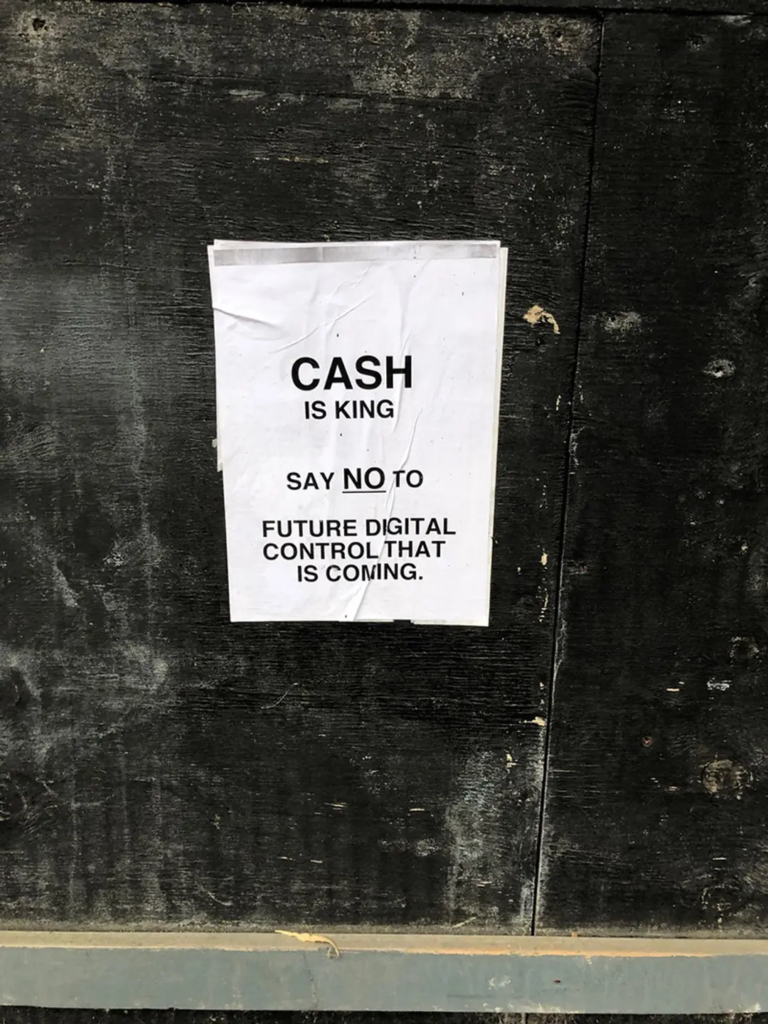
Figure 1. A street poster warning against a cashless future.
Anti-cashless messages often frame digital payments as a question of freedom, control and public resistance.
This is why the war on cash is so often misdescribed. The usual story says that people are simply choosing digital payments because they are convenient. The public has allegedly spoken through its taps, swipes and scans. Politicians, bankers and fintech executives present themselves as humble responders to our desires. We wanted speed; they delivered it. We wanted seamlessness; they built it. We wanted a modern life without the burden of coins and notes; they obliged.
But this story is too tidy. Many people use cards because cards are offered, encouraged, normalised and increasingly required. The fact that I sometimes use a digital payment does not mean I asked every café, train kiosk, parking meter and sports stadium to refuse cash. It does not mean I want money to become inseparable from banks, apps, network fees and data trails. Behaviour inside a narrowing system is not the same as consent. When one payment route is made easier and another is quietly obstructed, the resulting “preference” tells us less about desire than about infrastructure.
Physical cash is public money. It is issued under public authority, generally through central banks, and it circulates as a bearer instrument. Whoever holds a banknote can spend it. The money in a bank account is different. It is a claim on a private institution. It exists as an entry inside a commercial banking system. When you tap a card or phone, you are not handing over public money. You are asking a chain of private actors to update records on your behalf. Banks, card networks, payment processors, device companies and data systems all stand between you and the person you are paying. They do not merely move value. They observe, sort, charge, approve and sometimes deny.
This is the deeper transformation. Going cashless does not simply replace paper with pixels. It turns payment from a public act of transfer into a private act of permission. Money becomes less like a thing you hold and more like a door you are allowed to pass through, provided your identity, account, device, location, risk score and transaction type are acceptable to the system.
That is why cashlessness should not be understood only as privatisation, though it is that. Nor only as surveillance, though it is that too. It is also a change in the architecture of citizenship. A cash user can participate in the economy without being continuously authenticated. A fully cashless person must be recognised by institutions before they can act. This is a profound shift. The question is no longer simply whether you have money. It is whether the network agrees to let your money move.
The financial and technology industries gain enormously from this shift. Visa, Mastercard, banks, fintech platforms, mobile wallet providers, cloud companies and large retailers all benefit when payments become digital, centralised and data-rich. Digital payments generate fees. They produce behavioural data. They make transactions compatible with automated accounting, loyalty systems, credit scoring, advertising, fraud detection, tax collection and platform governance. Every tap is not just a payment. It is a small contribution to an expanding infrastructure of financial visibility.
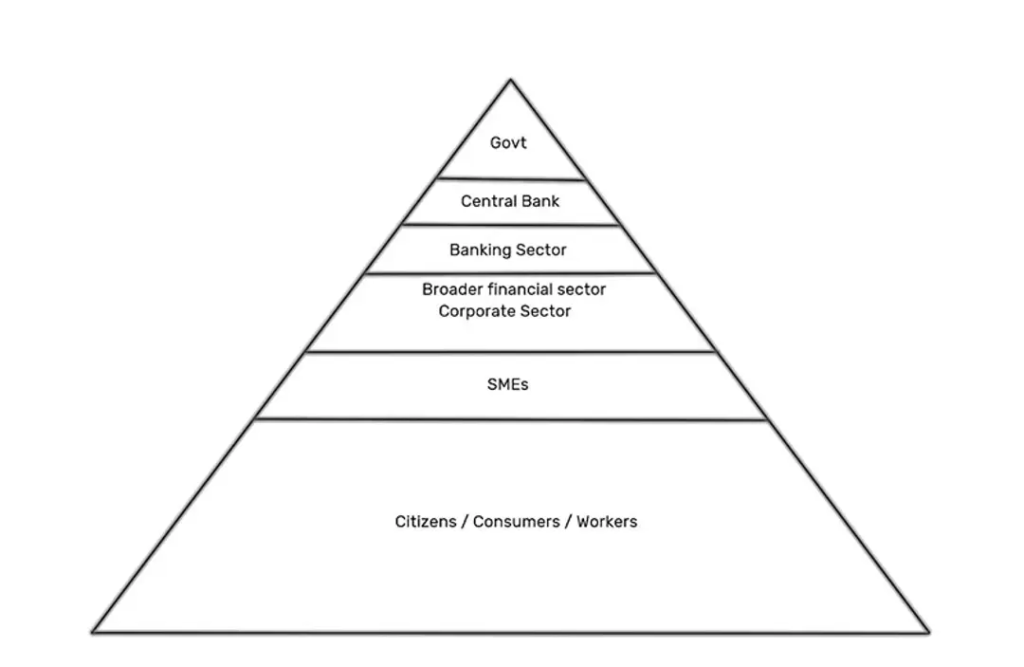
Figure 2. The payment power pyramid.
A cashless economy does not simply connect buyers and sellers; it inserts banks, platforms and payment networks into almost every transaction.
It is not surprising, then, that critics of cashlessness often suspect conspiracy. The beneficiaries are visible. The rhetoric is coordinated. The direction of travel is consistent. Corporate leaders, central bankers, consultants and policymakers all repeat the same phrases: innovation, inclusion, efficiency, convenience, security, modernisation. To many people, this sounds like a script. Sometimes it is. Industries do lobby, coordinate and manufacture consent. But the script is powerful not only because powerful people repeat it. It is powerful because it matches the deeper logic of the economy they inhabit.
A useful way to picture this is not as a puppetmaster but as a current. Executives, policymakers and consumers are all standing in a river. Some are stronger swimmers, some are clinging to rocks, some are building boats, and some own the mills downstream. But the river has a direction. It pushes toward scale, speed, data extraction, automation and platform control. Those who move with it appear innovative. Those who resist it appear backward. No secret council is needed for the current to carry society in one direction.
Cashlessness is not merely the end of cash; it is the conversion of money into an access system.
This systemic pressure is easy to see in everyday life. A bank closes a local branch to cut costs and encourage app use. With fewer branches, small businesses find it harder to deposit cash. Some businesses then stop accepting cash, saying it is inconvenient. Customers encounter more cashless shops and begin to carry less cash. With lower cash use, banks claim there is less demand for ATMs and close more of them. With fewer ATMs, it becomes harder to obtain cash. The decline of cash becomes proof that cash is declining naturally. The system produces the evidence that justifies its next step.
No single actor needs to order this sequence. It is a feedback loop. Each decision appears rational inside its narrow frame. The bank cuts costs. The retailer simplifies operations. The customer adapts. The policymaker reads the statistics. The fintech firm offers a solution. Together, the pieces create coercion without anyone needing to call it coercion.
The same logic operates at the level of large platforms. Amazon has little reason to build an infrastructure for cash. Its model depends on accounts, stored payment credentials, logistics data, automated fulfilment and customer tracking. A cash payment is not just inconvenient for Amazon; it belongs to a different world. The more commerce is reorganised around Amazon-like systems, the more cash appears archaic. Street-level shops then feel pressure to imitate the platform logic. They install tablets, QR codes, card readers, delivery apps and loyalty systems. A handwritten sign reading “card only” is often presented as a small operational choice. In reality, it is a tiny act of alignment with a much larger machine.
Cash is friction, but the word “friction” deserves scrutiny. In the language of business, friction is usually bad. It slows conversion. It interrupts flow. It gives people time to hesitate. It creates costs that cannot be easily automated away. But not all friction is harmful. Doors have locks. Courts have procedures. Voting has rules. Public space has pauses, delays and negotiations. Friction can protect freedom by preventing every process from being optimised for extraction. Cash is a form of democratic friction. It slows the total conversion of social life into data and account relationships.
To call cash inefficient is therefore not enough. Inefficient for whom? Cash may be inefficient for a bank that wants to close branches. It may be inefficient for a chain retailer that wants fully automated checkout. It may be inefficient for a tax authority seeking total visibility. It may be inefficient for a platform that wants to integrate payment with identity, advertising and behavioural prediction. But cash can be highly efficient for a child buying a snack, a street musician receiving a tip, a migrant worker sending help through informal networks, an elderly person budgeting with notes, a person escaping an abusive household, or a small merchant who does not want every exchange mediated by fees.
The politics of cash becomes confusing because the monetary system is already a hybrid. Cash is public money, but it can protect individuals from public surveillance. Bank deposits are private money, but they are backed, regulated and rescued by public authority. Conservatives may defend cash because it limits state power. Leftists may defend cash because it limits corporate power. Libertarians may love its autonomy. Social democrats may value its universality. Migrants, informal workers, the elderly, the poor, the undocumented and the privacy-conscious may all use it for different reasons. Cash scrambles the usual political map.
This confusion has intensified as governments and corporations sometimes collaborate openly in the digital enclosure of payments. The freezing of bank accounts during political emergencies, the use of card networks to enforce sanctions, the payment restrictions placed on welfare recipients, and the promotion of digital payment partnerships in the name of development all reveal the same basic fact: once payment depends on accounts and networks, it can be governed remotely. This does not mean every intervention is equivalent or every restriction illegitimate. It means that a cashless system makes monetary participation conditional in ways cash does not.
India’s demonetisation campaign in 2016 offered one dramatic example of how public power can attack cash while private payment firms benefit. Certain banknotes were abruptly invalidated, creating chaos for millions who depended on them. Digital payment companies and card networks presented themselves as agents of modernisation and inclusion. But the event showed how easily the language of progress can mask a transfer of power. People were not merely being introduced to new tools. They were being forced out of an older monetary commons and into systems run by institutions with their own interests.
The most revealing thing about cashlessness is that it advances through a strange combination of compulsion and adaptation. A shop removes cash. A customer complains once, then stops complaining. A transit system removes ticket offices. Passengers learn the app. A stadium refuses notes and says it is safer. Fans grumble, then tap. An airline declines banknotes on board. The embarrassed passenger discovers that his money no longer counts in that space. Over time, refusal becomes normal. Normality then becomes evidence of consent.
Class matters here. Cashlessness often spreads first through elite and middle-class spaces: airports, music festivals, corporate campuses, upscale cafés, boutique gyms, chain restaurants, online services. These are the places where people are most likely to possess bank accounts, smartphones, stable addresses, credit histories and social confidence. Working-class, migrant and elderly communities often hold on to cash longer, not because they are primitive but because cash continues to serve practical needs. Yet the word “still” does ideological work. A shop that “still” takes cash sounds as if it has not caught up. A person who “still” pays with coins becomes a remnant of the past.
This is how cultural pressure does what law may not. People begin to feel ashamed of using cash. They apologise at counters. They ask whether cash is “okay”, as if presenting legal tender were a breach of etiquette. The card reader becomes the expected interface; the banknote becomes a social interruption. Once payment choice is recoded as technological sophistication, resistance becomes awkward. The future does not need to ban the past. It only needs to make the past embarrassing.
The disappearance of cash is often described as convenience, but it is enforced through infrastructure.
The COVID-19 pandemic accelerated this trend. Businesses that had long wanted to reduce cash handling suddenly found a public-health justification. Signs appeared claiming that cash was unsafe. Some establishments refused notes while welcoming crowds of unmasked people. The evidence that banknotes were a major transmission risk was weak, but the story was useful. It allowed retailers to present a cost-saving and automation-friendly decision as a gesture of care.
The pandemic also pushed people into online shopping, delivery apps and remote services, all of which depend on digital payment. Habits changed under emergency conditions and then remained altered after the emergency passed. A temporary shock became a permanent shift in infrastructure. This is one of the oldest dynamics of technological change: crisis creates permission. What had once seemed too abrupt can suddenly be framed as necessary.
Yet the movement away from cash creates a paradox for the banking system. Bank deposits derive part of their legitimacy from the promise of convertibility into cash. The numbers in your account feel like money because you believe you can withdraw them as public currency. If cash becomes inaccessible or culturally obsolete, bank money becomes more autonomous, but also potentially more fragile. People may begin to see that the digital units they use every day are not public money but private claims within a bank-dominated system. Cash anchors trust in that system even as the system undermines cash.
Central banks understand this tension. They see private digital payments expanding and cash use falling. They worry about resilience, inclusion, sovereignty and public access to money. One proposed response is central bank digital currency, or CBDC: a digital form of public money that citizens could use directly or indirectly. In theory, CBDC could preserve access to state money in a digital age. In practice, it raises new questions. Would it compete with commercial banks? Would it be anonymous? Would it be programmable? Who would operate the wallets? Would private firms mediate access? Would central banks dare to create a genuinely public payment alternative, or would they design something so weak and outsourced that it merely legitimises the existing digital payments empire?
This is where the debate has become politically volatile. For years, many critiques of cashlessness came from civil-liberties advocates, privacy campaigners, monetary reformers, anti-corporate activists and people concerned about exclusion. After the pandemic, a new wave of pro-cash activism emerged from the populist Right. Lockdowns, vaccine passports, digital identity systems and CBDC proposals were woven together into a single story of impending total control. In this story, cashlessness is not mainly the consequence of corporate automation and payment privatisation. It is the project of an authoritarian state, often imagined in alliance with global institutions, philanthropists and shadowy elites.
This version of the story has spread rapidly because it contains fragments of truth. Digital payment systems can enable control. Governments can freeze accounts. Platforms can censor commerce. Welfare recipients can be forced into restricted payment cards. CBDC could be designed badly. The problem is not that these concerns are invented. The problem is that they are often arranged into a fantasy that obscures the actual structure of power. Instead of analysing banks, card networks, retailers, platforms, state agencies, infrastructures and capitalist incentives, conspiracy thinking searches for a hidden author. Like the villagers of Vardø, it turns systemic force into personal malice.
The result is politically disastrous. When reactionaries become the loudest defenders of cash, many progressives begin to associate pro-cash politics with paranoia, nationalism, anti-vaccine activism or worse. Digital payment promoters can then dismiss criticism as the domain of cranks. The corporate enclosure of money benefits from its most hysterical opponents. Serious concerns about privacy, exclusion, resilience and market power are contaminated by fantasies about microchips, satanic bankers and global plots.
This is how territory is ceded. Moderate progressives who might once have criticised banks and Big Tech retreat from the issue because they dislike the company they would be keeping. They begin to speak instead of “financial inclusion”, by which they often mean the absorption of everyone into corporate account systems. The unbanked must be banked. The cash user must be upgraded. The informal must be formalised. The excluded must be connected. Rarely do they ask connected to what, on whose terms, with what costs, and with what possibility of refusal.
A genuine politics of cash has to resist both corporate boosterism and conspiratorial distortion. It must be systemic without becoming paranoid. It must name power without inventing demons. It must understand that elites matter, but not because they stand outside the system pulling every string. They matter because they are often the best-positioned servants of the system’s dominant tendencies. They remove obstacles, write reports, lobby regulators, fund pilots, close branches, design apps, sponsor conferences and repeat the ideology of inevitability. They may not wake each morning thinking about how to abolish monetary freedom. They may simply be doing their jobs. That is precisely the problem.
Hannah Arendt’s phrase “the banality of evil” is overused, but it captures something important here. The cashless transition is advanced by ordinary professional routines: cost reduction, product development, compliance, innovation strategy, customer analytics, fraud prevention, shareholder value, digital transformation. Each phrase sounds reasonable. Together, they build a world in which no transaction is outside the network.
The Right-wing version of anti-cashless politics often avoids this because it remains attached to a romantic image of capitalism as the realm of small entrepreneurs and free individuals. In that story, the problem is not the system but corrupt elites betraying it: woke corporations, socialist governments, globalists, central bankers. But the drive toward cashlessness is not a betrayal of contemporary capitalism. It is one of its clearest expressions. A system that seeks to commodify, automate and datafy more of life will naturally prefer digital payments. Cash is a stubborn remainder, a public and informal instrument inside a world of platforms.
This does not mean that governments are innocent. States often welcome digital payments because they can make taxation, policing and surveillance easier. They may prefer citizens who are legible. They may use payment systems to enforce policy, punish enemies or manage populations. But the actual cashless world we encounter every day is not built primarily by central banks issuing digital currencies. It is built by commercial banks, card networks, payment processors, retailers, smartphone companies and platforms. CBDC is, at present, mostly a proposal. The private cashless system already exists.
The danger is not a future digital dictatorship alone, but the ordinary corporate cashless system already surrounding us.
This distinction matters because focusing only on CBDC can misdirect resistance. A person may rail against a hypothetical digital pound while paying every day through Visa, Apple Pay, PayPal, Stripe or a banking app. A commentator may denounce state control while ignoring corporate control. A libertarian may fear programmable public money but say little about private platforms that already block transactions, close accounts, harvest data and set the terms of participation. The future threat becomes a screen that hides the present.
Welfare payment cards show the issue more clearly than the fantasies do. In some countries, benefit recipients have been placed on restricted cards that prevent purchases of certain goods or limit spending to approved stores. These systems are often justified as protection, discipline or empowerment. In practice, they can stigmatise users, reduce autonomy, favour large retailers and impose moral surveillance on the poor. They show what payment control looks like when applied first to those with the least political power. The question is not whether digital control could happen. It already does, unevenly.
The same is true of financial censorship. Payment processors and platforms can refuse service to legal but controversial businesses. Banks can close accounts based on risk models or reputational concerns. Fraud systems can block transactions without clear explanation. Automated compliance can freeze people out of their own money. Sometimes these actions prevent real harm. Sometimes they are arbitrary, opaque or politically convenient. In a cashless society, access to money depends on systems whose decisions may be difficult to contest.
Resilience is another neglected issue. Cash works when the power is out, when the phone battery dies, when the network fails, when a bank app crashes, when a cyberattack disrupts payment systems, when a natural disaster interrupts communications. A fully digital payment system is efficient until it is not. The more society depends on centralised networks, the more failures cascade. Cash is not only a privacy tool. It is a backup infrastructure.
This backup function is often invisible precisely because it works quietly. Like a bicycle in a car-dominated city, cash may appear old-fashioned until congestion, fuel shortages, strikes or breakdowns remind us why simpler systems matter. A resilient society does not replace every older technology with a newer one simply because the newer one is faster. It keeps multiple channels open. It values redundancy. It recognises that convenience under ideal conditions is not the same as security under stress.
The analogy with bicycles is useful. For a long time, car culture presented itself as modernity itself. Roads were redesigned around automobiles, and those who cycled were treated as marginal, poor, childish or eccentric. Then movements demanded bike lanes, not because everyone must cycle everywhere, but because cities should not be organised entirely around cars. Bicycles offered low-cost mobility, autonomy, health, resilience and human scale. They also placed limits on the total domination of urban life by the automobile.
Cash is the public bicycle of payments. Digital bank systems are the private Uber of money. They may be convenient, but if they become the only option, society becomes dependent on platforms whose interests are not the same as the public’s. We do not need to abolish digital payments. Many people like them; many uses are genuinely convenient. The point is to prevent total Uberisation. A healthy payment ecology requires balance: cash, bank payments, public digital options, community systems and legal protections that preserve choice.
This balance will not maintain itself. If left to market incentives, the system will continue to push toward cashlessness because the dominant institutions benefit from it. Protecting cash requires active policy. Governments can require essential services and physical retailers to accept cash. They can support ATM networks and banking access. They can prevent banks from abandoning communities. They can treat cash infrastructure as public infrastructure, not as a declining commercial product. They can regulate fees, data use and account closures in digital payments. They can design any future public digital money to complement, not replace, physical cash.
There is also a cultural task. Cash must be defended not as nostalgia but as a modern freedom. It is not a relic for people who cannot adapt. It is a public technology with properties that digital systems struggle to replicate: privacy, immediacy, offline usability, inclusion, resilience and final settlement without a platform. A banknote is simple, but simplicity is not inferiority. Sometimes simplicity is the condition of universality.
The question is not whether cash will remain the dominant payment method. In many places, it probably will not. The question is whether it will remain meaningfully available. A society can tolerate declining cash use if cash infrastructure remains strong enough for those who need or prefer it. But once infrastructure falls below a certain threshold, choice becomes fictional. You may have the legal right to use cash, but no nearby ATM, no bank branch, no retailer willing to take it and no social confidence to insist. Rights without infrastructure are decorative.
This is why the politics of cash must avoid the trap of individual preference. The issue is not whether you personally like cash. You may prefer your card. You may enjoy your phone wallet. You may never carry coins. That is fine. But your convenience should not become the basis for abolishing someone else’s access, privacy or autonomy. Payment systems are collective infrastructures. They shape the conditions under which everyone participates in economic life.
The same argument applies to merchants. A small business may believe going cashless saves time or reduces theft risk. In some cases it might. But when many businesses make that decision together, the public payment environment changes. What is rational at the shop level can become harmful at the social level. This is why infrastructure cannot be governed entirely by individual business preference. A restaurant cannot decide on its own that wheelchair access is unnecessary because most customers do not use wheelchairs. Likewise, a shop’s preference for card payments must be weighed against the public function of cash.
At the root of all this is a struggle over what money is. Is money a public medium that allows people to transact with minimal permission? Or is it a platform service that grants conditional access to the economy? Is payment a civic capability, or a data-producing event? Is inclusion the ability to participate without dependence, or the requirement that everyone be absorbed into corporate accounts?
A cashless society answers these questions in one direction. It says that participation should be mediated. It says that every transaction should pass through institutions. It says that the unrecorded exchange is suspicious, inefficient or obsolete. It says that monetary life should be optimised for systems, not for people. That is why the issue matters even to those who rarely use cash. The fate of cash tells us what kind of society digital modernisation is building.
We should resist the false choice between embracing every digital payment innovation and retreating into paranoid fantasies. It is possible to criticise cashlessness without imagining a secret cabal. It is possible to defend cash without rejecting technology. It is possible to support digital convenience while opposing digital compulsion. The task is not to stop all change. It is to politicise the direction of change.
The storm that killed the men of Vardø was not raised by witches. It was the result of forces too large and complex for the villagers to see. Our cashless storm is also systemic, but unlike the weather, it is not beyond politics. Its winds are made of incentives, infrastructures, regulations, business models, cultural narratives and institutional choices. Those can be changed. The invisible hand is not a law of nature. It is a pattern of human arrangements that can be interrupted.
Cash will not save us from capitalism, surveillance, inequality or technological domination on its own. But preserving it creates space for other values inside a system that wants to make all value platform-compatible. It keeps open a small zone of public, offline, non-account-based exchange. It reminds us that not every act must be tracked, scored, intermediated and monetised. It gives the child with a lemonade stand, the pensioner with a weekly budget, the street vendor, the undocumented worker, the person fleeing control and the privacy-minded citizen a way to transact without asking the network for permission.
Going cashless is often sold as a story of liberation from the inconvenience of paper. In reality, it risks binding us more tightly to institutions whose power grows with every transaction they mediate. The future should not belong only to the tap, the scan, the app and the account. A democratic money system needs pluralism. It needs public options, private options, digital options and physical options. Above all, it needs the political courage to say that faster is not always freer, and that a society with no cash may discover too late that it has given up more than loose change.