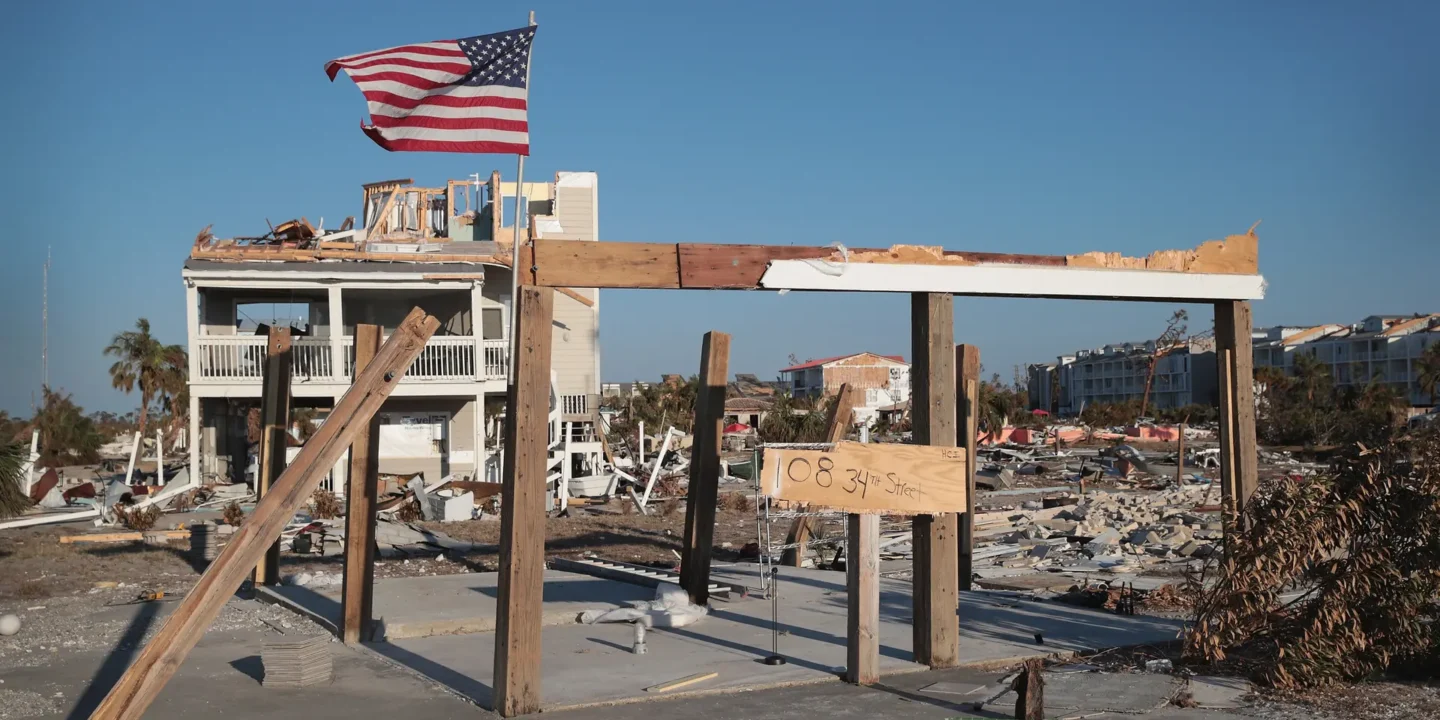










The Florida peninsula looks like a finger dipped into hot water. It reaches out from the American mainland into the Gulf of Mexico and the Atlantic, surrounded on nearly every side by seas that are growing warmer year after year. Warmer water gives storms more energy; stronger storms place roofs, windows, bridges, roads and beachfront apartments back into the language of probability. People still buy houses by the sea, still watch sunsets from balconies, still imagine coastal life as a reward for success. But insurers see another map: wind speeds, tide levels, reconstruction costs, reinsurance prices, claims curves, and the chance that one day Miami or Tampa-St Petersburg will take a direct hit from a monster hurricane.
In the language of climate science, this is not disaster-movie fantasy but a question of timing. Recent near-misses have already functioned like trailers for the future. The full catastrophe has not yet arrived, but it has already begun changing market behaviour. Homeowners fear losing houses. Insurers fear losing capital. Reinsurers fear losing confidence in their models. Banks fear that collateral will become an uninsurable ruin. The first way the climate crisis enters ordinary life may not be seawater coming through the living room, but a letter from an insurance company: your policy will not be renewed.
This moment is often misunderstood. Many people assume that when insurers retreat from high-risk areas, it is simply corporate greed, or another case of Wall Street abandoning ordinary families. There is certainly a profit logic here, and an instinct of industry self-preservation. But the deeper truth is that insurers are becoming the first gate through which climate reality enters the balance sheet of capitalism. Politicians can deny climate change. Buyers can believe in luck. Developers can keep selling ocean views. Local governments can depend on property taxes. But insurance pricing cannot pretend forever that seas are not warming, forests will not burn, and rainfall will not become more violent. The cruelty of insurance lies in the fact that it brings the future forward and pins it to today’s house price.
Without insurance, there is no mortgage. Without a mortgage, most people cannot buy property. Without buyers who can borrow, there is no stable housing market. One secret of modern property is that “ownership” never happens alone. You own a house not merely because you signed a deed, received the keys and moved in, but because a bank is willing to lend, an insurer is willing to cover, a government is willing to provide infrastructure, and the market is willing to believe that this property will retain value in the future. A house looks like private property, but it stands on a whole structure of public and financial scaffolding. Climate change is now removing one of its most important supports: insurability.
The insurance crisis, then, is not a side story of the housing market. It is a redrawing of capitalism’s spatial order. In the past, maps were shaped by states, racial segregation, lending systems, infrastructure and wealth. Today, new boundaries are being drawn by risk models and insurance retreat. Some places remain lendable, tradable and appreciating. Others are quietly being deleted from the financial system. The city has not disappeared. The streets are still there, the houses are still there, the people are still there. But if insurance vanishes, banks withdraw, buyers hesitate and prices fall, then in the eyes of capitalism a place begins to slide from “asset” to “burden”.
Many homeowners already feel this slide. They reinforce roofs, install impact-resistant glass, replace wooden materials, clear flammable vegetation, turn lawns into gravel, wrap houses in fire-resistant surfaces. They try to prove to insurers: I am not the most dangerous customer; please do not abandon me first. These private adaptation efforts are rational, but they carry a sad helplessness. A household can replace windows, but it cannot cool the ocean. It can clear brush, but it cannot end drought. It can raise foundations, but it cannot repair an entire watershed. Home hardening is becoming a climate-age ritual of confession: people paying private penance for systemic risk.
Insurers do not look only at a house. They look at a region. Even if your roof is strong, risk still spreads if surrounding roads flood, firefighting resources are thin, the power grid is fragile, or neighbouring houses become fuel for flames. Climate disaster does not respect property lines. A fire will not stop at the edge of a deed. A storm surge will not turn away from your door because you paid your premium on time. Insurance models understood this earlier than many political theories did: risk is collective, even when ownership is individual.
In places where insurers refuse to operate, property first loses not its price, but its permission to be believed.
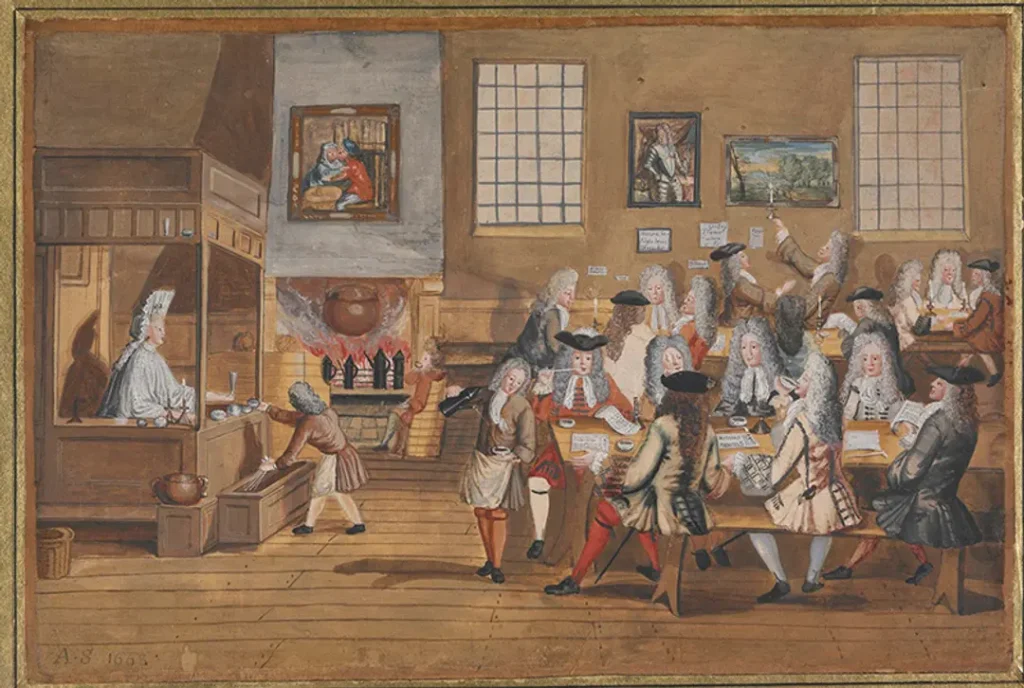
A London coffee house, c1690-1700. Courtesy the British Museum
This is why insurance retreat is so frightening. It does not merely raise the cost of living. It redefines which places the financial system can still trust. Coastlines, hillsides, forest edges and riverfront communities once signified scarcity, scenery, wealth and desire. Now they also signify fuel, storm tracks, flood probabilities and rebuilding costs. In the past, risk was often hidden beneath beauty. Today, risk is piercing through beauty. The sunset over the ocean is still beautiful, but beauty is no longer enough to persuade a reinsurer.
The history of insurance is, in one sense, the history of turning danger into capital. From ancient shipping agreements to Genoese marine insurance, from bets among shipowners in London coffee houses to fire insurance, insurance has always worked by spreading an unbearable individual loss across a larger group and a longer period of time. Merchants could send ships to sea because someone would cover the risk of sinking. Homeowners could do business in cities because fire no longer necessarily meant total ruin. Banks could issue mortgages because collateral was protected. Insurance did not eliminate risk. It made risk bearable for investors, owners and lenders.
That is why insurance matters so much to capitalism. Capitalism needs the future, and the future is always uncertain. Insurance packages uncertainty as a calculable cost, allowing lending, construction, trade and long-term investment to proceed. Without insurance, many apparently bold commercial activities would immediately look too dangerous. Insurance is the economic system’s sedative. It lowers fear, allowing people to keep signing contracts, buying houses, building ships, opening factories and starting shops in the presence of risk.
The problem climate change creates is that some risks no longer behave the way traditional insurance assumed they would: dispersed, random and estimable. A single hurricane may affect hundreds of thousands of homes at once. A wildfire may destroy an entire community. Floods may repeatedly strike the same area. Heatwaves may stress infrastructure and health systems simultaneously. Insurance is good at handling accidents. It is less good at handling a new normal. When “once-in-a-century” events recur with increasing frequency, when historical data becomes unreliable, when the past no longer predicts the future, the actuarial world on which insurance depends begins to loosen.
Reinsurers feel this loosening first. They stand behind the insurance system, insuring the insurers. Insurers transfer risk to reinsurers; reinsurers aggregate risks across regions, hazards and asset classes, then use models to calculate how much they can bear. But if risks rise everywhere at once, if wildfires, floods, hurricanes and heatwaves cease to be independent, if climate change makes disasters correlated, then the ancient wisdom of diversification meets its limit. You cannot cool a basket by placing several warming regions inside it.
This is why large reinsurers take climate change more seriously than many governments. They do not need to appease denialists in elections, and they cannot persuade a balance sheet with ideology. They see claim frequency, loss severity, model error, capital costs and reinsurance pricing. For them, climate change is not a moral issue but a profit-and-loss issue. They believe in climate change not because they have suddenly become environmentalists, but because the climate has started sending them invoices.
When insurers leave, banks do not simply retreat afterward; they lose their reason to remain in the same retreat.
Mortgage banks appear to have little to do with storms. They do not put out fires, repair roofs or measure wind speed. But a bank’s sense of security comes from collateral value, and collateral value comes from saleability, which in turn depends on insurance. If a house cannot be insured, it is hard to finance. If it is hard to finance, it is hard to sell. If it is hard to sell, its market value falls. Insurance retreat is amplified through the banking system until it reaches household wealth, local tax bases, school budgets, business investment and community stability.
This is not a single-household problem, but a local economic spiral. Premiums rise, homeowners strain. Policies are cancelled, buyers disappear. Prices fall, household assets shrink. Tax bases decline, local governments cut services. Services decline, communities become less attractive. Capital retreats further. Climate risk becomes financial risk; financial risk becomes social risk. The disaster economy begins before the disaster arrives.
The process recalls an older form of redlining. Insurers and lenders once used race as a proxy for risk, marking Black neighbourhoods as places unworthy of investment. Today’s new red lines are not officially drawn by race but by wind, fire, water and heat. Yet the effect may be similarly brutal: communities drained of finance, homes devalued, residents trapped in assets they cannot easily sell, insure or borrow against. The difference is that this time many expensive, white, affluent, ocean-view places are discovering that they too may fall outside the line. Climate risk is bringing exclusion back into capitalism’s most beloved real-estate zones.
This does not mean older inequalities vanish. Quite the opposite. The richest can self-insure, move, rebuild or absorb losses. Middle-class families may find themselves trapped between mortgages and premiums. The poor are often left in more dangerous places, with weaker infrastructure and fewer options for evacuation. Climate redlining may reach wealthy neighbourhoods, but its deepest pain will still fall on people with the fewest choices. Insurance retreat is never merely a climate fact. It travels through class, race, age and disability, producing unequal forms of abandonment.
Historically, disasters have sometimes driven institutional innovation. The Great Fire of London helped expand property insurance. The San Francisco earthquake and fire pushed new thinking about financial stability and public risk management. Catastrophe has a way of forcing society to admit that private markets cannot bear all risk alone. The difference now is that climate catastrophe is not a one-time shock but continuous pressure. After a single city fire, an insurance system can reprice and rebuild confidence. But if disaster becomes seasonal, if fires, floods, hurricanes and heatwaves arrive in rotation, innovation must do more than repair markets. It must reorganise habitation, construction, taxation and retreat.
Here a paradox appears. Laissez-faire capitalism depends on insurance to make private investment possible. Yet when climate risk becomes uninsurable, private markets hand responsibility back to the state. Insurers withdraw, and state-backed insurers of last resort expand. Reinsurance prices rise, and governments offer subsidies. Flood risk spreads, and public money builds seawalls. Wildfire threats increase, and governments fund firebreaks, helicopters and home-hardening schemes. The more a region celebrates small government, the more likely it is to discover after disaster that it needs a large one.
The underwriters of laissez-faire capitalism are summoning the state back to the scene of risk they thought had been privatised.
This is not accidental. Insurance is itself a privatised form of social security. It collects premiums from many people to compensate the losses of a few. In private insurance, this mutuality is wrapped in profit, risk selection and contractual language. When risk is calculable and dispersed, private insurance can function. When risk is concentrated and immense, the state is forced to become the insurer of last resort. The market handles good weather; the state handles bad weather. This may be the least dignified political formula of the climate age.
Florida and California are already demonstrating the formula. Private insurers retreat, state or quasi-state insurance plans expand. Governments subsidise mitigation, invest in flood and wildfire prevention, and increase disaster-management budgets. On the surface, this is the state protecting residents. In practice, it is also the state protecting housing markets, bank assets and local fiscal systems. The state is not doing charity outside the market. It is holding the market up so that it does not have to admit how many places have become uninsurable.
But public pockets are not bottomless. A state can subsidise premiums for a while. It can backstop failed insurers, build seawalls, harden communities and expand insurers of last resort. But if disasters become more frequent, losses larger and high-risk areas more numerous, taxpayers will eventually ask: why should we keep subsidising houses built in storm tracks, fire corridors and floodplains? Why should inland residents pay for coastal mansions? Why should places not yet affected cover premiums for places hit again and again? The socialisation of climate risk will eventually meet the patience limits of democratic politics.
This is where the insurance crisis is most likely to tear politics open. Disaster areas will demand solidarity. Non-disaster areas will demand fairness. High-risk homeowners will say: we are taxpayers too; we need help. Lower-risk taxpayers will say: your housing choices should not be transferred to us without limit. Developers will ask government to keep protecting the market. Environmentalists will demand an end to dangerous building. Banks will want assets not to collapse. Insurers will want permission to price risk honestly. Politicians will try to postpone every painful decision. Water, fire and wind will eventually push these conflicts into public budgets.
Emissions in one part of the world become premiums in another, but our politics still pretends the bill can remain local.
The cruelest economic feature of climate change is that causality is global while payment remains local. One country’s energy policy can affect another country’s floods. One industry’s data centres can raise electricity demand across borders. A forest cut down in one region can alter climate risk far away. Decades of emissions from wealthy societies can become heatwaves and insurance crises in poorer communities. Yet insurance policies are local, mortgages are local, tax debates are local, and elections are local. The climate bill moves across borders; political responsibility remains trapped inside them.
This makes solutions especially difficult. Cutting emissions requires international coordination, and international coordination is now colliding with nationalism, energy-security anxiety, industrial competition and electoral cycles. Adapting to climate change requires long-term investment, while politics often rewards short-term tax cuts and immediate relief. Prevention is cheaper than rebuilding after disaster, but successful prevention is often invisible. Disaster relief is expensive, but easier to turn into political imagery. Governments tend to spend after disasters because spending before them requires imagination; spending afterward requires only fear.
Climate feedback loops compress time further. Melting ice reduces reflection and increases ocean heat absorption. Thawing permafrost releases methane, accelerating warming. Forests weakened by fire and drought lose their ability to absorb carbon. Hotter air holds more water, making rainfall more violent. Drier vegetation makes fire spread more easily. Insurance models can update, but if the physical world enters accelerated change, models will always be chasing reality. Capitalism loves pricing the future, but climate change is bringing the future closer in unstable form.
In such conditions, small-government ideology increasingly looks like fair-weather philosophy. It sounds appealing against a background of stable climate, predictable seasons and low disaster costs: less regulation, lower taxes, private choice, market discipline, personal responsibility. But when water, fire, wind and heat arrive together, personal responsibility quickly meets its boundary. You can personally buy a pump, but you cannot personally rebuild a watershed. You can personally clear your yard, but you cannot personally manage a drought-stricken forest. You can personally buy insurance, but you cannot personally maintain an insurance market. You can personally evacuate, but you cannot personally maintain bridges, highways and warning systems.
Climate catastrophe forces governments to intervene in life because life itself has been repoliticised by climate.
This is not simply a matter of left or right in the traditional sense. When disaster strikes, people demand that government appear. Even communities hostile to taxes will want faster firefighters, quicker road repairs, immediate rescue, prompt aid and available insurance. The climate crisis is bringing the state back into domains that markets once claimed they could manage. The question is no longer whether government will intervene, but whether it intervenes early or late, intelligently or clumsily, fairly or in favour of the wealthy, preventively or after the damage is done.
Small-government advocates face an awkward fact: refusing climate policy does not reduce government intervention. It merely shifts intervention from front-end investment to back-end payout. You can oppose green industrial subsidies, but you will eventually pay for wildfire response. You can oppose building restrictions, but you will eventually subsidise flood reconstruction. You can oppose emissions regulation, but you will eventually confront insurance retreat and property-value collapse. Climate denial does not make the state smaller. It makes the state larger later, under worse and more expensive conditions.
Yet big government has no easy answer either. If the state assumes without limit the risks private markets reject, it may encourage people to remain in dangerous areas, continue developing coastlines and forest edges, and transfer future losses to public budgets. Public backstopping can protect families, but it can also protect bad land-use patterns. The hard policy question is not simply whether to rescue, but how much to rescue, how many times, whom to rescue, and what changes to require in return.
This means the future politics of insurance will increasingly become the politics of retreat. Some places must be hardened. Some must restrict new construction. Some must restore wetlands, mangroves and fire-adapted ecosystems. Some may have to be gradually moved away from. But retreat is one of the hardest words for a democratic society to say. It sounds like defeat, abandonment, an admission that certain dreams are no longer sustainable. Homeowners do not want to hear it. Local governments do not want to say it. Developers will resist it. Banks will fear losses. Politicians will delay. So we use gentler words such as adaptation, resilience and mitigation, trying not to say: some places should not continue to be inhabited in the old way.
This does not mean all high-risk areas must be abandoned. Cities can become safer. Buildings can be stronger. Wetlands can be restored. Fire management can improve. Warning systems can save lives. Many investments are worth making, and the earlier they are made, the cheaper they are. But adaptation has boundaries. Coastlines cannot be walled forever. Forests cannot be cleared forever. Premiums cannot be subsidised forever. Taxpayers cannot indefinitely cover the same class of losses. Eventually, the insurance market will force politics to admit ecological limits.
Future housing maps may therefore be determined less by schools, commuting, scenery and price than by insurability. Which places can still obtain reasonable premiums? Where will banks still issue mortgages? Which local governments can afford defensive infrastructure? Which households will be required to carry ever-higher risks themselves? Class division in the climate age may increasingly appear as the difference between those who can buy safety, those who can move away from risk, those trapped in depreciating assets, and those who live on land still recognised by the insurance system.
This will change the meaning of wealth. For many households, housing has long been the most important asset: the basis of borrowing, retirement, inheritance and class mobility. If climate change turns large numbers of homes into assets that are difficult to insure, sell or mortgage, household wealth will be redistributed. Not through revolution, not through tax law, but through storm tracks, fire boundaries and insurance models. Some people’s houses will remain capital. Others will slowly become containers of debt.
That is the true scale of the insurance catastrophe. It is not merely rising premiums, not merely insurers leaving Florida or California, not merely a few coastal mansions becoming awkward investments. It is an economic system discovering that its assumptions about property, risk and growth were built on a relatively stable climate. Stable climate was not background. It was hidden infrastructure. We used it for free, ignored it like air; now it has begun to charge, and the first bill collector has arrived dressed as the insurance industry.
The future is not without choice. Governments can invest early in emissions reduction and adaptation, change building codes, stop encouraging dangerous development, restore natural barriers, reform insurance subsidies and help high-risk communities move with dignity. Insurers can do more than retreat: they can participate in risk reduction, reward real mitigation, disclose model logic and avoid abruptly abandoning the most vulnerable. Banks can incorporate climate risk into lending while supporting safer transition. The public must also accept a hard fact: not every piece of purchasable land should be treated as a permanently habitable asset.
The worst choice is to keep pretending that the insurance crisis is only an insurance problem. It is the intersection of climate crisis, housing crisis, fiscal crisis and political crisis. Florida’s finger reaching into warm seas points not only to the American coast but to a wider future: when natural risk no longer agrees to remain at the edge of the model, capitalism will have to relearn boundaries.
By then, perhaps we will discover that insurers were not the coldest actors. They were merely the first to say something many people did not want to hear: there are places the future is no longer willing to underwrite.