












Scan today’s economic headlines and it is easy to reach a bleak conclusion: Western societies appear to be standing on the edge of an inheritance explosion. The baby-boom generation is ageing, and houses, stocks, pension accounts, business equity and long-term savings are beginning to pass to the next generation. Commentators speak of a “great wealth transfer” and warn of a new inheritocracy, a world in which wealth belongs not to the most capable but to those born into the right families. The story is unsettling. Affluent parents pass ever-larger assets to their children, who receive houses, capital and security before they have earned any of them; those without parental wealth continue to chase rising rents, student debt, stagnant wages and inflated housing prices. In this telling, inheritance becomes evidence that modern capitalism is sliding back toward feudalism.
The anxiety is not baseless. The scale of inherited wealth is indeed rising in many rich countries. Older generations have accumulated large amounts of housing wealth, financial assets and retirement savings, while younger generations wait, or worry, to see whether they will be included in this transfer. A society in which what children can own depends increasingly on what parents can leave behind has good reason to wonder whether equality of opportunity is more slogan than reality. Yet it is also a mistake to treat inherited wealth as an economic poison, or to imagine every bequest as fuel for an idle class.
Inheritance is not inherently anti-modern. For most families, it is not a manor, a trust fund or a yacht. It is a house whose mortgage has been paid off, a modest retirement account, a small business, or a portfolio built through decades of cautious saving. Sometimes it is not the end of wealth formation but the beginning: help with a down payment, protection during unemployment, support for grandchildren’s education, or continuity for a family enterprise that might otherwise be sold after the founder’s death. Inheritance can preserve privilege, but it can also transmit security. It can harden hierarchy, but it can also provide the first real capital cushion for households that have never had one.
The question, then, should not be the blunt moral one: is inherited wealth good or bad? A better question is: under what economic conditions does inheritance become dangerous? If a society enables ordinary people to own homes, pension assets, business shares and savings, inheritance is the natural outcome of a broadly asset-owning society. If, however, only a minority can accumulate assets while the majority spend their lives paying rent, interest and bills, inheritance becomes a hardener of class boundaries. Inheritance itself is not the disease; the disease is that too few people get the chance to build anything worth inheriting.
In recent decades, the dominant story about inheritance has often been framed as the return of dynastic capitalism. Economists have documented the rise of bequests and lifetime gifts relative to national income. In countries such as France, the United Kingdom and Sweden, inheritance flows have climbed back from their mid-20th-century lows toward earlier levels. Critics see in this a familiar and gloomy future: fewer people becoming wealthy through work and innovation, more people becoming wealthy through parents and grandparents; an economy that rewards bloodline more than creation.
The strongest version of this fear is the revival of patrimonial capitalism. In this view, returns to capital exceed economic growth for long periods, the assets of the wealthy multiply almost automatically, and ordinary wages struggle to keep pace. Inheritance then accumulates like water behind a dam, eventually flooding labour income and individual effort. Young people are not competing from a common starting line. Some stand on platforms built by their parents; others are still looking for the entrance.
The real worry is not that capital is inherited by the next generation, but that more and more people inherit debt, rent and insecurity.
That sentence may come closer to the real issue than the usual question of whether inheritance is fair. Inheritance provokes anger not simply because someone receives money they did not personally earn. Modern societies already tolerate many forms of unearned gain: rising house prices, stock appreciation, location rents, intellectual property income, stock options, and the protection that assets provide during inflation. What people resent is that these advantages are increasingly concentrated among those who already own assets, while those without assets struggle even to enter the process of accumulation. Inheritance looks like the problem because it exposes, late in life, inequalities that began much earlier.
This does not mean inheritance is unimportant. It matters, and it affects social mobility. Wealthy parents tend to have wealthier children. Part of this is education, networks, cultural capital and expectation management; part of it is simply money. Parents pay university fees and reduce their children’s debt. They help with down payments and allow their children to enter housing markets earlier. They leave bequests that reduce risk, finance entrepreneurship or allow earlier retirement. Wealth is not only a number. It is an ability to be less afraid. The greatest advantage inheritance offers is often not luxury, but calm.
Yet this advantage should not obscure another fact: inheritance does not occur only at the very top. Many ordinary families leave something behind. A modest but mortgage-free house, a small savings account, a life-insurance payment, or a family shop can transform the position of an heir. For someone with tens of millions, an inheritance of $100,000 may barely matter. For someone with little savings, no home and middle-age pressures, the same amount may mean escaping high-interest debt, making a down payment, caring for an elderly parent or finally having room to invest.
This is the paradox of inheritance. The rich inherit the most, but inheritance often matters least at the margin to the rich. Middle- and lower-wealth households inherit less, but those smaller bequests may change their life trajectory. In relative terms, a modest inheritance can have a more equalising effect than a large one. It will not create billionaires, but it may give some households their first buffer, their first protection against emergency bills, their first chance to turn income into assets rather than handing all of it to landlords, banks or medical creditors.
If we look only at absolute amounts, inheritance is plainly unequal. Wealthy families leave more, poor families leave less. But if we examine the size of a bequest relative to what the heir already owns, the picture becomes more complicated. Inheritance may widen opportunity gaps between families, yet it may also compress wealth differences among those who do inherit. A serious discussion must hold both facts at once. Inheritance is both a mechanism for transmitting privilege and a mechanism by which ordinary families form assets. To portray it only as aristocratic restoration is politically powerful but empirically incomplete.
Family wealth still matters, but in modern economies more wealth is created within a single generation through accumulation, entrepreneurship and asset participation.
Compared with the early 20th century, most Western countries have not simply returned to an old aristocratic order. Then, much private wealth came from existing family capital, land and inheritance. Today, inheritance remains significant, but self-made wealth has also grown markedly. Homeownership, pension systems, broader stock-market participation, entrepreneurship, educational expansion and financial asset ownership have allowed more people to build assets during their own lifetimes. The problem of modern capitalism is not that new wealth has disappeared. It is that the threshold for building new wealth is rising again.
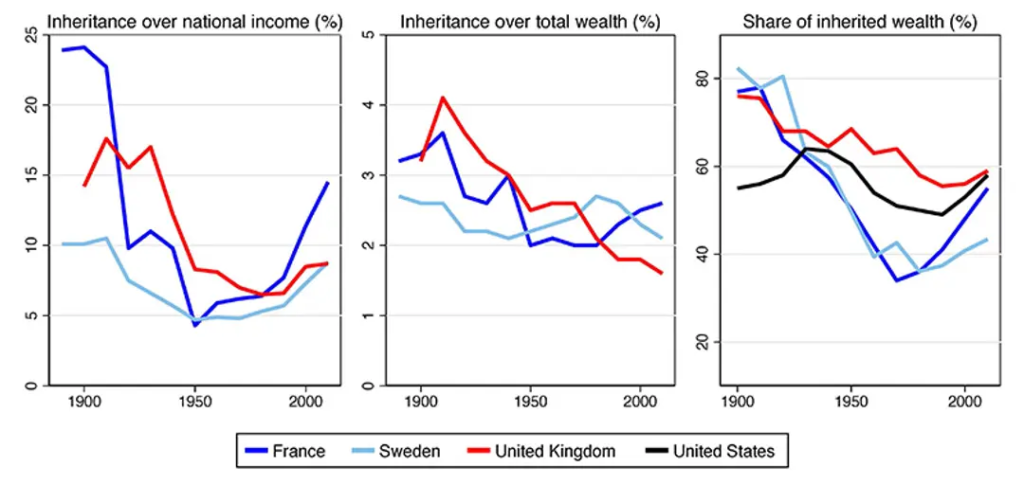
Figure 1: The historical evolution of inheritance in Western economies. From ‘Inherited Wealth over the Path of Development: Sweden, 1810-2016’ (2020) by Henry Ohlsson, Jesper Roine and Daniel Waldenström, Journal of the European Economic Association and, for the US, ‘On the Share of Inheritance in Aggregate Wealth: Europe and the USA, 1900-2010’ (2017) by Facundo Alvaredo, Bertrand Garbinti and Thomas Piketty, Economica
Housing is the clearest example. For earlier generations, buying a home was difficult, but in many places it remained an attainable middle-class goal. For many young people today, housing has turned from a consumer good into an entry ticket to the asset-owning class, and the price of that ticket increasingly depends on parental help. Inheritance, therefore, is no longer only something that happens after death. It enters earlier, at critical life stages. Whether parents can help with a down payment often matters more for a child’s fate than what they leave in a will decades later. The real inheritance age is not merely the age of the estate; it is the age of parental assets intervening early in life.
This also reminds us that statistical inheritance may underestimate actual intergenerational transfer. Family advantage is transmitted in many forms: better schools, stable housing, debt-free university years, internship opportunities, social networks, a safety net for failed entrepreneurship, psychological security, even health habits and language skills. These may never appear on an inheritance-tax form, but they powerfully shape opportunity. If we focus only on taxing estates at death while ignoring these earlier and often more important transmissions, we may simply chase the most visible target while missing the deeper structure of unequal opportunity.
This is not an argument against taxation. The issue is that inheritance taxes are often asked to carry too much moral weight. They look like an elegant solution: if wealth is transferred at death, tax it at the moment of transfer; if bequests are unearned, return part of them to society; if the rich leave the most, tax them more. The logic is simple, and the political slogan is clear. But actual inheritance taxes are rarely so simple.
First, inheritance taxes usually raise little revenue. Many countries set high exemptions, deductions and carve-outs to avoid hitting family businesses, farms, homes or middle-class estates. The result is that the very largest fortunes often reduce liabilities through trusts, foundations, lifetime gifts and complex planning, while less mobile middle-sized estates may face more difficulty. Second, valuation is hard. How should a family company, a piece of land, an illiquid private shareholding or a house that is not easily sold be valued at death? If heirs have no cash with which to pay the tax, should they be forced to sell the enterprise or the family home? These problems gradually hollow inheritance taxes out through exemptions.
More importantly, inheritance taxes touch a powerful emotional instinct. Many parents work, save, buy homes and invest not because they dream of founding dynasties, but because they want their children to feel less insecure. To them, if income has already been taxed, saved, converted into assets and then taxed again at death, the state appears to be reaching into a family’s final gift. Economists may explain fairness, but this emotional response is real. A tax that raises limited revenue, is easy for sophisticated wealth to avoid, is complex to administer and is widely perceived as unfair will struggle to become a stable pillar of modern public finance.
For lower-wealth heirs, a modest bequest is often not extra comfort, but the first real starting point for asset ownership.
This should change how we think about inheritance. The social goal should not be to prevent ordinary parents from leaving a house or savings to their children. It should be to ensure that more parents are able to leave a house or savings. If only elite families can pass on wealth, inheritance will of course appear suspect. But the solution is not to make all families unable to transmit assets. It is to broaden the base of asset formation. Helping more people build home equity, retirement accounts, business ownership, savings and financial capability is a deeper equalising project than punishing bequests.
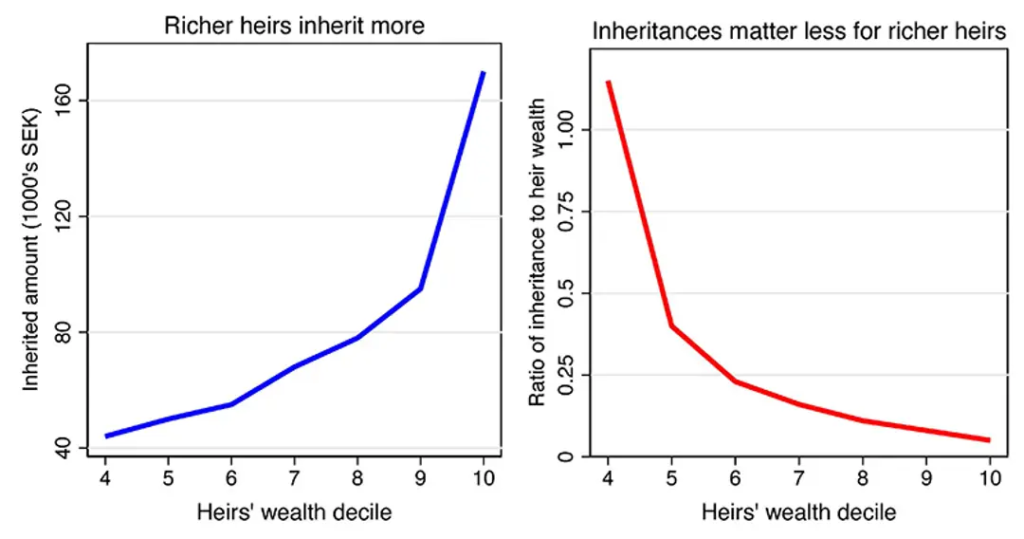
Figure 2: Inheritance and heirs’ wealth: larger gaps and smaller inequality. From ‘Inheritance and Wealth Inequality: Evidence from Population Registers’ (2018) by Mikael Elinder, Oscar Erixson and Daniel Waldenström, Journal of Public Economics
From this perspective, the decisive policy moments are not death, but birth, childhood, education, employment and the first chance to buy a home. By the time someone receives an inheritance at 55, many life paths have already been set. Educational quality, health, career choices, family formation, housing entry and risk tolerance were shaped decades earlier. If we want to increase equality of opportunity, placing our hopes in a tax at death is too late. More effective measures reduce differences early in life: high-quality education, child health, housing stability, vocational training, entrepreneurship support, savings incentives for lower-income families and broad pension coverage.
In other words, equality of opportunity is not achieved by weakening family ties. It is achieved by ensuring that family starting points are not so unequal that they become destiny. Parents wanting to help their children is one of the most stable motives in human society. Any system that tries to abolish that motive is unrealistic and may damage productive effort. A better goal is to give people without wealthy parents institutional support, so that their prospects do not depend entirely on the lottery of birth. A good society is not one without inheritance. It is one in which inheritance is not the only reliable source of security.
This also explains why capital income taxes often do more useful work than inheritance taxes. When wealth produces profits, dividends, rents and realised capital gains, taxing those flows is usually more stable, fair and enforceable than trying to settle everything at death. Capital income taxation corresponds to ability to pay and cash flow; inheritance taxation often runs into illiquidity, valuation disputes and avoidance planning. If a modern tax system wants to tax capital effectively, it should pay closer attention to how capital income is generated, realised and shifted across low-tax jurisdictions, rather than loading all symbolic meaning onto estates.
Of course, extreme inherited fortunes still deserve scrutiny. Very large fortunes can buy political influence, control media, shape public agendas, monopolise educational opportunity and avoid taxation through complex structures for long periods. These transfers are not the same as an ordinary family leaving a home. A smarter system should distinguish between the transmission of family security and the transmission of oligarchic power. It can target ultra-large fortunes, unrealised gains, trust-based avoidance, hidden cross-border assets and the political influence of wealth more precisely, instead of placing all inheritance in the same moral basket.
Many debates about inheritance are confused because they mix together three questions. First, should parents have the right to leave some property to their children? Most societies would answer yes. Second, can very large family fortunes damage equality of opportunity and democratic politics? The answer may also be yes. Third, is inheritance taxation the best way to solve that problem? That is far less certain. Accepting the second point does not automatically require a crude version of the third. Rejecting inefficient inheritance taxes does not mean denying the problem of wealth concentration.
Fewer countries tax inheritance today than in the 1960s, and those that retain inheritance taxes collect far less from them than before.
This trend deserves to be taken seriously. Many countries did not reduce or abolish inheritance taxes simply because they suddenly fell in love with the rich. They did so because these taxes often disappointed in practice. They failed to raise the expected revenue, missed the wealth best able to plan around them, and generated political resentment and economic distortion. The experiences of Sweden, Canada, Australia, Austria and Norway suggest that even in societies broadly supportive of welfare states, inheritance taxes can lose legitimacy. A policy that is not trusted even by many of the people it claims to help cannot easily carry the ideal of equality.
But weakening or abolishing inheritance taxes does not make the underlying problem disappear. Wealth concentration remains. Housing barriers rise. Educational differences persist. Participation in financial assets remains unequal. If inheritance taxes are not the answer, something else must be. The focus should shift from reducing the estates of the few to expanding the asset-building capacity of the many. That means more abundant housing supply, lower barriers to entrepreneurship, fairer education finance, broader retirement saving, wider access to capital markets, and stronger competition and antitrust policy.
Inherited wealth makes people uncomfortable because it reveals a fact modern societies prefer not to admit: the family remains one of the most powerful economic institutions. The state can provide education, the market can provide wages, banks can provide credit, but families provide time. Time allows assets to appreciate, mortgages to be paid down, mistakes to be absorbed and risks to be postponed. What wealthy families give their children is not only money, but a longer, wider and softer stretch of time. What poor families lack is not only money, but room to fail.
A serious equality policy should therefore create time for more people. Child benefits create developmental time. Public education creates learning time. Healthcare creates recovery time. Unemployment insurance creates time to choose again. Housing policy creates stable time. Entrepreneurship finance creates time to experiment. Inheritance is powerful because it transfers the accumulated time of one generation to the next. A fair society need not ban this transfer, but it should provide some form of public time cushion for those without family time to inherit.
This is perhaps the most overlooked part of the inheritance debate. Inheritance is not only past wealth entering the present. It is also past sacrifice entering the future. Parents consume less, save more, run small shops, repay mortgages, maintain businesses, buy insurance and contribute to pensions because they imagine a life beyond themselves. People work not only to make themselves more comfortable, but to spare their children some hardship. If policy punishes all transmission too harshly, it may weaken long-termism, saving, family-business continuity and the willingness of ordinary people to accumulate assets.
The other side must also be acknowledged. Family long-termism cannot substitute for social justice. A society in which children can be secure only if their parents accumulated assets is one that places those without such parents at a structural disadvantage. Inheritance can be an expression of love, but it cannot become the main mechanism by which opportunity is distributed. It can exist, but it should not rule. It can help families endure, but it should not determine whether a person can have housing, education, health and dignity.
So, is inherited wealth bad? The answer depends on the system around it. If growth is broad, housing is accessible, education is fair, entrepreneurship is open and capital participation is widespread, inheritance is a natural byproduct of a mature asset-owning society. It will create some inequalities and provide some stability. If growth is weak, housing is expensive, wages are stagnant, assets are concentrated and mobility is fading, inheritance becomes an amplifier of birth rank. Not because parents leaving wealth to children is inherently wicked, but because others lack credible paths to acquire wealth of their own.
The best society is not one in which nobody inherits wealth. It is one in which more and more people can inherit a little wealth, build a little wealth, and eventually leave something behind. The goal should not be to make inheritance disappear, but to prevent it from becoming the monopoly privilege of a few families. We need less symbolic anger about wealth transfers at death, and more institutional patience about opportunity structures at the beginning of life.
Over the past century, the most effective equalisation has often come not from inheritance taxes, but from ordinary people gaining access to assets: homes, pensions, stocks, education, human capital and small businesses. These have spread capital beyond a narrow set of families. The future task is similar. Rather than concentrating political energy on how to divide the estates of the few, we should ask how more people can accumulate assets during their lives. How can wages become savings? How can housing stop rewarding only those born early? How can entrepreneurship become more than a game for the children of the affluent? How can ordinary families also have something to pass on?
Inherited wealth is not necessarily bad. What is bad is a society in which inheritance becomes the only reliable entrance to wealth. A genuinely dynamic capitalism should not fear parents leaving assets to children. It should fear a world in which fewer and fewer people can enter the asset-owning class by any other path. Wealth being passed down is not the danger. The danger is that only a minority have wealth to pass down.