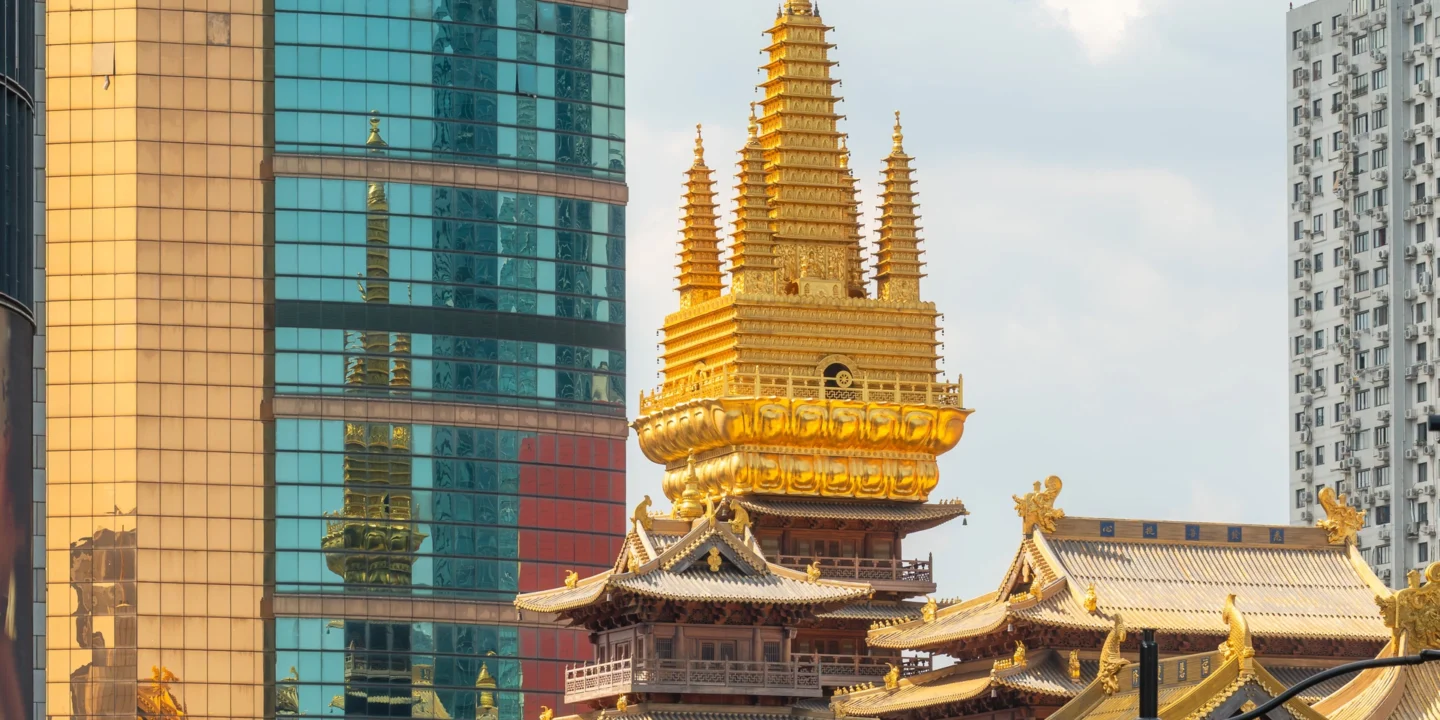











Stepping out of a bright office tower in Shanghai, I heard the bell of Jing’an Temple. Glass walls reflected traffic, advertising screens and the signs of financial institutions; only a few steps away, incense drifted slowly from beneath the temple eaves. One space belonged to capital markets: screens, meetings, reports, trading systems and quarterly results. The other belonged to an older order: bells, lamps, karma, restraint and prayer. They stood so close to one another that it was difficult to believe they had nothing to do with each other.
As someone who studies finance, I am accustomed to explaining corporate behaviour through incentives, governance structures, regulation and agency costs. Why does a company pay dividends? Because investors demand returns, because managers must release cash, because regulators want a more disciplined market, because boards need to send signals. But standing that day between temple and tower, I wondered whether another question had been neglected. What if corporate decisions are not driven only by law and profit? What if the ethical rhythm of the temple across the street also enters the boardroom, quietly and indirectly?
This is not to suggest that directors consult Buddhist sutras before deciding a cash-dividend ratio, or that executives use Taoist classics to calculate payout policy. Culture rarely works so directly. It is more like air: people may not discuss it, yet they breathe it. China’s traditional thought, especially Buddhism, Taoism and Confucianism, has long shaped how people understand wealth, obligation, virtue, return and fairness. Even when modern capital markets appear highly technical, many ancient ideas may still survive inside commercial judgment in more hidden forms.
In imperial China, merchants did not occupy a high formal status. They were often ranked below scholars, farmers and artisans. Yet many successful merchants earned reputation not only through commerce, but also by building bridges, funding schools, supporting temples and providing relief for local communities. Wealth that merely accumulated could seem dangerous; wealth that flowed back into society was more easily recognised as legitimate. Profit and virtue were not absolute opposites. They had to be balanced through restraint, obligation and reputation.
The political upheavals of the 20th century challenged these traditions fiercely. Religion was classified as feudal superstition; temples were closed; traditional ethics were displaced by the language of class and industrial construction. But culture is never only what institutions publicly display. Even amid intense transformation, ideas about merit, indebtedness, dignity, good deeds, family responsibility and social judgment survived in everyday language, household education and local custom. After reform and opening-up, markets reappeared, wealth became legitimate again, and religion and traditional culture gradually regained public visibility. A paradoxical phenomenon emerged: modern Chinese capitalism may still be using an ancient moral grammar.
Corporate dividends offer a useful point of observation. A dividend is the portion of corporate profit returned to shareholders. It is not a wage, nor is it charity. It is a form of sharing within capital itself. A company may retain earnings, or it may distribute them to investors. It may keep cash in the hands of management, or it may acknowledge shareholders’ claims on profit. For that reason, dividends are not merely a financial arrangement. They are a relational gesture. They tell investors: your trust has not been forgotten; your rights have not been entirely excluded by insiders.
In corporate-governance theory, dividends are often understood as a way to discipline management. If a company holds large cash reserves for too long, managers may be more tempted to engage in inefficient investment, related-party transactions or empire-building. Dividends return cash to shareholders, reducing the resources that management can use at its own discretion. They also signal financial health and governance transparency. In mature markets, regular dividends are often seen as a mark of reliability, respect for investors and long-term management.
Yet China’s stock market has long contained a troubling phenomenon: many companies report profits but are reluctant to pay dividends. Investors have a vivid phrase for such firms: “iron roosters” — roosters made of iron, from which not a single feather can be plucked. The phrase became popular because it translated financial disappointment into a vernacular moral judgment. It does not merely say that a company lacks money; it says that the company has money but is stingy. It does not say merely that the firm is poorly governed; it says the firm is not decent. Behind the insult lies a cultural expectation: after making money, one should give something back.
Nearly half of all profitable firms still went three or more consecutive years without paying a cent to shareholders.
Regulators, of course, noticed the problem. For years, China’s securities authorities have pushed listed companies to increase cash dividends, criticised chronic non-payers, and designed rules linking dividends to refinancing, governance evaluation and even large-shareholder stock sales. The policy logic is clear: if profitable firms refuse for years to share gains with shareholders, market trust erodes. Investors will not forever believe in a capital story that only takes in money and never returns it. A market without predictable return easily becomes a market of speculation, rather than long-term ownership.
These regulatory efforts have had some effect. More listed companies now pay dividends, and the total value of annual cash payouts has risen. But the problem has not disappeared. Many companies still maintain low payout ratios, and some remain silent even in profitable years. More interestingly, amid this general caution, some companies are noticeably more willing to share profits. They are not simply richer. They appear more willing to use dividends to build a relationship. What makes these firms different?
If we look only at balance sheets, we may get part of the answer: profitability, cash flow, firm size, ownership structure, financing constraints, industry cycles and regulatory pressure. All of these matter. But they do not explain all the variation. I therefore began to suspect that behind dividends there might be a softer force: local culture and moral environment. Corporations are not machines floating in an institutional vacuum. They are located in cities, communities, networks of relation and historical memory. Managers are not pure profit functions. They are ordinary people living inside a world of values.
The role of religion in economic life is not a new question. Max Weber famously discussed how the Protestant ethic shaped Western capitalism: diligence, thrift, a sense of calling and delayed gratification became connected to investment, accumulation and rational enterprise. Later research in the social sciences has also found that religious environments may influence saving, trust, risk preference, honesty and corporate governance. Religion does not necessarily issue commands directly. It can instead function as an informal rulebook, telling people what is respectable, what is excessive, what should be done and what should bring shame.
China offers a setting very different from the West. Its commercial culture did not develop from churches, Puritanism or a single theological tradition, but from the interweaving of Buddhism, Taoism, Confucianism and folk belief. Buddhism speaks of karma, giving, compassion and merit. Taoism speaks of balance, non-force, sufficiency and non-contention. Confucianism speaks of benevolence, righteousness, trustworthiness and duty. These traditions differ from one another, but together they restrain naked greed. They remind people that wealth is not isolated possession. Wealth always exists inside relationships.
If these ideas enter the business environment, we might expect to see different corporate behaviour. Managers may be less willing to be regarded as iron roosters; controlling shareholders may care more about reputation; local society may place greater emphasis on fairness and reciprocity; firms may become more willing to treat dividends as part of legitimate business practice. Not because temples directly regulate companies, but because the moral atmosphere reminds firms that taking without sharing is not an auspicious posture.
In a study of dividend behaviour among Chinese listed firms, this cultural influence can be translated into observable measures. Suppose a firm is headquartered near many Buddhist temples, Taoist shrines and registered religious institutions. Its local environment may preserve traditional ethics more strongly. If those ethics influence corporate conduct, firms in such regions should be more likely to pay dividends, or more generous when they do. The hypothesis sounds poetic, but it can be tested with serious financial data.
Researchers can geocode the headquarters of listed companies, count Buddhist and Taoist sites within a certain radius, and compare those measures with corporate dividend policy. To avoid mistaking religious influence for regional wealth, firm size or industry composition, one must also control for profitability, cash flow, ownership type, asset size, growth opportunities, regional economic conditions and governance structure. If religious environment remains significantly related to dividends after these controls, then culture is not merely background. It becomes a measurable force in governance.
The results are suggestive. Firms located in more religious environments are more likely to pay cash dividends, and they pay more when they do. Even after accounting for size, profits, cash flow and state ownership, the relationship remains. It does not operate like a hard legal command, nor does it alter costs as directly as a tax rate. It works more like continuous environmental pressure, pushing companies toward a greater willingness to share profits.
It was as if the invisible hand of culture was gently nudging firms toward a habit of greater respect for shareholders.
This influence is especially visible among private firms. Dividend policies at state-owned enterprises are often shaped by policy goals, fiscal arrangements, strategic tasks and superior-level evaluations, leaving less room for local culture to operate. Private firms are different. Their managers and controlling shareholders possess greater discretion, and they are more likely to be influenced by local reputation, personal ethics and informal norms. When formal regulation is incomplete, culture may become another governance mechanism. When law cannot cover every detail, morality begins to fill the gaps.
Of course, different traditions do not operate in identical ways. Buddhism and Taoism are often blended in Chinese folk practice, but their ethical emphases differ. Buddhism places a more explicit moral stress on giving. Dāna, or generosity, is not merely a good deed; it is a way of accumulating merit. The giver does not simply lose something, but receives a deeper return within the moral order of karma. Wealth, if grasped too tightly, becomes bondage; wealth, if rightly shared, can become merit and purification.
This idea easily forms a symbolic connection with corporate dividends. A business leader influenced by Buddhist ethics may not directly interpret shareholder payouts as religious giving, but may still be inclined to think that success should be shared, that excessive hoarding is neither auspicious nor respectable. Corporate profit is not the spoil of management alone, but the result of relationships among many parties. Giving shareholders a return is both an economic responsibility and a kind of moral completion.
Taoism takes a more subtle route. It emphasises naturalness, balance, restraint and wu-wei. It does not always command giving as actively as Buddhist dāna, but it resists excessive grasping and forced possession. The Tao Te Ching says that the sage does not hoard; the more he gives to others, the more he has. This is not a modern dividend policy, but it does oppose greed, contestation and imbalance. A manager influenced by a Taoist sensibility may value stability, avoid overexpansion and resist gripping wealth too tightly. Taoism may produce less of a direct impulse to distribute, but more of a governance style that avoids extremes.
For that reason, Buddhist influence on dividends may be more direct, while Taoism may work more as a slow balancing force. Both traditions discourage unrestrained greed, but Buddhism more clearly praises the merit of giving, while Taoism more quietly teaches the wisdom of non-contention. One pushes toward sharing; the other restrains excess. Together, they form a moral intuition opposite to the iron rooster.
Ethical norms, in effect, became an informal layer of oversight.
This oversight is not mysterious. It works through reputation, interpersonal evaluation, local custom, managerial self-understanding and investor expectations. A company that refuses dividends for years is not only questioned by the market. It may also be judged by local society as ungenerous, untrustworthy or lacking righteousness. Especially in regions where traditional ethics remain strong, entrepreneurs are not merely economic agents. They often wish to become respectable local figures, people of face, reputation and merit. Building bridges, funding temples, sponsoring education, donating to charity and paying dividends may belong to different spheres, but they may all serve the same purpose: proving that wealth is legitimate.
This cultural force may also improve investor protection. In theory, investor protection depends on law, disclosure rules, independent directors, audits and regulatory penalties. In reality, enforcement is always uneven, and minority shareholders cannot rely entirely on formal rules. If a local culture places greater emphasis on honesty, fairness and karmic consequence, the cost of exploiting minority investors becomes more than a legal cost. It becomes a reputational and moral cost. Some behaviour may not immediately violate the law, yet still be judged as something one should not do.
This is where soft norms meet hard institutions. Culture cannot replace law, but it can reduce the burden placed on legal enforcement. If a community broadly regards bullying small shareholders as shameful, expropriating company resources as damaging to one’s moral standing, and long-term refusal to pay dividends as reputationally harmful, corporate behaviour may move closer to good governance. Conversely, if an environment rewards short-term extraction, insider control and rapid cash-out, even well-designed rules may be evaded. Governance is not only institutional design. It is also a shared sense of what society permits.
Dividend stability is also worth noting. Some firms do not pay generously only when profits are high and disappear when profits are low; they try to maintain relatively stable dividends over time. Stable dividends resemble a promise: the firm will not renegotiate the relationship every year, but will consistently recognise shareholder claims. This resonates with Confucian and Buddhist values that stress reliability in relationships. A trustworthy person does not keep promises only in good times; a trustworthy company should not share profits only when convenient. Dividend smoothing is, in a sense, a ritual of keeping faith in the capital market.
This brings us back to a larger question: is the market really a moral vacuum? Economics often describes firms as profit-maximising machines and places culture at the edge of the model. But real firms are run by people, and people never live only inside incentive structures. They also live inside stories, fears, beliefs, reputation, shame, desire and habit. Even the most technical financial policy may carry cultural traces. On the surface, dividends are cash outflows. At a deeper level, they may be a firm’s response to a relationship of trust.
The Chinese case also reminds us that there is no single capitalist ethic. Western capitalism was shaped by Protestant morality, legal rationalism, individualism and contract culture. East Asian capitalism developed amid Confucian hierarchy, family enterprise, developmental states, Buddhist compassion, Taoist restraint and local networks. Capitalism is not identical software installed in different countries. It is rewritten by local cultures. Stock markets may globalise, but market participants still come from particular civilisations.
This does not mean that traditional culture always improves governance. Religion can also be performed, instrumentalised and commercialised. A corrupt official may burn incense; a predatory businessman may donate to a temple; a company may be generous at charity banquets while abusing minority shareholders in corporate governance. Moral language can restrain people, but it can also conceal interests. Religion should not be romanticised, and temples should not be expected to produce good companies automatically. Law, regulation, transparency, audits, investor litigation and market discipline remain indispensable.
Yet formal institutions are not sufficient either. Many rules operate effectively only when embedded in a certain cultural soil. Disclosure requires honesty; director responsibility requires a sense of shame; investor protection requires an idea of fairness; long-term management requires trust; dividend commitment requires treating shareholders as parties to a relationship, not outsiders who can be ignored. Without these soft foundations, hard rules easily become documents.
If policy is the hardware of governance, culture is the software; both must work together for the system to run smoothly.
China’s particularity lies in the fact that traditional culture was once suppressed and then returned in new forms through marketisation. Today’s entrepreneurs may not openly discuss Buddhist law or Taoist wisdom, but they may use words such as merit, fortune, decency, harmony and “not going too far” to understand business. A local tycoon may restore a temple, make charitable donations, raise dividends and host a New Year dinner for employees in the same year. He may not place these actions inside a single theory, but they all express one intuition: wealth must flow back, and success must be recognised by relationships.
This is what makes “divine dividends” a useful metaphor. Dividends are not, of course, religious rituals. They are part of corporate law, cash flow and financial policy. Yet they also resemble a ritual of reciprocity within the modern market. A firm receives investor trust, uses capital to generate profit, and then returns part of that profit to those who provided the capital. If it only takes and never returns, the relationship breaks down. If it shares steadily, trust accumulates. Shareholder meetings and temple ceremonies are far apart, yet both revolve around an ancient question: after receiving, are we willing to give back?
Standing that day between the Shanghai temple and the office tower, I realised that the sacred and the secular may not be as distant as we imagine. A corporation is not a cold machine, but an institution made of people. People calculate, but they also fear consequence. They pursue profit, but they care about reputation. They obey law, but they are shaped by custom. They attend board meetings, and they may also burn incense during festivals. Modern financial markets appear driven by data, but their participants still carry ancient cultural sensibilities.
This matters for how we understand capitalism. We often ask how capitalism can become more ethical. The answer cannot come only from regulation, nor only from religion. It requires institutions and culture to act together. Regulation sets the floor; culture shapes desire. Law punishes violations; ethics reminds people what counts as legitimate. Markets reward efficiency; society demands return. A healthy market needs clear rules, but also a form of self-restraint beyond rules.
Perhaps the next time we evaluate a company, we should look not only at margins, balance sheets and cash flows, but also at its value environment. Does it live in a culture that encourages sharing, trustworthiness and long-term relationships? Do its managers see shareholders, employees, communities and suppliers as part of a shared fate? Does it understand that profit, if entirely separated from responsibility, will eventually lose legitimacy? These questions cannot be calculated as easily as a price-earnings ratio, but they may determine whether a company can be trusted over time.
The temple bell will not appear directly in an annual report. It will not be written into dividend policy, nor will it form a line in a board resolution. But it may exist at a deeper level: in people’s understanding of what should be done, in an entrepreneur’s imagination of reputation, in investors’ expectations of fairness, in an ancient social intuition about whether wealth is legitimate. Earnings calls are louder, and market data moves faster, but the bells of tradition have not fallen silent.
The story of divine dividends is ultimately not a claim that religion automatically makes companies better. It is a claim that markets are never purely secular. Capital also needs moral language. Profit also needs legitimacy. Corporations also need social recognition. When business meets belief, it does not necessarily become holy, but it may be reminded of something important: wealth is not only possession, but relationship; profit is not only outcome, but responsibility. A capitalism that endures may have to learn precisely this — that principles and profits are not always enemies. Sometimes, they meet in the same dividend.