








Decolonisation now seems to be everywhere. Universities discuss how to decolonise their curriculums. Museums discuss how to decolonise their collections. Corporations discuss how to decolonise the workplace. Governments discuss how to decolonise architecture, law and language. India has been independent for more than seven decades, yet its leaders still speak of removing the traces of colonial rule when they build new national institutions. Introductory psychology courses can be decolonised; Biblical interpretation can be decolonised; business training can be packaged as decolonisation. A word once connected to imperial collapse, national independence and political revolution has entered almost every corner of public life.
This raises a question that appears simple but is difficult to answer: what is decolonisation?
The answer is difficult because those who use the word today are often not talking about the same thing. Some are discussing economic inequality. Some are discussing cultural identity. Some are discussing university syllabuses. Some are discussing museum artefacts. Some are discussing national sovereignty. Others use “decolonisation” as a term of accusation, a name for what they regard as a dangerous ideology. It can be invoked by former colonies and by universities in former imperial capitals; by anti-government protesters and by ruling governments; by leftists, nationalists, religious groups, corporations, student movements and international organisations. For this reason, decolonisation appears both morally powerful and conceptually unstable.
These different uses can still share the same word because all of them seek to draw on the moral authority of the 20th century’s anticolonial national liberation movements. Those movements overthrew European and other imperial systems, created dozens of sovereign states, and transformed the basic map of world politics. Yet national independence did not fulfil all its promises. Many countries gained flags, anthems and seats at the United Nations, while remaining trapped in poverty, debt, resource dependency, military intervention, cultural hierarchy and internal exclusion. It is precisely this gap — political independence achieved, but full liberation unfinished — that has allowed “decolonisation” to be reinterpreted so widely.
Historically, decolonisation first meant a concrete set of political events. It was not a campus slogan or a corporate value. It was the process by which colonised peoples in the mid-20th century ended colonial rule through war, strikes, protest, negotiation, diplomatic pressure and mass mobilisation. In 1945, the number of independent states in the world was still limited. Today, there are nearly 200 sovereign states, depending on how one counts them. National liberation movements in Asia and Africa moved the world from an imperial order into a system of postimperial and postcolonial states. This was one of the most consequential global political transformations after the Second World War.
Yet colonialism itself was never a single, tidy system. Imperial rule was always layered and uneven. Colonial governments governed different communities in different ways, creating hierarchies of race, religion, region, language, tribe, caste and ethnicity. French rule in the settler cities of Algiers and Oran did not resemble its rule in the Berber regions of eastern Algeria. British India was not simply a directly ruled colony, but a patchwork of British provinces, semi-autonomous princely states, frontier zones and excluded areas, each with a different relationship to imperial authority.
The United States’ overseas territories also reveal this unevenness. Puerto Rico, Guam and the Philippines were made into unincorporated territories, tied unequally to the continental United States and not fully covered by the US Constitution; Hawaii and Alaska were placed on a path toward statehood. Germany recruited African soldiers in East Africa as colonial intermediaries. Japan ruled Korea and Manchuria directly while making tactical alliances with anticolonial nationalists in parts of Southeast Asia. Colonialism was diverse in practice, but in popular imagination today it is often simpler: European maps, military helmets, guns, flags and boots stepping across non-Western continents.
Because colonialism seems visually clear in popular memory, decolonisation today can appear especially uncertain. Colonialism can be represented by imperial borders and flags; decolonisation has spread into education, culture, economics, psychology, business, religion and international relations. It can refer to former colonies seeking greater autonomy, or to universities in former imperial centres rearranging intellectual authority. It can refer to the Global South demanding new trade rules, or to a powerful nationalist government removing what it calls foreign cultural symbols. It no longer describes only one historical period. It has become a language that many political projects can borrow.
Many decolonial claims from the Global South still concern dependency after independence. Political sovereignty did not automatically bring economic sovereignty. Commodity exports, debt structures, trade rules, multinational corporations, military bases and international financial institutions continued to place many postcolonial states in weaker positions. The demand for a New International Economic Order in the 1970s was a classic expression of economic decolonisation. It was not satisfied with the raising of national flags. It demanded changes to commodity prices, trade regimes and financial structures so that former colonies could acquire real developmental capacity.
Another form of decolonisation talk comes from culture. The Indian government today often speaks of removing colonial-era traces, resisting the dominance of English, remaking national symbols, and even treating the Muslim Mughal past as part of what must be decolonised. Here, “colonial” no longer refers only to British imperial rule. It becomes a name for any historical inheritance thought to suppress Hindu civilisation, national spirit or indigenous language. Critics argue that this use can turn the language of anticolonialism into a tool of majoritarian nationalism, strengthening cultural exclusion in the name of decolonisation.
Still another form comes from former imperial centres. Universities, museums and research institutions in Britain, France, the United States, South Africa and elsewhere often served imperial governance or benefited from imperial extraction. They obtained money, prestige, specimens, archives and artefacts through empire. Today, students and scholars demand decolonised curriculums, the removal of statues of imperial figures, new interpretations of museum collections, and greater access to elite institutions for historically excluded communities. This kind of decolonisation is not a struggle for national independence. It is a struggle over knowledge, memory, resources and institutional legitimacy.
During the summer of 1960, the United Nations seemed to recognise a new member state every week.
That sentence reminds us that historical decolonisation once had a very concrete political rhythm. The year 1960 became known as the Year of Africa, when 17 European colonies on the African continent gained independence, including the Republic of Congo, Nigeria, Madagascar and Somalia. The number of UN member states expanded rapidly, and national self-determination became a legitimate norm of international politics. Colonial rule could no longer be publicly defended as it had been before. The multiplication of independent states meant that the world order itself had been reorganised.
Different countries reached independence by different paths. India and Pakistan gained self-rule through long mass mobilisations, protest, negotiation and the violence of Partition. Indonesia forced the Netherlands to accept independence, in part because postwar US financial pressure changed Dutch calculations. Algeria defeated French rule through a brutal war of national liberation. Zambia reached independence under Kenneth Kaunda, a nationalist leader who was recognised by fellow citizens as an anticolonial figure and by mining interests as a reliable negotiating partner. Botswana became independent as Britain sought to divest itself of an increasingly expensive and unpopular empire, with its original capital located outside its own territory.
Interestingly, many of the people directly involved in these struggles did not often use the word “decolonisation” itself. They more commonly spoke of national liberation, independence, freedom, self-determination and anti-imperial struggle. “Decolonisation” was initially more a term of scholars, officials and policy documents, a retrospective label that gained popularity after the events it described. Frantz Fanon and other intellectuals used related language, but many revolutionaries and mass-movement participants were concerned less with an abstract process than with the departure of rulers, the creation of states and the freedom of peoples.
This helps explain the ambiguity built into the word. “Decolonisation” carries a kind of passivity in its grammar. It does not clearly say who colonised whom, who resisted whom, who killed, who negotiated, who profited, who betrayed or who was excluded. It does not emphasise active subjects in the way that “national liberation” does, nor does it identify an enemy as clearly as “anti-imperial struggle”. Because it lacks a clear subject, it is easier to reuse. Governments, universities, corporations and movements can all place themselves inside the word and claim to be continuing unfinished work.
But the unfinished work is real. Not all peoples who sought independence received states. Kurds, Palestinians, Nagas, Tibetans, Catalans, West Papuans and others have made claims to self-determination or independence in different contexts without receiving full international recognition. Other groups live within formally independent states while claiming that they remain under colonial or internal-colonial forms of rule. The map of political sovereignty has not resolved every question about belonging, power and recognition.
For many postcolonial states, independence also failed to bring economic liberation. Resource extraction, trade dependence, debt relations, corporate control and global financial rules continued to place them in subordinate positions. Today, many migrants and refugees risk their lives crossing borders simply to find viable livelihoods, which itself testifies to the limits of 20th-century political decolonisation. If independence had fully delivered freedom, why would so many people have to leave their sovereign countries to seek life in former imperial centres or wealthy regions?
It was in this context that economic decolonisation became one of the most important extensions of the independence project. Latin American economists and international civil servants, especially those associated with the UN Economic Commission for Latin America and the Caribbean, sought to extend political independence into economic and social rights. They argued that the global economy trapped raw-material producers in low-value positions and made them dependent on industrial centres. Only by changing trade terms, raising commodity prices, strengthening industrial policy and reforming international finance could independent states truly escape colonial structures.
The Argentine economist Raúl Prebisch was central to this project. His work at ECLAC and later at the United Nations Conference on Trade and Development helped developing countries organise collective bargaining power. The Group of 77, founded in 1964, was an institutional expression of this effort by Latin American, Asian, African and Middle Eastern states to strengthen their collective economic sovereignty. They sought better prices for the commodities they produced and a reordering of trade and financial rules dominated by rich countries. In this way, decolonisation moved beyond the end of colonial government and became a framework for analysing durable economic hierarchy.
This economic decolonisation did not fully achieve its goals. The US-led global financial order, monetary system and trade regime limited the policy space of many postcolonial states. But it was not without effect. The 1973 oil embargo showed that resource-producing countries could use market power to challenge Western states. The boycott and divestment campaign against apartheid South Africa helped isolate the regime and push it toward negotiations. These cases show how decolonisation moved from military and political struggle into economic sanctions, resource control and institutional reform.
India assumed global standing as the exemplary case of peaceful, successful anticolonial national liberation.
India’s case reveals the complexity of cultural decolonisation. India became independent in 1947, and Gandhi’s nonviolent mass mobilisation, along with Nehru’s anticolonial internationalism, made it a symbol of national liberation in the postwar world. Nehru himself was educated in Britain, yet he represented a modern, constitutional and secular vision of Indian politics through Indian dress and anti-imperial language. His government supported decolonisation struggles across the world and presented India as a moral leader among postcolonial states.
The Modi government has reinterpreted that inheritance. It presents Nehruvian secular modernity as a colonial residue and treats English-language education, British institutional influence and even the Islamic cultural legacy of the Mughal period as objects of decolonisation. Cultural decolonisation here becomes linked to Hindu nationalism, Hindi-language politics and majoritarian mobilisation. It is no longer simply a rejection of the British Empire, but a rewriting of India’s internal historical orthodoxy and a claim about who represents authentic indigenous civilisation.
This use exposes the dangerous elasticity of decolonisation talk. Colonial governments certainly shaped postcolonial states through language, law, racial classification, religious distinction and administrative practice. The privileges of English, colonial legal codes, police powers and divide-and-rule structures did persist after independence. But ruling governments often discard only those colonial inheritances that inconvenience them while retaining imperial tools they find useful. Security laws derived from colonial rule may continue to be used to govern borderlands and dissent. Decolonisation can therefore become selective: removing symbols while preserving power.
This marks an important difference between cultural decolonisation and economic decolonisation. Economic decolonisation has often been articulated by weaker states and developing countries seeking to challenge global hierarchy. Cultural decolonisation, in some cases, can be articulated by strong postcolonial governments seeking to consolidate authority, suppress plural traditions, and present minorities as foreign or insufficiently native. When a powerful government uses language that once belonged to struggles against power, the meaning of decolonisation is reassembled.
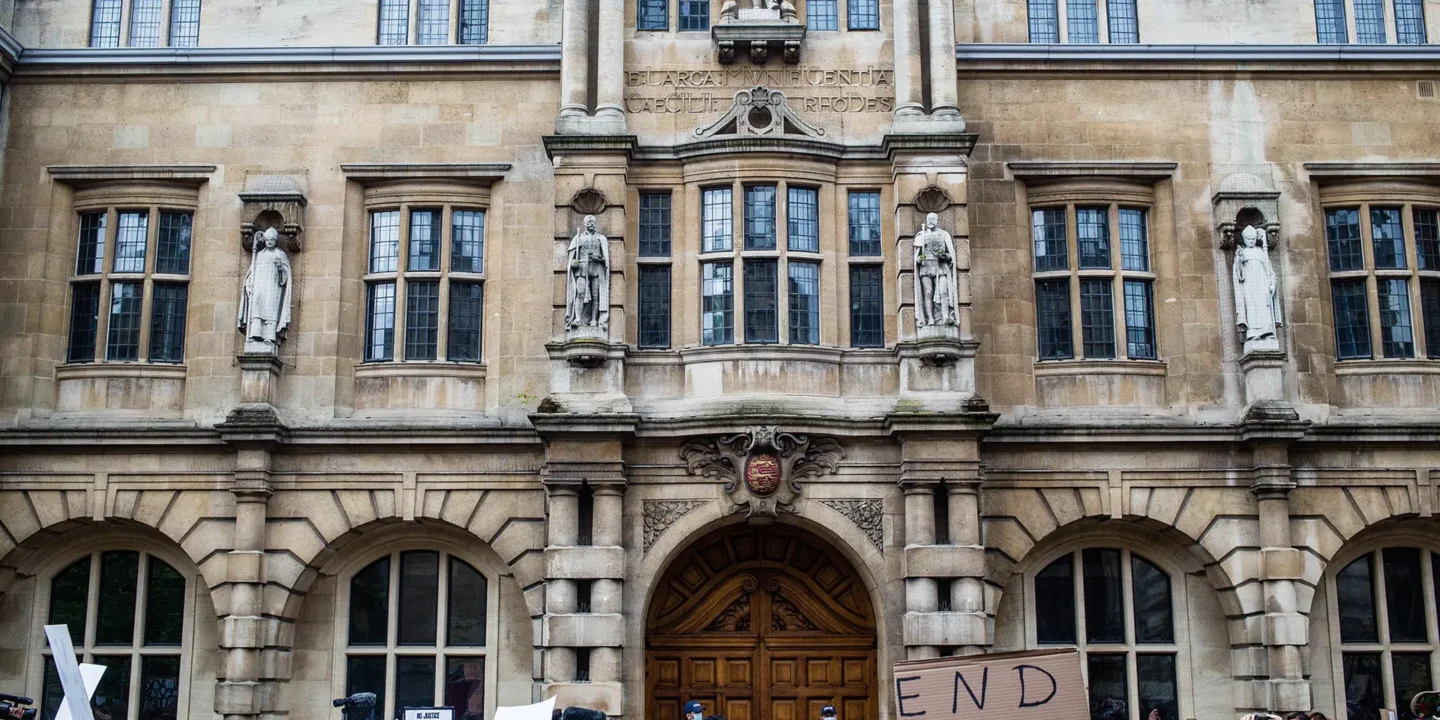
Educational decolonisation follows yet another path. The Rhodes Must Fall movement began in South Africa at the University of Cape Town, in protest against a large bronze statue of Cecil Rhodes. Rhodes was a British imperialist, prime minister of the Cape Colony, central figure in the colonisation of Rhodesia, and the benefactor behind the Rhodes Scholarship. Students asked why, in a post-apartheid South African university, such an imperial figure still occupied a place of honour. Whom does the university commemorate? Whom does it serve? Who receives its resources? Who is made to feel like a guest in someone else’s institution?
The movement soon spread to Oxford and other universities at the former imperial centre. Decolonising education became more than statue removal. It questioned curriculums, faculty composition, scholarships, research objects and intellectual authority. Why is European thought treated as universal theory, while non-European thought is often treated as regional material? Why do empire-builders have buildings, scholarships and memorials, while the knowledge, resistance and suffering of colonised peoples appear only in marginal courses? Decolonising education attempted to translate the moral legitimacy of anticolonial and anti-apartheid struggle into a redistribution of intellectual and institutional resources.
This demand is not absurd. Universities and museums have often been beneficiaries of empire. They hold objects taken during colonial conquest, use endowments built from imperial wealth, teach disciplines that once served imperial administration, and trained colonial officials. Asking them to confront that history and alter curriculums and resource distribution is a reasonable institutional reckoning. But it is still different from 20th-century wars of national liberation. It does not overthrow colonial government. It asks postimperial institutions to rearrange memory, knowledge and opportunity.
A new form of decolonisation talk, responding to the Gaza War, uses “decolonisation” as a pejorative.
In recent years, another use has emerged: decolonisation as a name for dangerous ideology. Some commentators, especially in discussions of Palestine, describe support for Palestinian self-determination as “decolonisation ideology” and accuse it of denying Israeli sovereignty or demonising an entire people. This usage responds primarily to decolonial theory and educational decolonisation in universities, rather than to the historical events of 20th-century decolonisation itself. It reimagines decolonisation not as a language of liberation, but as a threat to order and a source of hatred.
This shows that contemporary decolonisation discourses are not mutually compatible. Prebisch-style economic decolonisation criticised the power of postimperial states over developing countries. Modi-style cultural decolonisation can strengthen majoritarian state power within a postcolonial country. Rhodes Must Fall and related movements focus on knowledge, memory and access to resources in imperial or postimperial institutions. Anti-decolonial commentary portrays decolonial theory as dangerously radical. These uses share a word, but not a political project.
This does not mean that “decolonisation” has become meaningless. On the contrary, its popularity shows that the moral inheritance of 20th-century national liberation remains strong. People still believe that colonial rule was an injustice requiring overthrow and reckoning. They still believe that the oppressed have a legitimate claim to self-determination. They still believe that historical inequality can persist inside institutions, cultures and economies. If decolonisation had lost all moral power, so many people would not compete to claim it.
The problem is that this power comes from a historical event that is increasingly distant. Historical decolonisation once meant empires breaking apart, flags rising, colonial officials leaving, and national governments being formed. Today, decolonisation can mean syllabus reform, statue removal, trade-rule revision, religious nationalism, museum restitution, corporate training, psychology-course redesign, diplomatic argument or a change in state architectural style. The further it moves from the original events, the easier it becomes to expand — and the easier it becomes to dilute.
Historical decolonisation reached its moment of greatest political optimism in the 1960s and ’70s. It also inspired Black freedom movements in the United States, anti-racist campaigns and liberation struggles around the world. At that time, postcolonial states seemed to represent a new world: more equal, more autonomous, more anti-imperial and more solidaristic. That hope later weakened. Many independent states did not deliver peace or prosperity. Some fell into military rule, corruption or civil war. Solidarities between the Global South and industrialised countries were also eroded by deindustrialisation, migration anxiety and trade competition.
It was this disappointment that helped transform decolonisation from a historical process into decolonisation talk. It no longer merely describes the end of empire. It has become a reservoir of legitimacy for many political and institutional projects. It can provide language for economic reform, or for nationalism; for student protest, or for state power; for expanding democracy, or for excluding dissenters. Its authority comes from anticolonial struggle. Its ambiguity comes from the fact that the promises of anticolonial struggle were never fully realised.
To answer the question “what is decolonisation?”, then, we must distinguish several layers. First, historical decolonisation was the process by which colonial empires collapsed and colonised peoples struggled for independent states. Second, economic decolonisation is the post-independence challenge to global economic hierarchy and resource dependency. Third, cultural and educational decolonisation criticise the survival of colonial legacies in language, knowledge, memory and institutions. Fourth, decolonisation in contemporary ideological conflict has become a symbol that different sides compete to claim or condemn.
Without these distinctions, we cannot understand why the same word can belong to the Algerian War of Independence and to a debate over an Oxford syllabus; to the Group of 77 seeking economic sovereignty and to the Indian government removing selected historical symbols; to the language of the oppressed and to the vocabulary of powerful governments and conservative critics. Decolonisation is not a single answer. It is a continuing argument about historical justice, power redistribution and unfinished liberation.
Its central question has not disappeared: after colonial rule formally ended, who actually became free? Who received a flag but not resources? Who entered the university while remaining marginal in the order of knowledge? Who lives inside an independent state but remains treated as an internal outsider? Who possesses sovereignty but lacks economic choice? Who claims to decolonise while merely consolidating a new form of domination?
This is why decolonisation talk will continue. It is popular not because the concept is clear, but because the world remains unequal. Historical decolonisation changed the international order, but it did not end all the consequences of colonial relationships. So long as political independence coexists with economic dependency, cultural recognition with intellectual hierarchy, state sovereignty with internal exclusion, and imperial legacies that can still be seen, used or denied, decolonisation will continue to be invoked.
Decolonisation was once a revolution that changed the map of the world. Today, it is more often a language for contesting the meaning of the world. It can remind us that liberation remains unfinished; it can also be misused as an instrument of new power. To understand it, we must ask not only who says “decolonisation”, but what colonial inheritance they seek to undo. Are they challenging power, or consolidating it? Whom do they make freer, and whom do they exclude? Only by asking these questions can this overused word retain the seriousness it inherited from the age of national liberation.