











Over the past several decades, the Western world has experienced a vast wave of private wealth. House prices have risen, pension assets have expanded, financial markets have grown, corporate valuations have soared, the number of billionaires has multiplied, and more and more of the ultra-rich have become global celebrities. A quick glance at the headlines seems to lead us to a familiar conclusion: we are living through a new Gilded Age. Wealth has once again become power, capital has once again overwhelmed labor, and a small minority has once again occupied the highest position in history.
This narrative is deeply appealing. It presents the past century and more as a U-shaped story. In the late 19th and early 20th centuries, taxes were low, markets were only lightly regulated, democratic forces were weak, and capital could accumulate almost without restraint. Wealth became highly concentrated. Then the two world wars destroyed capital, postwar progressive taxation and welfare states weakened the rich, and wealth inequality declined. After 1980, however, neoliberal policies, financial liberalization, tax cuts, and globalization reversed the trend toward equality, and wealth once again flowed toward the top. This story has become the default framework through which many people understand modern capitalism.
The problem is that this powerful new orthodoxy does not fully match the historical evidence. Wars and progressive taxation certainly mattered. Capital taxes, financial regulation, and political shocks did restrain the expansion of rich people’s fortunes. But they were not the main reason wealth inequality fell so sharply in the 20th century. The more important force was not that the top was pushed down, but that the bottom and the middle were lifted up. Over the past century, ordinary people acquired unprecedented forms of asset ownership, especially housing and pension savings. The democratization of Western wealth came mainly from the expansion of middle-class assets.
This means we need a different way to understand the history of wealth. Capitalism did not simply move toward boundless inequality, nor did it become temporarily more equal only because of war and high tax rates. The more decisive forces were political and institutional change: the expansion of suffrage, the spread of education, improvements in labor law, the legalization of trade unions, rising wages, and a financial system that began to provide mortgages and savings instruments to ordinary households. Workers became more productive and earned higher incomes, which allowed them to buy homes. Living standards rose and life expectancy increased, which made retirement saving necessary. Wealth was no longer mainly aristocratic estates, industrial shares, and control of large companies. Increasingly, it took the form of family homes and long-term pension accounts.
Today, residents of Europe and the United States are richer in real purchasing-power terms than at any previous point in history. By wealth, we mean all the assets owned by households and individuals minus their debts: housing, bank deposits, stocks, pensions, insurance savings, and net worth after mortgages. Long-term data show that since 1980, wealth per adult has multiplied several times over. On a century-long scale, the increase is even more striking. More importantly, a considerable share of this new wealth does not belong only to the very top. It is held in the homes and retirement assets of ordinary families.
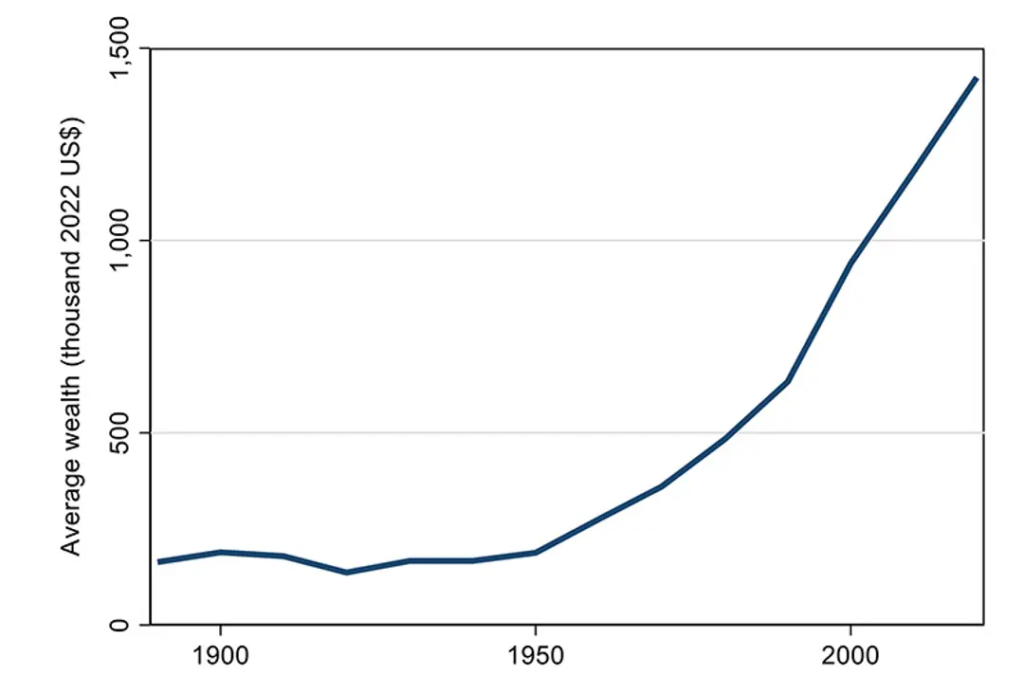
Figure 1: rising real average wealth in the Western world. Note: wealth is expressed in real terms, meaning that it is adjusted for the rise in consumer prices and thus expresses change in purchasing power. The line is an unweighted mean of the average wealth in the adult population in six countries (France, Germany, Spain, Sweden, the UK and the US) expressed in constant 2022 US dollars. Source: Waldenström (2024, Chapter 2)
This is what new research is beginning to emphasize. We should not look only at lists of the super-rich, although their wealth is indeed enormous and has real social and political consequences. We also need to examine how the entire structure of wealth has changed. Over the past 130 years, the composition of wealth has shifted fundamentally: from agricultural land, industrial capital, and concentrated share ownership toward housing, pensions, and insurance savings. Ownership itself has changed along with it. An ordinary household with a home and a pension is certainly not a capitalist in the old sense of a major owner. But it possesses a kind of asset security that many working-class people in history never had.
Thomas Piketty’s Capital in the Twenty-First Century had such enormous influence precisely because it offered a grand, clear, and politically powerful historical explanation of inequality. Piketty argued that capitalism has an inherent tendency to generate wealth concentration. If the rate of return on capital remains higher than economic growth over the long run, those who own capital will become increasingly rich, and wealth inequality will keep rising. Only wars, revolutions, progressive taxation, and policy interventions can temporarily interrupt this tendency. In this account, the equalization of the mid-20th century appears as an exception, while the return of inequality after 1980 appears as the return of capitalism’s natural logic.
There has been much debate around the book, but most of it has focused on theory. Economists have discussed the so-called fundamental laws of capitalism, the relationships among the capital income share, the rate of return on capital, savings rates, and growth rates. Comparatively fewer people have examined the historical data themselves with equal care. How exactly is wealth measured? Which assets are included? Are data from different countries truly comparable? Did real estate, pensions, and business assets mean the same thing in different periods? If the empirical foundation is biased, even the most elegant theory may produce conclusions that are too neat.
My research reaches a striking new conclusion about the history of Western wealth and inequality.
In recent years, new research on the history of wealth inequality has begun to supplement and revise the existing picture. Scholars have reexamined classic cases such as France, Britain, Germany, and the United States, while also bringing Spain, Sweden, Switzerland, the Netherlands, Canada, and other countries into comparison. As new data have emerged, the story has become less simple. Wealth has indeed grown dramatically, and top wealth has recovered in some countries, especially the United States. But over the longer run, Western societies today remain more equal than they were a century ago. Wealth concentration has not returned to the levels of the 1910s and 1920s, especially in Europe.
The new core findings can be summarized in three points. First, people in Western countries are wealthier today than they have ever been. Second, the composition of wealth has changed profoundly, moving away from land and business capital controlled by elites and toward housing and pensions widely held by ordinary households. Third, wealth inequality fell sharply during the 20th century and has remained at historically low levels in Europe. The United States has seen a rebound in recent decades, but even there, inequality remains below the extreme concentration seen before the Second World War. These findings require us to shift attention from “how much the rich lost” to “what ordinary people gained.”
Consider the first point: the growth of average wealth. Measured in real purchasing power, wealth per person in the West has grown enormously over the past 130 years. In the first half of the 20th century, average wealth did not change dramatically. After wars, crises, and upheavals, overall wealth levels remained relatively stable. But after the Second World War, asset values began to rise continuously. After 1950, housing, financial assets, pensions, and business capital together drove the expansion of household net wealth. By the early 21st century, the wealth held by ordinary adults had reached several times its earlier level.
This growth did not occur only during one particular policy era. It did not come simply from postwar European reconstruction, nor did it come entirely from market liberalization after the 1980s. In fact, average wealth in Western societies increased in almost every decade after the Second World War. It rose during periods of heavier regulation and also during periods of market liberalization. It grew when tax rates were high and continued to grow after tax rates fell. This suggests that deeper structural forces lay behind the expansion of wealth: productivity growth, urbanization, the development of housing finance, the maturation of pension systems, the spread of education, and longer life expectancy.
Of course, asset values rose especially rapidly after the 1980s. Financial deregulation, lower tax rates, higher corporate profits, globalization, and the technological revolution all pushed up capital valuations. Many people therefore take this as evidence of a return of inequality. But once housing and pensions are included, it becomes clear that asset appreciation did not belong entirely to the top. The main wealth of ordinary families also grew through homes and retirement assets. Market liberalization certainly created new fortunes, but it did not automatically erase the middle-class asset base built over previous decades.
Over the past 130 years, the composition of wealth has undergone a monumental transformation.
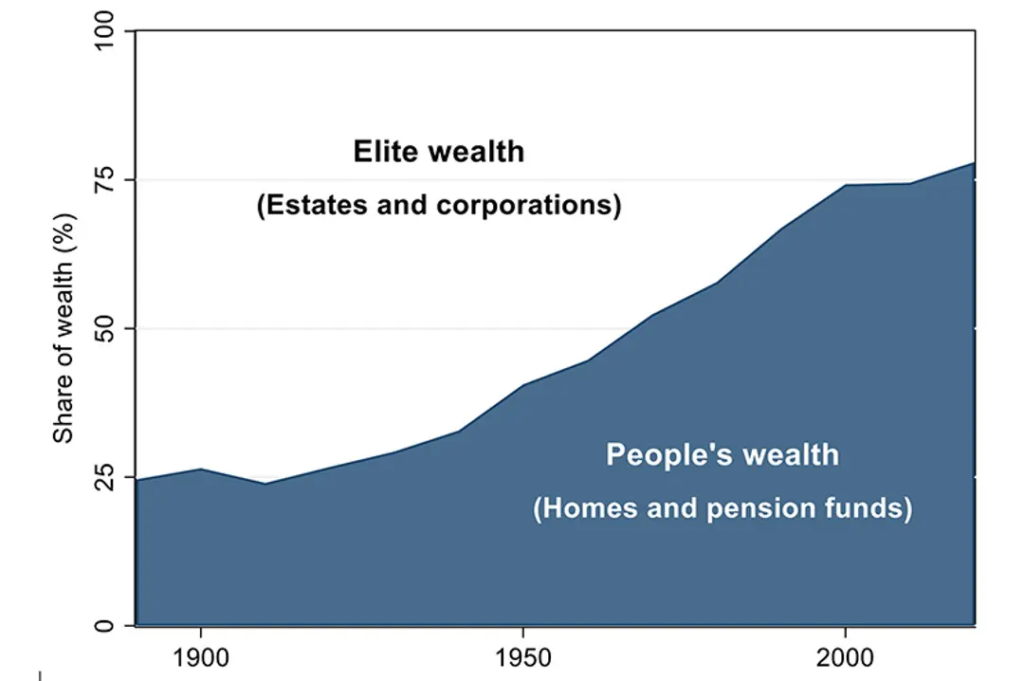
Figure 2: the aggregate composition of assets: from elite wealth to people’s wealth. Note: unweighted average of six countries (France, Germany, Spain, Sweden, the UK and the US). Source: Waldenström (2024, Chapter 3)
The second major change is that wealth no longer looks the way it once did. In the late 19th and early 20th centuries, wealth consisted mainly of agricultural land, estates, industrial capital, and company shares. These assets were highly concentrated and were usually held by aristocrats, landlords, industrialists, and financial elites. Even when ordinary workers had modest savings, it was difficult for them to enter the world of true asset ownership. Capital belonged to the few, labor to the many. The distinction was stark.
Today, wealth has a completely different appearance. Housing has become the largest component of household wealth, while pensions and insurance savings have become increasingly important. For low-wealth and middle-wealth households, housing is often the main asset. For workers, pensions are long-term assets accumulated through employment. A worker may not own company shares or engage in financial speculation, but he may own a home and have a retirement account. These assets change household security, and they also change the distribution of wealth.
The expansion of homeownership has been especially important. In the first half of the 20th century, homeownership rates were not high in many Western countries. Many families rented from private landlords, lived in urban apartments, or depended on employer-provided housing. After the Second World War, mortgage systems developed, governments supported housing finance, wages rose, suburbs expanded, and families began buying homes on a large scale. Today, homeownership rates in many Western countries range from 50 percent to 80 percent. This was a vast movement of asset democratization.
Pensions had a similar effect. In the past, being able to retire for a long period and live on savings was itself a privilege of the few. Many people worked until near the end of life or relied on family care. As life expectancy rose, public pensions were established, and occupational and private pensions developed, retirement savings became part of the ordinary worker’s asset portfolio. Pensions are not wealth in the traditional sense of an asset that can be sold at any moment, but they represent future income rights and long-term accumulation. They transform part of labor income into a form of capital and allow ordinary people to organize wealth across the life cycle.
These changes in asset composition have powerful distributive consequences. The rich still hold more corporate shares, financial assets, and commercial real estate. Ordinary households mainly hold homes and pensions. Therefore, when housing and pensions rise as a share of total social wealth, wealth distribution naturally becomes more widespread. In other words, declining inequality does not necessarily require the destruction of rich people’s assets. If ordinary people’s assets grow faster, wealth concentration will fall.
The relationship between homeownership and wealth inequality is clearly visible. In general, countries with higher homeownership rates have lower wealth inequality. The reason is intuitive: housing is the large asset that ordinary households are most likely to accumulate. If most families rent forever, returns from housing are concentrated among landlords and investors. If most families own their homes, the gains from rising house prices are distributed much more broadly. Differences between France and Italy, and between Nordic and central European countries, reveal this pattern.
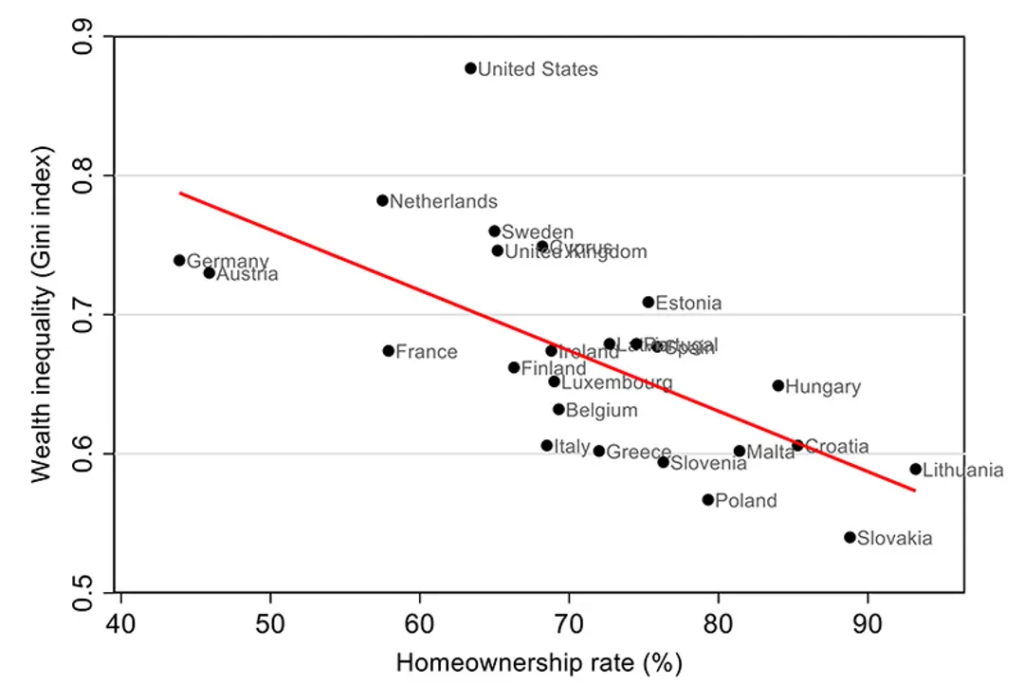
Figure 3: homeownership and wealth inequality in Europe and the US. Source: Waldenström (2024, Chapter 6)
Today, most wealth exists in housing and pensions, and these assets are mainly held by low-wealth and middle-wealth households.
This is precisely why Western wealth inequality has declined so significantly over the past century. At the beginning of the 20th century, the richest 1 percent often owned more than half of national wealth; in some European countries, their share approached two-thirds. Wealth concentration was extremely high. A small number of families and elites controlled land, industry, and financial assets. Ordinary people had almost no assets sufficient to protect them against illness, unemployment, old age, or economic shocks.
From the 1920s to the 1970s, wealth concentration continued to decline. The usual explanation is that war and high taxation struck down the rich. But more detailed data suggest that the decline came mainly because the middle and lower groups grew wealthier more quickly. Homes, savings, and pensions allowed more and more families to own assets. The top did not always become poorer; rather, ordinary people became richer faster. Wealth distribution shifted from a pyramid of elite ownership toward a broader pattern of middle-class ownership.
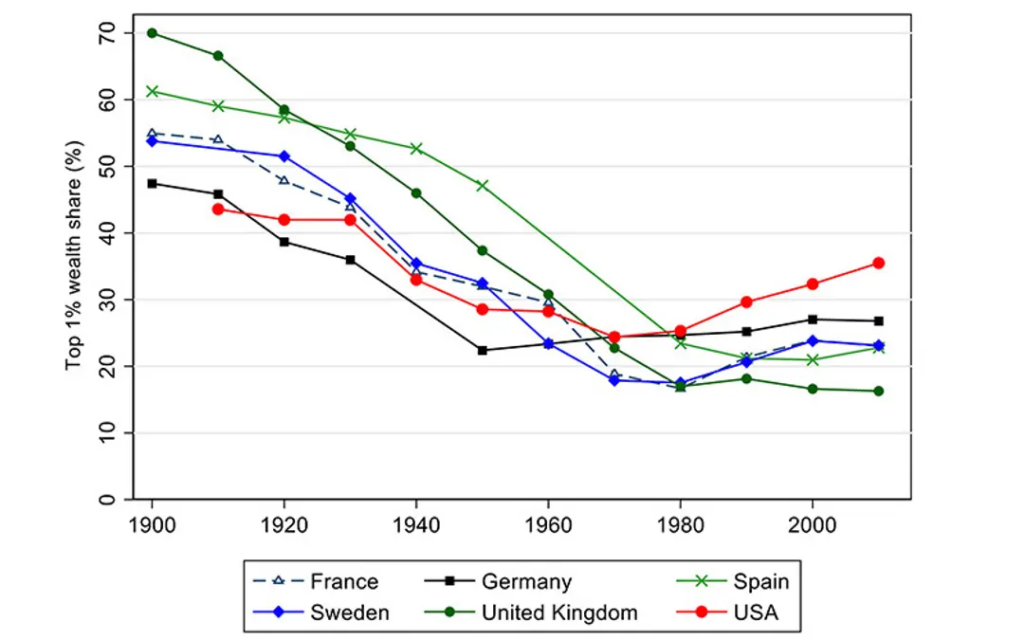
Figure 4: the great wealth equalisation over the 20th century. Source: Waldenström (2024, Chapter 5)
After the 1970s, Europe and the United States followed different paths. In Europe, the top wealth share has generally remained at historically low levels, perhaps with a slight rebound, but still far below early-20th-century levels. In many European countries, the richest 1 percent own roughly 16 percent to 24 percent of wealth, with Germany and Switzerland somewhat higher. The United States has seen a more pronounced revival of wealth concentration, especially through financial assets, technology entrepreneurship, stock markets, and business ownership. But even in the United States, current wealth inequality has not returned to the extreme levels seen in some European countries before the First and Second World Wars.
This does not mean that America’s problems are not serious. Wealth concentration in the United States has risen. Inequality in homeownership has widened. The racial wealth gap persists. Stock-market and entrepreneurial wealth are highly concentrated. Pension coverage is uneven. Households at the bottom often have insufficient assets and may even be heavily indebted. But from a long-term historical perspective, America’s wealth structure today is still different from the aristocratic capitalism of Europe around 1900. The problem is not that all progress has disappeared, but that some of that progress is now being eroded.
To explain the decline in wealth concentration, we must decompose the top wealth share. A decline in the top share may occur because the rich lose wealth, or because everyone else accumulates wealth more quickly. Long-term data support the latter explanation. Over the past century, the wealth of the rich did not, on average, collapse across all periods. Instead, the absolute wealth of the middle class and ordinary workers grew faster, especially between 1950 and 1980. This was the main force behind wealth equalization.
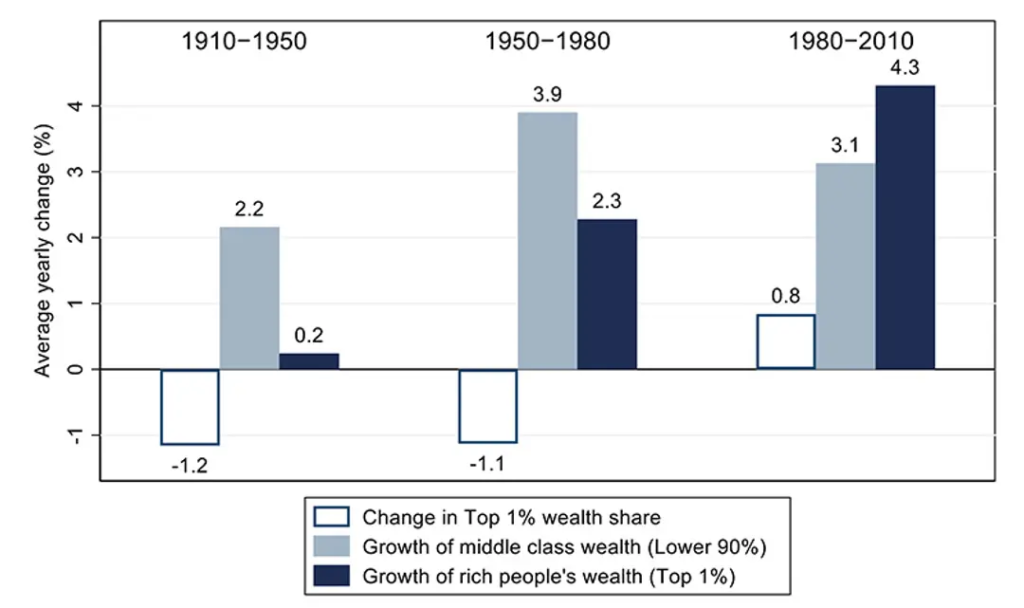
Figure 5: Western wealth growth: the middle class vs the rich. The graph shows a six-country average (France, Germany, Spain, Sweden, the UK, the US) of the average annual growth rate of real (inflation-adjusted) net wealth per adult individual in the top 1 per cent and the lower 90 per cent of the wealth distribution during three time periods. Source: Waldenström (2024, Chapter 6)
This also weakens the “war equalization” narrative. The two world wars did destroy some capital, especially in countries where they caused physical destruction, inflation, and financial turmoil. But when we compare belligerent and non-belligerent countries, we find that the decline in the top wealth share did not occur only in countries where capital was severely damaged. Sweden and other countries that did not fight also experienced a decline in wealth concentration. The United States saw a fall in the top share during wartime, while Spain’s top share changed little during the Spanish Civil War. War mattered, but it cannot explain the broad long-term trend.
Looking further at absolute wealth, the rich did not suffer catastrophic losses in most countries and periods. France experienced a major capital shock during the First World War, and Germany during both world wars, but elite wealth did not universally collapse elsewhere. If rich people’s wealth did not continuously fall, while the top share nevertheless declined, then the denominator must have changed: total social wealth grew, and much of that growth came from the accumulation of assets by the lower and middle groups. Equalization did not come only from destroying the top. It came from widening the circle of asset owners.
Wealth taxes and inheritance taxes briefly approached confiscatory levels in the early 1970s.
Progressive taxation is another common explanation. After the Second World War, many Western countries raised income taxes, inheritance taxes, and wealth taxes, while capital gains came under greater regulation. These policies certainly limited the accumulation of some great fortunes and may have reduced the creation of new large fortunes. During periods of high tax rates, entrepreneurship, capital mobility, and business valuations were affected in some countries, and many entrepreneurs moved to lower-tax jurisdictions. Taxation was clearly not irrelevant.
But the tax explanation also has limits. If wealth equalization mainly came from pushing down the rich through taxation, we should see an absolute decline in top wealth. The data, however, more strongly support the expansion of ordinary people’s assets. Taxes may have prevented a rebound at the top, and they may have helped finance education, housing, and welfare policies. But they were not the sole engine of change across the wealth distribution. What really mattered was that ordinary people gained the institutional conditions necessary to accumulate assets: higher wages, better education, more secure employment, more mature financial systems, wider access to mortgages, and retirement saving arrangements.
This brings us back to the political transformation that began in the early 20th century. The expansion of suffrage changed whom the state served. Democratic politics allowed workers and the middle class to demand education, labor protections, housing policy, and social security. Education reform expanded basic and higher education and raised workers’ skills. Labor laws shortened working hours, improved safety conditions, legalized trade union activity, and strengthened workers’ bargaining power. Financial institutions gradually began to serve wider populations by offering mortgages, savings plans, mutual funds, and pension products.
Together, these institutional changes transformed how people participated in the market economy. Ordinary people were no longer merely assetless sellers of labor. Through homes and retirement accounts, they began to share in asset growth. Democracy did not simply redistribute the wealth of the rich to the poor. Instead, it changed education, labor, and financial institutions so that ordinary people could enter the process of wealth accumulation. This was a slower and more institutionalized form of equalization than revolution or confiscation, but it proved more durable.
The most important equalizing force was the expansion of wealth ownership among ordinary citizens.
This point is especially important today. If we see wealth only as a tool of power for a small number of billionaires, we overlook the social meaning of ordinary asset accumulation. Housing and pensions are certainly not perfect assets. Rising house prices can exclude young people. Excessive reliance on housing can create property bubbles. Market-based pensions can bring financial risk. Yet they still represent a historical breakthrough: ordinary households entered the world of wealth ownership. Without such assets, families would be far more vulnerable to unemployment, illness, old age, and economic crisis.
This also means that future equality policy cannot focus only on how to push down the rich. It must also focus on how to expand the asset base of ordinary people. Helping more people own homes or enjoy stable housing rights, making pension coverage broader, cheaper, and more reliable, enabling workers to share in corporate profits and long-term savings tools, and continuing to improve education and wages may change the structure of wealth more effectively than simply raising top tax rates. The core of wealth democratization is not to make everyone a billionaire, but to give ordinary people secure, accumulable, and transferable assets.
Of course, housing wealth also creates new contradictions. If rising house prices mainly benefit those who already own homes while young people and low-income groups are shut out, then housing can shift from an equalizing tool into a source of intergenerational inequality. If urban housing supply is insufficient, land regulation is rigid, and credit expands excessively, the assetization of housing can create a new divide: homeowners become richer and richer, while non-homeowners find it harder and harder to enter. In the past, the expansion of homeownership reduced inequality. In the future, if the threshold for homeownership becomes too high, housing may instead increase inequality.
Pensions carry similar risks. People with stable careers, long-term employment, and formal jobs are more likely to accumulate retirement assets. Gig workers, temporary workers, informal workers, and low-income workers may lack coverage. If financial market returns are highly unequal, fees are expensive, or employer pensions cover only higher-income groups, pensions can also widen the gap. Asset democratization, therefore, cannot remain merely a historical achievement. Institutional design must be constantly renewed so that new generations can also enter the system of asset accumulation.
The historical lesson of capitalism is therefore more complex than the usual narrative suggests. Market economies do produce inequality. Capital income can become concentrated. The rich can use political influence to protect their own interests. But under conditions of democracy, education, labor protection, and broad financial access, market economies can also produce widespread wealth accumulation. The Western experience of the past century shows that it is not impossible for ordinary people to gain asset ownership. The key question is whether institutions provide them with the income, credit, education, and security needed to participate in that accumulation.
This does not mean we can be complacent about contemporary inequality. The renewed rise of top wealth in the United States, the concentration of power among tech giants and financial capital, the importance of inherited wealth, housing markets that exclude young people, regional divides, and racial wealth gaps may all erode the middle-class wealth base built over the past century. If asset ownership once again becomes concentrated among a small minority, and if ordinary households are trapped in high rents, low savings, and unstable work, the historical gains of equalization may be reversed.
But understanding past progress is crucial. If we mistakenly believe that wealth equalization came only from wartime destruction and high tax rates, we may underestimate the importance of education, housing, pensions, labor law, and democratic institutions. If we look only at the growing number of billionaires, we may miss the historical fact that hundreds of millions of ordinary households accumulated assets. A society that wants to become fairer must not only limit predatory wealth; it must also expand productive and broadly shared forms of wealth ownership.
Wealth accumulation itself is not necessarily bad. Successful companies can create jobs, raise wages, increase tax revenues, and drive technological progress. Household wealth can provide security, fund investment in the future, and protect against risk. The problem is not the existence of wealth, but how wealth is created, how it is distributed, whether it rests on exclusion, and whether it gives more people the ability to participate in the future. A healthy capitalism is not one without wealth. It is one in which the growth of wealth no longer belongs only to the few.
The story of the “great wealth wave,” therefore, should not be understood simply as a tale of victory for the rich. It is also the story of ordinary people entering the world of assets. Over the past century, Western societies have indeed become vastly wealthier, and wealth distribution is more equal than it was in the age of aristocratic capitalism. This progress is imperfect, unstable, and should not be romanticized. But it did happen. Housing and pensions gave ordinary families an unprecedented foundation of wealth, and democracy and institutional reform made that transformation possible.
The question for the future is whether this democratization of wealth can continue. Can young people afford homes? Can low-income workers accumulate pensions? Can immigrants and minority groups obtain equal opportunities to build assets? Can workers share in the gains from technology and business growth? Can tax systems limit unearned monopoly rents without strangling productive investment? Can cities expand housing supply without sacrificing quality of life? These questions will determine whether the wealth wave of the 21st century continues to broaden ownership or turns once again into a tsunami for the few.
History does not support simple pessimism. Capitalism was once far more unequal than it is today, ordinary people once had almost no assets, and the past century did witness large-scale equalization. But history does not support naive optimism either. The American rebound, housing exclusion, and financial asset concentration remind us that progress can be reversed. The best conclusion is a realistic one: wealth equality does not arrive automatically, but neither can it emerge only from disaster. It comes from institutional choices. If democracy, education, labor rights, housing finance, and pension systems can continue to expand asset ownership among ordinary people, wealth growth can once again become a force for social progress.
We do live in an age of great wealth. But the meaning of this wave lies not only in the appearance of more superyachts on the surface of the sea. More importantly, over the past century, hundreds of millions of ordinary families acquired boats of their own for the first time. Whether the next generation can also climb aboard, rather than being pushed back into the water by house prices, debt, and unstable work, will determine whether we can turn wealth growth into a fairer and more prosperous future.