











The United States did not become a credit card nation by accident. Long before plastic cards arrived in mailboxes, long before magnetic stripes, loyalty points and online checkout pages, the American economy had already learned to live on borrowed time. The colonies were chronically short of hard money. Coins were scarce; cash moved slowly; harvests, wages and payments did not always arrive when people needed to buy, sell or settle accounts. Credit filled the gap. People purchased goods “on account”, promising to pay later when crops were sold, ships returned, wages arrived or family fortunes improved.
Borrowing, in this early world, was not yet a separate financial product. It was woven into trade, reputation and community. A shopkeeper knew the farmer who owed him. A merchant knew which families were likely to pay. Credit measured not only purchasing power but social standing. To be trusted with delayed payment was to be known. In a country short of metallic currency and long on ambition, credit became a substitute for cash and, just as importantly, a substitute for certainty.
The 19th century changed the rhythm of borrowing. As the United States moved from farm production toward industrial wage work, millions of households began to receive more regular income. Wages and salaries did not make everyone secure, but they made future income more predictable. Businesses selling sewing machines, furniture, pianos, refrigerators, radios, washing machines and automobiles discovered that predictable paychecks could be converted into predictable instalments. A family could acquire an expensive durable good with a small down payment and then repay the balance over time. Industrial capitalism created the goods; instalment credit created the buyer.
This arrangement did more than expand consumption. It reorganised the household’s relation to the future. The promise of next month’s wages could be pulled into the present and turned into a car, a piano or a washing machine. The household became a small planning unit, balancing future pay against present comfort. The creditor, meanwhile, became a manager of time. To lend was to take a slice of a worker’s future and attach it to a commodity already sitting in the living room or parked outside the house.
In the cities, department stores developed a different credit form: the charge account. Unlike instalment credit, which was designed for large purchases repaid over time, charge accounts served affluent customers who wanted convenience, status and flexibility. A shopper could buy without cash, receive a monthly bill and pay without interest. These accounts were less a profit centre than a sales device. They encouraged the customer to return, to buy more, to feel recognised. The store was not simply extending credit; it was cultivating loyalty.
The link between credit and identity emerged here with special clarity. Stores issued charge tokens, metal plates and other small objects that carried account information. To present such a token was to be identified as a trusted customer. In modern cities full of strangers, credit became a badge of recognition. The customer did not have to explain herself at every counter. The metal plate spoke for her. It said: this person belongs in our books.
Mass consumer credit fit neatly into the age of mass production. Advocates in the early 20th century described a virtuous circle. Credit allowed households to buy more goods. Higher demand encouraged factories to expand. Larger factories lowered costs, created more jobs and raised purchasing power. Higher wages then supported more borrowing and more consumption. In this vision, credit was not a moral weakness but an industrial lubricant. It kept goods moving from factory to household and kept workers moving from wage packet to marketplace.
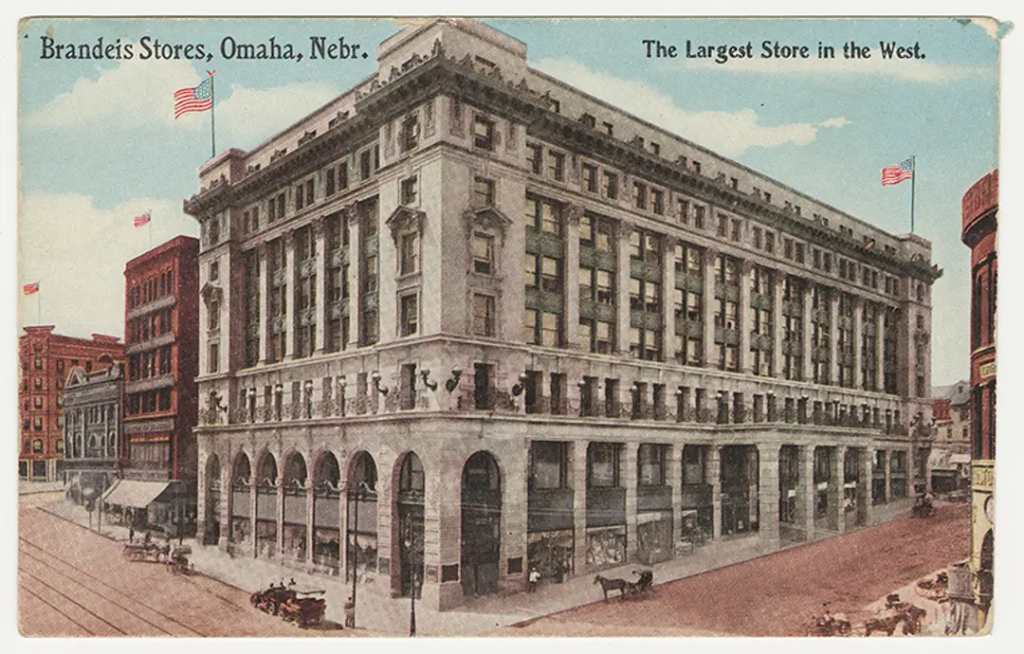
Undated postcard of Brandeis department store; Omaha, Nebraska. Courtesy History Nebraska
Critics saw the same machinery and feared a different outcome. If households spent future income today, what would sustain tomorrow’s demand? If factories depended on borrowed purchasing power, would the system require ever larger infusions of debt merely to keep moving? Consumer credit seemed less like a stable engine than a stimulant. Each round of borrowing created the need for another.
The Great Depression turned that anxiety into reality. After the 1929 crash, consumers hesitated. They postponed purchases. They delayed replacing cars, appliances and furniture. They did not want to borrow into uncertainty. Each individual act of caution made sense; together, they deepened the crisis. Factories lost orders. Workers lost jobs. Unemployed workers spent less. Less spending meant fewer orders still. The credit-fuelled circle of the 1920s did not gently slow. It seized up.
Policymakers drew a lesson that would shape the rest of the century. American industry had been built around a mass consumer market, and that market had come to depend on household borrowing. If private credit collapsed, production collapsed with it. The New Deal is remembered for public works, labour law, banking reform and social insurance, but it also helped legitimate consumer credit as a matter of national economic management. Borrowing was no longer merely a private arrangement between seller and buyer. It became part of the machinery of employment, growth and recovery.
This was the first great transformation in the politics of credit. Debt moved from the moral world of household prudence into the macroeconomic world of national demand. A family that borrowed to buy a refrigerator was not only making a private decision. It was helping factories run, workers stay employed and the economy expand. The federal government did not invent consumer credit, but it gave it a new public purpose.
The Second World War temporarily reversed the priority. The government wanted households to save rather than spend. Factories were needed for war production, not civilian goods. Inflation had to be controlled. The Federal Reserve imposed strict controls on consumer credit, particularly instalment plans used to purchase cars and appliances. Yet regulation did not stop credit innovation. It redirected it.
Retailers adjusted charge accounts to work around, and later within, the rules. Customers received the now-familiar interest-free period, followed by monthly interest on any balance carried forward. Businesses also had to improve recordkeeping. They needed to know who owed what, when payment was due and whether new purchases complied with federal restrictions. Large department stores adopted card-based accounting systems, including Charga-Plate, that connected the sales floor to the credit office. The card was not simply a payment device. It was an information device.
This matters because the modern credit card was born from two forces that are often treated separately: consumer desire and administrative control. The card made buying easier, but it also made customers easier to track. It joined identity, credit limit, transaction record and repayment schedule into one portable object. The metal plate and later the plastic card were not merely conveniences. They were early pieces of a private data infrastructure.
After the war, policymakers promised abundance. Wartime restraint had been justified by the expectation that peace would bring homes, cars, appliances, travel and modern comforts. Department stores entered the postwar boom ready to sell that future. They followed white middle-class families out of downtown shopping districts and into suburbs, carrying their charge accounts with them. Credit cards became part of the new geography of consumption. The suburban family needed stores, parking lots, appliances, gasoline and flexible credit. The card helped stitch those pieces together.
Gasoline companies had their own networks. Before the war, firms such as Standard Oil had built charge-account systems linking service stations over large territories. Rationing interrupted credit sales, but the postwar car economy revived them. Gas cards turned fuel purchasing into a routine account relationship. Railroads experimented with unified credit plans too. Travel, business mobility and credit began to converge.
The postwar card did not merely let people buy things; it taught businesses to recognise them across space.
This convergence created the setting for the travel-and-entertainment card. Department store cards were tied to particular firms. Gasoline and rail cards linked related businesses within a single sector. Diners Club, introduced by Frank McNamara in 1950, promised something broader. It allowed executives to entertain clients at restaurants and clubs without cash. Soon it expanded into hotels, travel and other services. Its ideal user was male, mobile, professional and expense-accounted: the executive, salesman or man who “gets around”.
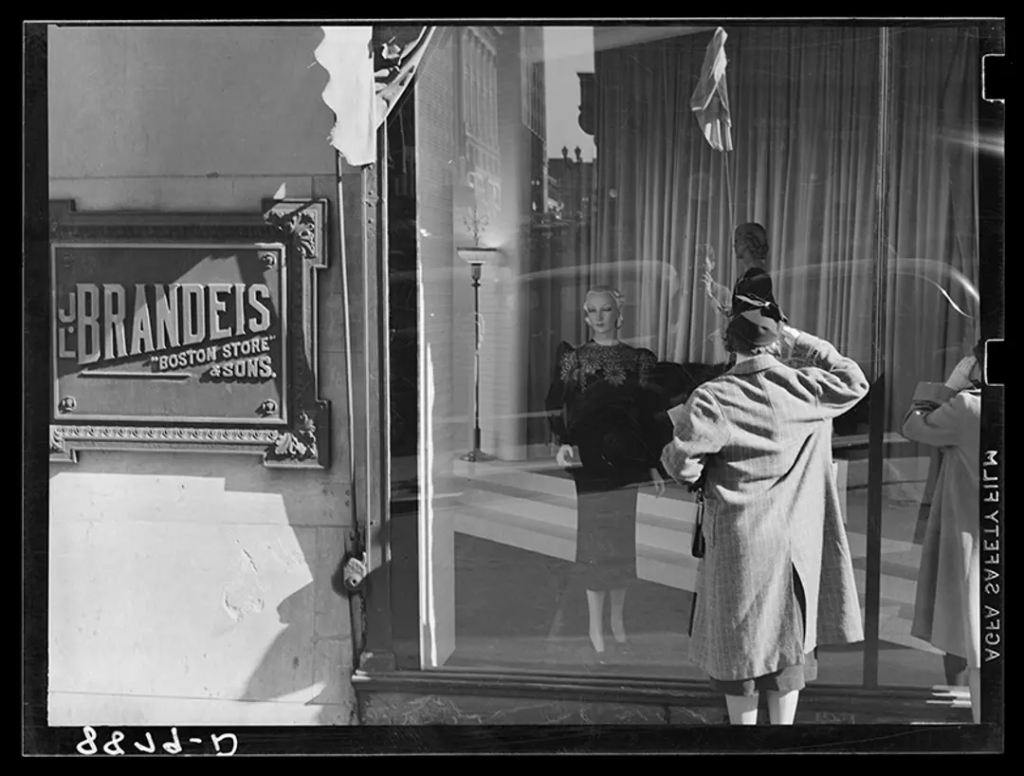
Brandeis ‘Boston Store’; Omaha, Nebraska, 1938. Courtesy the Library of Congress
The card solved a problem for postwar business culture. Expense-account capitalism required mobility and performance. Deals were made over lunches, drinks, hotels and flights. The card gave the travelling businessman a portable commercial identity. It was not just credit; it was admission. It declared that the bearer belonged to the world of corporate circulation.
Banks entered the card business from another direction. In the 1950s, most American banks were small and local. New Deal regulations had made banking safer but less expansive. Geographic restrictions limited where banks could operate. Interest-rate rules and other regulations constrained profitability. Banks served businesses, held deposits and made local loans, but many bankers wanted new ways to grow.
Department store credit suggested a possibility. Large retailers had cards; small retailers usually did not. Bankers in towns and cities began experimenting with local card plans that connected small merchants into shared credit systems. A customer could use one bank card at several local shops. For banks, the card promised access to consumer finance and closer relationships with merchants. The ambition was not yet national. It was community banking extended through a new medium.
Bank of America changed the scale. Unlike most American banks, it was large, branch-based and consumer-oriented. By the late 1950s, it had hundreds of branches across California and deep experience with mortgages, auto loans and household accounts. It had also invested in computers, which executives believed could make a statewide card system manageable. The card required not only lending capital but information processing: billing, authorisation, fraud control, merchant settlement and account management. Bank of America had the machinery to try.
The central problem was the same one that confronts all payment networks: consumers will use the card only if merchants accept it, and merchants will accept it only if enough consumers carry it. Many banks solved this by recruiting merchants first and relying on those merchants to sign up customers. Bank of America reversed the logic. It already had millions of customers. If it put cards directly into their hands, merchants would follow.
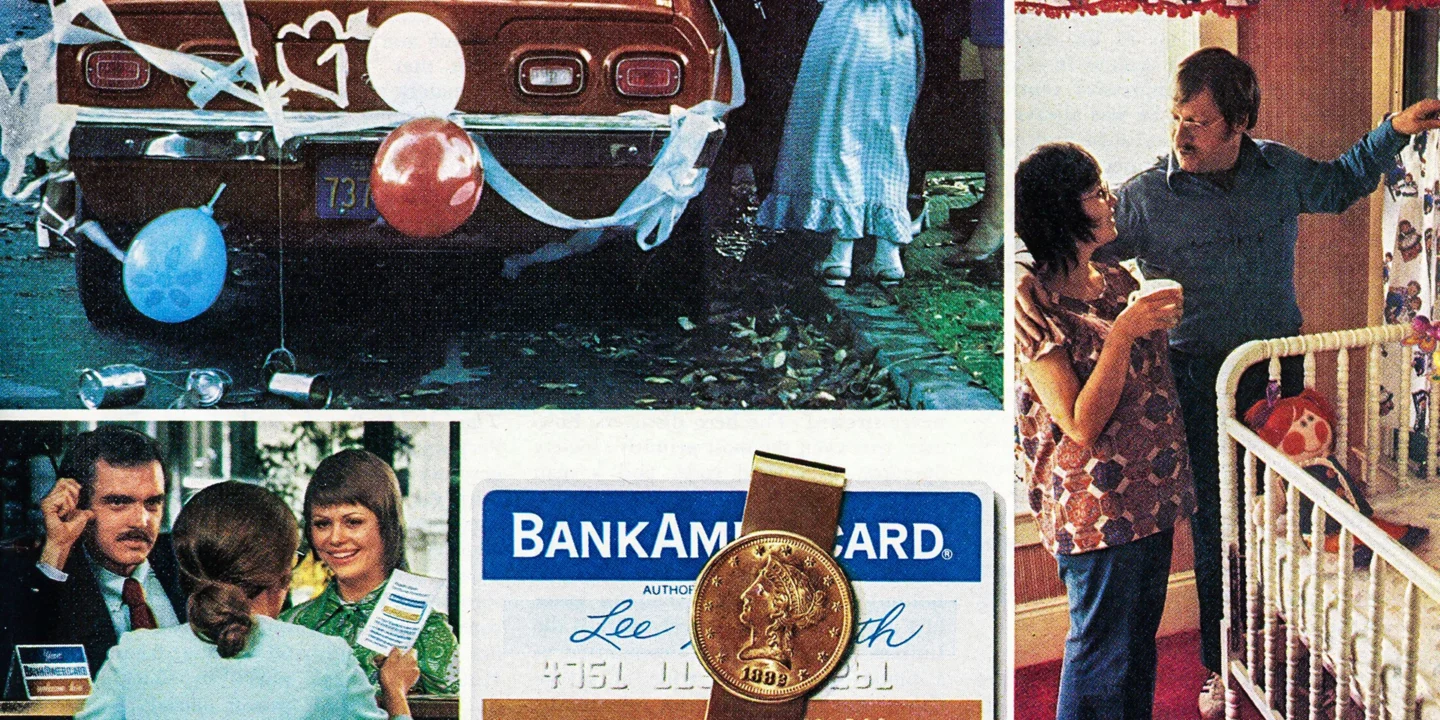
In 1958, beginning in Fresno, the bank mailed unsolicited BankAmericards to account holders. Over the next few years, more than 2 million cards went out across California. They arrived without being requested. They were also new in form: embossed plastic rather than metal or cardboard. Plastic carried the aura of the future. It looked modern, light, clean and automatic. The strategy was reckless, expensive and effective. It created an instant cardholder base while producing large fraud losses and delinquencies.
By the early 1960s, department store cards and travel cards had become familiar, but the bank card remained uncertain. Chase Manhattan, one of the country’s largest banks, abandoned its early card experiment after only a few years. Yet the pressures that had pushed bankers toward cards did not disappear. Banking remained geographically constrained and profit-starved. Cards seemed to offer a way around old limits: a product built on information technology, consumer credit and merchant relationships.
Still, scale was difficult. Early card markets were divided by gender and purpose. Travel-and-entertainment cards such as Diners Club and American Express catered to businessmen. Department store cards and many bank cards were oriented toward household shopping, often imagined as female. The BankAmericard was marketed as a family card. One card followed the male executive through airports and restaurants; another followed the suburban homemaker through stores and supermarkets. The dream of a universal card required merging these worlds.
Bank of America tried. It enrolled hotels and airlines, expanding beyond household shopping into travel. But geography remained a barrier. Under banking law, Bank of America could not simply open branches across the country. Its competitors in travel credit operated nationally. The bank needed a way to be everywhere without legally becoming everywhere.
It found one by turning the card into a network. Bank of America recruited banks in other states to issue BankAmericards under licence, using their own local merchant and customer relationships. The result was a national system built out of local banks. Regulation still confined banks geographically, but the card network crossed borders that branches could not.
Competitors responded by building rival networks. Regional associations formed in the Midwest and New England and then combined into what became Master Charge, later MasterCard. By the late 1960s, bank cards were spreading with astonishing speed. Fewer than 70 banks issued cards in 1965. Five years later, more than 1,200 did.
For consumers, the expansion appeared as a storm of plastic in the mailbox. Bank of America urged its licensees to mass-mail unsolicited cards. Competing banks followed. Department stores and gasoline companies joined in. Tens of millions of live credit cards were mailed across the country before Congress banned the practice in 1970. The card was not something consumers always applied for; often, it simply arrived.
In the rush to build networks, banks treated the mailbox as a branch office and the household as a market to be captured.
The risks were obvious. Cards arrived activated and ready to use. There were no modern activation systems. Anyone who opened the envelope could sign the card and start spending. Banks wanted to beat competitors to consumers, so they often used customer lists, shareholder lists, credit-bureau names and mass-marketing sources with minimal screening. Thorough credit evaluation slowed the campaign. Speed mattered more.
The result was more than a business fiasco. It became a political event. Consumer groups, labour unions and lawmakers began to see credit cards as a threat to household security, privacy and fairness. Borrowers worried about liability for lost or stolen cards, including cards they had never requested. Billing errors proliferated through automated systems. Credit bureaus gained new power. Families received cards for wives, children and even dead relatives, raising anxieties about household authority and moral discipline.
The backlash came in two forms. First, consumer and labour groups pushed to regulate the price of credit. State usury laws already limited interest rates on many consumer loans, but credit cards often slipped through exemptions. As cards spread, organisations such as the AFL-CIO and consumer advocates campaigned to bring card lending under state rate ceilings. By the early 1970s, many states capped card interest rates in the range of 12 to 18 per cent.
These caps mattered. Banks borrowed the money they lent. If interest rates rose, but state laws prevented banks from raising card rates, banks absorbed the risk. This discouraged them from turning cards into long-term debt machines. Cards remained closer to convenience credit than to perpetual revolving debt. Price regulation did not eliminate borrowing, but it limited the business model.
The second form of backlash concerned information and liability. Congress passed a series of consumer credit laws in the late 1960s and 1970s: Truth in Lending, Fair Credit Reporting, Fair Credit Billing and other measures designed to make credit markets safer and more transparent. Credit cards were central to this legislative wave. The technology that promised convenience had created new hazards: hidden costs, mistaken bills, identity misuse, database power and household overextension.
The first credit-card boom produced not only a lending market, but a consumer-rights state built to contain it.
Yet the political response misunderstood part of the problem. Credit cards were treated mainly as a consumer protection issue, when they were also a banking regulation issue. Banks had entered the card market partly to escape geographic and regulatory limits. The card networks they built would gradually weaken the very state-level protections that consumers had just won.
The process began quietly. In some regions, banks issued cards across state lines through partnerships. A large bank in one state might manage accounts for customers recruited by a smaller bank in another. Legal disputes arose over which state’s laws applied. Was the card governed by the state where the consumer lived and used it, or by the state where the issuing bank was located? Over time, courts and finally the Supreme Court settled on the bank’s location. At first, this seemed technical. Most states had interest-rate caps, and differences between them were not enormous. Soon, it would become decisive.
Meanwhile, large banks began to imagine the card as more than credit. Walter Wriston at Citibank and others saw cards, ATMs and electronic terminals as pieces of a new consumer banking architecture. Citibank was a global institution, yet domestic rules prevented it from branching freely across state lines. A card could travel where a branch could not. It could attach the bank to consumers in states where the bank had no physical presence. The card was becoming a bank in miniature.
In 1977, Citibank acted. BankAmericard had recently rebranded as Visa, signalling ambitions beyond its California origins. Citibank used the moment to launch a national solicitation campaign, mailing pre-approved card applications across the country. Many consumers saw the offer as part of the Visa transition and accepted. Competitors were startled. They still believed local banking relationships mattered. But they also remembered the lesson of the 1960s: in the card business, hesitation could mean losing the mailbox. A new solicitation war began.
By 1979, banks were approving tens of thousands of card applications every day. Bank cards surpassed department stores as the leading source of card borrowing. The credit card was no longer an accessory to retail. It had become a mass banking product.
Then inflation changed everything. In the late 1970s, prices rose rapidly, and policymakers debated the causes. Some blamed consumer credit for “anticipatory buying”: households used credit to purchase before prices climbed further, increasing demand and pushing prices higher. In 1979, Federal Reserve chairman Paul Volcker launched his assault on inflation by restricting money growth and allowing interest rates to soar.
High rates devastated card issuers operating under state price caps. Banks’ cost of funds rose above what they could charge consumers. For Citibank, the danger was existential. It had millions of cardholders, many recruited through its national campaign, and New York’s strict consumer laws limited what it could charge. The bank had staked its consumer future on cards just as monetary policy turned the product into a money loser.
Citibank found a way out. Lawyers identified a route through the Bank Holding Company Act that allowed the bank to move its card operation to another state if that state invited it. South Dakota, eager for financial jobs, changed its laws in 1980. It had no meaningful interest-rate ceiling for credit cards. Citibank moved its card business there and exported South Dakota’s permissive rules to customers across the country.
This was the second great transformation in the politics of credit. State-level consumer protection had constrained the card business by forcing lenders to live within local price rules. Once banks could choose their regulatory home and export those rules nationwide, the balance shifted. States began competing to attract banks by offering lenient laws. Delaware followed South Dakota. Other states faced pressure to loosen their own rules or lose financial business.
Massachusetts tried to hold out with an 18 per cent cap and no annual fees. Out-of-state banks flooded its residents with more expensive cards. Local banks complained that they could not compete. The legislature eventually raised limits. The result seems strange only if one assumes consumers always select the cheapest credit. In practice, high-rate banks could spend more on marketing, mail more offers and reach consumers more aggressively. The cheaper product did not automatically win. Bad plastic money crowded out good.
Once banks could choose their regulator, the credit card became a weapon against local democracy.
From the 1980s onward, credit cards became consistently more profitable than ordinary bank lending. Competition did not eliminate those profits. The usual explanation is consumer irrationality: people misunderstand interest rates, underestimate future borrowing, overvalue rewards, respond to teaser rates and fail to compare fees. There is truth in this, but it is incomplete. Consumers did not simply become foolish. They were placed inside a market designed to make comparison difficult and delay costly.
Card issuers learned to profit from time, attention and confusion. Low minimum payments stretched debt into the future. Teaser rates encouraged balance transfers. Late fees and penalty rates turned small mistakes into revenue. Affinity cards linked borrowing to universities, sports teams, charities and professional identities. Rewards programs made the card feel like a way to earn rather than a way to pay. The product became psychologically dense. It sold convenience, status, liquidity, loyalty and self-expression, while charging heavily for delay.
This is the card’s most important innovation. It did not merely lend money. It changed the meaning of payment. Cash ends a transaction. A debit card moves existing money. A credit card opens a relationship between the purchase and the future. The transaction is not complete at the register. It continues into the billing cycle, the grace period, the minimum payment, the interest charge, the fee schedule and the credit score. The card turns every purchase into a possible financial event.
The credit score deepened this transformation. Repayment behaviour became data. Data became reputation. Reputation became access to apartments, cars, mortgages, insurance, jobs and further credit. Earlier charge plates had identified the trusted customer to the store. Modern credit cards helped identify the disciplined financial subject to the economy. To carry and manage credit became a test of citizenship in a market society.
This new form of financial citizenship was unequal from the start. Affluent cardholders used cards for convenience, rewards and free short-term float. They paid balances in full, collected points, enjoyed fraud protections and gained status. Less affluent cardholders used cards for liquidity. They carried balances, paid interest, incurred fees and financed the rewards enjoyed by richer users. The same card that was a perk for one household became a trap for another.
The rewards system made this upward redistribution almost elegant. Merchants paid interchange fees. Merchants passed costs into prices. All consumers paid those prices, including those using cash, debit or basic cards. Affluent cardholders with premium rewards received points, miles and cash back. Struggling borrowers paid interest and fees. The system presented itself as individual choice, but it functioned as a private tax-and-transfer programme, moving value upward through the payment network.
Consolidation strengthened these dynamics. Large issuers had the marketing budgets, data systems and legal departments to normalise complex fees and aggressive solicitation. The proposed mergers and combinations of major card companies are not just ordinary business news. They shape the terms on which households encounter money. The bigger the issuer, the more likely its practices become industry standards.
But the deepest reason credit cards remain powerful is that the American political economy still needs household borrowing. Wages for many workers became less secure. Healthcare, education, housing, childcare and transportation grew more expensive. Public supports remained thin. The card became a household shock absorber. It covered the car repair, the medical bill, the grocery gap, the delayed paycheck, the emergency flight, the rent shortfall. In official language, this is access to credit. In lived experience, it is often the privatisation of insecurity.
Here lies the cruel ambiguity of the credit card. It extends credit to people whom older financial institutions excluded: poor households, minority borrowers, young adults, people without collateral. That access can be useful and sometimes necessary. Yet the same access often comes at high cost. The card includes borrowers in mainstream finance by exposing them to its most expensive terms. Inclusion and extraction arrive together.
Outstanding credit card debt rose relentlessly after deregulation. It doubled again and again between the early 1980s and the 2000s, crossed the trillion-dollar mark before the financial crisis, fell briefly after 2008, then resumed its climb. The pandemic interrupted the pattern, but only temporarily. When emergency supports faded and prices rose, card balances surged again. Each new peak was presented as a data point. It was also a social signal: households were still being asked to bridge the gap between income and cost with revolving debt.
The obvious reforms remain necessary. A federal interest-rate cap would reduce the worst abuses. Fee limits would matter. Stronger underwriting rules would prevent issuers from profiting by pushing credit on households already in distress. Rewards programmes