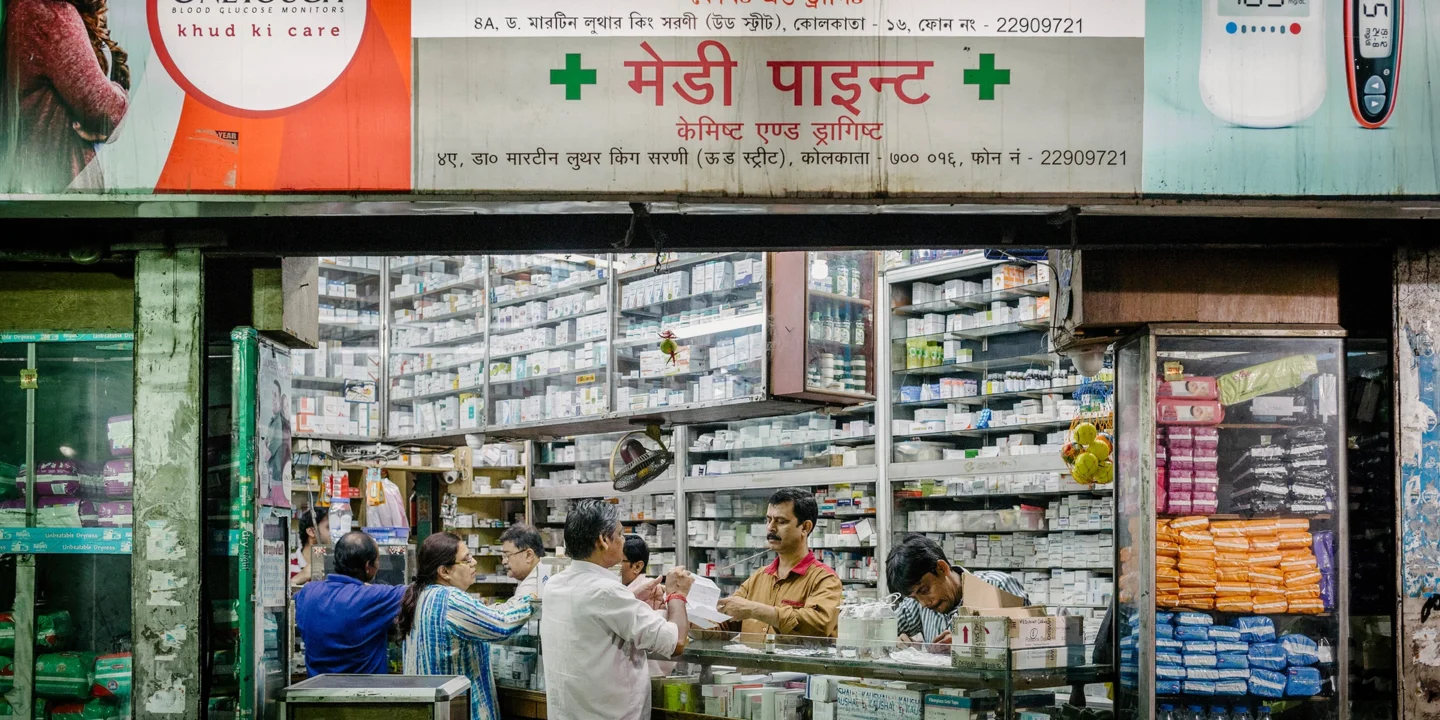











By late afternoon, the pavement outside Sushil’s pharmacy has become a waiting room. Motorcycles nose through the traffic in Hyderabad, vendors call over one another, and customers appear at the counter carrying symptoms rather than prescriptions: a fever that began last night, a cough that will not settle, a child with diarrhoea, a labourer whose throat hurts but whose shift begins again in the morning.
Sushil is 48. His bachelor’s degree is in commerce, not pharmacy, but he grew up watching his father, who was formally trained, work behind a similar counter. Over the years, he learned to recognise the ordinary repertoire of sickness: the gestures people make when describing abdominal pain, the sound of a congested chest, the look of someone who has already calculated how much treatment can be afforded.
When a customer cannot pay for a complete course of antibiotics, Sushil takes a strip of tablets and cuts it. The packet may have been designed for five or seven days. He sells enough for two or three.
To an outside observer, the exchange can look like a textbook example of irresponsible dispensing. The diagnosis is uncertain. No laboratory test has identified a bacterium. The treatment is incomplete. Yet from Sushil’s side of the counter, refusing the medicine can feel more reckless than providing it.
“What am I supposed to do?” he asked when we questioned him about the practice. Someone has travelled from a village, has little money and cannot return easily. Perhaps the illness is bacterial; perhaps it is not. Perhaps three days of tablets will help. Sushil sees himself not as weakening medical standards but as preventing abandonment.
“I cannot risk a person’s life,” he said. “If they have no money, I will give them what they can afford. I cannot simply send them away.”
This is the first difficulty in understanding antimicrobial resistance. Antibiotics are often described as products that people consume too casually. But in places where care is expensive, diagnosis is slow and work is insecure, the decision to take them may be anything but casual. It is often made under extraordinary pressure.
Across India, antibiotics are commonly understood as “strong medicine”. The expression captures more than pharmaceutical potency. Strong medicine is medicine capable of defeating time. It promises to shorten an illness before wages disappear, before a child misses examinations, before a shopkeeper loses customers or a migrant worker is replaced.
For decades, that promise has seemed credible. Antibiotics are familiar, relatively inexpensive and available through neighbourhood pharmacies, informal practitioners, private clinics and household medicine cabinets. Many people have taken them repeatedly without experiencing an obvious immediate consequence. The body appears to improve; the danger remains invisible.
Consider a construction worker hired by the day. He has no written contract, paid sick leave or reliable protection against dismissal. A supervisor can replace him from the crowd waiting outside the site. If he develops diarrhoea, a chest infection or a painful wound, his choices are not simply medical. They are economic calculations made while unwell.
A clinic visit may require transport, consultation fees, tests, medicines and hours away from work. Waiting for a diagnosis can cost more than the treatment. A visit to a pharmacy, by contrast, may take 10 minutes. A few tablets, some painkillers and a day in bed might allow him to return before his place is given to someone else.
In this setting, antibiotics perform tasks normally assigned to institutions. They compensate for the absence of paid leave. They stand in for diagnostic laboratories. They bridge gaps in primary healthcare. They allow unsafe water, crowded housing and insecure employment to remain politically tolerable by helping individuals survive their immediate consequences.
The medicine does not repair any of these systems. It helps people move through them.
That is why the problem cannot be reduced to ignorance. A labourer may understand that a longer course would be preferable but lack the money to buy it. A doctor may know that a fever is probably viral but have no test with which to prove it. A farmer may recognise that routine antibiotic use is undesirable but also know that one outbreak could destroy a flock and the family income attached to it.
Each decision can be rational within a narrow horizon. Taken together, those decisions create a disaster whose costs appear somewhere else and later.
Bacteria adapt. Some already possess traits that allow them to survive exposure to a drug. Others acquire resistance through mutation or through the exchange of genetic material. When antibiotics kill susceptible organisms, the survivors face less competition. They multiply. A medicine that once worked reliably begins to fail.
The consequences are delayed enough to escape the moment of decision. Sushil does not see resistance when he cuts the strip. The worker does not feel it when his fever subsides. A poultry farmer does not observe it when medicated feed prevents an outbreak. The cost may become visible months or years later, in another patient, another town or another country.
Antimicrobial resistance is therefore not merely the cumulative effect of bad prescribing. It is a system for postponing costs. Antibiotics purchase immediate stability, while bacteria keep the account.
Antibiotics have become a hidden welfare system: they compensate for missing clinics, missing wages, missing sanitation and missing time.
India occupies a central place in the global crisis because so many pressures converge there. The country has a high burden of infectious disease, uneven access to clean water and sanitation, overcrowded hospitals, extensive pharmaceutical manufacturing, rapid growth in intensive animal farming and a fragmented healthcare market.
It is also one of the world’s most important producers of generic medicines. Its factories supply affordable drugs to domestic patients and to health systems across Africa, Europe and North America. The same industrial capacity that makes treatment accessible can create conditions favourable to resistance when antibiotic residues enter rivers, soils and sewage systems.
To describe India as an “epicentre”, however, can mislead. The word suggests that resistance begins in one location and radiates outward towards innocent observers. In reality, India sits inside networks constructed by global demand.
Foreign hospitals seek low-cost generic antibiotics. Supermarkets demand inexpensive shrimp and poultry. Investors reward rapid pharmaceutical expansion. Consumers benefit from cheap medicines and food without seeing the environments in which their low prices are produced.
India does not simply generate the crisis. It concentrates activities whose benefits are dispersed internationally while many of their biological and environmental costs remain local.
Those costs do not stay local for long.
A resistant bacterium can cross a border without making its carrier ill. It may travel inside the gut of a tourist returning from a holiday or a business trip. It may move with a migrant worker, a patient transferred between hospitals or food shipped through an international supply chain.
Resistance genes can also circulate without the original bacterial strain. Microbes exchange genetic instructions. A gene selected in wastewater near a manufacturing plant may eventually appear in a pathogen infecting a hospital patient thousands of kilometres away.
The routes are numerous: sewage, rivers, soil, food, animals, aircraft cabins, conflict, displacement and trade. The modern world moves people and commodities with extraordinary efficiency. It moves microbial life with them.
This mobility complicates the familiar moral division between countries that use antibiotics responsibly and countries that do not. Nations in the Global North have often established stronger prescribing controls, better sewage treatment and more restrictive rules for agricultural use. These measures matter. But no national stewardship programme can isolate a country from a global ecology of resistance.
A hospital in Switzerland or Britain may carefully limit the use of certain drugs while purchasing active pharmaceutical ingredients from a supply chain that produces antibiotic pollution elsewhere. A supermarket may prohibit antibiotics in domestic farming while importing seafood raised under different regulatory conditions.
Responsibility cannot be contained within the clinic where the final prescription is written.
Our own interest in resistance developed from different kinds of fieldwork. For Assa Doron, it emerged through anthropological research around Hyderabad’s pharmaceutical zones, where industrial growth and contaminated waterways exist side by side. For Alex Broom, it arose through sociological work on vulnerability, self-medication and the institutional pressures shaping antibiotic decisions.
Over years of research in pharmacies, hospitals, villages, factories and farms, the same pattern kept appearing. Antibiotics were rarely used for a single reason. They were used because several systems had failed at once.
A prescription might compensate for inadequate diagnostic equipment and an overcrowded ward. A packet purchased without a prescription might compensate for unaffordable consultation fees. Antibiotics mixed into animal feed might compensate for cramped sheds, weak biosecurity and production schedules that left no room for slower growth.
Resistance formed at the intersection of these arrangements. It could not be explained by microbiology alone because the selective pressure acting on bacteria was organised socially.
Inside the body of the daily wage worker, the process may begin quietly. An antibiotic reaches the gut and kills susceptible bacteria. Some survive. They may already carry resistance genes, or they may acquire them from neighbouring microbes.
The worker feels better and returns to the job. Yet the composition of microbial life inside him has changed. If a later infection occurs, treatment may be more difficult. Resistant organisms may also leave his body through faeces and enter drains, sewage, soil or water.
Where sanitation is reliable, many of these microbes will be contained and removed. Where sewage is untreated or water sources are contaminated, they re-enter human communities. A private medical decision becomes an environmental exposure.
This process is experienced unequally. People living in homes with clean water, functioning toilets and access to timely healthcare are better protected from repeated infection. Those in informal settlements, rural communities or marginalised neighbourhoods are exposed more frequently and often receive less precise treatment.
Caste, class and gender shape who can use a private toilet, who must collect water, who can travel to a clinic and whose illness is taken seriously. Women and girls may delay treatment because of household responsibilities, restrictions on movement or lack of control over money. They may face recurrent urinary or reproductive infections while having limited access to testing.
Resistance is biological, but exposure to it follows existing social lines.
Open defecation, untreated sewage and inadequate waste collection are often discussed as separate development problems. In the age of antimicrobial resistance, they are part of medicine. Sanitation determines whether resistant bacteria remain in one body or circulate through many.
The boundary between health policy and infrastructure policy begins to dissolve.
Resistance is not simply spreading through society; it is recording which communities were denied the infrastructure needed to avoid it.
The same blurring occurs between human medicine and agriculture. By volume, most antimicrobials sold globally are used not in people but in animals. Exact estimates vary, but roughly two-thirds of total consumption is associated with livestock production.
Antibiotics can treat sick animals, yet in intensive farming they also perform economic functions. They reduce the risk created by crowding. They help animals survive environments designed for rapid growth. In some cases, they promote weight gain or compensate for inconsistent hygiene.
India’s poultry and aquaculture sectors have expanded dramatically. Chicken, eggs and farmed shrimp now reach consumers on a scale that would have been impossible under older systems of production. This expansion is often celebrated as agricultural modernisation: greater efficiency, more affordable protein and stronger export revenues.
But efficiency can be misleading when its hidden requirements are ignored. Thousands of birds housed closely together create ideal conditions for infection. Shrimp ponds stocked densely can suffer devastating disease outbreaks. Farmers working with narrow margins may be unable to tolerate the loss of even one production cycle.
Antibiotics offer insurance. Rather than transforming the conditions in which disease emerges, they make those conditions temporarily productive.
The resulting waste does not remain neatly inside farms. Drug residues and resistant organisms leave through manure, wastewater, pond discharge, runoff and dust. Manure may be spread on fields. Pond water may enter canals. Particles from animal sheds may circulate in the air.
Resistance moves between species and environments. A bacterium selected in a chicken may exchange genetic material with microbes in soil or water. Farm workers carry organisms home. Flies, wild birds and rodents move through waste.
The environment becomes not merely a pathway but a reservoir: a space in which antibiotics, metals, disinfectants and bacteria interact repeatedly.
Once resistance is established in such an ecology, controlling prescriptions in human hospitals will not be enough. A physician may use antibiotics perfectly and still encounter an infection carrying genes selected through agriculture or industrial pollution.
Research involving travellers illustrates the mobility of these organisms. Studies of people returning to Europe from South Asia have found high rates of temporary gut colonisation by resistant bacteria. Most travellers show no symptoms. They cross airports, return to families and resume ordinary life without knowing what they carry.
This does not mean travel should be treated as contamination or that travellers should be blamed. It demonstrates something more unsettling: the circulation of resistance is built into normal mobility.
Trade adds further routes. Indian shrimp travels to supermarkets in the United States and Europe. When consignments are rejected after tests detect prohibited antibiotic residues, the incident is often framed as a problem of export compliance. A shipment failed to meet the rules.
But the rejected container is only the visible portion of a much larger system. Residues are evidence that antibiotics have been incorporated into production. Even shipments with no detectable residue may come from environments in which resistance has been selected and dispersed.
The question is not simply whether a particular prawn contains a banned drug. It is what kind of farming system was required to produce millions of prawns cheaply enough for global markets.
Labour conditions are part of that system. Workers in aquaculture and seafood processing may face insecure contracts, low wages and limited protection from chemical and biological exposure. As in the streetside pharmacy, antibiotics help an unstable arrangement continue.
They protect yields, reduce losses and satisfy delivery schedules. Their usefulness to the farmer or exporter is real. So is the collective risk.
This is why campaigns focused solely on consumer choice are inadequate. A label promising “antibiotic-free” production may influence a narrow part of the market, but it does not transform the financial pressures that encourage pharmaceutical dependence.
Nor does it address pollution from factories making the drugs themselves.
Around Hyderabad, one of India’s largest pharmaceutical manufacturing regions, industrial estates produce medicines and active ingredients for global markets. The city is praised as both an information-technology centre and a pharmaceutical capital, a place where scientific expertise and low-cost production have helped build an economic success story.
Beyond the glass offices and factory gates, villagers describe another landscape.
They speak of water changing colour, chemical odours arriving at night and canals carrying foamy or dark effluent. Farmers complain that crop yields have fallen. Livestock drink less or produce less milk. Fish disappear. Migratory birds no longer return to familiar wetlands.
At one site, Shanakar, a former village head, pointed towards a polluted canal near his community. For decades, he has challenged companies and regulators over industrial discharge. The water below us was dark and almost motionless.
“Because of the pollution, the fish died,” he said. Fields that once produced reliable rice harvests now yield far less. A buffalo that formerly gave eight or 10 litres of milk might produce only two.
“This is what progress looks like for us.”
Residents may struggle to prove that a particular factory caused a particular illness or crop loss. Industrial zones contain multiple facilities releasing mixtures of chemicals. Pollution moves through water and soil, and its health effects may take years to appear.
This uncertainty can protect the polluter. What is difficult to attribute is easier to deny.
Yet environmental sampling around some manufacturing hubs has repeatedly detected antibiotic residues, resistant bacteria and resistance genes at troubling levels. Wastewater can contain concentrations capable of exerting strong selective pressure on microbial communities.
The factory does not need to release live pathogens. By releasing antibiotics into an environment filled with bacteria, it creates a vast experiment in selection.
Low or fluctuating concentrations can be especially significant. They may not kill every organism. Instead, they favour those able to survive partial exposure, allowing resistance traits to multiply and circulate.
Heavy metals and other industrial chemicals can add to the process. Resistance genes to metals and antibiotics sometimes sit close together on mobile genetic elements. Exposure to one pollutant can indirectly help preserve resistance to another.
The factory drain becomes an evolutionary workplace.
At the same time, substandard or falsified antibiotics enter domestic and international markets. These represent a different pathway into the same crisis. A medicine containing too little active ingredient may suppress an infection without eliminating it. Bacteria survive treatment and gain another opportunity to adapt or spread.
Environmental contamination and poor-quality medicine are not identical. One acts outside the body, the other within it. Both produce conditions in which the least susceptible bacteria are favoured.
MRSA, drug-resistant tuberculosis and highly resistant strains of E coli, Klebsiella and Acinetobacter are often discussed as discrete medical enemies. But their rise is connected to these landscapes of partial treatment, polluted water, crowded hospitals and pharmaceutical dependence.
The superbug is not a monster that suddenly appears. It is a record of repeated exposure.
The cheapest medicine often depends on the most expensive silence: polluted villages, invisible waste and workers who cannot afford to object.
The global pharmaceutical industry complicates any simple national account of responsibility. Over recent decades, manufacturing has shifted towards countries where production costs are lower and environmental enforcement may be weaker or inconsistent.
This relocation has made medicines more affordable. Generic drugs manufactured in India are indispensable to health systems around the world, including programmes treating HIV, tuberculosis and other major diseases. Millions of people owe their lives to the availability of low-cost pharmaceuticals.
The point is not that manufacturing should be removed from India or returned wholesale to Europe and North America. Such a move could raise prices, damage livelihoods and reproduce the same pollution elsewhere.
The issue is how low cost is achieved and who is required to absorb it.
Buyers in wealthy countries often award contracts to suppliers offering the lowest price. Environmental performance may receive limited scrutiny. A factory investing in advanced wastewater treatment can be placed at a disadvantage against a competitor that externalises those costs.
Procurement systems thus reward the very practices governments later claim to oppose. Hospitals may announce ambitious plans to reduce antimicrobial resistance while purchasing antibiotics through supply chains that encourage resistance at the point of production.
The contradiction resembles the global politics of carbon. Consumers enjoy energy or commodities while emissions accumulate elsewhere. Antibiotic manufacturing has its own footprint: not only the amount of medicine consumed, but the resistant ecology produced during its manufacture, sale and disposal.
Unlike carbon dioxide, resistance is alive. It reproduces, exchanges information and moves between organisms. Yet the political problem is similar. Benefits appear immediately and are widely distributed. Costs emerge gradually, cross borders and are hardest on people with the least power to avoid them.
In rural India, antibiotics perform another form of substitution. Formal healthcare may be distant, understaffed or unaffordable. Patients turn to rural medical practitioners, informal providers, shops and acquaintances.
A consultation in a town can involve bus fares, a day of lost work and long queues. A local practitioner may offer medicines immediately, sometimes from a mixed packet without labels. The treatment may include an antibiotic, a painkiller, a steroid or vitamin tablets.
From the perspective of medical regulation, this is dangerous. From the patient’s perspective, it may be the only service available at the necessary time and price.
Antibiotics stand in for continuity of care. They turn an uncertain illness into an actionable routine: swallow these tablets and return if the fever remains.
The drug carries the authority of medicine even when the medical system is absent.
This reliability is now beginning to fracture. Infections that were once treated with common, inexpensive drugs require newer and more costly alternatives. Some no longer respond even to last-resort medicines.
The consequences are most severe where patients cannot afford repeated treatment. A resistant infection means longer hospital stays, additional tests, more expensive drugs and more time away from work. The people who relied most heavily on cheap antibiotics are least able to absorb their failure.
Newborn sepsis is one of the starkest examples. In India, resistant bacterial infections are estimated to contribute to tens of thousands of neonatal deaths each year. A baby may be delivered safely only to acquire an infection for which standard treatment no longer works.
The loss of antibiotic effectiveness also threatens surgery, cancer treatment and the management of chronic disease. Chemotherapy weakens immunity. Caesarean sections and other operations create opportunities for infection. Dialysis and catheters provide routes into the body.
Modern medicine does not merely use antibiotics as one treatment among others. It relies on them as protection around many other interventions.
Yet antibiotic consumption cannot be assigned neatly to poverty. In prosperous urban neighbourhoods, a different route leads to the same prescription.
Educated patients search symptoms online, consult family networks and arrive at private clinics convinced that they know which medicine is necessary. Payment creates a consumer relationship. A consultation that ends without a drug can feel incomplete.
Manish Yadav, a community physician in Chennai, described “two Indias within one India”. In affluent districts, patients may be overinformed, armed with brand names and expectations of immediate recovery. In poorer areas, knowledge of antibiotics and resistance may be limited.
What the groups share is confidence in pharmaceutical speed. The rich may demand antibiotics because they consider themselves knowledgeable consumers. The poor may seek them because they cannot afford diagnostic delay. Both treat the medicine as the shortest route back to normal life.
This convergence reveals why education campaigns have limited reach. Telling people that antibiotics do not work against viruses is important. It does not remove the reasons they want a prescription.
A software engineer may need to return to an office. A mother may have no one else to care for her children. A shopkeeper may fear losing a week of business. A student may face an examination. The circumstances differ, but each person is attempting to compress illness into a manageable period.
Antibiotics have become medicines for bacterial infection and technologies for protecting schedules.
Inside a crowded public hospital, Priya Patil moves rapidly from one bed to another. The patients present with overlapping symptoms: fever, cough, weakness, diarrhoea, pain. Pollution, poor housing and chronic disease complicate the picture.
Is the infection bacterial, viral, fungal or parasitic? Does the patient have more than one condition? Has an antibiotic already been taken at home? Is the organism resistant?
Ideally, laboratory tests would guide treatment. In practice, results may take too long, equipment may be unavailable and patients may be unable to pay. A physician facing dozens of cases must decide before certainty arrives.
“To start antibiotics, to stop antibiotics, which antibiotics?” Patil said. The questions follow every consultation.
Under such pressure, broad-spectrum drugs offer a defensive strategy. They cover several possible bacteria at once. Last-resort antibiotics may be used because resistance to common medicines is already widespread.
This is sometimes called empirical treatment, but the term can make improvisation sound more controlled than it feels. The clinician acts on probability because the institution cannot provide precision.
Broad treatment may save the patient in front of the doctor. It also destroys susceptible bacteria across the body and increases selective pressure. The clinical benefit and the ecological cost occur simultaneously.
Patil understands the danger. She has watched dependable drugs stop working. Yet patients expect medicine, and a prescription is visible evidence that the doctor has acted.
To send someone home with instructions to rest, drink fluids and return if symptoms worsen may be medically appropriate. It can also be interpreted as indifference. Patients who feel dismissed seek another doctor.
Private practitioners face an additional financial risk. Clinics depend on reputation and repeat custom. A doctor known for withholding antibiotics may lose patients to one who promises faster relief.
The physician is therefore asked to defend the future effectiveness of antibiotics while being judged on the immediate satisfaction of an individual customer.
Hospitals create similar incentives. Early broad-spectrum treatment can reduce uncertainty, shorten stays and increase patient turnover. Prophylactic antibiotics may allow procedures to be performed quickly and beds to be freed.
In competitive private healthcare, efficiency has a financial value. A patient who recovers rapidly creates space for another patient. A hospital that appears decisive may gain a stronger reputation than one that waits for laboratory confirmation.
Antibiotics become management tools. They smooth the movement of bodies through institutions.
The same medicines that made complex hospitals possible are being weakened by the organisational logic of those hospitals.
To call this “misuse” places too much weight on individual intention. The word suggests that correct behaviour is readily available and that patients, pharmacists or clinicians simply choose otherwise.
But the worker seeking tablets, the doctor covering an uncertain infection and the hospital pursuing faster discharge are responding to different parts of the same structure. Their decisions are not identical, and responsibility is not evenly distributed. Yet each is rewarded for shifting risk into the future.
Every prescription buys time from one crisis while borrowing it from another.
Pharmaceutical marketing reinforces the pattern. During an early visit to a public hospital in Hyderabad, staff initially attempted to remove us because they assumed we were drug-company representatives.
The misunderstanding was revealing. Promotional visitors were so common that an unfamiliar person carrying documents was immediately placed in that category.
Medical representatives circulate through hospitals and clinics with samples, brochures and digital presentations. They introduce combinations, newer generations and broader-spectrum drugs. Their language is clinical but their purpose is commercial.
A new antibiotic may be presented as faster, more powerful or better suited to local resistance patterns. The pitch responds precisely to the anxieties of overloaded clinicians: uncertainty, limited time and the fear that an older treatment will fail.
Doctors are generally aware that the information is selective. Yet representatives also provide a service. Keeping up with new trials, treatment guidelines and resistance data requires time many clinicians do not possess.
A concise presentation between patients may be easier to absorb than a lengthy paper. Conference sponsorship, meals and professional invitations further blur the line between education and sales.
In rural settings, the distinction can become almost meaningless. Practitioners with limited formal training may depend heavily on representatives to learn about medicines. The person teaching them how a drug works is also the person paid to increase its sales.
Information enters the health system through the commercial channel most capable of delivering it.
Manufacturers do not create every pressure leading to antibiotic use, but they know how to exploit those pressures. The overcrowded clinic becomes a market opportunity. Patient demand becomes evidence of unmet need. Rising resistance becomes a reason to sell a newer drug.
The industry profits from the failure of older antibiotics while participating in the system that accelerates that failure.
This is another trap. Resistance expands the market for more powerful medicines, but the commercial model offers weak incentives to preserve them. A new antibiotic is most valuable socially when used rarely. A product is most valuable commercially when sold.
Governments and researchers have attempted to solve this contradiction through new funding mechanisms, subscription models and incentives for antibiotic development. Such efforts are necessary. The scientific pipeline for genuinely novel antibiotics remains fragile.
But no new medicine can remain effective if it enters the same ecology of overuse, pollution and structural dependence. Innovation without reform supplies the system with another temporary resource to consume.
The deeper we followed antibiotics across India, the more they appeared inseparable from the country’s history of development.
After independence, Jawaharlal Nehru argued that political sovereignty required scientific and industrial capacity. India would build steel plants, dams, laboratories and pharmaceutical factories. It would not remain dependent on former imperial powers for essential technologies.
Medicines held particular symbolic force. The ability to manufacture antibiotics suggested that infectious disease, once a major limit on life, could be mastered through national expertise.
Generic production later became a source of international pride. Indian companies challenged monopolies, lowered prices and supplied medicines to countries neglected by multinational firms.
This history matters because criticism of pharmaceutical expansion can sound like an attempt to deny the Global South technologies long controlled by the North. Calls for stricter regulation may be interpreted as disguised protectionism, particularly when they come from countries that built wealth through their own polluting industries.
Environmental justice cannot mean preventing India from producing medicines while wealthy nations continue consuming them. Nor can antimicrobial stewardship become a new language through which poor patients are told to accept less treatment.
The question is how to preserve access without treating resistance and pollution as acceptable prices.
Antibiotics also supported agricultural development. Intensive poultry and aquaculture provided affordable animal protein to a growing urban population and generated export income. Production at this scale depended on scientific breeding, formulated feed, temperature control and pharmaceutical protection.
Free-trade agreements and export strategies promise further expansion. Pharmaceuticals and agricultural goods are presented as areas in which India can compete globally.
From the perspective of national accounts, success is measured in output, revenue and market share. Resistant genes do not appear on the balance sheet. Neither does the loss of a village pond, the illness of a farm worker or the future cost of a drug-resistant infection.
Economic growth counts the commodity but not the ecology required to produce it.
On poultry farms outside Hyderabad, workers open sacks of powdered additives and tip them into water tanks serving thousands of birds. The labels may be technical, and workers may not know the names of the active ingredients. Some mixes include antimicrobials.
The sheds are noisy and crowded. Birds are bred to reach market weight quickly. Production schedules leave little room for recovery from disease. An outbreak can spread with extraordinary speed.
Routine pharmaceutical use appears less like an optional shortcut than part of the architecture of the farm.
Civil-society organisations have played an important role in documenting these practices, particularly where official data are incomplete. Investigations into antibiotic use in Indian poultry have linked intensive production to environmental contamination and the emergence of resistant bacteria.
Reports attract attention when they identify a banned drug or a “superbug”. But the routine character of exposure may be more important than any scandal.
Farm workers inhale dust, handle medicated feed and walk through waste. Families consume food produced within the system. Manure reaches fields. Water circulates between farms and communities.
Antibiotics and resistant organisms become part of ordinary surroundings.
The people most exposed may possess the least information or power. A farm employee cannot easily demand a change in production methods. A contract farmer indebted to a larger company may have little control over chicks, feed, medicine or sale prices.
Responsibility is fragmented along the chain. The corporation can say the farmer administered the drug. The farmer can say the integrator supplied the inputs. The retailer can say the product passed required tests.
Everyone participates, and no one appears to control the whole.
Contact with resistance is becoming less an exceptional medical event than a condition of everyday economic life.
India’s wider disease burden intensifies the dependence. Tuberculosis remains widespread, and the country carries one of the world’s largest burdens of multidrug-resistant TB.
Treatment for resistant tuberculosis is longer, more toxic and more expensive than ordinary therapy. Patients may take combinations of drugs for months or years, enduring side effects while attempting to continue working and caring for families.
Interruptions are common when clinics are distant, drugs are unavailable or treatment becomes unbearable. Each interruption can further narrow the remaining options.
At the same time, chronic illnesses are rising. Diabetes, cancer, kidney disease and cardiovascular conditions increase vulnerability to infection and bring more people into contact with hospitals, catheters, surgery and immune-suppressing treatment.
India therefore faces infectious diseases associated with inadequate sanitation alongside chronic diseases associated with demographic and economic change. Both increase demand for effective antibiotics.
Dependence deepens precisely as reliability declines.
Hospital-acquired infections illustrate the collision. Patients enter facilities seeking treatment for one condition and acquire another from contaminated equipment, surfaces, staff or nearby patients. Crowded wards and limited infection-control resources facilitate transmission.
When the organisms involved resist several drugs, routine care becomes dangerous. A successful operation can be undone by an infection. A premature baby survives birth but not the bacteria encountered afterwards.
During the COVID-19 pandemic, the reliance on antibiotics became even more visible. Faced with a novel virus and uncertain treatment, clinicians frequently prescribed antibiotics as a precaution. Some guidelines and institutional practices encouraged broad coverage despite the relatively low proportion of patients with confirmed bacterial co-infections.
The prescription performed emotional and organisational work. It reassured doctors that they had not overlooked a secondary infection. It reassured families that treatment was active. It gave hospitals something familiar to offer amid uncertainty.
Antibiotic sales rose even though the disease itself was viral.
The pandemic did not create this reflex. It exposed how deeply antibiotics had become associated with action.
A future in which they no longer work is often imagined through catastrophe: untreatable epidemics, closed borders and overwhelmed hospitals. Such events are possible, but the post-antibiotic era may arrive more quietly.
It may appear as an operation postponed because the infection risk is too high. A cancer treatment adjusted because the patient cannot be protected. A premature infant for whom available drugs fail one by one. A urinary infection requiring hospital admission rather than tablets at home.
Modern healthcare would not end at once. It would become narrower, slower, more expensive and more dangerous.
Many procedures now considered routine rely on the assumption that infection can be controlled. Hip replacements, organ transplantation, caesarean delivery, bowel surgery and chemotherapy are made feasible by antibiotics.
Remove that protection and risk calculations change throughout medicine.
The consequences would also be distributed unequally. Wealthy patients may access rapid diagnostics, isolation rooms, newer drugs and international treatment. Poor patients will encounter failure first and most often.
Resistance does not make everyone equally vulnerable. It magnifies the value of money, infrastructure and social protection.
Globally, surveillance shows rising resistance among common bacterial infections. First-line drugs increasingly fail, forcing clinicians towards more expensive or toxic alternatives.
India’s scale makes the problem especially visible, but the underlying forces are international: intensive farming, medical commercialisation, industrial pollution, insecure labour, unequal access to care and procurement systems built around the lowest immediate cost.
The term “superbug” can obscure this political history. It makes the bacterium sound unusually malevolent, as though microbes have launched an attack on human civilisation.
Bacteria are not violating the rules. They are responding to the environments humans have created.
The extraordinary achievement of antibiotics was never that evolution had been defeated. It was that medicine enjoyed a temporary advantage. Each exposure placed pressure on that advantage. The more completely societies built hospitals, farms and labour markets around cheap antimicrobial protection, the harder it became to use the drugs sparingly.
Antibiotics are now load-bearing. Removing them without replacing the functions they perform would cause immediate harm.
This is why stewardship framed as restriction alone will fail. A pharmacist cannot simply stop selling partial courses if customers have no affordable clinic. A doctor cannot wait for laboratory results if the laboratory does not exist. A farmer cannot abandon prophylactic drugs while remaining responsible for losses created by overcrowded production.
People need alternatives before restraint becomes realistic.
These alternatives include clean water, sewage treatment, infection control, vaccination, reliable diagnostics, paid sick leave, better housing, safer farms and financial protection from medical costs. They may not look like antibiotic policy. They are the foundation of it.
A worker with paid leave can wait for a diagnosis. A clinic with rapid testing can avoid unnecessary broad-spectrum treatment. A farmer supported during an outbreak can prioritise biosecurity rather than routine medication. A factory facing enforceable discharge standards must include waste treatment in the price of production.
The solution to antimicrobial resistance is therefore partly to make antibiotics less necessary.
New drugs remain essential. Scientists need to discover treatments for infections resistant to existing medicines. But innovation cannot substitute for changing the systems that consume each new drug’s effectiveness.
Bacteria will eventually adapt. The goal is not to find a final antibiotic but to preserve each one by reducing the pressure placed upon it.
That requires intervention across entire supply chains. Pharmaceutical companies should disclose where and how antibiotics are manufactured. Wastewater standards must be measurable and enforceable. Buyers should include environmental performance in procurement decisions rather than rewarding only low prices.
Wealthy countries that benefit from inexpensive generic medicines should help finance cleaner production. Technology transfer should not mean selling costly equipment unsuited to local conditions. It should build regional capacity for treatment, monitoring and maintenance.
Agricultural policy must address the economics of farming, not merely prohibit selected drugs. Farmers need veterinary support, disease surveillance, improved housing for animals and protection against catastrophic losses.
Healthcare reform must make diagnostics available at the point where prescribing decisions are made. Public campaigns should explain resistance, but they should not blame patients for acting within systems that offer them few safe choices.
International action plans increasingly recognise the economic stakes. Updated global strategies place figures on the costs of resistant infection: higher spending on treatment, lost productivity, reduced livestock output and wider damage to welfare.
Economic estimates may succeed where warnings about future deaths have struggled. Governments accustomed to treating AMR as a technical health issue may respond when resistance is shown to threaten trade, employment and growth.
Yet there is a danger in relying too heavily on economic calculation. The people most harmed may not generate the largest measurable losses. A newborn’s death, a village’s contaminated water or a woman’s untreated infection cannot be reduced adequately to productivity.
The crisis is fundamentally about whose time and health can be sacrificed to keep systems running cheaply.
India’s role must be understood within this shared structure. It is neither an innocent bystander nor the singular source of global resistance. It is a place where the demand for inexpensive medicine, food and labour converges with inequality, environmental stress and extraordinary scientific capacity.
The country manufactures drugs that sustain health systems worldwide. It also bears pollution associated with that manufacturing. Its farmers feed domestic and international markets. Its workers and communities absorb much of the biological risk.
The Global North cannot purchase the benefits and nationalise the blame elsewhere.
Nor can Indian authorities point to foreign demand while neglecting domestic regulation, public health and environmental enforcement. Shared responsibility does not mean equal responsibility. Power differs along the chain.
Large corporations, governments and institutional buyers shape conditions far more strongly than an individual patient purchasing three days of tablets.
The image of Sushil cutting a strip in half can easily become a symbol of the crisis. It is visible, intimate and morally uncomfortable. Yet focusing on his scissors risks missing the machinery surrounding them.
Before the tablet reached his counter, raw materials were produced, factories discharged waste, marketers promoted brands, regulators approved licences and distributors moved stock. The customer arrived after drinking unsafe water, working without sick leave and deciding that a clinic would cost too much.
Sushil’s action is the final link in a sequence of decisions made by institutions with far greater resources.
This does not make dispensing without adequate diagnosis safe. It explains why enforcement directed only at street pharmacies is likely to move the problem rather than solve it.
Close one shop and another provider will appear if the need remains.
The antibiotic trap is built from this mismatch between individual decisions and structural causes. Each person is asked to protect the future effectiveness of medicine while surviving an immediate situation they did not create.
The labourer must consider global resistance while trying not to lose tomorrow’s wage. The doctor must preserve last-resort drugs while treating a critically ill patient without test results. The farmer must reduce antibiotic use while meeting production targets and repaying debt.
Their choices matter. But choice is not the same as control.
A post-antibiotic future will arrive not as a single collapse, but as the gradual subtraction of treatments, livelihoods and forms of security once considered ordinary.
Superbugs cross bodily and national boundaries because the systems producing them do the same. Medicines, food, capital and labour circulate through arrangements designed to capture short-term value and distribute long-term harm.
Resistance is the biological expression of that distribution.
It appears in the gut of the worker, the sewage beneath the settlement, the hospital ward, the poultry shed, the shrimp pond and the canal behind the pharmaceutical plant. These locations may seem separate. Antibiotics connect them.
They also reveal what modern societies have demanded from the drugs. Antibiotics have been expected to cure bacterial disease, compensate for weak sanitation, protect industrial farming, speed hospital turnover, support insecure employment and preserve confidence in medical institutions.
No medicine can carry so many systems indefinitely.
Reducing resistance will require more than persuading people to value antibiotics. It will require building a world in which fewer people must use them to remain employed, feed their families, satisfy customers or keep overcrowded institutions functioning.
Until then, the drug will continue to solve the emergency in front of us while enlarging the emergency we cannot yet see.
The tablet cut in half is not merely incomplete treatment. It is a fragment of a larger bargain. A few days of relief are purchased by placing another small claim on the future.
Bacteria keep the receipt.
Note: where necessary, pseudonyms are used to protect the identities of individuals and communities.