







In the early years of the 20th century, a group of wilderness rangers sat high on a ledge of rim rock in the mountains near the border of New Mexico and Arizona. Below them, an animal crossed the river. At first, it looked like a deer. Then it climbed onto the bank, and the rangers saw that it was a mother wolf. Her grown pups came toward her in greeting.
At the time, the United States government treated predators as enemies of progress. Wolves, bears, mountain lions and other animals that threatened livestock or game were to be eliminated. Rangers were expected to kill them when they had the chance. The men raised their rifles and fired until their ammunition was gone.
When they reached the riverbank, one of the rangers, a young Aldo Leopold, arrived in time to watch what he would later call “a fierce green fire” dying in the wolf’s eyes. Something in that moment unsettled him permanently. The animal they had killed was not merely a nuisance removed from the landscape. It was part of a larger order the rangers did not yet understand. Leopold would later say that, at the time, they had not learned to “think like a mountain”.
That phrase has become one of the most famous in environmental thought. It is often taken to mean that we should think systemically, patiently, ecologically: beyond human convenience, beyond immediate gain, beyond the short time horizons of markets and politics. All of that is true. But it is not the whole truth. To think like a mountain is also to understand fear. It is to accept that a living world depends not only on beauty, abundance and harmony, but also on threat, restraint and the presence of creatures that make us uneasy.
The wolf’s dying gaze taught Leopold that nature is not a park arranged for human comfort. A mountain needs wolves not because wolves are charming symbols of wildness, but because deer fear them. Deer need that fear because, without it, they may overgraze the mountain that sustains them. Humans need predators, too, not because predators are safe, but because a world without them becomes too safe in the wrong way. It becomes simplified, overused, domesticated, and eventually damaged.
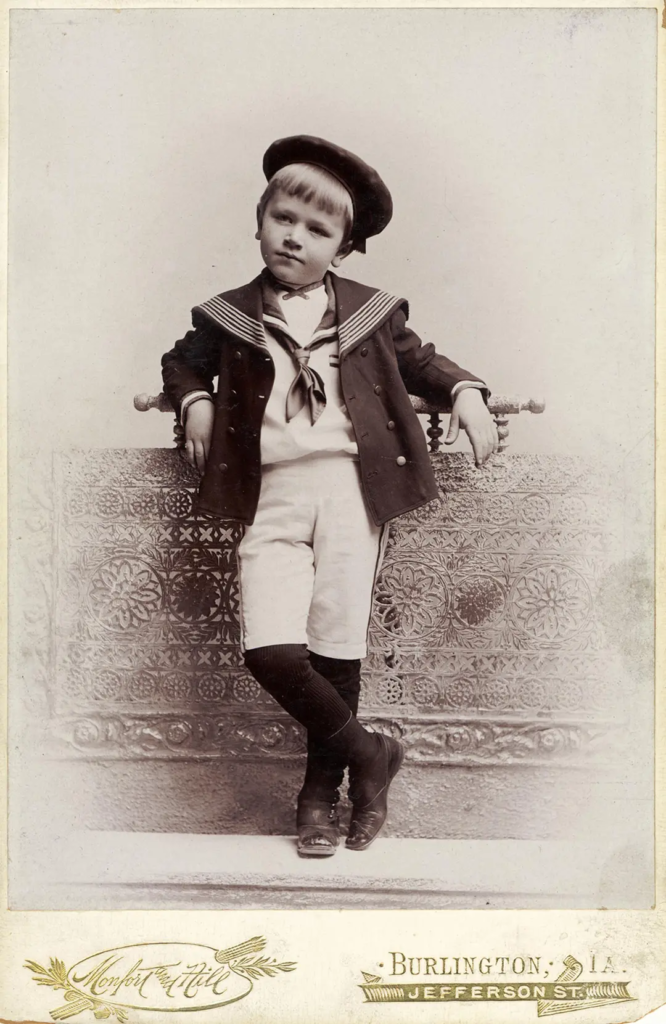
Aldo Leopold, aged six, in 1893. Courtesy the Aldo Leopold Archives, University of Wisconsin-Madison
Leopold’s question, then, was not merely whether we can love nature. Many people can love flowers, mountains, birdsong and sunsets. The harder question is whether we can love a world that resists us. Can we accept a nature that includes animals capable of killing livestock, frightening hikers or spoiling our plans? Can we recognise that some forms of fear are not failures of conservation but signs of ecological health? Can we make room for beings that do not exist for our reassurance?
Leopold was born in 1887 in Burlington, Iowa, into a family of German ancestry. His father, Carl, ran a desk-making business, and his mother, Clara, managed the household. Carl often took his son outdoors to hike and hunt, and the young Leopold developed a lifelong attachment to the natural world. By 1907, that attachment had become a vocation: he enrolled in the first forestry school in the United States, founded at Yale University only a few years earlier.
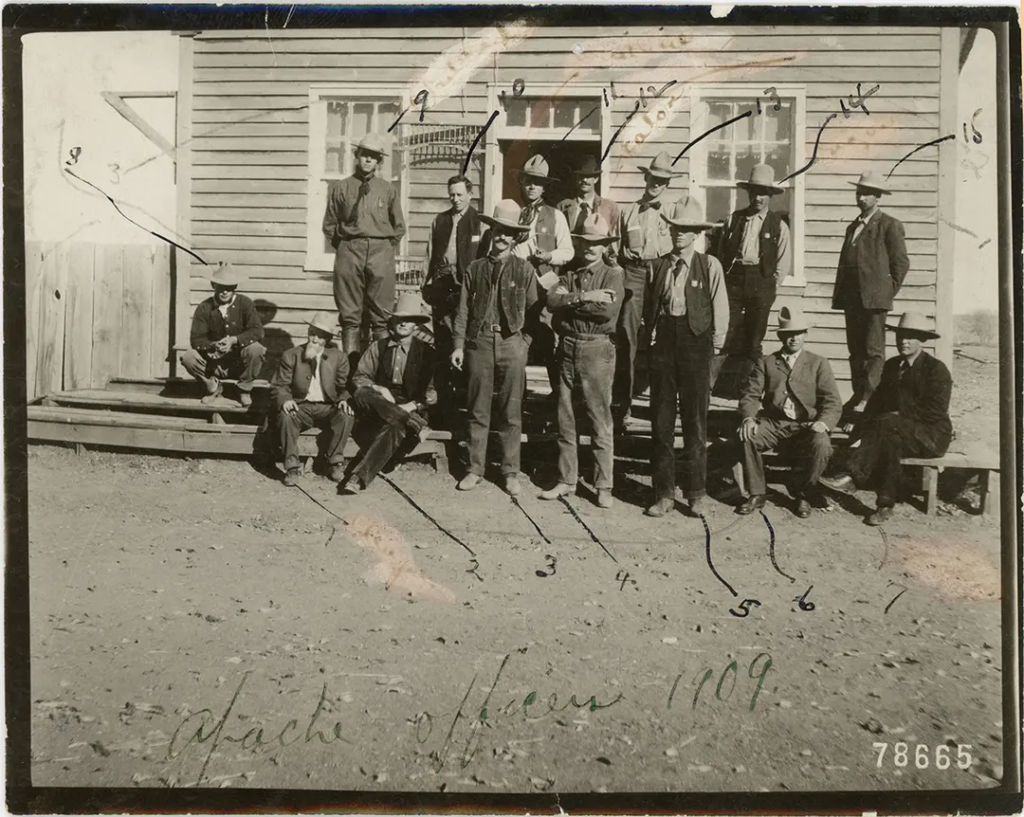
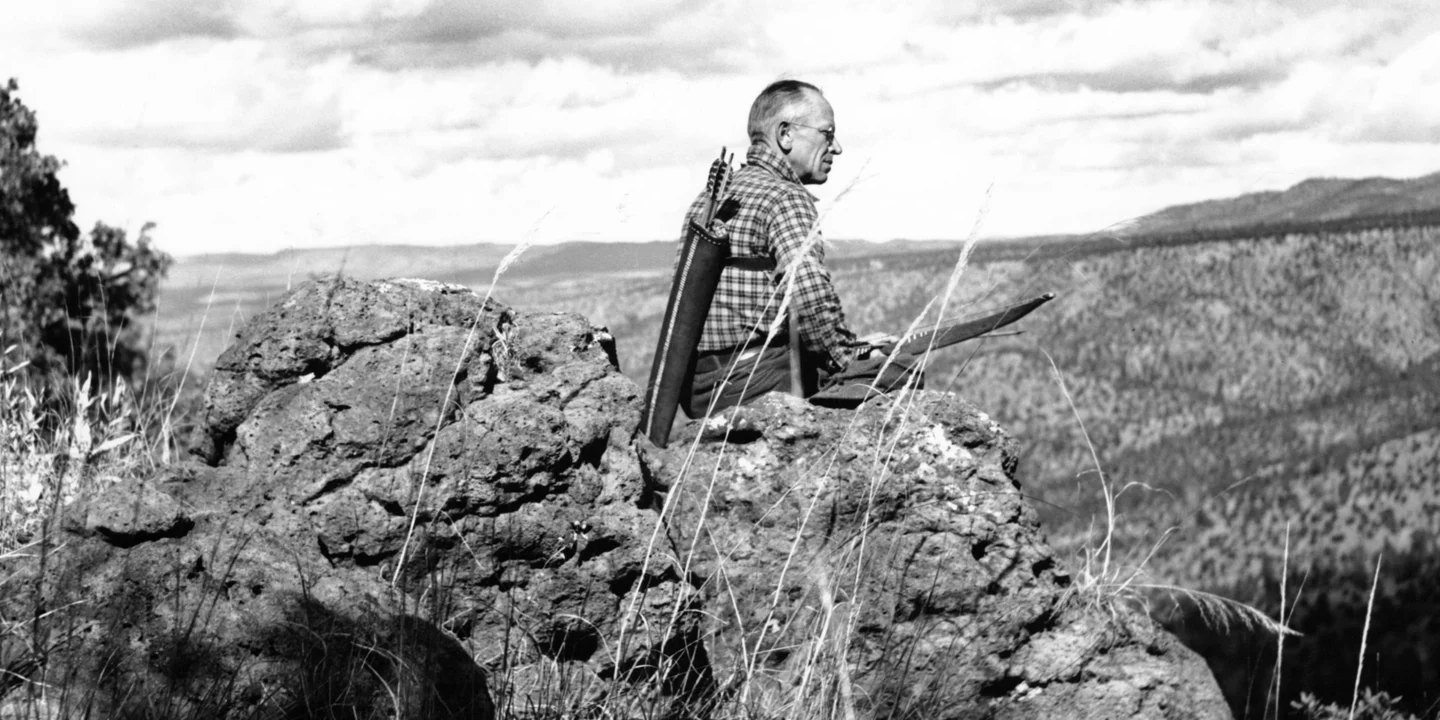
Apache National Forest Officers in 1909; Leopold is number 11. Photo courtesy the Arizona Memory Project
After graduation, Leopold joined the US Forest Service. His first assignments took him to the forests of New Mexico and the Arizona Territory, places still sparsely settled by Euro-American standards and full of the practical difficulties of frontier conservation. He travelled on horseback, dealt with hunters and ranchers, responded to fires, investigated poaching, assisted in rescues and learned the land through work. Like many good rangers, he became a generalist: part naturalist, part law officer, part labourer, part diplomat, part witness.
Over time, he also became an environmental philosopher, though not in the usual academic sense. His thinking emerged from forests, rivers, animal tracks, fire scars, weather, grasslands and the practical management of land. He did eventually become a professor of game management at the University of Wisconsin, Madison, the first position of its kind. But much of his writing remained rooted in observation rather than theory. He thought with places.
His posthumous book A Sand County Almanac, published in 1949, made that thinking available to a wider public. The first part of the book records seasonal changes on his Wisconsin farm. Later essays draw from his years as a ranger and develop what he called a land ethic. The story of the wolf’s “green fire” appears there, as does his mature conviction that humans must change not merely their policies toward land, but their sense of belonging within it.
A proper relationship with the environment depends on learning to see the world and our place in it entirely differently.
Leopold wrote that an ethical relation to land is impossible without love, respect, admiration and a sense of value broader than economics. That last point remains central. Land is not merely a storehouse of resources, a scenic backdrop, a recreation site or a production system. It has value in what Leopold called the philosophical sense. It is a community, and humans are members of it.
Since the publication of A Sand County Almanac, philosophers, ecologists, anthropologists and conservationists have debated what it means to think like a mountain. Some understand the phrase as an early call for systems thinking: a reminder that ecological relations unfold across long time spans and that human interventions often have consequences far beyond their intended targets. Others read it as a more-than-human ethics, a way of recognising that animals, plants, soils and waters have value beyond human use.
Still others have treated Leopold as a critic of economic reductionism. If land is valued only according to what it yields for markets, then the relations that make it alive become invisible. Forests become timber, rivers become irrigation, predators become threats to livestock, and mountains become scenery. Leopold’s thought resists this flattening. It asks us to see ecological communities as communities, not inventories.
More recent thinkers have placed Leopold in conversation with work on how forests, animals and environments respond to human action in ways that exceed human intention. Across these interpretations, one thread remains constant: to live rightly with nature requires a change in perception. We must learn to see ourselves from the land’s point of view, or at least from a perspective less captive to human urgency.
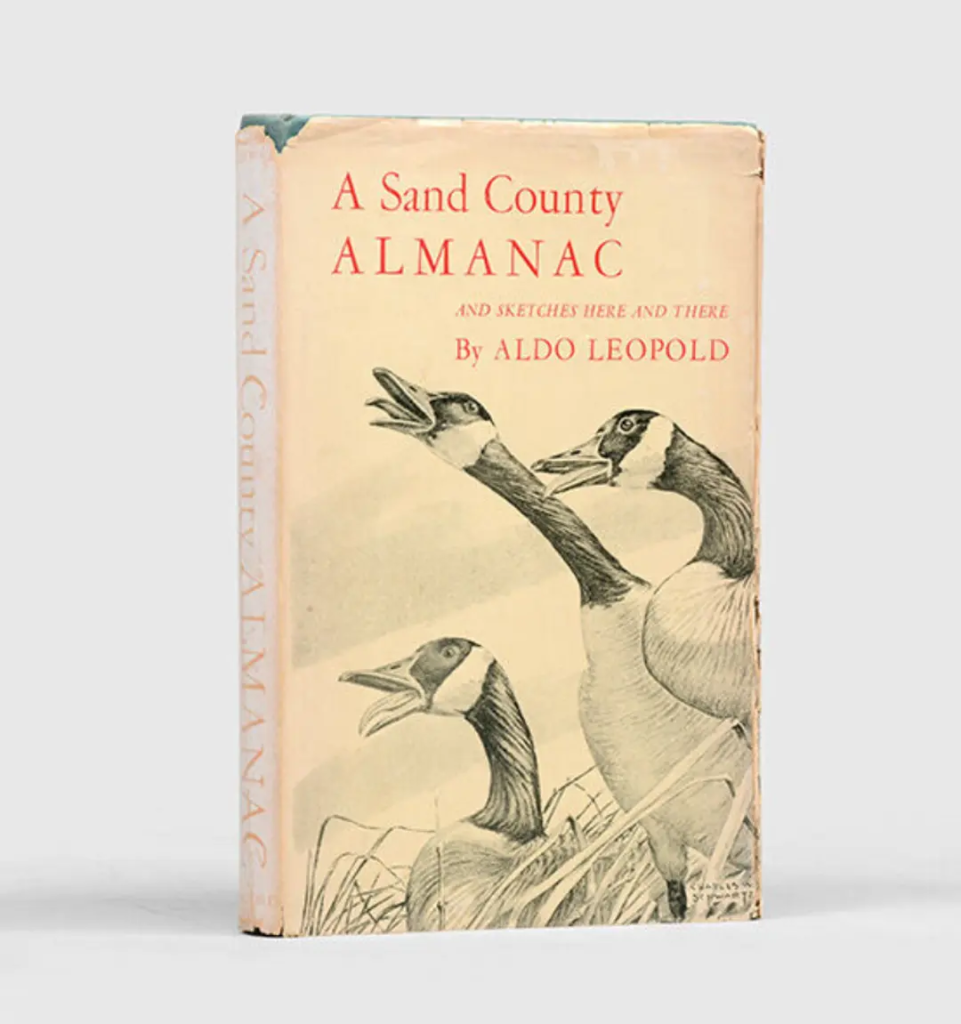
A Sand County Almanac (1949). Courtesy Peter Harrington Rare Books
Yet one part of Leopold’s lesson is often softened. Thinking like a mountain is not only about interdependence. It is about fear as a necessary relation. The mountain, Leopold suggests, fears its deer just as deer fear wolves. Humans fear predators, and sometimes mosquitoes, storms, fires, deserts and darkness. These fears are not simply psychological obstacles to be conquered. Some of them belong to the order of life.
I came to Leopold through the outdoors before I came to him as a thinker. As a young person, I spent time hiking and camping in Arizona with my family. In high school, a biology teacher assigned A Sand County Almanac. He also volunteered with the Forest Service, surveying bears in Arizona. Years later, after completing a master’s degree in philosophy in New York City, I left academia for a time and joined the Forest Service myself.
At first, philosophy seemed like an odd background for ranger work. My colleagues had usually studied biology, ecology or natural resource management, and many seemed more comfortable sleeping on the ground than in a bed. But I soon discovered that they were often better readers of environmental philosophy than many academics. They knew John Muir, Edward Abbey and Aldo Leopold not as names in a syllabus but as companions in the field. One lead ranger ended each workday by reciting a passage from Muir.
I carried A Sand County Almanac with me on patrol. In the mountains, Leopold’s sentences returned unexpectedly. A flower, a sunset, a mosquito or the silence after a storm would call up some passage I had read. I thought then that I understood what it meant to think like a mountain. Only later did I see that I had understood mostly the beautiful part. I had not yet understood the frightening part.
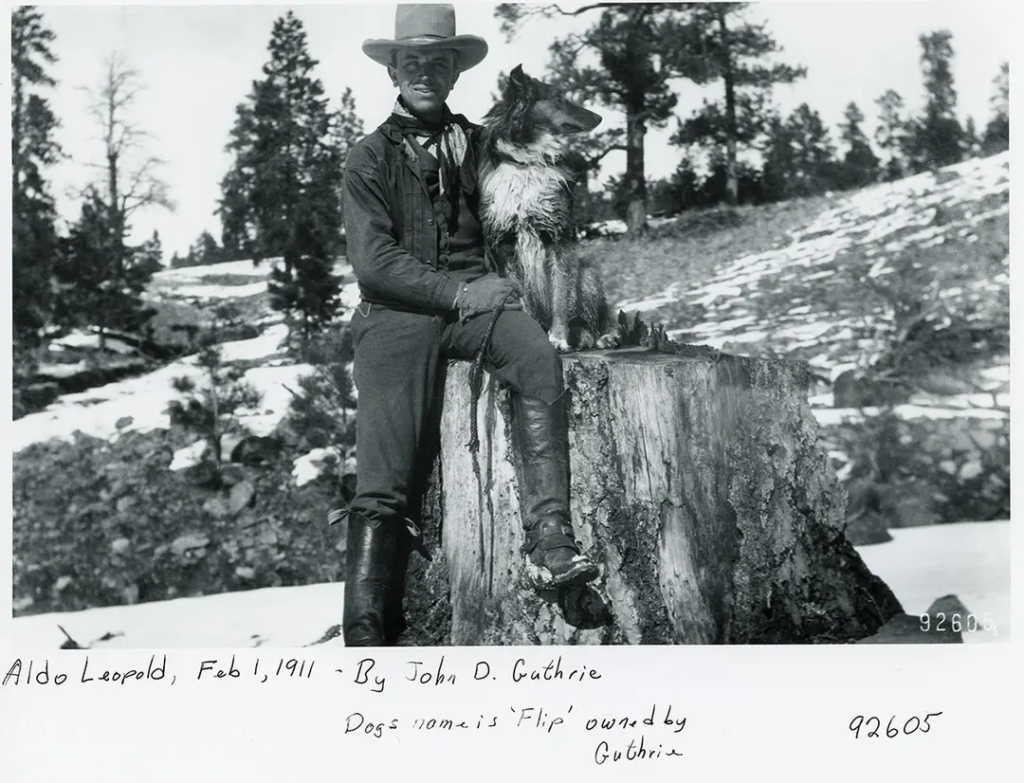
Leopold in 1911. Courtesy the Arizona Memory Project
In the essay “Escudilla”, Leopold tells the story of a grizzly called Old Bigfoot, who lived on a mountain named for its bowl-shaped summit. Once each spring, the bear came down and killed a cow belonging to local cowboys. Otherwise, he kept to himself. No one saw him, but his tracks appeared in muddy springs at the base of the cliffs. Those tracks were enough. Cowboys thought of the bear when they saw the mountain. Around campfires, talk turned to cattle, dances and bear. Old Bigfoot claimed little, but his presence altered the whole county.
The bear gave the mountain an aura. His existence made the place more than terrain. It made it a country of risk, story and attention. Seeing Escudilla meant thinking of bear. To know he was there was to behave differently, to ride differently, perhaps even to speak differently. A predator’s presence reorganised human imagination before it ever reorganised human movement.
I felt something similar when I began working in the Sierra Nevada of California. Grizzlies had been wiped out there by the 1920s, but mountain lions remained. They were rarely seen, yet their presence was everywhere. A track in damp soil. A scream in the cold dark. A report from another ranger. A story told quietly at the station. You entered the forest differently because lions were there.
Fear was part of that difference, and so was respect. The two were not easy to separate. To know that an animal might be watching from cover, that it could move more quietly than you, that you were not the only capable body in the woods — this knowledge changed the mountains. It made them less available, less consumable, less like a stage for human recreation. It made them wilder.
There have been only 29 fatal mountain lion attacks on humans in North America since 1868.
The statistical danger was small. A person is vastly more likely to be struck by lightning than attacked by a mountain lion. But statistics do not fully govern the body. Late one night, while driving along a dirt road about half a mile from the ranger station, I rounded a corner and found a mother lion with four cubs standing before me. Her stare went through me before thought could catch up. Though I was safe behind metal and glass, I instinctively reached to lock the truck doors. Only afterward did I laugh at myself.
Back at the station, I remembered that I had been leaving my cabin door open at night to let in cool air. I stopped doing that.
Such fear can look irrational if measured only by probability. But ecological fear is not always about odds. It is about relation. A mountain lion does not have to attack many humans to change how humans move through lion country. Its presence creates caution. Caution changes behaviour. Behaviour changes the land. The same is true for deer, elk, wolves, bears, and many other beings whose lives are shaped by the possibility of being hunted.
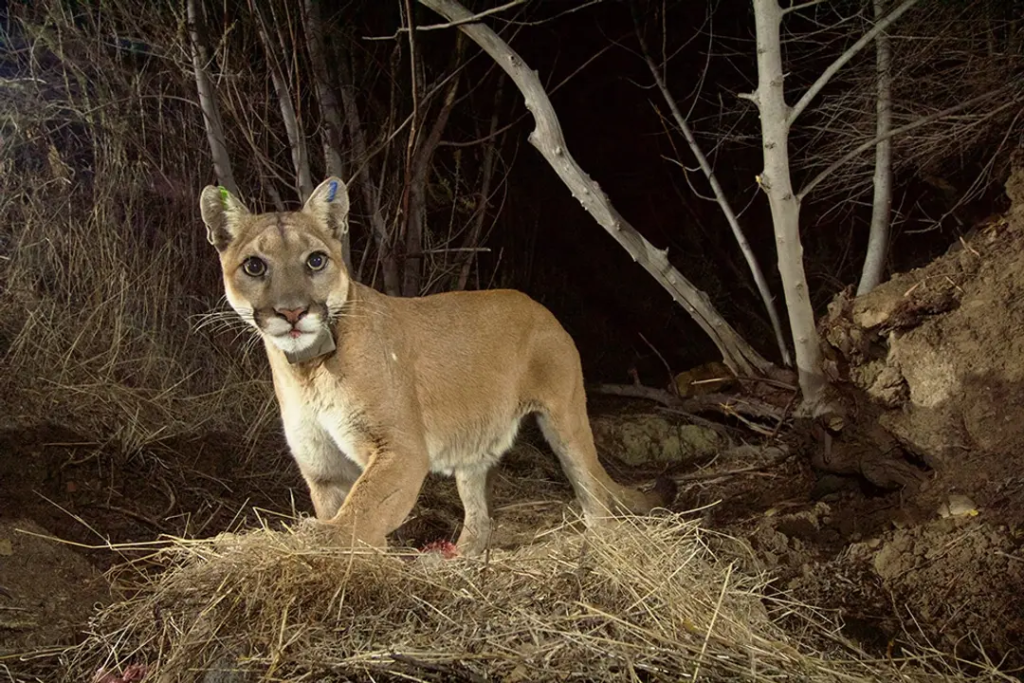
A mountain lion caught on camera. Courtesy the National Park Service/Public Domain
Fatal encounters do happen. In 2024, a young man was killed by a mountain lion in the Sierra Nevada, the first such fatality there in two decades. In January 2026, a woman was found dead after a mountain lion attack in Colorado’s Roosevelt National Forest. Such events are tragedies, usually for both human and animal. Mountain lions involved in fatal attacks are almost always tracked and killed afterward. Fear begins with one death and often ends with another.
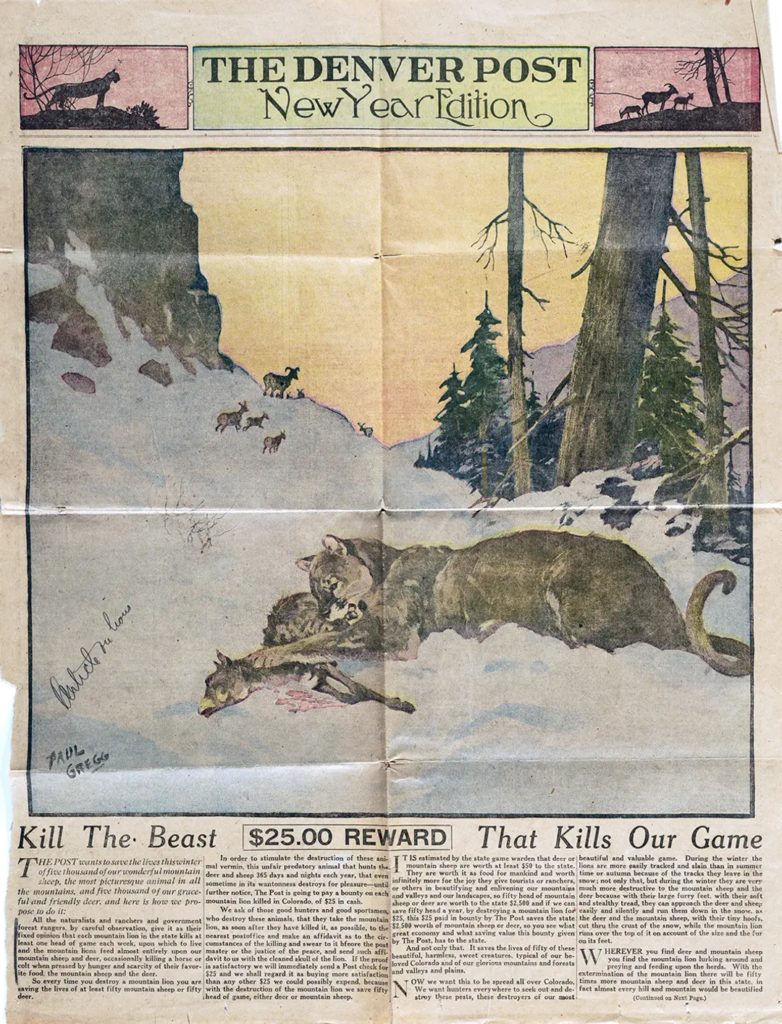
Old Bigfoot met a similar fate. A government trapper was sent to kill him. Poison and traps failed, so the trapper eventually rigged a rifle to a tripwire in a narrow gorge where he guessed only the bear would pass. Old Bigfoot walked into the wire and shot himself.
Officials saw his death as progress. The land would be safer for cattle and settlers. A dangerous animal had been removed. Yet Leopold’s telling is full of grief. He mourns the deception of the method. He notices the bear’s poor, patchy hide, not yet thick with seasonal fur, and calls the circumstances of the killing an insult. The language is striking. He does not treat Old Bigfoot as vermin. He treats him as a being owed some measure of dignity.
Leopold mentions that, seeing the mountain now, “you no longer think of bear”.
That sentence is one of the saddest in Leopold’s work. The mountain remains, but something has gone out of it. The loss is not only biological, though it is certainly that. It is also perceptual, moral and atmospheric. A mountain without its bear becomes easier to use, easier to cross, easier to reduce. It becomes less capable of interrupting human confidence.
Today, rangers and conservationists might say that the land has lost part of its wilderness character. The phrase is useful but incomplete. Wilderness character is not only solitude, naturalness or the absence of roads. It is also the presence of beings that make human mastery uncertain. A land without predators may still be beautiful. It may still have trees, peaks, lakes and trails. But it no longer asks the same things of us.
When I worked in the Sierra Nevada, we did not think of grizzlies except as an absence. We did not think of wolves except historically. Yet we knew how different the mountains would feel if they were still there. There might be fewer visitors in some places, more hesitation, more attention to sign and sound. Some areas would remain less trammelled simply because they would resist easy comfort. If the Sierra someday lost its mountain lions, would it still be the same Sierra? We did not think so.
Leopold had noticed that forests without wolves often suffered in ways humans had not predicted. Deer populations increased. Plants were overbrowsed. The next generations of deer starved. What seemed like kindness toward deer and safety for humans became damage to the mountain itself. Today we describe this as a trophic cascade: changes at one level of a food web producing effects throughout an ecosystem. Leopold was among the early thinkers to grasp the pattern, and especially the role of fear within it.
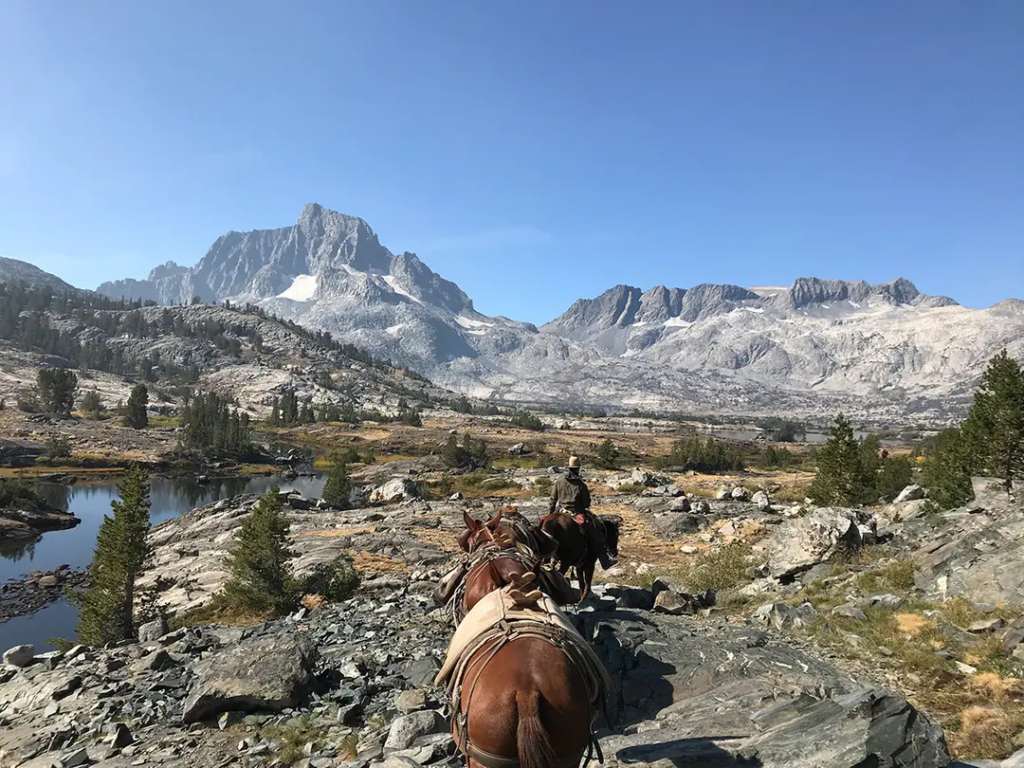
In the Sierras. Photo supplied by the author
To think like a mountain is to see that wolves matter not only because they kill deer, but because deer know wolves may kill them. Fear changes where deer feed, how long they remain, how they move and what plants get a chance to grow. The mountain’s life depends on these adjustments. Safety, if extended too far, becomes dangerous.
John Muir once wrote that when we try to pick out anything by itself, we find it hitched to everything else in the universe. Leopold would agree, but he would add that some of the hitching is done by fear. Interdependence is not always gentle. The ties that hold a biotic community together include hunger, flight, caution, injury, avoidance and death. To remove fear entirely is not to make nature kinder. It is to unravel part of its structure.
The perceived risk of predation reorganises animal behaviour across space and time, with cascading effects.
Contemporary ecology has given this insight a name: the landscape of fear, or the ecology of fear. The concept describes how animals alter their behaviour in response to perceived predation risk. Elk may avoid certain valleys if wolves are present. Deer may browse less heavily in exposed places. Smaller animals may shift feeding times or travel routes. These changes can affect vegetation, streambanks, erosion, biodiversity and the movement of other species.
In some cases, predators reshape ecosystems not simply by reducing prey numbers, but by changing prey behaviour. The wolf kills, but the possibility of the wolf also acts. Fear becomes ecological force. What Leopold sensed in the mountains has become a formal part of environmental science.
This makes the meaning of progress less obvious. Human beings often try to overcome fear by eliminating what frightens us. We kill predators to protect livestock, drain wetlands to reduce disease, suppress fires to protect property, spray insects to make recreation pleasant, engineer landscapes to minimise discomfort. Some of these interventions save lives. Some are necessary. But Leopold’s warning remains: too much safety may produce danger in the long run.
Rangers know this lesson in theory, but it is easy to forget in practice. I nearly forgot it in the Dinkey Lakes Wilderness.
The Dinkey, despite its unfortunate name, is one of the most beautiful wilderness areas in the Sierra Nevada. It is also less visited than many nearby places. Local lore says it was named after a dog called Dinkey who saved his owner from a grizzly bear. Without that story, the name sounds small and unimpressive, as though the area were merely a cluster of little lakes. In reality, its relative obscurity helps preserve its solitude.
One of the Dinkey’s defining features is mosquitoes. For much of the summer, they arrive in dense, relentless clouds. Rangers work in head nets. Breakfast requires lifting a spoon under mesh. Evening swims become impossible because the rush from lake to tent must be made as quickly as possible. Conversation becomes punctuated by slaps. The air itself seems to bite.
One day, hiking through a swarm of them, I found myself thinking that the world would be better if they were all dead. What harm could that really do? Soon after, a father and son came running down the trail, waving their arms in defeat. The mosquitoes had overwhelmed them. Their week-long camping trip was over.
At that moment, the insects became newly legible. They were not merely pests. They were guardians. They kept some people away. They preserved solitude not by beauty, but by irritation. They helped make the Dinkey what it was.
As we live in fear of mosquitoes, the Dinkey must live in fear of people, as must other wild places.
That thought changed my attitude. I did not come to love mosquitoes exactly, but I learned to respect the kind of fear and discomfort they produce. They reminded me that wildness is not always grand. It is not only wolves on ridgelines or grizzlies on mountains. Sometimes it is a cloud of tiny bodies making a place less convenient for us.
Researchers have noted that mosquitoes and other biting insects influence the movement of animals, including humans. Caribou alter routes and behaviour to avoid them. People abandon campsites, trails and plans. Vast amounts of flying biomass become a force in landscape use. Like predators, mosquitoes shape behaviour through avoidance. They make certain places less easy to occupy.
This does not mean mosquitoes should be romanticised. They kill more humans than any other animal on Earth by spreading infectious diseases, leading to hundreds of thousands of deaths each year. Efforts to reduce mosquito-borne illness are essential in many regions. New technologies, including genetically modified mosquitoes and bacterial interventions, may save many lives.
But here, too, Leopold’s lesson complicates the idea of improvement. If mosquitoes are removed from some wild places, those places may become more hospitable to humans. More visitors may arrive. More trails may be used. More camps may be built. More pressure may fall on fragile ecosystems. A successful removal of discomfort may become an invitation to overuse. The cure may have consequences beyond the disease.
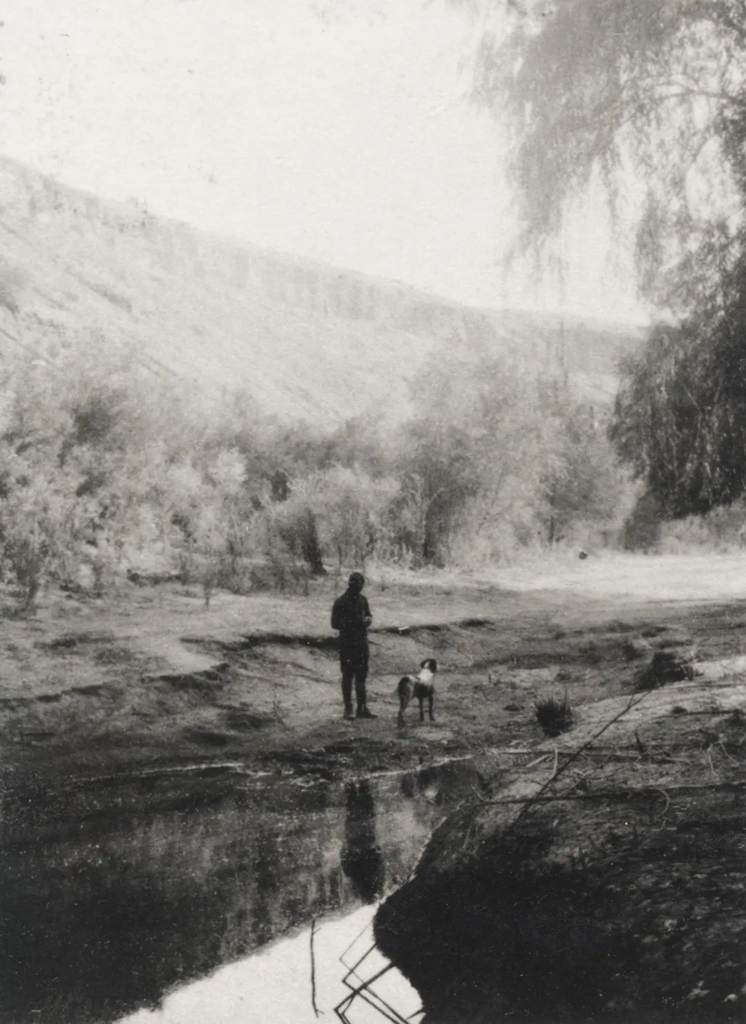
Green lagoon, Colorado River trip, 1922. Courtesy the Aldo Leopold Archives, University of Wisconsin-Madison
The point is not that we should preserve every danger in every context. Malaria, dengue and other mosquito-borne diseases are not ecological ornaments. Human suffering matters. But it is also true that the things we experience as inconvenience can sometimes protect landscapes from us. Not every reduction of fear is an ecological gain.
This brings us to wilderness, a term Leopold helped shape and one that has remained contested ever since. In a 1921 essay, he defined wilderness as a continuous stretch of country preserved in its natural state, open to lawful hunting and fishing, large enough to absorb a two-week pack trip, and free of roads, artificial trails, cottages and other works of man. By a two-week pack trip, he meant travel by horse and mule into the backcountry.
The definition is appealing, but imperfect. Many places we call wilderness contain human works, including Indigenous trails, dwellings, burning practices and sacred sites. Some wilderness areas cannot be traversed by horse or mule. The very phrase “works of man” reflects assumptions that later conservationists have had to reconsider. Wilderness has often been imagined in ways that erase the presence and histories of Indigenous peoples.
Even so, Leopold’s definition helped generations of rangers and conservationists ask why certain places matter and how they might be protected. Related to wilderness is the more elusive concept of wildness. Wilderness often names a legal or geographic category. Wildness names a quality: unruly, self-willed, not fully controllable, not arranged entirely around human use.
Fear belongs to wildness. Philosophers have long disagreed about fear. Stoics often sought to overcome fear by changing judgment rather than controlling events. Aristotelian traditions, by contrast, allow that fear may be appropriate when it responds to real danger in the right way. Fear can be a form of practical intelligence. It can tell us that the world is not ours to command.
Similar disagreements surround wildness. Hobbes famously described life in the state of nature as solitary, poor, nasty, brutish and short, casting wildness as a condition to be escaped. Some contemporary primitivist thinkers reverse the valuation, treating wildness as the condition of real freedom and civilisation as the source of alienation. Leopold belongs to neither extreme. He does not ask us to abandon civilisation. He also refuses to define progress as the elimination of everything that frightens or resists us.
His land ethic offers another path. “A thing is right,” he wrote, “when it tends to preserve the integrity, stability, and beauty of the biotic community. It is wrong when it tends otherwise.” This is one of the most influential sentences in environmental ethics, and one of the most difficult. It shifts moral attention away from human beings alone and toward the broader community of soils, waters, plants and animals. Humans become members, not conquerors.
Leopold effectively places humans on equal footing with all other parts of the biotic community.
That move was radical in its context. Leopold did not deny human needs, nor did he simply forbid hunting, fishing, meat-eating or land use. He was himself a hunter and a manager of game. But he insisted that ethical judgment must include the long-term flourishing of the land community. The question is not only whether an action benefits us. It is whether it preserves the integrity, stability and beauty of the whole.
This can be understood as a kind of ecological consequentialism, though Leopold did not write in the vocabulary of academic moral theory. He asks us to consider effects across species and timescales, including beings whose perspectives we cannot easily inhabit: wolves, deer, bears, mosquitoes, soils, waters, mountains. The good being sought is not the greatest happiness of the greatest number of humans, but the durable flourishing of a complex biotic community.
Fear belongs to that flourishing. A stable ecosystem is not one in which every creature feels safe. It is one in which fear, hunger, reproduction, death, restraint and abundance interact in ways that sustain life over time. From the point of view of an individual deer, wolves are terrifying. From the point of view of a mountain, wolves may be necessary. To think like a mountain is to hold both truths at once.
Leopold’s principle is not perfect. He leaves key terms such as integrity, stability, beauty and biotic community insufficiently defined. Philosophers have rightly worried about the dangers of subordinating individuals entirely to ecological wholes. Tom Regan, for example, argued that an unqualified land ethic could become a form of eco-fascism. If killing an innocent person somehow preserved the integrity of a biotic community, would Leopold’s principle require it? Surely not. But the limits are not always clear.
The same uncertainty applies to animals, plants and insects. What rights, if any, do bears have? Wolves? Mosquitoes? Trees? How should those claims be weighed against human safety, food systems, Indigenous sovereignty, public health or rural livelihoods? Would mosquitoes be protected as ecological actors or condemned as disease vectors? Leopold gives us a powerful orientation, not a complete decision procedure.
Still, that orientation matters. It teaches that ethical thought can emerge from lived encounter as much as from abstract theory. Leopold’s greatest essays are not arguments in the narrow sense. They are stories: a dying wolf, a vanished bear, a farm in winter, a mountain altered by deer. Narrative is not decoration in his philosophy. It is the medium through which moral perception changes.
This may be one of Leopold’s deepest contributions. He showed that environmental ethics cannot be developed only from armchairs. It must be learned in contact with the world: in mud, tracks, carcasses, insects, weather, fear and regret. The land ethic is not merely a principle to apply. It is a way of seeing that must be cultivated through experience.
Today, Leopold’s broad claim that humans belong to ecological systems no longer seems as radical as it once did. Many people accept that ecosystems have value beyond economic utility and that human beings are not masters standing outside nature. But the harder implication remains unresolved. It is easy to say that we are members of the biotic community. It is harder to accept the other members.
Membership sounds pleasant until it includes wolves that kill elk, bears that take cattle, mountain lions that frighten hikers, mosquitoes that ruin vacations, fires that renew forests but threaten homes, rivers that flood, and deserts that do not care whether we are thirsty. A community that contains nonhuman beings is not a community organised around human preference. It will sometimes inconvenience, endanger or humble us.
In some towns, residents have displayed bumper stickers declaring “Kill a wolf, save an elk”.
Resistance to predator reintroduction shows how difficult Leopold’s lesson remains. In Arizona and New Mexico, state wildlife agencies, the US Fish and Wildlife Service and tribal partners have worked to reintroduce the Mexican grey wolf, the very kind of animal Leopold once helped eradicate. Opposition has been fierce in some areas. Billboards show wolves in crosshairs. Ranchers worry about livestock. Hunters worry about elk. Residents worry about safety and control.
Similar conflicts have unfolded in Europe. Brown bears reintroduced to the Pyrenees have faced resistance from shepherds, farmers and politicians. Rewilding projects that propose returning predators or large herbivores often produce excitement among conservationists and anxiety among those who must live closest to the animals. The argument is never only about ecology. It is about fear, property, memory, livelihood and power.
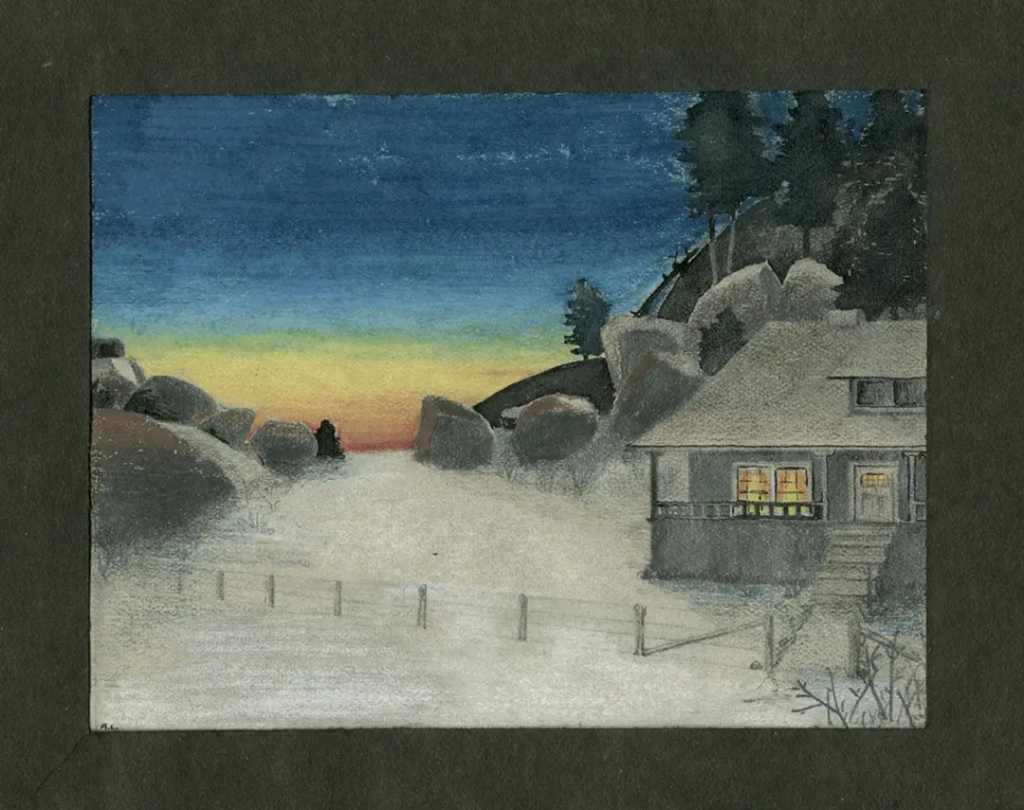
Crayon and ink drawing by Aldo Leopold of a Forest Service house at Tres Piedras, New Mexico, c1911. Courtesy the Aldo Leopold Archives, University of Wisconsin-Madison
Leopold does not give an easy answer to these conflicts. He does not ask people to erase their own interests or pretend that predators cause no harm. A rancher who loses animals to wolves has suffered a real loss. A community afraid for its children or livelihood is not simply irrational. If fear is ecologically meaningful, then human fear is part of the story too.
But Leopold asks whether fear must always be answered by elimination. Can we live with some dangers, compensate some losses, adapt some practices, and accept some discomforts because the larger community requires them? Can we distinguish between fear that calls for prudence and fear that becomes a demand for domination? Can we let the land push back?
That may be the most difficult part of the land ethic. It is not only about expanding sympathy. It is about accepting limits. Humans must not always have the final comfort, the safest trail, the fullest herd, the easiest campsite, the quietest night, the cleanest separation from nuisance and threat. Sometimes membership means that other beings retain the power to disturb us.
A mountain without wolves may look peaceful. A forest without bears may feel safer. A lake basin without mosquitoes may attract more campers. A coastline without sharks may reassure swimmers. But in each case, the removal of fear may also remove a relation that helped keep human presence in check. The absence of danger can become an invitation to excess.
This does not mean fear is always good. Terror can traumatise. Disease can devastate. Predation can destroy livelihoods. No serious environmental ethic should treat human vulnerability lightly. The task is more subtle: to ask which fears belong to a healthy world, which are unjustly imposed, which can be mitigated without unraveling ecological relations, and which we must learn to bear.
Leopold’s own life began inside the logic he later criticised. He killed wolves because that was the policy, the science and the common sense of his profession. His conversion did not come from innocence. It came from regret. That matters. He did not stand outside the destructive habits of his time. He participated in them, then learned to see them differently.
The dying wolf did not give him a formula. It gave him a wound in thought. From that wound came a lifetime of reflection on what humans owe the land. Perhaps the power of the story lies in its refusal of purity. Leopold’s environmental philosophy begins not with communion but with killing. Its authority comes from the fact that he knew what it meant to be wrong.
We face similar tests now. Climate change, mass extinction, habitat fragmentation and industrial extraction are far larger than the predator eradication campaigns of Leopold’s youth, but they share a pattern: humans pursue safety, profit, convenience or control, and only later discover the wider relations damaged by success. We remove obstacles and call it improvement. Then the mountain answers.
To think like a mountain today may require more than restoring wolves or protecting wilderness areas. It may require rethinking our desire for a frictionless world. Much of modern life is built around the reduction of discomfort: climate control, pest control, risk management, instant navigation, predictive technologies, sanitised recreation, curated landscapes. Some of this is humane and necessary. But a life with no unwanted encounter may also become a life sealed against the more-than-human world.
Nature cannot be fully encountered as scenery. Scenery is looked at from a distance. A living world surrounds, resists, interrupts and sometimes frightens. Fear is one of the signs that we are not merely spectators. It tells us that other beings have their own powers, routes, hungers and claims. It reminds us that the land is not passive matter awaiting our plans.
The question is not whether we should seek danger for its own sake. Romanticising risk can be foolish, especially when the risks fall unevenly on rural communities, Indigenous peoples, workers or the poor. The question is whether we can make a place in our ethics for nonhuman powers that we cannot wholly domesticate. A world safe only for humans may not remain safe for humans for long.
Leopold’s mountain thinks in longer terms. It knows that deer without wolves can become a danger to themselves. It knows that a bear can give a place a presence beyond its visible body. It knows that mosquitoes may protect solitude. It knows that fear can be a boundary, a warning, a form of respect and a relation. It knows that beauty without integrity is fragile.
We are not mountains, of course. We cannot literally think as they do. But Leopold’s phrase asks us to stretch imagination beyond human immediacy. The mountain is a figure for the long view, the whole community, the perspective from which our comforts appear partial and our solutions premature. To think like a mountain is to ask what our fear prevents us from seeing.
The lesson remains severe. We may say we want wildness, but often we want only wildness that behaves. We want predators that stay far enough away to be symbolic, forests without smoke, rivers without flood, insects without bites, trails without risk, landscapes with just enough danger to feel authentic but not enough to alter our plans. We want nature to be wild in appearance and tame in practice.
Leopold asks for more honesty. If we want real wildness, we must accept that it will not always reassure us. If we want a biotic community, we must accept members that do not ask permission. If we want mountains to be more than scenery, we must allow them to remain places where human confidence is not absolute.
That is why there can be no nature without fear. Not because fear is the highest ecological value, and not because suffering is good. There can be no nature without fear because a world without anything that frightens us would be a world entirely arranged around us. It would be a world emptied of genuine otherness. It would be safe in the way a museum is safe, or a theme park, or a cage.
Leopold’s dying wolf still looks back at us from that riverbank. Her green fire asks whether we can learn without first destroying. Old Bigfoot asks whether a mountain without bear is still the same mountain. The lion at the bend in the road asks whether our fear can become respect rather than retaliation. The mosquitoes of the Dinkey ask whether annoyance may sometimes be a form of protection.
No single answer covers every case. Some predators must be managed. Some diseases must be fought. Some fears must be reduced. But a conservation ethic that seeks only comfort will save little worth saving. A wilderness without anything that pushes back may still look beautiful, but its beauty will be increasingly hollow.
Leopold offers no final formula, only a discipline of perception. Look longer. Think wider. Remember the unseen relations. Ask what disappears when danger disappears. Ask what kind of world remains when every creature that troubles us has been removed.
A mountain without wolves, a forest without lions, a wilderness without mosquitoes, a sea without sharks, a land without anything capable of making us cautious — such a world might at first feel like peace. Eventually, it would become something else. It would no longer be fully alive.
It would no longer look like our world at all.