









Between 2010 and 2011, Los Zetas kidnapped dozens of migrants travelling north from Central America. In the eastern Mexican state of Tamaulipas, near the municipality of San Fernando, authorities later uncovered mass graves that became symbols of a new kind of terror in the country’s drug wars. A 2016 report by the Open Society Justice Initiative argued that there was compelling evidence that killings, enforced disappearances and torture committed by members of the Zetas cartel met the legal definition of crimes against humanity. Few criminal organisations in Mexico came to embody organised brutality so completely. Los Zetas did not merely traffic drugs. They seized towns, attacked civilians, fought the state with heavy weapons, and turned disappearance itself into a technique of rule.
Most people are taught to imagine such men as the absolute opposite of soldiers or police officers. On one side stands the state, with uniforms, laws, barracks and courts. On the other stand the cartels, with masks, safe houses, corruption and terror. This division makes moral sense. It is also politically convenient. It allows us to believe that legal violence and illegal violence belong to different worlds, animated by different kinds of people.
Los Zetas make that belief harder to sustain. The organisation was founded by former members of Mexico’s military special forces. In 1997, more than 30 soldiers from the Special Forces Airmobile Group, known in Spanish as GAFES, defected to work for the Gulf Cartel in northeastern Mexico. They brought with them training in counterinsurgency, jungle warfare, psychological terror, surveillance, discipline and heavy weapons. Even the gang’s name came from the Z codes used in the Mexican Army’s radio system. What moved from the state into the cartel was not only manpower. It was expertise.
Seen from that angle, Los Zetas were not simply criminals who became unusually violent. They were a case of occupational transfer. Skills developed by the state for one theatre of violence were redeployed in another. The uniform changed. The employer changed. The moral vocabulary changed. The practical knowledge did not.
Social scientists have a name for such people. The sociologist Charles Tilly called them ‘violence specialists’: men, usually, whose labour consists in the organised use or threat of force. They may work for armies, police departments, cartels, militias, guerrilla movements, private security firms, prisons, intelligence agencies or death squads. They may be celebrated as protectors, feared as predators, prosecuted as criminals, honoured as veterans or forgotten as disposable men. Across these differences, they share a craft.
To describe violence as a craft can sound obscene, as though naming its skill somehow dignifies its harm. Yet refusal to see the labour involved only makes the system harder to understand. Violence specialists train, obey, improvise, compete, take risks, receive wages, seek promotion, learn from superiors, and sell capacities that not everyone possesses. They do not all do the same thing, and they are not morally equivalent. But they often inhabit the same labour ecology.
My own research with imprisoned young men in Mexico made this unsettling continuity difficult to ignore. In 2023, after COVID-19 restrictions were lifted, I visited La Quinta del Bosque, a juvenile detention centre in the State of Mexico near Toluca. The centre, once an old farmer’s house, holds young people, mostly male, who committed crimes between the ages of 14 and 17. I interviewed 18 young men who had belonged to criminal organisations and had been sentenced for homicide.
Again and again, they described violence as work. They used chambear, the Mexican Spanish vernacular for ‘to work’, when speaking about guarding drugs, carrying guns, protecting territory and killing people. Their language was not heroic. It was not always remorseful. Often it was practical. Someone gave an order. Someone paid. A task had to be done.
The point is not that killing becomes ordinary simply because a young man calls it work. Nor is it to erase the victims, whose suffering remains the centre of any moral account of these crimes. The point is that the young men themselves had entered a world in which violence was organised as employment. It had wages, hierarchies, skills, risks, recruitment channels, prestige and prospects. It was not only a moral collapse. It was a labour market.
Much conventional thinking about violence begins somewhere else. One common explanation treats violent people as naturally aggressive, as though some human beings are born closer to savagery and need only an opportunity to reveal it. Another sees criminal violence as the product of trauma, deviance or psychological damage. In this view, violence is a pathology that erupts when normal social restraint breaks down.
A parallel story is told about legal violence. Soldiers and police officers, we often assume, join their professions from a desire to protect others. Their use of force is framed as sacrifice rather than deviance. They may be imperfect, but their violence is imagined as fundamentally different in origin from that of criminals. One side acts from brokenness or greed; the other from service.
History makes such neat separation impossible. Soldiers and police officers have tortured, disappeared and killed civilians in many places and under many flags. Military dictatorships in Chile, Argentina, Uruguay, Brazil, Paraguay and Bolivia relied on legally organised violence against their own populations. Police violence in the United States is documented and internationally known. Uniforms can authorise courage and discipline. They can also authorise cruelty.
The reverse is also true. Criminal groups do not recruit only monsters. They recruit boys who want money, status, protection, escape, masculine recognition or a place in a hierarchy that appears to value them. Some are drawn by fear. Some by coercion. Many by opportunity. Their choices may be morally terrible, but they are often socially intelligible.
The border between the soldier and the hitman is sometimes less a matter of skill than of payroll, permission and public myth.
The idea that violence can be erased simply by correcting deviant minds has been challenged for decades. In 1989, UNESCO adopted the Seville Statement on Violence, which rejected the claim that war and organised aggression are biologically inevitable. Violence is shaped by culture, ideology, institutions and social learning. Boys are not born with a cartel’s worldview or an army’s discipline. They are taught what violence means, when it is admired, who may use it, and which deaths count as honourable.
This insight matters, but it does not go far enough. Societies do not merely teach beliefs about violence. They maintain institutions that employ it. The question, then, is not only why some individuals become violent. It is why violence remains such a durable occupation, why so many organisations need it, and why so many young men can recognise it as a plausible career.
Recruitment reveals the continuity. Governments and gang leaders use different symbols, but often similar promises. They tell boys that armed service will bring respect, money, brotherhood, excitement and purpose. They present danger as masculine proof. They turn the weapon into an object of status. They offer a larger cause: the nation, the community, the organisation, the boss, the family, the neighbourhood, the revolution.
During fieldwork in Mexican towns where criminal organisations were present, some schoolboys told me that weapons were alluring and military men looked cool. They did not always see soldiers and cartel members as opposites. They saw armed men, admired by peers, feared by others, moving with confidence through a world in which most working-class jobs offered little dignity or pay. Some boys regarded cartels as enemies of the community. Others were less certain, especially once they understood how much a hitman could earn. Several young men I interviewed in detention said they hoped to join the army or police after release.
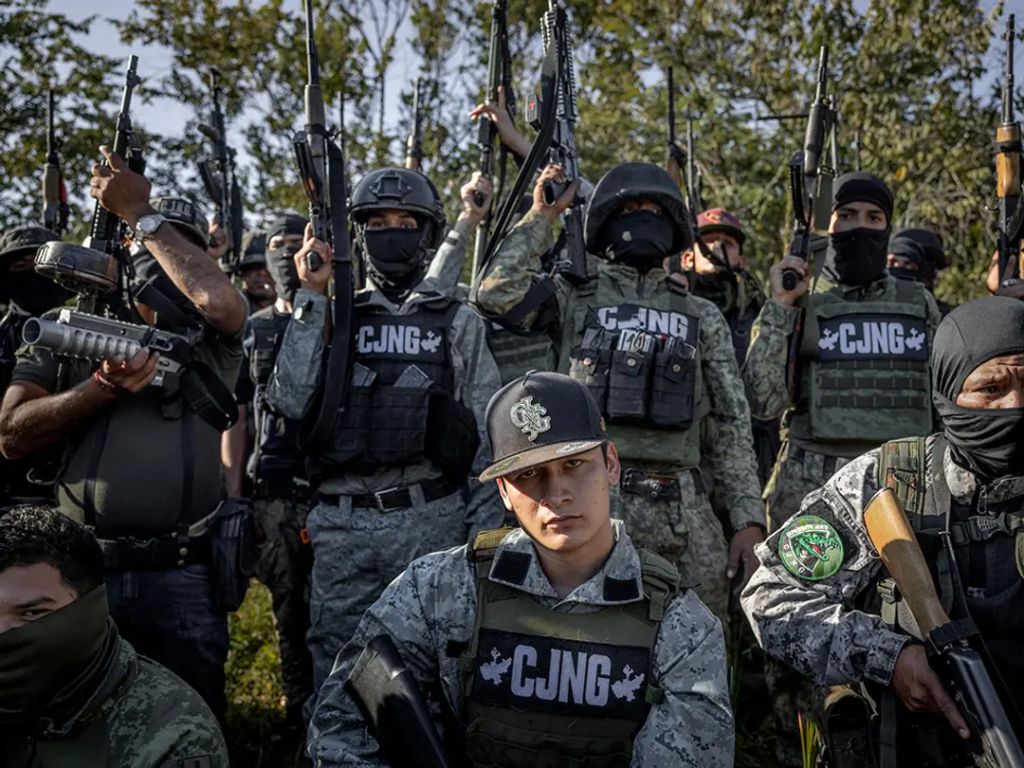
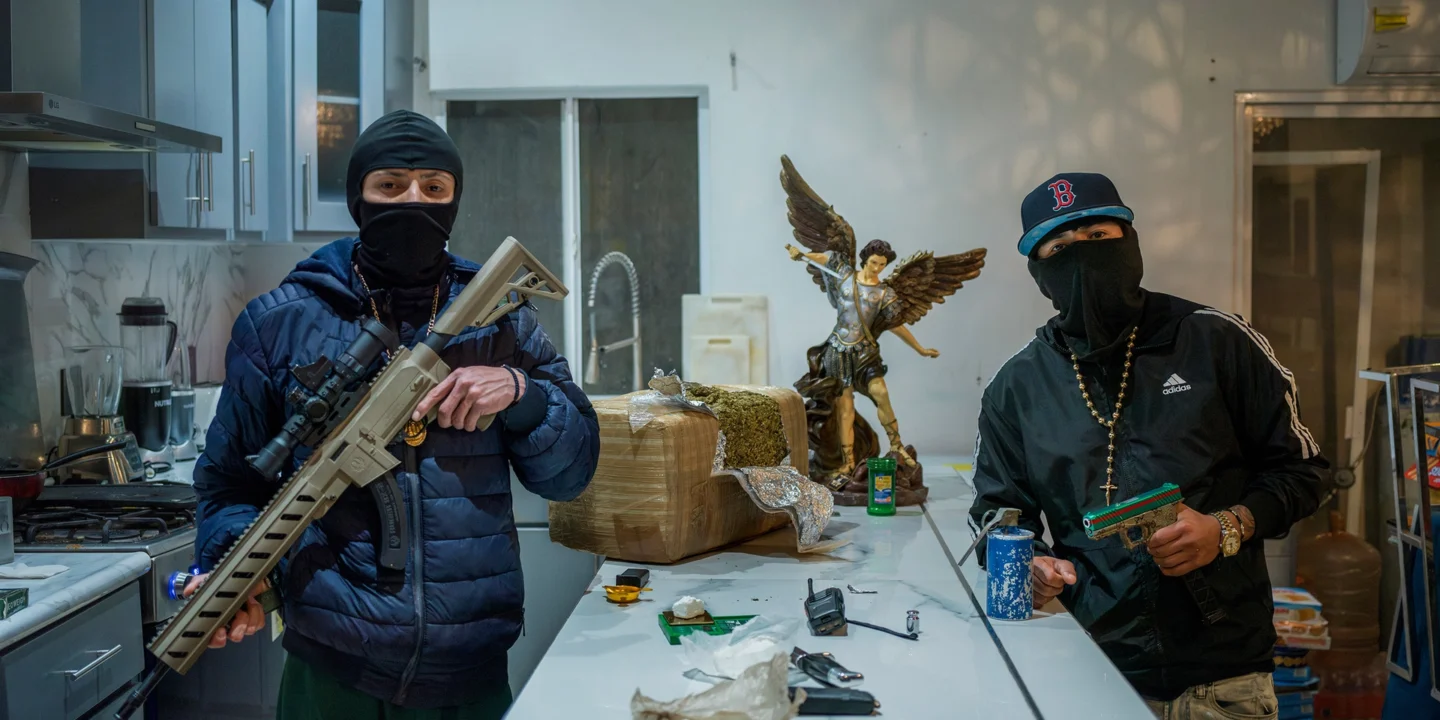
Members of the Jalisco Cartel in territory under their control near the city of Uruapan, Mexico. Photo by Mads Nissen/Panos Pictures
Such statements should disturb us. They suggest that, for some young men, legal and illegal violence appear as different employers in the same occupational field. A gun may be worn in the name of the state or carried in the service of a cartel, but the attraction can be similar: wages, authority, masculine recognition and the chance to escape humiliating poverty.
Sociologists sometimes call risky occupations of this sort edgework: activities that involve danger, skill and the thrill of proximity to death. Firefighters, soldiers, police officers, racers, climbers, gang members and others may experience the edge as terrifying and intoxicating at once. For young men with few routes to social prestige, danger itself can become a credential.
None of this means that psychological differences are irrelevant. Violence workers often develop, or are selected for, desensitisation, risk tolerance, obedience under pressure and appetite for adrenaline. The idealised soldier — brave, physically capable, calm before death — embodies one version of this profile. The gangster or hitman may cultivate another. In both cases, the job reinforces a particular form of masculinity, one in which fear must be mastered, pity suppressed and status earned through proximity to harm.
Money, however, remains central. A 16-year-old I interviewed told me that he sent part of his earnings to help pay for his mother’s medical expenses and his baby’s food. Another young man, around 18, said that the money from violent work had helped his parents build a house they would never have been able to afford through their ordinary jobs. These are not excuses. They are evidence of the economic terrain in which moral decisions are made.
A society that offers some young men only precarious manual work, migration, humiliation or armed employment should not be surprised when armed employment becomes thinkable. The violence specialist is not produced only by cruelty or ideology. He is produced by an economy of blocked futures.
There are people who call for abolishing the army or the police. In most societies, such positions remain marginal, especially in communities where armed threats are immediate. In rural Mexico, I met no one who supported abolishing the police or military. A secondary school student told me he had seen a gang invade a wedding party with powerful weapons, threatening guests and stealing money and jewellery. Another said his father had witnessed a gunfight between gang members and the army while travelling to a clinic. In such places, the demand for protection is not theoretical.
Fear sustains the legitimacy of legal violence. It also sustains the market for illegal violence. A shopkeeper may pay extortion because he fears a gang. A politician may hire gunmen because she fears rivals. A cartel may employ hitmen because it fears competitors and police. A state may expand its armed forces because citizens fear disorder. Violence workers exist because people, organisations and governments believe they need them.
This is why thinking of violence specialists as workers is so uncomfortable. It does not flatten moral distinctions, but it reveals shared structures. Police officers and soldiers are waged workers subordinate to command. Hitmen and cartel enforcers also work under hierarchy, receive payment, perform assigned tasks and depend on organisational discipline. Private military contractors, prison guards, border agents, bodyguards and bouncers occupy still other points along the spectrum.
Violence is not only an eruption of disorder; it is one of the ways societies organise order.
Legal systems recognise some of these workers and conceal others. Governments count soldiers, police officers, prison guards, customs agents and private security personnel in official employment categories. The International Labour Organization’s International Standard Classification of Occupations includes protective service workers and armed forces occupations. Clandestine violence workers do not appear in labour surveys, but their absence from statistics does not mean they are absent from the economy.
Indeed, legal violence specialists have often been among the first groups to win state support. Most countries do not treat soldiers or police officers like ordinary workers. Their right to strike is heavily restricted or nonexistent. Police strikes are legal only in a small number of countries, subject to conditions, and military union rights are even rarer. Yet pensions, veterans’ benefits and support for wounded soldiers helped shape modern welfare systems in the United States after the Civil War and in Europe, the United Kingdom and Australia after the world wars.
This history complicates the image of violence workers as mere servants of the state. They are also labourers whose dangerous service has been used to claim social rights. The veteran, in many societies, became a politically powerful figure because he embodied sacrifice for the nation. His claim on public care helped expand the idea that the state owed certain protections to those who served it.
Criminal violence workers rarely receive anything similar. Their injuries, trauma and deaths are treated as deserved or invisible. Yet the labour structure remains. A hitman may be disposable to his employer in much the same way that a low-ranking soldier can be disposable to a state. Both may discover that the organisation that demanded courage is less generous when the worker is wounded, imprisoned, traumatised or no longer useful.
Private security has made the continuum even clearer. Work once associated with bouncers, guards or bodyguards has become a global industry. Private military companies have allowed states to purchase violence at arm’s length, blurring the boundary between public war and private contract. Blackwater, hired by the United States during the Iraq War, became infamous for this model. The Wagner Group, used by Russia in Crimea and later in conflicts in Syria, Libya, the Central African Republic, Mali and Ukraine, represents another version of the same tendency.
In Iraq in 2008, the US Department of Defense employed more than 155,000 contractors, more than the number of troops deployed. Many of these contractors were former soldiers. Their skills, acquired under the authority of the state, were resold on another market. When contracts ended, some returned to policing or other security work. A career in violence could move from army to contractor to police department, crossing institutional boundaries without abandoning the craft.
Private military companies expose a truth that states often prefer to obscure: legitimate violence is not always directly performed by public servants. It can be outsourced, subcontracted, deniable and profitable. Governments may claim a monopoly on violence while renting parts of that monopoly to private actors. The uniform remains, but the payroll becomes more complicated.
Once violence becomes a transferable skill, every war creates workers for the next one.
Across history, ruling elites often monopolised the profession of organised violence. Roman Praetorian Guards shaped imperial succession. The Aztec Pipiltin governed as warriors and priests. Japan’s samurai fused martial skill with political hierarchy. Violence and power were not separate domains. Those who ruled often did so because they commanded force directly.
Modern mass armies changed that relationship. Napoleon’s armies helped transform soldiering into a broader career of national service. Recruits were promised not merely wages but honour, advancement and participation in a collective cause. Governments learned that soldiers who believed they served a people, not merely a ruler, were more reliable. The modern state’s claim to a legitimate monopoly on violence depended not only on law, but on making violent service meaningful to ordinary men.
That legitimacy has always been fragile. States that cannot pay, honour or control their fighters become vulnerable. Revolutions in Russia, France and China were shaped in part by military breakdown. In Mexico, Porfirio Díaz, himself a retired general, neglected his armed forces so badly that revolutionaries such as Pancho Villa — many with histories closer to banditry than formal military command — could out-recruit and outfight the regime.
Cartels in Latin America and the Caribbean exploit a similar weakness today. They compete with states not only through corruption and terror, but through wages. One imprisoned hitman told me he earned 10,000 pesos, just under US$600, for a killing. That was roughly what a Mexican police officer might earn in a month, and far more than most working-class jobs in the small rural town where he had lived. Only migration to the United States and remittances could offer comparable income.
Such pay transforms the moral landscape. A young man may know that killing is wrong and still see no other route to money, respect or escape. He may fear the cartel, but also admire the men who carry guns. He may understand that the job could kill him and still compare it favourably with a lifetime of poverty. The labour market does not remove responsibility, but it shapes temptation.
Statistics reveal the scale of the loss. According to the UN Office on Drugs and Crime, more than 3 million people were murdered in Latin America and the Caribbean between 1990 and 2021, most of them young men. Even if only a fraction of those deaths involved professional hitmen, the region has lost an enormous number of lives to markets of organised violence.
Some of those lives were once visible to me as classmates. I grew up for a time in a small town in rural southern Mexico. Because of my parents’ middle-class resources, I eventually studied in Mexico City. Over the years, I heard that some of the boys I had known had disappeared, only to be found dead weeks or months later. Many had entered forms of manual work that required no university degree and offered little chance of escape from precarious life. Some were victims. Some may have been recruited. Some vanished into the vast accounting of young male death that defines the region.
It would be wrong to conclude that working-class men naturally choose violence. Most do not. Many resist conscription, recruitment and coercion at great personal risk. Russian men have tried to avoid being sent to Ukraine. Americans dodged the draft during the Vietnam War. Young Mexicans have refused cartel work, fled their towns, stayed silent or paid the price of saying no. Violence is a labour market, but like many labour markets, it contains people who would rather be elsewhere.
The deeper question concerns demand. Why do societies keep needing these workers? Why are there so many employers for men trained, willing or desperate enough to harm others? Cartels need enforcers because prohibition, drug demand, territorial competition and corruption make violence profitable. States need soldiers and police because borders, property, order and sovereignty are backed by force. Private actors need guards and contractors because insecurity has become a business opportunity. Fear creates employment.
A politics that focuses only on the violent individual will always arrive too late. By the time a boy accepts a gun, many prior systems have already failed or succeeded, depending on one’s perspective. Schools failed to offer another future. Labour markets failed to pay enough. Masculine status was attached to danger. The community feared armed groups but also admired them. The state appeared distant, corrupt or underpaid. The cartel understood the local economy better than the ministry did.
This is why prevention cannot mean only policing. More police may be necessary in places where people face armed predation, but policing alone expands the number of legal violence workers without reducing the conditions that make illegal ones useful. A society that wants fewer hitmen must reduce the market for hitmen. That means addressing impunity, corruption, drug policy, poverty, local employment, migration pressures, masculine prestige, community protection and the profitability of organised crime.
It also means rethinking what honour is offered to young men. Armed institutions are often very good at providing ritual, belonging, hierarchy and a story of significance. Schools, civilian employers and public institutions are often worse at this. For a boy who feels invisible, the gun does not only pay. It announces that he matters. If peaceful societies cannot offer forms of recognition as intense as violent ones, they should not be surprised when some young men find violence more persuasive.
The same problem exists after war. Demobilised fighters do not stop possessing their skills simply because a conflict ends. If no civilian path absorbs them, other conflicts will. A man trained to fight may become a security contractor, a gang member, a police officer, a mercenary, a smuggler’s guard or a paramilitary. The world is full of organisations ready to purchase experience in fear.
Here the old figure of the condottiere returns. Machiavelli warned that mercenary soldiers who fight only for wages cannot be trusted to die for a prince. Modern states thought they had solved this problem by turning fighters into national servants. Yet the global market for violence has recreated the condottiere in new form: the contractor, the cartel-trained enforcer, the former soldier hired abroad, the security specialist moving from one conflict to another.
The problem is not that violent men exist outside society, but that society keeps finding uses for them.
An ethical reckoning begins when we stop treating violence specialists as alien figures. They are part of our communities. They are sons, fathers, brothers, neighbours, classmates, veterans, employees, prisoners, guards, migrants and dead boys in shallow graves. Some have committed unforgivable acts. Some have protected people from harm. Some have done both at different times under different employers.
Recognising them as workers does not absolve them. It relocates the question. Instead of asking only what is wrong with these men, we must ask what kind of society makes their skills valuable. Who pays them? Who trains them? Who honours them? Who abandons them? Who profits from their risks? Who calls their violence service, and who calls it crime?
Legal distinctions remain necessary. A democratic state’s use of force should be accountable to law in a way that cartel violence never is. Police officers and soldiers are not morally identical to hitmen. Victims of criminal organisations deserve protection, justice and truth. But moral distinctions become more serious, not less, when we understand the shared labour structure beneath them. Otherwise we allow legality to hide the continuities that make violence portable.
For the young men at La Quinta del Bosque, violence had already become a biography. Some would leave prison hoping to join the army or police. Some would return to communities where cartels remained powerful. Some would try to find other work. All carried the mark of having entered an occupation that societies condemn in one form and celebrate in another.
The victims remain absent from their language more often than they should. This too is part of the training. Violence work requires the shrinking of other people into targets, threats, orders, jobs, obstacles or collateral damage. Armies teach this in one vocabulary; gangs in another. Undoing violence therefore requires more than removing weapons. It requires restoring the full human presence of those whom violence turns into tasks.
Can societies learn to live with fewer violence specialists? Not by pretending danger does not exist. Not by abandoning communities to gangs. Not by romanticising stateless peace. The question is whether we can reduce the demand for men whose labour consists in fear and injury, while preserving the forms of protection that vulnerable people actually need.
That would require a different imagination of security. Security would have to mean not only armed response, but trustworthy institutions, decent work, public health, schools, housing, nonviolent forms of masculine dignity, functioning courts, less profitable illicit markets, and communities able to settle conflict without calling in men with guns. It would also require restraining the state itself, because state violence, once unleashed without accountability, becomes another employer in the same dark market.
Violence specialists will not disappear soon. They are woven into the present organisation of states, borders, markets and criminal economies. For now, most societies believe they need them. Many probably do. Yet necessity should not be confused with inevitability. The fact that a form of work exists everywhere does not mean we should stop asking what would make it less necessary.
Los Zetas began as a reminder of what happens when trained state violence migrates into criminal enterprise. Their history is horrifying, but it is not incomprehensible. Skills moved. Men changed employers. A state-built craft entered a cartel economy. The result was catastrophe.
The lesson is not that soldiers and police are the same as criminals. The lesson is that violence is a profession before it is a moral category, and professions travel through the channels societies create for them. If we want fewer Zetas, fewer mercenaries, fewer child soldiers, fewer dead boys and fewer armed men selling fear to the highest bidder, we must ask not only who chooses violence, but who keeps hiring.
Supported by a grant from the Open Society Foundations.