











India is a federal union of 28 states. On a map, these states look like administrative units inside a single country; in population, language, history and economic scale, they often resemble countries gathered under one political roof. Uttar Pradesh alone has more than 200 million people, more than many large European nations combined. Tamil Nadu, Maharashtra, Gujarat, Punjab, Bengal and Kerala each carry different languages, religious compositions, colonial inheritances, natural resources and traditions of social reform. Since the end of British rule in 1947, they have belonged to the same republic, but they have not travelled along the same path of development.
Kerala lies at India’s southwestern edge, facing the Indian Ocean and the Arabian Sea. With roughly 35 million people, it is not one of India’s larger states, but it is densely populated. Today, Kerala is widely regarded as one of India’s most successful regions: highly literate, long-lived, medically well served, socially aware, deeply connected to the world and richer than the national average. But in the 1970s, Kerala was not a prosperous model. Its average income was only about two-thirds of the Indian average, making it one of the poorer regions of the country. The question, then, is compelling: how did a once income-poor state become one of India’s richest and most discussed development stories?
Kerala matters because, from the beginning, it disturbed the usual story told by development economics. We often assume that growth comes first and welfare later; that industrialisation precedes education and healthcare; that capital accumulation creates the fiscal space for health, literacy and longer life. Kerala inverted this sequence. While still poor, it already had some of India’s highest literacy rates, best health outcomes and longest life expectancy. It seemed to possess, without sufficient income to explain them, many of the human-development achievements usually associated with richer societies. “Kerala is different” became a phrase shared by scholars and locals alike.
It was different, first of all, from much of North India. Many northern states had dismal records in education, public health, women’s status and basic public services, while population growth remained high. Kerala, by contrast, underwent an early demographic transition: fertility fell, population growth slowed, female education rose and basic healthcare spread. These changes occurred while income remained low. For scholars such as Amartya Sen and Jean Drèze, Kerala offered powerful evidence that living standards cannot be measured by income alone; health and education are not prizes awarded after growth, but part of development itself.
This became the core of what later came to be called the Kerala Model. In the 1970s and ’80s, India was caught in an intense economic debate. Growth had faltered, and many argued that the country should abandon socialist planning and state intervention in favour of markets, private enterprise and liberalisation. Kerala seemed to offer a different answer. The state should invest in schools and hospitals; public action could improve life expectancy, literacy, health and gender equality even when income growth was weak. Development, in this view, was not merely GDP growth, but the expansion of people’s ability to live longer, healthier and more capable lives.
But that conclusion later proved incomplete. Kerala was not only a welfare success. It also became rich. From the 2000s onward, Kerala’s per-capita income moved decisively above the Indian average, and by 2022 it was roughly half again as high as the national level. This transformation has not been explained as fully as the earlier human-development story. Scholars became so accustomed to treating Kerala as a case of welfare, education and health that they paid less attention to its later income surge. Yet basic education and healthcare alone cannot automatically produce rapid capital accumulation. If a region’s income rises dramatically, investment, migration, remittances, industrial change and market structures must also be part of the explanation.
Historically, Kerala possessed at least four conditions that most Indian states could not easily replicate. First, it had long been connected to the world economy, especially through West Asia, the Arabian Sea and European trading networks. Second, it possessed distinctive natural resources and ecological conditions: spices, coconuts, rubber, tea, timber, heavy rainfall, mountains and water. Third, it had a highly literate, skilled and mobile population. Fourth, it had a powerful Left political tradition that promoted land reform, education and healthcare, and later learned to reinterpret the role of markets and private capital. Kerala’s prosperity cannot be attributed to any one of these forces. It came from their interaction.
Many early explanations emphasised Left politics. Communists, trade unions, peasant movements, anti-caste mobilisation and land reform did indeed leave deep marks on Kerala society. Other explanations focused on geography and history: a long coastline, semi-equatorial climate, strong monsoons, mountainous ecology, trading traditions, a multi-religious society, and the governance legacies of princely states such as Travancore and Cochin. Kerala’s Muslim and Christian populations are far larger as a share of the population than in India as a whole, and Christianity has very ancient roots there. This mixture of religions, maritime exchange and relative openness to the wider Indian Ocean world exposed Kerala earlier than many inland regions to global goods, capital and educational institutions.
Yet even when the Kerala Model was most admired, local critics were sceptical. They argued that high literacy and long life expectancy concealed income stagnation, severe unemployment, fiscal strain and weak investment. A society sustained by state spending and welfare, they warned, would eventually reach its fiscal limit unless private investment and income growth revived. By the 1990s, these limits were visible. Traditional industries were declining, agricultural investment was retreating, and the public sector was carrying heavy burdens. Kerala seemed to have excellent social indicators but no obvious economic engine to support them.
What prevented a deeper crisis was remittances. Keralites had long migrated to other parts of India and abroad, but after the oil boom of the 1970s, large numbers went to Saudi Arabia, Kuwait, the United Arab Emirates, Bahrain and Qatar. The Gulf economies needed construction workers, shop employees, technicians and service workers; Kerala had literacy, unemployment, migration networks and older ties to West Asia. A vast transoceanic labour circuit emerged. People left Kerala, and money returned. Household income, housing construction, consumption, education, healthcare, shops, transport, cinemas, restaurants and small businesses were all reignited by remittances.
The Left shifted its focus from land and education reform to private investment and decentralisation.
This shift was crucial. The old Left’s historic mission had been land reform, worker protection, caste equality and public education. The new Left gradually recognised that redistribution and public services alone could not sustain long-term prosperity. Agriculture no longer provided enough employment; traditional industry had been weakened by union pressure and capital flight; and the state needed new sources of investment. Left politics therefore moved away from the language of class struggle and toward infrastructure, local governance, private services, tourism, education, healthcare and small-business development. It did not abandon welfare commitments, but it began to acknowledge the importance of markets, overseas capital and private investment.
To understand this transformation, one must return to Kerala’s earlier structure. Around 1900, what is now Kerala was not a single political unit. It consisted of the princely states of Travancore and Cochin, and the British Indian district of Malabar, along with a few smaller entities. These regions had different political arrangements, but they shared a common ecology. The Western Ghats ran along the eastern border, the Arabian Sea lay to the west, and between them stretched a narrow coastal plain and wet uplands. Unlike many arid and semi-arid parts of India, Kerala received abundant rainfall, had plentiful water and experienced very little famine. These natural conditions supported not only life, but also diversified agriculture and commercial crops.
Land, however, was scarce. The strip between sea and mountains was narrow, and population density was high. The rice-growing plains were fertile, but land per head was extremely low. Many farmers owned far less land than the Indian average. Agriculture could support life, but it could not make most families prosperous. For this reason, Kerala was never simply an agricultural society. Coir, cashew, spices, timber, rubber, tea, finance, trade and small processing firms gave the region a larger non-agricultural sector than many other parts of India.
Spices were especially important. Black pepper, cardamom, cloves, cinnamon and ginger from the uplands had long found ready markets abroad. Coconut supported coir-rope manufacturing. Forests provided timber for shipbuilding and later plywood. The climate was suitable for rubber and tea plantations. Foreign capital, export merchants, local intermediaries and religious communities all participated in these sectors. Syrian Christians, Muslim traders and local family firms accumulated wealth through trade, processing and finance, and some of this wealth flowed into urban businesses, schools, banks and small plantations.
In the interwar period, poorer and deprived people circulated more.
This movement changed society. Poor people and lower-caste groups began to move out of traditional agricultural labour relations, looking for work in factories, towns, trade and overseas employment. At the same time, missionaries, social reformers and Left movements promoted education, anti-caste reform and public health. The princely states entered mass education relatively late, but they possessed more fiscal capacity than many British Indian districts. Schools, churches, community organisations, reform movements and state policy together pushed literacy upward. Kerala’s human-development advantage emerged at the intersection of social mobility and public investment.
In 1956, Malabar, Cochin and Travancore were merged to form the state of Kerala. At that time, agriculture still formed the basis of many livelihoods, but Kerala already had a higher non-agricultural share of output than many Indian states. Industry, trade, commerce and finance employed a substantial part of the workforce. Coir processing in Alappuzha, cashew processing in Kollam, mechanised factories around Aluva, rubber and spice cultivation around Kottayam, tea estates in the hills, and banks, colleges and churches concentrated in Thrissur and Kottayam all formed part of a small-scale, family-based, semi-urban economy.
This economy was not controlled entirely by large capital. Foreign firms stood at the top of tea estates and export trading, but many banks, small plantations, transport businesses, agencies, trading firms and processing enterprises were locally owned family businesses. Kerala’s later strength in gold loans, non-bank finance, family firms and small service enterprises can be traced back to this world. It developed an early local capitalism: modest in scale, widely distributed, dependent on families, trust, trading networks and overseas connections.
But in the two decades after 1956, private investment retreated from both industry and agriculture. Foreign firms left some businesses, plantations changed ownership, and militant trade unionism rose in coir and cashew processing. Many firms were small and could not withstand pressure for higher wages and more intense labour conflict. Some moved production across the border into Tamil Nadu, where unions were weaker and labour costs lower. At the same time, the Indian central government’s harsh treatment of private financial firms weakened private banks and broke the earlier synergy between industry, banking and commerce. Private capital retreated from industrial production and trade, while state-owned industries were often inefficient, loss-making and economically burdensome.
Before statehood began in 1956, a powerful communist movement had emerged.
The communist movement’s base lay in the countryside. Rural inequality in Kerala was not simply a matter of class; it was also tied to caste, landholding and social status. The central rice-growing plains were both fertile agricultural zones and early battlegrounds of Left politics. Communist organisers mobilised poor tenants and agricultural labourers to demand higher wages, better terms of employment and access to land. Lower-caste peasants and workers joined the Left not only for income, but also for dignity. Class politics and anti-caste struggle converged, giving Kerala’s politics a strong egalitarian character.
After 1967, communist-led coalition governments delivered radical land reform. The policy restricted large landholdings, redistributed some land to the landless, and raised agricultural wages. Compared with many other Indian states, Kerala implemented land reform more thoroughly and improved the status of poorer groups more effectively. It weakened landlords, strengthened agricultural labourers and promoted social equality. But it also had consequences for investment. Many middle-level landholders were not especially rich, yet land ceilings, rising wages and uncertainty reduced their willingness to invest in agriculture. Farming, especially paddy cultivation, began a long decline.
From the 1970s onward, private agricultural investment fell sharply. Tree crops such as rubber, coconut and spices continued, though not always dynamically, but seasonal field crops, especially paddy, retreated quickly. By the 1990s, traditional agriculture was no longer a major source of income or employment in Kerala. Many who still cultivated land did so because they had no alternative, or because they could rely on family labour to maintain small plots. Elsewhere in India, the Green Revolution transformed grain production; in Kerala, its impact was limited. Paddy acreage declined, food dependence on outside supplies increased, and local agriculture became increasingly subsidiary to household survival.
Many employers migrated to the Persian Gulf, leaving their homes and land behind.
This sentence captures Kerala’s strange transformation. How could a society with high rural unemployment, declining agriculture and troubled traditional industry avoid a deeper collapse? The answer was Gulf migration. After the oil shocks of 1973 and 1979, investment boomed across the Gulf, and construction, retail and services required large numbers of workers. Keralites entered these labour markets in great numbers, helped by literacy, migration networks, older connections with West Asia and the pressure of unemployment. Wages earned in the Gulf returned home and filled the gap created by the retreat of agriculture and industry.
At first, remittances supported consumption and housing. New houses appeared in villages; shops, cinemas, restaurants, transport firms and small service businesses expanded in towns. Later, remittances also became investment: schools, private hospitals, tourism, hotels, real estate, retail, finance and processing businesses grew. Overseas income did not merely improve household life. It created local markets. A family member working in Dubai or Doha could mean better schooling for children, a renovated house, a relative opening a shop, a neighbour entering transport, and an entire townscape being remade by new consumption.
Migration brought more than money. It changed occupations, skills and social imagination. Overseas work enabled many families to cross older caste and class boundaries, and it altered consumption habits, gender roles, marriage markets and educational aspirations. Children were encouraged to learn English, acquire technical skills and pursue professional degrees. Families increasingly imagined their future across regions and countries. Kerala became a deeply outward-looking society, with local life connected to Gulf labour demand, oil prices, exchange rates, migration policy and international education.
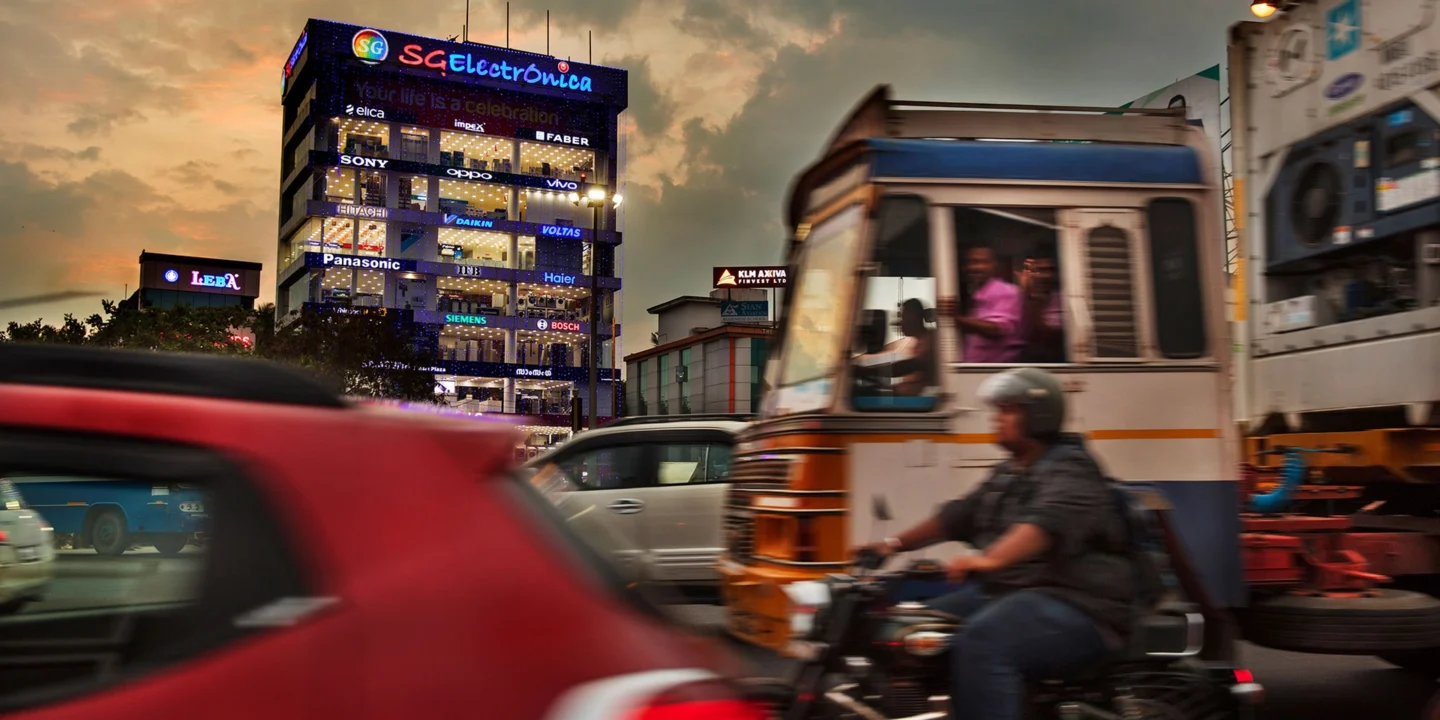
After India liberalised its economy in the 1990s, growth accelerated nationally. Tariffs fell, private capital became more active, and services and new industries expanded. Kerala was affected by this broader shift, but its growth pattern remained distinctive. It did not become a large-scale manufacturing centre like Gujarat, nor did it rely primarily on an IT hub like Bangalore. Its growth came more from remittance-supported consumption and investment, upgraded natural-resource processing, healthcare, education, tourism, hotels, real estate, finance, transport and small enterprises. Family firms remained central.
At the same time, Kerala’s demographic transition was largely complete. It aged earlier and faster than most of India. Low fertility, long life expectancy and overseas migration made Kerala look like an Indian state already living in the future. Its young people were educated and often eager to leave for the Gulf, Europe, North America or Australia to study and work. Older people remained at home, increasing demand for healthcare and care services. This structure reflected social progress, but it also created fiscal and labour-market challenges.
Politics changed as well. The Left Democratic Front came to power repeatedly, and since 2016 it has ruled continuously. But its social base was no longer the alliance of agricultural workers and tenants that had powered communist politics in the 1960s and ’70s. Once land reform was delivered, the old agenda lost force. Once agriculture declined, traditional class politics no longer explained society adequately. If the Left was to remain electorally viable, it had to reinvent itself: maintaining welfare and public services while accepting private investment, small business, tourism, infrastructure and market dynamism.
The Left became friendly toward private capital and shed the rhetoric of class struggle.
This does not mean that Kerala’s Left became purely neoliberal. Rather, it learned to coexist with markets. The government reduced its hostility to private capital and focused on infrastructure, local governance, public services, corruption control and urban improvement. The private sector increasingly invested in education, healthcare and services, while the state maintained welfare, decentralised governance and administrative capacity. Tourism is an excellent example of this new synergy: the state builds roads and improves the public environment; private capital builds hotels, resorts and services; lakes, mountains, beaches and the brand of “God’s own country” provide the landscape.
New enterprises also emerged. Spices were no longer merely harvested and packaged, but processed into nutraceuticals, pharmaceutical inputs and higher-value extracts. Rubber products moved beyond tyres into medical and surgical accessories. Jewellery manufacturing became linked to design experimentation and consumer markets. Ayurvedic products, health tourism, hotels, restaurants, education services, private hospitals and information-technology parks formed a new economic map. Kerala has a high concentration of start-ups. Although many firms remain small and few raise public equity, they are deeply embedded in family capital, remittance flows and local service networks.
This is the real structure of Kerala’s later prosperity. Early human-development achievements created education, health and mobility. The Gulf economy provided jobs and remittances. Natural resources and ecological conditions offered commercial possibilities. Family firms and small capital converted remittances into investment. Political adaptation allowed markets to operate within a welfare-state framework. Kerala did not grow rich through the state alone, nor through the market alone. It grew through a complex complementarity among the state, families, overseas labour markets, natural resources and private enterprise.
This also explains why the Kerala Model needs to be updated. The old version emphasised education, healthcare, land reform and Left welfare policy. The new version must also include migration, remittances, private services, natural-resource processing, tourism, urbanisation and the market compromise of the new Left. If we say Kerala succeeded because of welfare alone, we cannot explain its income surge. If we say it became rich because of markets alone, we cannot explain why it possessed such strong human capital, social foundations and public-service capacity. Its success lies precisely in the sequence and combination: social capability first, capital flows later; public investment first, private investment later; welfare foundations first, income growth later.
But success has created new problems. Kerala now produces only a small share of its food needs and depends heavily on central supplies and neighbouring states. Land reform improved equality but did not bring sustained agricultural productivity growth. Ageing is accelerating, increasing pressure on public healthcare, pensions and care services. The expansion of private education and healthcare has increased supply but may also deepen inequality. High literacy does not mean high-quality higher education, and many educated young people still face underemployment, pushing them to seek opportunities abroad. A highly outward-looking economy remains exposed to changes in global labour demand, oil prices, exchange rates and migration policy.
Recent climate change and overdevelopment have increased disaster risks.
The environment may be the gravest challenge. Kerala’s natural conditions were once its advantage: abundant rainfall, mountains, rivers, forests, coastline and attractive landscapes supported agriculture, health and tourism. But those advantages are being threatened by overbuilding and climate change. Gulf money has financed houses, hotels, resorts and service-sector construction, while land has become a speculative asset. Roads, dwellings and tourism infrastructure have expanded into ecologically sensitive regions. Landslides, soil erosion, flooding and human-wildlife conflict have worsened. The catastrophic floods of 2018 and the near-disaster of 2019 reminded the state that its development path is pressing against natural limits.
This produces an irony. Part of Kerala’s recent growth depends on exploiting the very ecological assets that make it distinctive and valuable. Tourism requires mountains, water, forests and coastlines, yet can damage them. Real estate raises household wealth and consumption, yet can intensify disaster risk. Services raise incomes, yet increase pressure on land. If “God’s own country” becomes the country of builders and real-estate lobbies, Kerala will erode its own core advantage. Recent efforts to promote responsible tourism are attempts to correct this danger.
Kerala’s future question is no longer the simple one that once fascinated development economists: how can a poor state provide education and healthcare? Its new questions are more complex. How can a richer state maintain equality? How can high welfare avoid fiscal crisis? How can markets expand without destroying ecology? How can remittances be turned into productive investment rather than only consumption and real estate? How can a highly literate population receive genuinely strong higher education and skills? How can an ageing society sustain care? These are the problems of a mature society, encountered early by a developing region.
Kerala still has many advantages. The quality of life in its small towns is high. Its public-health base is strong. Worker safety and social awareness are relatively advanced. Relations across caste and religion, though never free of tension, are more sociable than in many places. The state can attract migrant workers from elsewhere in India, while sending its own youth across the world to study and work. Tourism, health, education, food processing, rubber, spices, digital services and the knowledge economy all offer possibilities. If Kerala improves higher education, protects its ecology, controls fiscal risk and channels more remittance money into productive investment, it may still open a more equal and greener path to prosperity.
But that path is uncertain. Kerala’s economy is deeply dependent on the world market and on the continued adjustment of political alliances. Its success has never been the clean victory of one theory. It is the accumulation of historical accidents and institutional choices. Maritime trade, spices, princely finance, missionary education, social reform, communism, land reform, trade-union struggle, the Gulf oil boom, overseas remittances, market liberalisation, family enterprise, the new Left and the tourism landscape have all altered its fate at different moments.
How, then, did Kerala get rich? The answer is not simply that welfare produced growth, nor that markets rescued welfare. A better answer is that Kerala first used public action to raise human capability, then used migration to connect that capability to global labour markets. It first used Left politics to reshape social equality, then allowed the new Left to recognise the necessity of private investment. It first used natural resources and world trade to connect with external markets, then used remittances and family capital to expand services and small enterprise. Its prosperity is the product of high human development, global migration, private investment and political adaptation working together.
This is what makes Kerala’s experience worth taking seriously. It reminds us that development is not a choice between state and market, but a combination of social capability, public institutions, capital flows and historical geography. Without education and health, Keralites could not have migrated in such large numbers and seized overseas opportunities. Without remittances and private firms, the welfare base might have become unsustainable. Without political adaptation, market investment might have remained suppressed. Without ecological protection, future growth may destroy the advantages that made past growth possible. Kerala’s miracle is real, but it is not finished. It remains an experiment unfolding under pressure.