

Recent Posts










Heart-health advice often begins with what to cut back on: less salt, less saturated fat, fewer ultra-processed foods. Yet one of the most useful changes may be about adding something instead. Dietary fiber — found only in plant foods — is consistently associated with healthier cholesterol, steadier blood sugar, better digestive function, and a lower risk of cardiovascular disease.
That matters because many adults eat far less fiber than recommended. In the United Kingdom, the adult target is about 30 grams a day, but only a small minority regularly reach it. The gap is not usually caused by a lack of exotic “superfoods.” It is more often the result of everyday meals that contain too few beans, whole grains, vegetables, fruits, nuts, and seeds.
The encouraging part is that fiber does not need to arrive through a perfect diet or a complicated plan. Small additions can accumulate quickly, and the evidence suggests that even modest increases may be meaningful.
What Fiber Really Is
Fiber is not a single substance. It is a broad family of carbohydrates that human digestive enzymes cannot fully break down. Instead of being absorbed in the small intestine like sugars and starches, much of it travels onward to the large intestine.
Some fibers dissolve in water and form a gel-like material. These soluble fibers are abundant in foods such as oats, barley, beans, lentils, apples, and citrus fruit. Other fibers are less soluble and add bulk to stool; whole grains, wheat bran, nuts, seeds, and many vegetables supply them. Resistant starch — found, for example, in legumes and some cooked-and-cooled starchy foods — also escapes digestion in the small intestine.
These categories overlap, and foods usually contain a mixture. Their effects also vary. Certain fibers influence bowel regularity, while others are readily fermented by gut microbes. During fermentation, bacteria produce metabolites including short-chain fatty acids. These compounds help support the cells lining the colon and may also take part in signaling pathways connected with inflammation, metabolism, and blood-vessel function.
This is why “eat more fiber” is useful but incomplete advice. Quantity matters, yet so does variety. A bowl of oats, a serving of chickpeas, a pear, and a handful of seeds bring different fiber structures and different companion nutrients to the table.
What the Heart Evidence Shows
Heart disease has many causes, so no single food component can determine an individual’s future. Genetics, tobacco exposure, movement, sleep, stress, alcohol, blood pressure, blood lipids, diabetes, and the overall dietary pattern all contribute. Within that larger picture, however, fiber has shown a remarkably consistent relationship with cardiovascular health.
A systematic review and dose-response meta-analysis of 22 prospective cohort-study publications found that each additional 7 grams of total fiber per day was associated with about a 9% lower relative risk of both cardiovascular disease and coronary heart disease. Seven grams is a realistic amount: it can be supplied by a combination such as a serving of beans plus a piece of fruit, depending on portion size.
A broader series of systematic reviews reached a similar conclusion. When researchers compared people with the highest fiber intakes with those consuming the least, observational studies generally found roughly 15–30% lower rates of several major outcomes, including cardiovascular-related death, coronary heart disease, and stroke. This is the basis for the often-repeated summary that a high-fiber diet is linked with about one-quarter lower cardiovascular risk.
Those percentages need context. They describe relative differences between groups, not a guaranteed reduction for every person. Most long-term evidence is observational, so it cannot prove that fiber alone caused the difference. People who eat more fiber may also have other health-supporting habits. Even so, the pattern appears across many studies, and randomized trials show that increasing fiber can improve several recognized risk factors, including LDL cholesterol, systolic blood pressure, and body weight.
The source of fiber may matter too. Whole grains and cereal fibers repeatedly show protective associations, while fibers from vegetables and fruits also contribute. This does not mean one category is universally superior. Rather, it supports choosing minimally processed plant foods instead of relying on a single isolated ingredient.
Fiber may also help indirectly. Type 2 diabetes raises cardiovascular risk, and higher-fiber dietary patterns are associated with a lower risk of developing the condition. Fiber-rich meals often produce a gentler rise in blood glucose, especially when the fiber remains within an intact or minimally processed food. They can also be more filling, which may support weight management without requiring extreme restriction.
When Heart Disease Is Already Present
Prevention is only part of the story. A person who already has cardiovascular disease or hypertension may wonder whether changing fiber intake can still make a difference. The available research is smaller than the evidence for primary prevention, but it points in a useful direction.
A 2022 systematic review examined prospective studies of adults with established cardiovascular disease as well as controlled trials involving people with cardiovascular disease or hypertension. Higher fiber intake was associated with lower all-cause mortality in the observational data. In the trials, increasing fiber improved some cardiometabolic risk factors, including LDL cholesterol in participants with cardiovascular disease and blood pressure in those with hypertension.
The certainty was not identical for every outcome, and the number of studies was limited. Fiber should therefore be viewed as an adjunct to evidence-based care — not a replacement for prescribed medicines, cardiac rehabilitation, blood-pressure management, or clinical follow-up. Anyone with heart disease who plans a major dietary change should coordinate it with a clinician or registered dietitian, particularly if fluid, potassium, or carbohydrate intake has been medically restricted.
How Fiber May Support the Cardiovascular System
Why would material that humans do not fully digest affect the heart? The answer is probably not one mechanism but several connected pathways.
It can help lower LDL cholesterol
Viscous soluble fibers can trap or bind some bile acids in the intestine and increase their excretion. Because the liver uses cholesterol to make new bile acids, this process can draw more cholesterol from circulation and help lower LDL cholesterol. Oats, barley, beans, lentils, and psyllium are well-known sources of viscous soluble fiber, although their effects depend on the amount and the wider diet.
Gut microbial fermentation may add another route. Short-chain fatty acids produced from certain fibers can interact with cholesterol metabolism, but this biology is complex and research is ongoing. The clearest practical message is that fiber-rich whole foods can contribute to a cholesterol-lowering eating pattern; they do not cancel out the effects of high saturated-fat intake or replace lipid-lowering medication when it is needed.
It may support healthier blood pressure
Clinical trials show modest reductions in blood pressure when fiber intake rises, particularly among people with hypertension. Several explanations are plausible. Fiber-rich dietary patterns tend to supply potassium, magnesium, and polyphenols, while displacing some refined foods high in sodium. Fermentation products may also influence inflammation and the way blood vessels relax.
Claims that short-chain fatty acids directly “switch off” high blood pressure are too simple. Much of the mechanistic evidence comes from laboratory or animal research, and human responses differ. The overall blood-pressure benefit is better established than any one microbial explanation for it.
It can soften glucose peaks
Soluble and structurally intact fibers can slow stomach emptying and the absorption of carbohydrate. That may reduce the size and speed of post-meal glucose rises. Over time, a diet built around fiber-rich foods may support insulin sensitivity and reduce the likelihood of type 2 diabetes — both relevant to cardiovascular health.
This effect depends on the food. A whole apple and clear apple juice contain similar origins but not the same physical structure or fiber load. Likewise, a whole grain is metabolically different from a highly refined product with a small amount of fiber added back.
It supports a healthier overall pattern
Fiber-rich foods rarely bring fiber alone. Beans supply plant protein; nuts and seeds provide unsaturated fats; fruits and vegetables contribute vitamins and polyphenols; whole grains add minerals and a complex food structure. A high-fiber diet may work partly because these foods replace lower-fiber options and improve the quality of the whole plate.
Bringing More Fiber to the Plate
Biology becomes useful only when it changes an ordinary meal. Rather than chasing an exact number at every sitting, build several dependable fiber sources into the day and let them add up. Adults following UK guidance can use 30 grams a day as a practical destination; recommendations elsewhere vary with age, sex, and energy needs.
Try one or two of these changes at a time:
- Choose oats, a high-fiber whole-grain cereal, or whole-grain toast at breakfast. Add berries, pear, chia, or ground flaxseed.
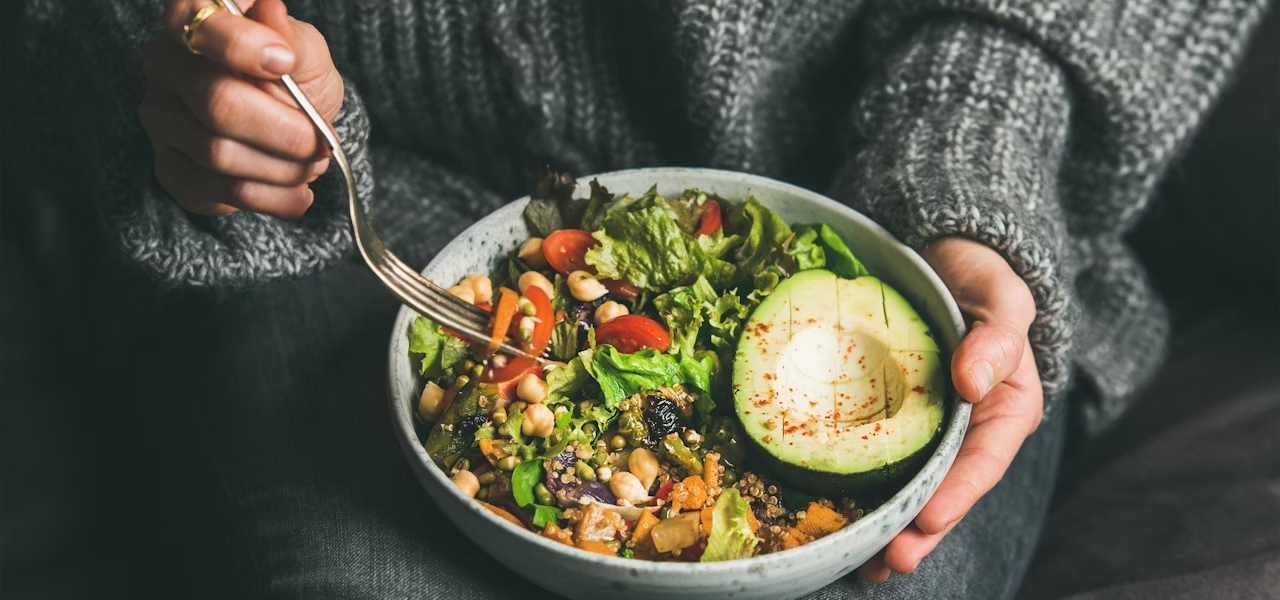
- Make beans, lentils, or chickpeas a regular part of soups, curries, salads, pasta sauces, and grain bowls.
- Keep the edible peel on potatoes, apples, pears, and other produce when appropriate and well washed.
- Replace some refined grains with barley, brown rice, bulgur, whole-wheat pasta, rye, or other intact whole grains.
- Use nuts, seeds, fruit, or raw vegetables as convenient snacks.
- Add vegetables to meals you already cook instead of treating them as a separate project.
Variety is worth pursuing because different plants provide different fibers and phytochemicals. A goal such as 30 different plant foods across a week can be a playful prompt for diversity, but it is not a medical threshold. Beans, grains, nuts, seeds, herbs, and spices can all count toward variety; success does not require 30 large servings.
If your current intake is low, increase it gradually. A sudden jump can temporarily cause gas, cramping, or bloating as the digestive system and microbial community adapt. Spread fiber through the day and drink enough fluid unless a clinician has told you to restrict fluids. People with irritable bowel syndrome, inflammatory bowel disease, swallowing difficulties, bowel narrowing, or recent gastrointestinal surgery may need individualized advice about fiber type and amount.
Supplements such as psyllium can be useful in specific circumstances, but they are not nutritionally equivalent to a varied plant-rich diet. Whole foods deliver multiple fiber types along with protein, healthy fats, micronutrients, and polyphenols. If a supplement is used, it should be introduced according to its directions and checked against medicines or medical conditions with a healthcare professional.
The Bottom Line
Fiber is not a shield against every heart problem, and eating more of it cannot erase smoking, inactivity, uncontrolled blood pressure, high LDL cholesterol, or other major risks. It is, however, one of the most practical dietary levers available.
Across cohort studies, higher fiber intake is consistently linked with lower cardiovascular risk. Trials and clinical reviews also show improvements in several factors that shape that risk, including LDL cholesterol, blood pressure, glucose control, and body weight. The most useful strategy is not to search for one perfect fiber. It is to eat a wider range of beans, whole grains, vegetables, fruits, nuts, and seeds — and to increase them at a pace your body can tolerate.
FAQs
How much fiber should adults eat?
UK guidance recommends about 30 grams a day for adults. Other national recommendations may differ by age, sex, and energy intake. If you are well below your local target, gradual progress is usually more comfortable than a sudden change.
Which fiber-rich foods are most helpful for cholesterol?
Foods rich in viscous soluble fiber — including oats, barley, beans, lentils, and psyllium — have the strongest direct evidence for lowering LDL cholesterol. For overall cardiovascular health, combine them with varied vegetables, fruits, whole grains, nuts, and seeds.
Can fiber replace heart medication?
No. Fiber-rich foods can support prevention and may improve risk factors alongside treatment, but they do not replace prescribed medication or medical care. Discuss major diet changes with your healthcare team if you have cardiovascular disease, hypertension, diabetes, kidney disease, or medically imposed dietary limits.