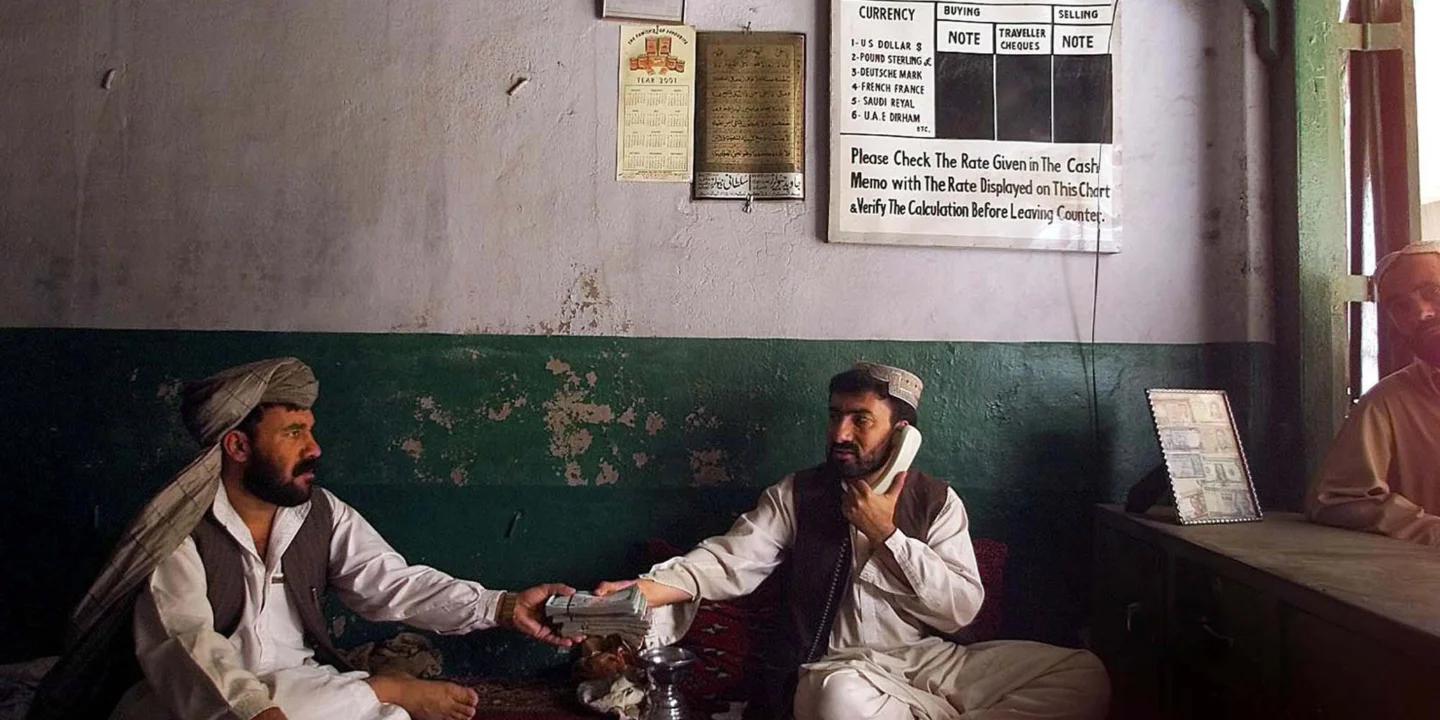












The global financial system looks like a clean, bright, highly precise factory. Every card tap, QR-code payment, bank transfer, remittance, loan, insurance payment or securities trade is like a component placed on an assembly line. It is stamped with a time, identified by a bank, carried by a payment network, verified by a clearing institution, screened by a risk system and enclosed by regulatory rules. You buy a coffee on your way to work and imagine that you have merely spent a few dollars. But somewhere out of sight, a string of data about you, the merchant, the location, the amount, the device, the account and the pattern of behaviour has already entered the financial production line.
This assembly line is one of the basic infrastructures of modern life. It allows money to move almost like light. It lets a credit card be authorised in seconds. It makes wages, mortgages, equities, subscriptions, insurance and cross-border payments appear orderly and recordable. It also gives states, banks and platforms an unprecedented capacity to observe. The miracle of modern finance is not only that money moves faster. It is that, as money moves, it leaves behind a more and more complete shadow.
We have learned to call this shadow security. Banks need to know their customers. Payment companies need to detect unusual activity. Regulators need to trace money laundering, tax evasion, fraud and terrorist financing. These reasons are not absurd. A completely opaque financial world would indeed make crime easier. But the problem with modern finance is that it has slowly turned the idea that “transactions must be visible” from a tool of governance into a moral common sense. It is as if every flow of money that cannot be seen is naturally suspicious, and every payment that does not enter an official database carries the smell of crime.
Yet another financial world has always existed. It is not always written on a banking licence, nor does it always appear on a regulator’s list. In Chinese history it has been called feiqian, or “flying money”. In the Arabic-speaking world, it is hawala. In South Asian trading traditions, it is hundi. In many migrant communities, it is simply “finding someone to send money home”. In English, the phrase “underground banking” casts a shadow over the whole thing, as though it naturally belongs to drug dealers, smugglers, corrupt officials and terrorist organisations. But that image is too convenient, and too modern.
Underground banking was not invented by criminals. It was invented by distance, risk and trust. Long before modern states had passports, banking licences and anti-money-laundering departments, merchants needed to move value from one city to another. Carrying metal coins across deserts, mountains and seas was heavy and dangerous. So notes, credit, messages, guarantors and distant partners emerged. Money did not have to complete the journey physically, as long as trust could complete it.
That is the core of underground banking. It is not a system without order, but a system not centred on the state. It is not finance without credit, but credit not proved only by a bank account. It is not an absence of structure, but a structure hidden in personal ties, ethnic networks, trade routes, religious communities, diasporic relationships and long-term reputation. Modern finance likes to outsource trust to institutions. Underground banking compresses trust back into relationships between people.
Seen this way, underground banking is not the opposite of modern finance, but its ghost version. Modern banks promise safety, speed and cross-border reach; underground banks promise the same things, by other means. Modern banks rely on compliance documents, servers, clearing systems and state authorisation. Underground banks rely on the reputation of brokers, community memory, two-way flows of funds and a simple rule: if you destroy your credibility, you destroy your future business.
Today, this system remains immense. Nobody knows its real scale, because part of its value lies precisely in not being fully measurable. But it likely handles hundreds of billions of dollars every year. Migrant remittances are its most common use. A worker in New York, Dubai, London or Kuala Lumpur who wants to send money to Bangladesh, Somalia, Pakistan, the Philippines or a county town in China may not want to wait for a bank wire, may not have complete documents, may not be able to bear high fees, and may not trust the formal banking system. For him, underground banking is not a financial adventure. It is part of family life.
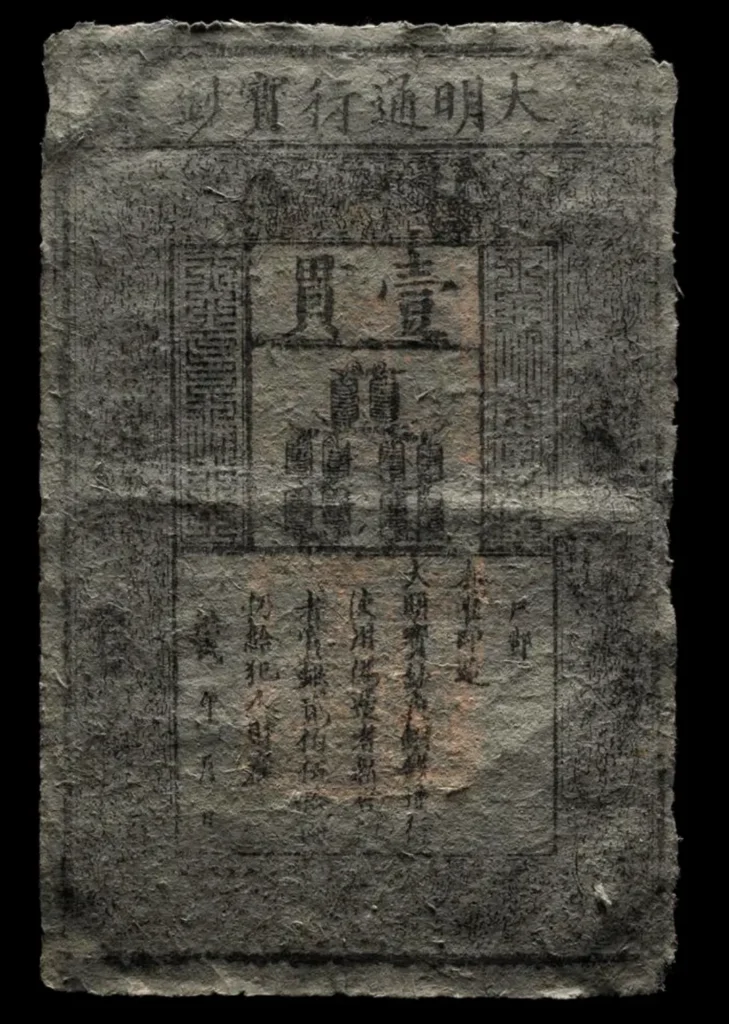
A Ming dynasty-era banknote from 1375. Courtesy the British Museum, London
Unlike bank wire transfers, the speed of underground remittance networks comes not from machines, but from trust laid down in advance.
A typical transaction is simple. You hand cash to a local broker. The broker contacts a partner far away. Your relative receives local currency in another country after giving a code, a name or a prearranged piece of information. It looks like magic: money disappears in one city and appears in another. But the same banknote has not moved. What has crossed the border is a promise between two pools of funds. Today one side pays out more; tomorrow a reverse flow may settle it. One transfer may be offset through trade, another through family funds. The border has not seen the money pass, but value has crossed it all the same.
The mechanism is efficient in a way that makes states uneasy. Formal bank transfers can take days. Fees accumulate at several points. Exchange rates are not always friendly. Underground brokers can be faster, cheaper and more flexible. They do not need to build a full informational file for every small transaction. They do not need to employ armies of compliance officers. They do not need to place every customer under layers of screening. Modern finance spends money on visibility. Underground finance saves money through partial invisibility.
This is also what makes it dangerous. A low-record, low-friction, transnational system of money movement will naturally attract not only migrant families and small merchants, but also people who wish to evade the sight of the state. Drug proceeds, corrupt money, funds escaping capital controls and terrorist donations may all seek such routes. Defenders of underground banking say that most users are innocent. That is true. Security officials say that such networks can be used by criminals. That is also true. The difficulty is that both statements are true at the same time.
States are not good at dealing with things that are true at the same time. They prefer to classify: legal or illegal, transparent or suspicious, registered or banned. Underground banking confuses these categories. It may serve the most vulnerable and the most dangerous; it may be a lifeline for a migrant mother and a laundering route for a cartel. It reminds us that the morality of a financial tool does not reside in the tool itself, but in the networks and power relations through which it is used.
That is why states are so uneasy. On the surface, they worry about the criminalisation of underground banking. More deeply, they worry about illegibility. The modern state does not only want to collect taxes, arrest criminals and enforce sanctions. It also wants society to become something that can be understood through forms, accounts, addresses, identity numbers and transaction records. Where a person works, where the money comes from, whom it is sent to, what it buys, what it owes, whom it supports — together these data form the field of governance. Underground banking cuts holes in that field of vision.
To the state, those holes are dangerous. They mean that value can move without leaving sufficient traces; that capital controls can be bypassed; that relatives can be helped without a bank; that a corridor can be created between currencies, laws and political systems. States will of course say this is about fighting crime. But the logic of power includes another desire: no large-scale social practice should remain for long outside the state’s field of vision.
Chinese feiqian illustrates this especially clearly. China maintains foreign-exchange controls, limiting how much individuals can convert each year, partly to prevent capital flight. But capital, family and educational ambition do not stop moving because of an annual quota. Overseas students need tuition and living expenses. Newly wealthy families want to move assets into safer currency environments. Merchants want more flexible cross-border settlement. So informal networks emerge, or re-emerge. They circulate through WeChat, shops, exchange counters, trading companies and personal connections, like financial mycelium growing along the edge of the formal system.
The same logic appears across the world. Somali diasporas depend on hawala to support relatives at home. South Asian commercial networks use hundi for long-distance settlement. Many communities in Latin America, Africa, the Middle East and Southeast Asia have their own informal remittance routes. These networks are not merely chaotic remnants left behind by failed states. They are patches invented by society when formal finance does not fully serve complicated reality.
Sometimes the patch is contaminated. Drug cartels may use informal pools to clean cash. Sanctioned organisations may move funds through community networks. Corrupt officials may evade scrutiny through underground channels. These risks are real and should not be romanticised. But if we look only at them, we miss a larger fact: the formal financial system is also full of criminal money. Vast flows of laundering, tax evasion, sanctions evasion and corrupt wealth do not all hide in corner grocery stores. Much of it moves through global banks, law firms, offshore companies and real-estate markets. Underground finance is not the only basement of wrongdoing. Aboveground finance has many rooms with the curtains drawn.
The question, then, is not whether underground banking is clean. No financial system is clean. The question is why some forms of opacity are called crime while others are called wealth management; why informal remittances by poor people are treated as risks, while offshore asset movement by the rich is often treated as tax planning; why states are hostile to the neighbourhood money broker but have so often tolerated elaborate concealment in expensive suits.
What states most want to tame is not the crime inside underground banking, but the proof that financial order can exist without passing through the state.
After 9/11, the United States and other countries pushed hard to regulate hawala and similar underground networks. They demanded registration, reporting, customer identification and suspicious-activity monitoring, hoping to bring informal brokers into the global anti-money-laundering framework. The goal was understandable. No state could simply ignore the possibility that terrorist organisations were using hidden financial routes. But the imagination behind regulation was larger: every small path of money should be connected to the main road; every flow of value should be placed on the informational conveyor belt.
This effort has not eliminated underground banking. The reason is simple. If a broker’s competitive advantage lies in speed, low cost and asking fewer questions, then turning him into a miniature bank removes the very reason he exists. Those willing to comply fully often become part of the formal remittance industry. Those unwilling to comply continue to hide behind community networks, trade and cash flows. States can raise the risks, but they cannot abolish the demand. As long as formal finance remains expensive, slow or exclusionary, underground banking will continue to exist.
This creates an illuminating contrast with cryptocurrency. Bitcoin also began as a promise to escape the state-controlled financial system. It defined the problem as trust: we should not have to trust banks, central banks or third parties. It proposed a trustless digital ledger, replacing intermediaries with mathematics, cryptography and blockchain. It seemed more modern, more radical, more native to the internet than hawala. One system was corner brokers and paper notes; the other was global nodes and encrypted algorithms. Yet the irony is that the older system has proved harder for states to absorb.
The reason is that blockchain was, from the beginning, a machine for recording. It is public, continuous and analysable. Users may hide their real identities, but the transactions themselves leave permanent traces. Once exchanges, stablecoin issuers and wallet providers are brought under regulation, states do not need to control the entire blockchain in order to build an observational system around it. Chain-analysis companies, regulators and law-enforcement agencies can trace the paths of funds and connect addresses to real-world identities. Bitcoin wanted to escape the financial assembly line, but it created a more transparent and more durable one.
Stablecoins prove the point even more clearly. They solved Bitcoin’s volatility problem, making digital currencies more useful for remittances and cross-border payments. But their “stability” usually comes from a connection to dollars, bank reserves and issuing institutions. The more useful they become, the more they need to enter the regulatory field of vision; the closer they move to everyday finance, the more they resemble the system they originally sought to replace. Digital currencies once promised borderless payment. They have often become a new channel of joint surveillance by states and companies.
States monitor digital currencies like factory inspectors walking along a transparent assembly line that never shuts down.
The stubbornness of underground banking comes precisely from the fact that it is not fully digital. It can keep records, or not keep them. It can use paper, or memory. It can settle through trade, or through family obligations. Its weakness is that it depends on trust; its strength is that it depends on trust. Digital systems turn trust into code, and code leaves traces. Underground systems turn trust into relationships, and relationships are harder for outside observers to read.
This does not mean underground banking is ideal. It may exploit customers. Its exchange rates may be opaque. It may leave vulnerable migrants without remedy. If a broker runs away with the money, the customer may not be able to go to the police. If criminal funds are mixed into the network, ordinary users may be drawn into risk without knowing it. If the state cannot observe anything, public safety can indeed suffer. Underground banking is not a utopia. It is a grey compromise among state, market and community.
But it does ask a question modern finance would rather avoid: why would people give money to a broker in the back room of a grocery store instead of using a formal bank? The answer is often not that they love illegality. It is that the formal system does not fit them well enough. The fees are too high, the process too slow, the documents too demanding, the language barriers too large, the bank branches too distant, the risk of account freezes too frightening, the privacy costs too high, or the destination country lacks reliable financial infrastructure. The existence of underground banking is an invoice for the failures of formal finance.
This means that enforcement alone cannot solve the problem. Close one group of brokers and, if the demand remains, another will appear. If states want to reduce the risks of underground banking, they cannot only treat it as an enemy. They must ask which functions people actually need: low-cost remittances, instant settlement, small cross-border payments, non-discriminatory accounts, language support, flexible identity verification, and trust within migrant communities. If the formal system does not provide these functions, the informal system will.
The future of financial order may therefore lie not in abolishing every underground network, but in recognising that finance has layers. At the top sits the fully regulated banking system, suited to large, formal, auditable transactions. In the middle are low-cost remittance firms, mobile wallets, community financial cooperatives and lightly regulated small-value cross-border channels. At the bottom are more relationship-based, harder-to-read informal networks. The goal of the state should not be to pretend that only the first layer can legitimately exist. It should be to push the riskiest flows downward in volume, while drawing life-sustaining flows into safer, cheaper, semi-formal channels.
This requires an idea of governance different from total visibility. The state cannot, and should not, see everything. A society in which every small act of support, every family remittance and every gesture of community assistance must be uploaded, identified, scored and stored may become somewhat safer, but also more suffocating. Privacy is not merely a veil for crime. It is part of a free life. The question is how to distinguish acceptable privacy from dangerous opacity.
That distinction is difficult. Criminals hide behind the privacy of ordinary people; ordinary people are asked to surrender more privacy because criminals exist. Modern financial governance swings constantly along this line. Every terrorist attack, drug case or wave of fraud pushes states to demand more information. Every rise in compliance costs, mistaken account closure or blocked migrant remittance sends people searching for detours. Underground banking is not a monster outside the law. It is a product of this oscillation.
A larger geopolitical issue is also emerging. The global financial system has long centred on the dollar, American banks, American sanctions capacity and American regulatory networks. Many countries increasingly fear that dependence on this system means their financial sovereignty can be cut off at any moment. Cryptocurrency was once imagined as an instrument of de-dollarisation, but it has become easier to trace, regulate and absorb. The alternative payment networks that have actually endured are the old informal networks of trust. They may not be able to support state-level financial decoupling, but they teach one lesson: decoupling is not achieved by new technology alone. It requires social relationships, credit pathways and habits of settlement.
This is the most instructive thing about underground banking. It shows that payment systems are not merely technical systems. They are social systems. Bank accounts, blockchains, cash, hawala and feiqian all answer the same question: how can I trust that someone far away will recognise the value I surrender here and now? Modern finance answers through law. Digital currency answers through code. Underground banking answers through relationships. Each answer has costs, and each has its own way of failing.
Law can exclude the undocumented, the poor and the sanctioned. Code can produce transparent surveillance and technical barriers. Relationships can produce closure, favouritism and criminal misuse. No form of finance is naturally just. What matters is preserving some competition and balance among different systems. If every payment enters the same state-bank-platform pipeline, efficiency may increase, but society loses its exits. If all money moves underground, public order and trust collapse. Freedom needs gaps. Governance needs boundaries.
Today, when you tap your card to enter the subway, order food from your phone, buy stablecoins or pay rent, you participate in the aboveground financial world. Your money is numbered, recorded, cleared and screened. This world is powerful and convenient, and increasingly resembles a panoramic factory maintained jointly by banks, platforms and the state. It makes transactions smooth, and transactors transparent.
At the same time, another world continues to operate. It may be hidden in the grocery where you buy spices, behind the counter of a phone-repair shop, in diaspora WeChat groups, in introductions made outside a mosque, between trade invoices, or in a promise from one uncle who knows another uncle. Hundreds of billions of dollars move through these channels. They are not always clean, not always safe, not always admirable. But they prove something: even in the age of data finance, money can still fly along the old routes of human trust.
States will keep trying to tame it. Banks will keep describing it as risk. Technology companies will keep promising to replace it with better digital tools. Criminals will keep trying to exploit it. Migrant families will keep needing it. This contradiction will not disappear soon.
The future of underground banking may not be to defeat the law, but to force the law to recognise its own limits. Every person poorly served by the formal system becomes a potential client of the informal one. Every costly compliance requirement, every slow cross-border transfer, every account denied without explanation, every fear of frozen currency gives underground banking another lease on life. It is not an ancient leftover outside modern finance. It is the shadow infrastructure released by the internal pressures of modern finance itself.
To borrow from James C Scott, it remains stubbornly illegible. But perhaps more precisely, it refuses to be legible only to the state. It is legible to communities, to brokers, to families, to trade routes, and to people ignored by formal finance. And as long as those people’s needs remain, this banking beyond the law will not disappear. It will continue to run beneath the factory floor like an underground river: quiet, dangerous, necessary, and more alive than states would like to admit.