









To describe politics in terms of Left and Right is now one of the most familiar habits of the modern world. People say that one city is Left-leaning and one rural district is Right-leaning; that one party represents workers and another represents business; that young people are more progressive and older people more conservative; that financial centres vote liberal while agricultural regions vote conservative. The map appears clear until we try to explain it.
If the Left represents labour, why are so many Left-leaning regions also the richest, most educated, most financialised and most technologically advanced places in the world? If the Right represents capital, why do so many large corporations, universities, banks, media companies, internet firms and global industries sit in liberal cities? If capitalism is what the Left wants to overthrow, why do so many of the most successful capitalist economies depend on broadly Left-wing policies: public education, basic healthcare, women’s employment, social mobility and state investment? Conversely, if the Right protects wealth, why do so many rural and working-class voters who are not wealthy support conservative politics year after year, across generations?
These questions are difficult because we have become too accustomed to imagining politics as a class war, while forgetting that class itself does not exist inside only one economic system. Land has its rich and poor, and finance has its owners and employees. Agrarian society has masters, tenants and labourers; industrial-financial society has entrepreneurs, shareholders, managers and wage-earners. Workers do not automatically belong to one political camp, and capital has never been a single force. The modern divide between Left and Right is less a struggle of poor against rich than a long conflict between two forms of wealth, two forms of social order, and two forms of security.
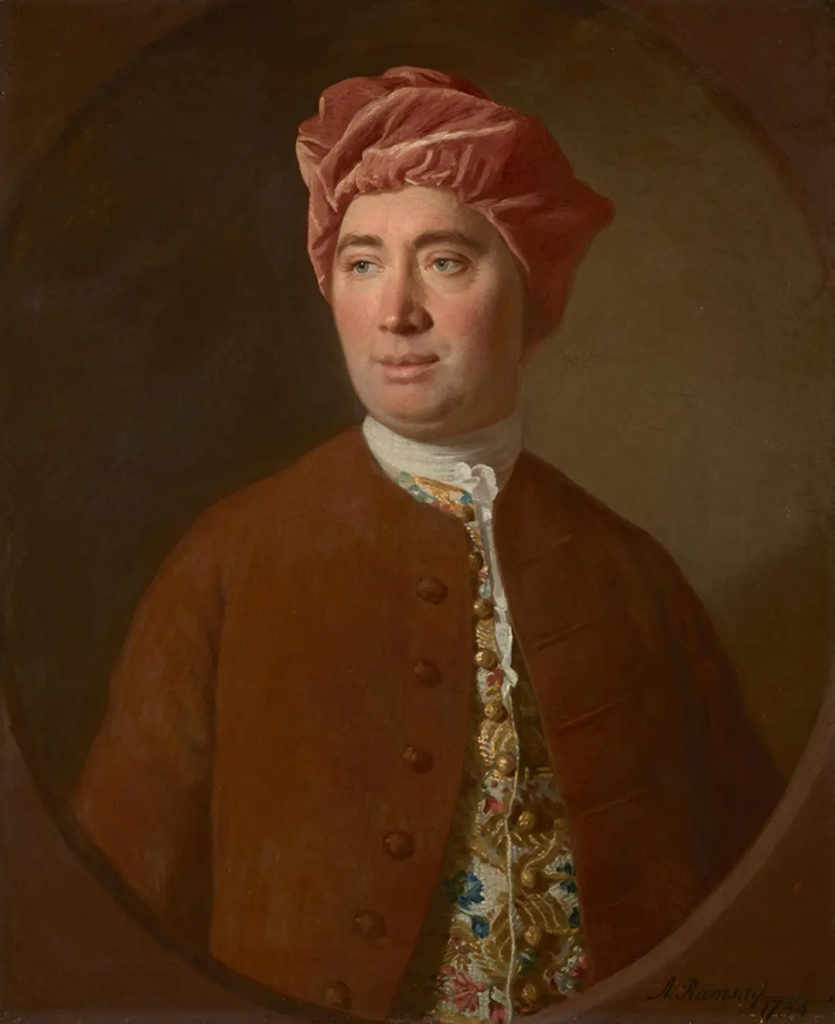
David Hume (1754) by Allan Ramsay. Courtesy the National Galleries of Scotland
The terms “Left” and “Right” come from the seating arrangements of the French National Assembly during the Revolution. Those who defended the old order, the Church and aristocratic privilege sat on the Right; those who supported the Third Estate and revolutionary reform sat on the Left. This origin matters, because the division was not originally a modern struggle between workers and capitalists. It was a struggle between land, hierarchy and inherited authority on one side, and commerce, citizens and a more mobile society on the other. On the Right were land, family and traditional authority. On the Left were cities, professions, contracts and new wealth.
Later, Marx offered another powerful explanation. He placed landowners and factory owners in one large category, the bourgeoisie, and farm and factory workers in another, the proletariat. This framework shaped modern political language enormously. But it also obscured a fact: landholders and stockholders are not always the same people, and landed capital and financial capital do not always form the same order. The landholder wants stability, inheritance, local control and social obedience. The stockholder wants liquidity, expansion, profit, debt, risk and market freedom. Both may exploit labour, but they exploit the world in different ways.
The 18th-century philosopher David Hume saw this fracture earlier than many later political theorists. In “Of Public Credit”, Hume worried about Britain’s growing reliance on public debt, especially the selling of bonds to finance war and empire. For him, this was not merely a fiscal problem, but a revolution in social structure. Bonds and stocks created a new form of wealth: wealth not fixed in land, not required to care for tenants, not dependent on family inheritance, not obliged to bear local responsibility. It could be bought and sold. It could move across borders. It could collect interest from a London coffee house.
Land wealth required people to stay. Financial wealth allowed people to leave.
This was what frightened Hume. The power of the landowner came from place. Landowners possessed fields, estates, tenants, villages, family graves and reputations passed through generations. Land made them rich, but it also bound them. A landholder who wished to keep his status had to maintain the house, manage the land, attend to tenants, participate in local affairs and transmit the estate to the next generation. Land was not a pure asset. It was a whole social role. To own land was to possess power, but also to be trapped inside responsibility.
Stocks and bonds were different. They extracted wealth from local obligation. A person no longer had to own an estate in order to receive income; no longer had to manage land in order to share in the profits of imperial expansion or government debt; no longer had to wait for a father to die in order to buy a future stream of interest with cash. Young aristocrats, merchants, urban speculators and transnational investors could all gain access to a kind of freedom that had been rare before: freedom from complete dependence on family, land and local duty.
What Hume truly saw was not merely the danger of debt, but the fact that money was becoming a tool for escaping place.
This escape produced an early form of modern liberty. Liberty was not only a philosophical right; it was also an economic capacity: the ability to leave one’s father, one’s village, one’s land, one’s birth-assigned occupation; the ability to turn wealth into securities, into cash flow, into a portable future. Hume saw this liberty, and he saw its cost. Whenever one person gained the freedom to escape an old relation, some older authority lost control. Fathers lost control over children. Landlords lost control over villages. Kings lost control over war. Local communities lost control over wealth.
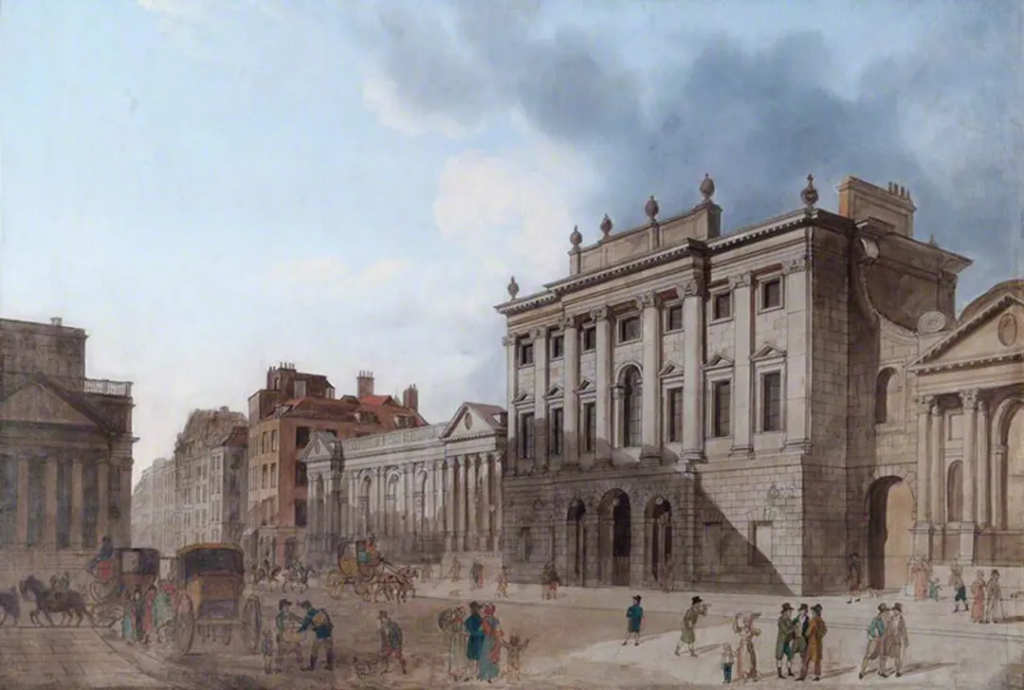
A View of the Old Bank of England, London (c1800) by Thomas Hosmer Shepherd. Courtesy the Bank of England Museum
The growth of British public debt made this change concrete. The government borrowed to fight wars. Private citizens bought bonds and received interest. That interest came from taxation. Rural people paid taxes; urban stockholders received income. The wealth of the land economy was at least entangled with local life. The wealth of the stockholder economy could be separated from the communities that paid for it. A British investor could even invest in a foreign government if the return was better. Wealth no longer naturally owed loyalty to nation, land or family. It owed loyalty to return.
Jonathan Swift once observed that power, which had previously followed land, had now gone over to money. Hume’s fear of this change does not look strange today. He anticipated three tensions that still define modern politics. First, wealth detached from traditional responsibility weakens the authority of elders, landlords and local hierarchies. Second, tax revenue flows from the countryside to urban financial centres, leaving peripheral regions feeling drained. Third, governments dependent on creditors become increasingly constrained by financial markets and the will of capital. Even if a monarch remains on the throne, real power may shift to those willing, or unwilling, to buy government debt.
All three tensions are connected to liberty. The stockholder gains liberty, and the landholder loses control. The young gain liberty, and parents lose obedience. The city gains liberty, and the countryside loses resources. Capital gains liberty, and the state loses sovereignty. From the beginning, “liberty” in modern politics was never a simple virtue. It also meant the dismantling of an older order. The Left often calls this emancipation. The Right often experiences it as betrayal.
Looking back, we can see that the world Hume feared did arrive. The Industrial Revolution, railway construction, commercial expansion, public debt markets, banking systems, joint-stock companies and transnational finance became the basic structure of the modern economy. Factories and railways did not emerge from nowhere. They depended on debt, investment, stocks, banks and expectations of future returns. Modern people like to distinguish the “real economy” from the “financial economy”, but historically industry and finance grew almost together. Factories required financing. Railways required bonds. Empires required national debt. Cities required credit. Modern capitalism was, from the beginning, the interlacing of manufacturing and finance.
But there was another factor Hume could not fully grasp: inflation. During much of premodern history, money’s value was relatively stable, and wealth could be stored in land, precious metals, grain and physical goods. But early modern Europe was transformed by a price revolution. Silver, New World trade, war spending, demographic change and monetary expansion produced long periods of rising prices. Inflation changed the meaning of saving. To bury money underground had once been a way of protecting wealth; in an inflationary age, it became a slow loss. To keep coins in a war chest had once been prudence; in an inflationary age, it became asset decay.
To store wealth in land was to accept obligation; to store wealth in securities was to buy an exit.
Inflation rewarded those who kept money moving. Buying raw materials, producing goods, selling abroad, investing in businesses, holding bonds and lending at interest all allowed wealth to resist depreciation. By contrast, preservation, hoarding and stillness became more expensive. Early capitalism was not only the product of greed or Protestant discipline. It was also a survival technology for adapting to inflation. People had to make money produce more money, or money would quietly lose value.
This helps explain the density of economic experimentation in early modern Europe. National banks, public debt, joint-stock companies, insurance, futures, securities markets and colonial trade were all attempts to discover how wealth might travel through a world of changing prices. Spain possessed empire, silver, religious unity and global territory, yet repeatedly went bankrupt. The Dutch and British, by contrast, built new power through trade, finance and manufacture. The traditional signs of strength — land, palaces, precious metals, religious unity — no longer guaranteed fiscal stability. The new question was: who could organise future cash flows most effectively?
Modern society was born from that question. Today we keep money in bank accounts, pensions, funds, stocks and property not because we are naturally in love with financialisation, but because cash itself is eroded by inflation. Banks turn deposits into loans; loans support housing, education, businesses and consumption; states manage currency through interest rates; financial markets organise expectations through asset prices. The whole system rests on a modern fact: motionless wealth deteriorates; mobile wealth at least has a chance of preserving itself.
Hume believed that this system would destroy the stability of the old society. He was not wrong. It did. It weakened landed aristocracies, released young people, enlarged cities, pushed forward industry, financed empire, and produced debt dependence, speculative bubbles and financial crises. It gave people unprecedented social mobility, and also placed them in a condition of permanent unease. Modern restlessness is not an accidental mood. It is the basic rhythm of the financialised economy: one must move forward in order not to fall behind.
By the late 18th century, the political conflict between the land economy and the stockholder economy had become institutionalised. British party politics divided around the East India Company, public debt and imperial finance. Early American party conflict formed around the agricultural South and the financial-industrial North. The fiscal crisis of the French Revolution was also deeply connected to national debt, aristocratic privilege and the interests of new capital. The near-simultaneous formation of Left and Right in these countries was not coincidence. The Right tended to represent land, hierarchy, inheritance, religion and local authority; the Left tended to represent cities, credit, manufacture, trade, personal liberty and institutional experiment.
This does not mean that the Left was, from the beginning, anti-capitalist. Quite the opposite. Historically, the Left has often stood with industry, finance and urban modernisation. Public education, secular law, women’s rights, freedom of movement, labour organisation, welfare institutions, scientific administration and infrastructure building all serve a more mobile, productive and financialised society. An educated, healthy population able to leave the village, borrow, start businesses and change jobs is extremely useful to the stockholder economy. Many Left-wing policies are not external enemies of capitalism. They are infrastructure for capitalist modernisation.
This is why Japan, South Korea, the Nordic countries and many successful economies adopted broadly Left-wing institutions while competing in capitalist markets. Public education is not anti-capitalist; it supplies skilled labour to a high-productivity economy. Universal healthcare is not anti-capitalist; it reduces household risk and increases labour mobility. Gender equality is not anti-capitalist; it expands the workforce and talent pool. Social security is not anti-capitalist; it allows people to leave old jobs and enter new industries. Much of the Left’s institutional programme is also the stockholder economy’s demand for human capital, creditworthiness and mobility.
Why, then, does the Left constantly criticise capitalism? Because it both creates and hates the system it serves. The Left believes in mobility, emancipation, equality and the possibility of reorganising society; these beliefs help industrial-financial capitalism grow, but they also constantly expose the new forms of oppression that capitalism creates. The stockholder economy needs free people, but it also turns free people into debtors, employees, consumers and data points. After helping modern economies break through the old order, the Left discovers that the new order also requires resistance.
Modern political alignment is often determined not by class alone, but by which form of security people trust more.
This helps explain why many working-class conservatives are not simply “voting against their interests”. If interests mean only wages, healthcare and job opportunities, they may often choose policies that harm them. But if interests also include family authority, religious continuity, local belonging, whether children remain nearby, and whether the way of life of grandparents is respected, the choice becomes less mysterious. The stockholder economy offers mobility, but mobility breaks local societies apart. It lets children leave parents, women leave traditional gender roles, young people leave rural areas, and religion and custom lose binding force. For some, these losses hurt more than money.
The security of the land economy comes from relations. Who are you? Where do you belong? What do you inherit? Whom do you care for? Who cares for you? Where will you be buried? These questions are difficult to price in modern economics, but they are central to how many people understand life’s meaning. The security of the stockholder economy comes from choice. Can you leave? Can you begin again? Can you change careers? Can you borrow? Can you invest? Can you live in another city or country? The Left often emphasises choice. The Right often emphasises belonging. Their conflict is not a misunderstanding, but a real collision between two human needs.
Modern people do not belong entirely to one side. A person may depend on the stockholder economy at work while desiring the landholder economy at home. One may live on stocks, pensions and urban wages while hoping that one’s children inherit one’s religion, language and surname. One may seek freedom in youth and stability in old age. One may become rich in financial markets and later buy a farm, estate or rural life in search of meaning. Landholder and stockholder are not pure classes. They are two tendencies, often mixed inside the same person.
Yet these tendencies have not merged into a seamless system. Across the world, Left and Right still fail to live together peacefully. They can trade, compromise and form temporary alliances, but the conflict returns. The reason is that they do not want the same thing. The stockholder economy wants mobility; the land economy wants fixity. The stockholder economy rewards detachment; the land economy rewards loyalty. The stockholder economy sees the future as open space; the land economy sees it as a chain of inheritance. They can overlap, but they cannot be fully unified.
The American Civil War offers an extreme example. The slaveholding South was obviously deeply involved in the capitalist world market through cotton, credit, trade and empire. But the North was more industrial, more financialised, and more likely to see slavery as an old system obstructing free labour and modern market expansion. If we say simply that the Right represents capitalism and the Left opposes it, we cannot explain why the anti-slavery side was also the more industrial, financial and modern side. More accurately, the Civil War was a conflict between two capitalist orders: one based on land, plantation, racial hierarchy and forced labour; the other on industry, credit, wage labour and mobile population.
This does not absolve either side. The financial-industrial order also exploited, brutalised and produced poverty and imperial violence. But it required a different social structure. It needed schools, transport, contracts, mobile labour, urban populations and financial markets. It could not depend entirely on birth status and fixed hierarchy. For that very reason, it continually absorbed people who had previously been excluded: peasants, immigrants, women, minorities, the poor, so long as they could become workers, consumers, borrowers, taxpayers or entrepreneurs. The modern financialised economy needs more and more people to enter the system, not because it is purely benevolent, but because expansion requires new subjects.
Class analysis remains important here, but it is insufficient. Employers do push down wages. Workers do need organisation. Capital does accumulate power. Yet the financialised economy also requires a large pool of people who are not rich but have credit, education, health and ambition, and who are willing to borrow to buy homes, attend university, start businesses and consume. It needs social mobility as fuel. A traditional land economy can tolerate most people remaining forever in the position into which they were born. The stockholder economy prefers to manufacture new borrowers, new consumers, new entrepreneurs and new skills. The restlessness of modernity is how we struggle against inflation, debt and depreciation.
This is why the Left can build capitalism and always try to escape capitalism.
The contradiction of the Left comes from its historical task. It helps people escape land, patriarchy, church, racial hierarchy and birth status. It creates public education, healthcare, labour rights and social security. It allows more people to enter cities, wage systems, consumer markets and financial systems. It helps modern capitalism mature. But once people are free, they discover that they are bound by new systems: debt, rent, wage discipline, asset prices, market volatility, professional anxiety. So the Left builds the social conditions required by the stockholder economy, while resisting the alienation produced by that economy.
The Right has its own contradictions. It criticises financial elites, globalisation, urban liberals and multinational corporations, yet often supports tax cuts, deregulation and business power. It claims to protect ordinary people while preserving many structures of inequality. The reason is that the Right is not simply “pro-business”. It protects a certain sense of order: family hierarchy, local belonging, national borders, traditional gender, religious authority, control over land and cultural continuity. If corporations destroy these things, the Right may resent them. If state intervention protects these things, the Right may support it. Small government, in this context, is not a consistent principle, but a tool used against certain emancipatory forces of the stockholder economy.
This also explains the global rise of the Right. Globalisation, financialisation and cultural liberalism have made many people feel that they have lost place, identity and control over their children’s future. Rural regions decline. Young people move to cities. Traditional industries disappear. Family relations loosen. Religious authority weakens. Borders are penetrated by capital and migrants. For such people, the issue is not total economic growth, but the loss of command over a familiar world. Right-wing politics translates that experience into borders, land, family, nation and culture war.
Climate change may further strengthen the return of land politics. If habitable land becomes scarcer, water more contested, agricultural regions less stable, coastlines retreat and migration pressures rise, land may become more immediate and brutal than financial markets. Over the past few centuries, great powers have often competed for trade, markets and influence; in the future, they may more directly compete for water, food, minerals and livable space. The stockholder economy depends on transnational interconnection, and land politics attacks that interconnection. Tariffs, border walls, resource nationalism, territorial expansion and foreign-aid cuts can all be read as the land economy striking back against the stockholder economy.
In that setting, some apparently absurd political slogans become less absurd. Annexing territory, fighting over islands, controlling borders, restricting foreign capital, punishing international supply chains — these violate the efficiency logic of a financialised world, but they fit the old impulse of landed power. Many people do not want cheaper goods or higher stock returns. They want borders, land, control and a secure space to pass on to descendants. When the future becomes unstable, the attraction of liquidity may decline, and the attraction of fixity may increase.
Many people would rather have land and command than money and liberty.
This sounds anti-modern, but it explains much of modern politics. Liberty means choice, but choice also means uncertainty. Money means mobility, but mobility also means thinner relationships. Land means limits, but limits also mean belonging. For some people, to be bound to a place, a family, a religion or a nation is not oppression, but safety. The Left often sees such binding as a chain from which people must be liberated. The Right often sees it as a root without which human life cannot endure.
We should not romanticise the land economy. It can produce patriarchy, hierarchy, exclusion, racial domination and war. Nor should we romanticise the stockholder economy. It can produce debt, alienation, speculation, imperial expansion and rootless anxiety. A better analysis should admit that modern politics is not a simple movement within one system, but a long tug-of-war between two overlapping systems: landed capital and financial capital, fixed power and mobile power, inherited order and credit order. Capitalism has never been one machine, but a continuing compromise between these forces.
This also lets us understand the power of the Left differently. The Left is not only the moral language of the poor, nor merely a machine for anti-capitalist slogans. It is the institutional laboratory through which modern society adapts to inflation, mobility, finance and industrial complexity. From banking systems to public education, from labour rights to women’s emancipation, from urban governance to same-sex marriage, the Left keeps inventing institutions that allow more people to leave old identities and enter new social relations. It is not always right, and it often produces new bureaucracies and contradictions. But it has been a crucial source of modern wealth and modern liberty.
The power of the Right will not disappear either. As long as people grow old, fear their children’s departure, want to pass down faith and land, and feel abandoned by global mobility, the Right will exist. It represents a need for fixity that cannot be soothed only by GDP growth or rising stock prices. The real danger is not the existence of the Right, but the Right turning fear into aggression, exclusion and the destruction of liberal institutions. The real danger is not the existence of the Left, but the Left forgetting the financial-industrial basis on which it depends, and imagining that all traditional relations can be dissolved without cost.
Left and Right persist because human beings need two things at once: freedom and belonging, mobility and stability, innovation and inheritance, money and land. Modern politics is painful because these needs often damage each other. We want children to be free, and also to remain near us. We want economic growth, and also for communities to stay the same. We want investment returns, and also fear financial power over the state. We want personal choice, and also miss shared obligation.
The world Hume feared has become our world. But his fears are not obsolete. Public debt, financial markets, inflation, empire, rural decline, weakened generational authority and political polarisation are still central to our lives. We cannot simply mourn the disappearance of the landed order as Hume did, because the stockholder economy has also brought liberty, wealth, education and social mobility. Nor can we simply celebrate the total victory of liquidity, because without place, family and long responsibility, freedom becomes weightless.
Perhaps the clearest politics is not to choose either landholder or stockholder, but to understand that we have always lived between them. We need finance to resist inflation, fund innovation and expand opportunity. We also need local responsibility to protect families, communities and ecological limits. We need the experimental spirit of the Left, and we also need to acknowledge the depth of people’s need for continuity. Wealth must be able to move, but power must not become entirely detached from the people it affects.
When we forget the relationship between the Left and wealth creation, we hand the modern economy to those who understand only short-term profit. When we forget the relationship between the Right and the need for belonging, we hand place, family and tradition to those most skilled at mobilising fear. The war between landholder and stockholder is not over. It has merely changed names, platforms and electoral maps. To understand that war may be the first step toward understanding modern politics.